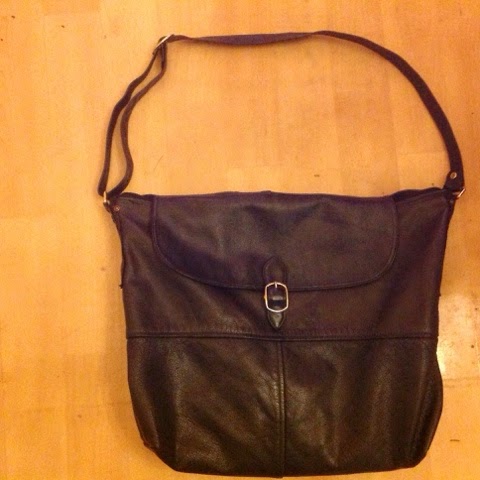
I am quite pleased with this cross-body messenger type bag I have made. It is a fusion of a really knackered and nasty men’s leather ‘donkey’ style jacket and a most unattractive leather bag, both bought in charity shops for £4.99 and £3.99 respectively. I revived the leather parts I wanted to use with a hefty dose of Dubbin and a renovating treatment in black, plus plenty of rubbing-in to soften it all. I sewed the leather and zips using a combination of a walking foot, roller foot and Teflon zipper foot, depending on the seam I was working on.
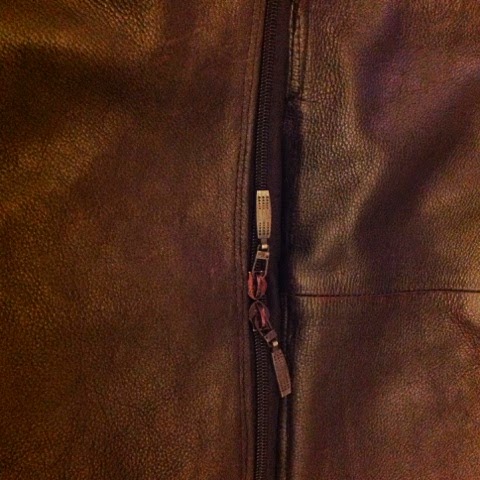
The flap and strap are from the handbag and the body is made from the jacket back. The off-cuts were useful for straps and edgings on other projects. I carefully prised the magnetic fastening off the old handbag and re-mounted it on the ‘new’ front, and reused the metal strap fittings. I added some rivets to strengthen the strap mounting (they had been in my work-box since the 1980s judging by the packaging). The double puller top zipper was salvaged from a broken sports bag, and the internal one came from my horde of zips un-picked from clothing that is worn past wearing.
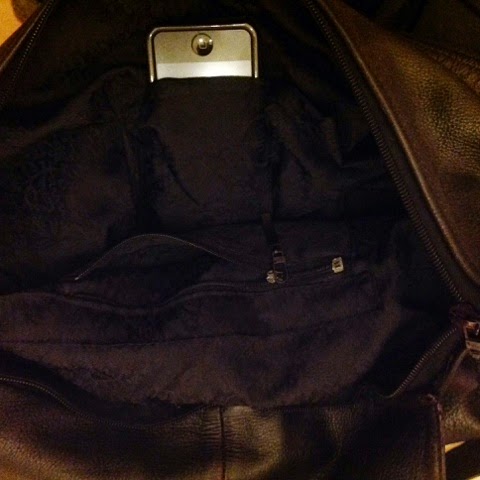
I then added a new lining in a polyester dark navy brocade which I had bought from Fabricland a number of years ago (not originally an expensive fabric). I including a phone pocket and zipped inner pocket to organise the interior. The brocade was from my fabric pile – so yes, not recycled!
I also purchased three new zip-pullers, which cost £8.97 but give the bag a professional finish.
One last treatment to cover the effects of working on the leather, and the darken open edges, and it looks good, even though I say so myself.
So taking the coat, bag, lining and zip pullers, my lovely new recycled/upcycled leather messenger bag cost me around £20.
Category: Uncategorized
Brioche stitch
I am playing with this stitch, in particular it’s parallel with machine knit Fisherman’s Rib (Cardigan Stitch). I have been helped in this by Nancy Marchant’s ‘Knitting Fresh Brioche’. The title makes me feel hungry, I can smell buttery brioche and croissant just mentioning it! However, I digress. ‘Knitting Fresh Brioche’ is a very useful book in which Nancy writes about two colour brioche in depth.
TV interview about widening diversity of bodies that are acceptable in fashion
I was pleased to be invited to meet with Elesha and fixers.org for a TV programme where we discussed how important it is to increase diversity of body shape and size on the catwalk and in mainstream fashion.
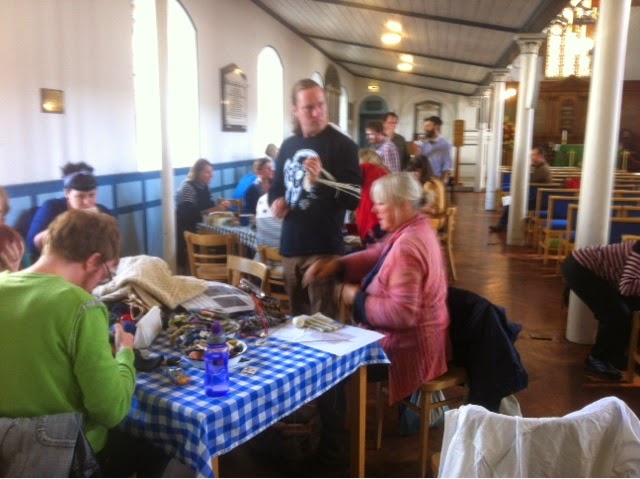
Make do and mend
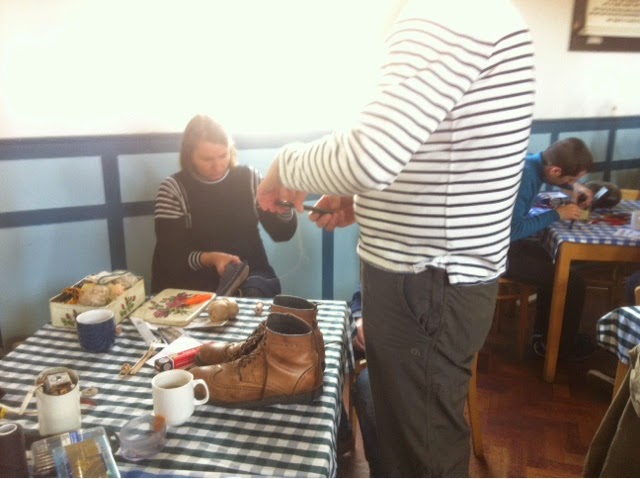
I ended up chatting to Sue Craig (Knitting the Map) and Tom of Holland. He was helping someone darn a sock.
Digital knit design
Having spent the day teaching digital knit design to students my head is reeling. It makes me realise how complex and multi-layered my knowledge is.
The proof photos of the last items for the latest book are coming back soon. I’m looking forward to seeing them as my own photos, whilst they look good when I take them, never match the great quality of the professionally taken ones.
The illustrations make such a difference to a (and I hate to use this word) ‘craft’ book. I’ve worked on quite a few, and had very different experiences.
- taking my own (difficult setting up space with good lighting, not having professional kit, limited knowledge of photography)
- with a semi-professional at home with minimum studio kit (OK experience – although the dogs were a bit of a bind, but the lighting was not good, and the final photos dull)
- with a professional photographer in a commercial studio (exhausting and exacting expereince, great images; strong, vivid and clear, if a little sterile)
- on location with stylists, models and a professional photographer with all the kit (periods of intense boredom whilst everything is shifted around, lighting sorted etc, freezing cold, lots of lugging equipment about and a challenge keeping knitting neat on location, interesting and well lit photos)
- in a professional photographer’s own location-based studio (aesthetically exacting, able to be more flexible, easier to keep knitting looking good, marvellous exciting images).
From this I guess you can tell which I thought was the most rewarding experience. However, the photos were for different purposes, some were for pattern book illustration, and some for technical knitting, so may not be fully comparable.
It is clear to me that the ‘author takes photos’ option has the following disadvantages:
a) can be challenging and often inappropriate for the author’s skillset
b) more often than not, results in poor quality images
But it has the following advantages:
a) author retains control of content
b) cheap for the publisher – whether a commercial publisher or self-publishing
As a further observation, it is crucial for good ‘how to’ books to have big pictures. In the example I mention above, of using semi-professional photos taken at home, the poor quality of the photos was compounded by the layout design cramming them into small frames at the side of text. At first I thought these should have been cropped so that more detail showed, but realistically the photos were original framed poorly so that they couldn’t be cropped without loosing content/context – hence the disadvantages of not using a professional photographer.
Having said all this, I am sure some authors take brilliant images and use them very well in books, these are just my personal experiences and observations. I suppose its a moan to publishers really, if they want a great ‘how to’ book, they need to invest in good photography and give space in the layout for images to be large enough to warrant their investment.
So my advice to other authors (for want its worth), is to persuade your publisher to shell out for professional photography and illustrations whenever and wherever possible.
The joy of needle punch felting
I have been lucky enough to be given a needle punch machine for Christmas. I’ve had a few opportunities to experiment with it, but I can see it will take some time to develop my skills.
Lostinknit on WordPress
Just ‘followed’ this blog about knit, take a look yourself.
Working on a couple of new designs
Brushing up on my intarsia skills for one of these. Planning to use Adriafil DK yarn on that one, and Sirdar recycled Aran the other. I really like the handle of the Recycled, and the colours are with a few exceptions very ‘useable’. It knits up well, feels rather like a cotton yarn but has more texture.