A bit of cotton dyeing using home made tannin extract

I posted recently about solar dying wool with mulberries and I thought I’d now have a go dying some commercially spun cotton that I have already, and conveniently, put up into hanks. There are six 50g hanks, so I am hoping for 300g of lovely coloured cotton to play with.

I don’t dye cotton often, but I do know that it requires tannin as a mordant. Well, being a bit disorganized, if I’ve got any commercial tannin mordant I can’t find, so it was a relief when after a quick look in Jenny Dean’s Colours from Nature, I found that bramble leaves and twigs contain tannin. A bit more research on the internet suggests that mulberry leaves also contain tannin. It looks like this is going to be a multi-day effort.

DAY 1

One thing we have in plenty in the garden and surrounding fields is brambles and of course we have a mulberry tree, so I went on a little foraging trip. I collected a basket full of mulberry leaves and brambles which I chopped up and boiled for an hour as instructed in the book.

DAY 2

I left these to soak overnight and have just strained the liquor off into a pan and slightly reheated this.

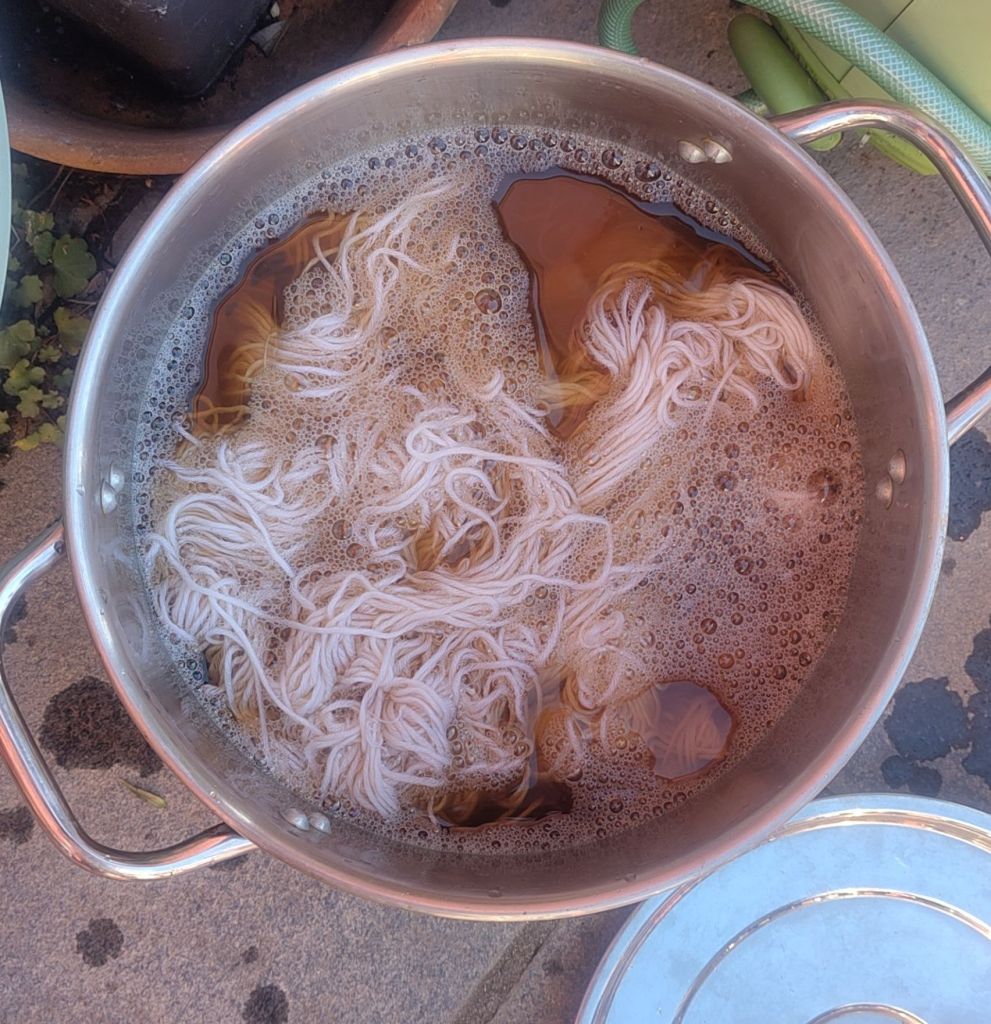
I’ve just submerged the damp cotton hanks in the tannin liquid, and will leave this for 24 hours for the cotton to absorb the tannin. According to Jenny Dean there is a likelihood this will stain my white cotton and is bleached white slightly yellow, so we will see.

Hanks of cotton soaking in the home made tannin solution

Hopefully the mulberry dye will accommodate this and give me a nice color.

DAY 3

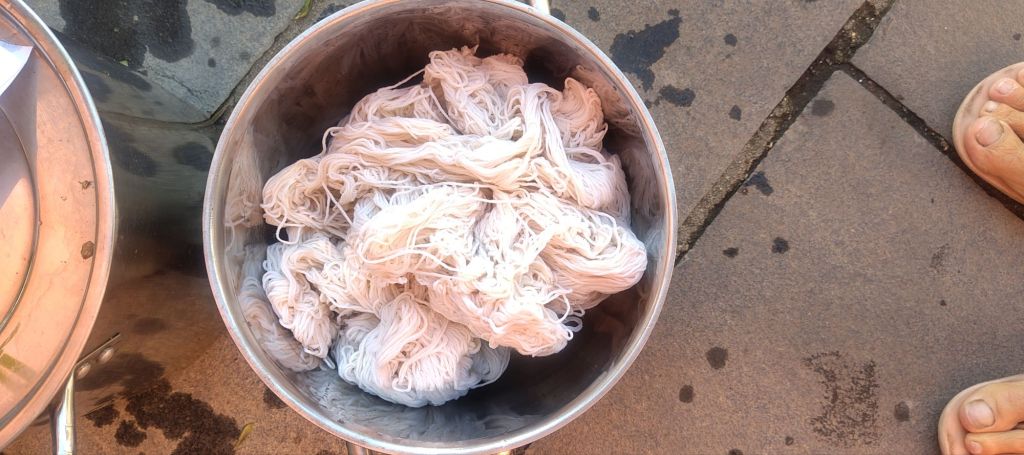
The cotton yarn after being soaked in tannin solution, a slight cream cast

After the tannin soak the cotton had taken on a slight creamy colour, not too bad at all. Maybe it didn’t take the tannin?

Straining the cooked and soaked mulberries to release the dye colour

I had prepared 1.5kg of mushy mulberries that weren’t really edible by cooking them up in some water and leaving them to soak and give up their colour overnight. I thought I was ready to get in with the dyeing, but luckily at this point I went back to Jenny’s book. Only then did I  realised that the cotton needed to be soaked in an alum mordant after the tannin. How did I miss this before?

The recommended amount is 4 tsp alum and 1.5 tsp of washing soda per 100g of fibre. Dissolve the alum and soda in enough water to cover the fibre,  and bring to a simmer. Then leave it to soak and cool for 12-24 hours.

DAY 4

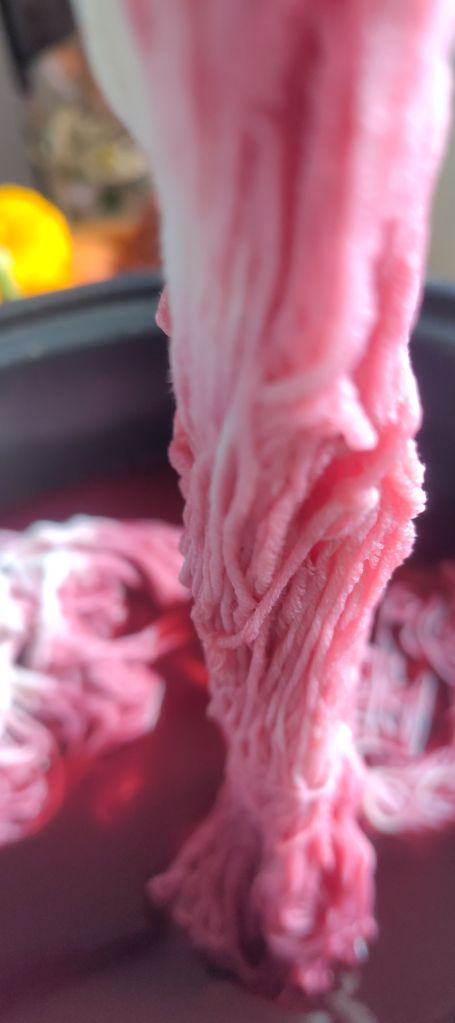
NOW I can put the hanks in the dye..

This afternoon I took the yarn out and rinsed it. Then strained the mulberry liqour and put it in the old slow cooker I use for dyeing. I added some salt (not sure why but seemed to remember it helps the dye take) and then added enough water so that the liquid would cover the fibre. After that I immersed the yarn in the dye.

Fingers crossed it will work.

First dipped hank… Now it needs to sit in the dye overnight…but we all know it’s probably going to wash out…

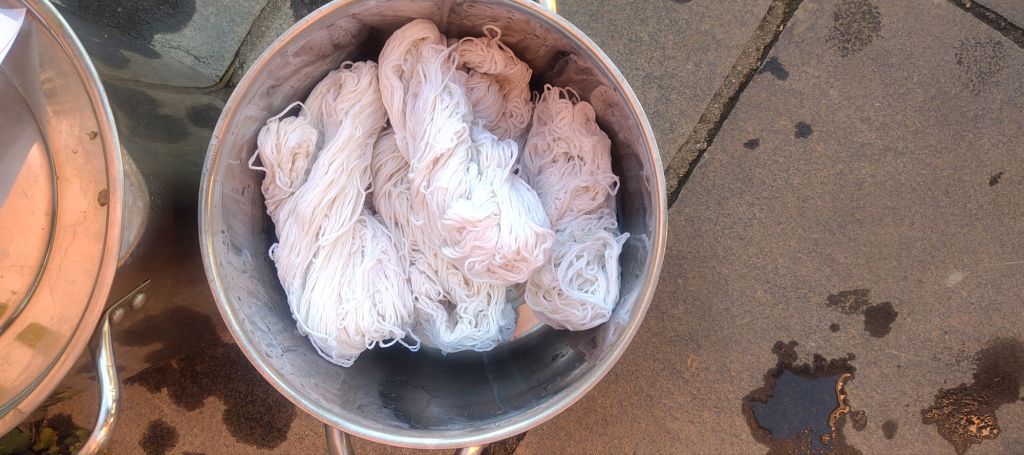
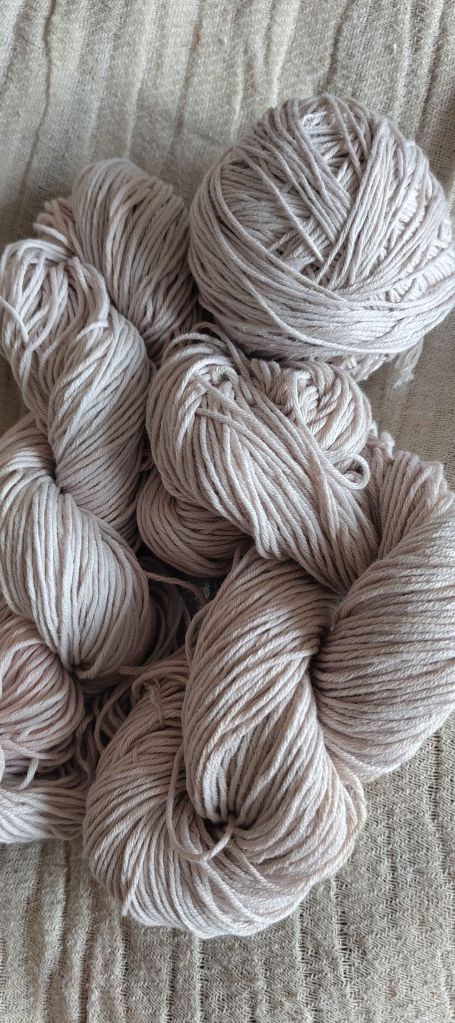
Well, the hanks came out looking lovely, but as predicted, the colour mostly washed out. It’s not a bad colour, it’s very a pale, lilacy grey, just not the pink I hoped for.

The final colour, a pale lilac grey.

Solar dyeing from the garden waste

As mentioned in my previous post we have a lot of fruit in the garden, a large amount of which is from a prolific Mulberry tree. I’ve made jam,  jelly, syrup, sauce, dried them and made fruit leathers. Plus Ross is making wine from three kilos of them.

One of the problems with mulberries is they have big pips and a stalk that is difficult to get out. Many of the things I’ve made have involved cooking the fruit up and then putting it through a Mouli or nylon sieve to get the pulp and juice and then working with that. As we have a lot of apples I use the windfalls to make pectin and sometimes add a few apples to give some body to the pulp.

Of course you end up with a lot of mulberry mush with pips and stalks in it. However this still retains the really strong color, and staining ability, that the complete mulberries have. So I decided to do some dying with the pulp. Last year I solar dyed with raspberries, which gave me a gentle pink, so this year I worked with the mulberry pulp in a similar manner. I use my own handspun yarn and solar dying with the mulberry pulp, which gave a pretty, pale crimson. I boiled up the mulberry mush again with a bit more water and added any berries that hadn’t been good enough to go into the jam. When I thought I got as much color into the liquid that I was going to get I strained the liquid off through a fine sieve, being careful not to squash the pulp through as well. The liquid went into a big jar with 1% alum solution, some salt and a dash of white vinegar. After a good stir  the dye jar was ready. 

Before I started all this I had put a 100g hank of handspun wool  yarn to soak in hot water with washing up liquid and a little bit of soda. Although the yarn had been washed already, this extra soak and the soda in particular, removed any remaining oil, ready for it to take the dye. The yarn had been spun and plied 2ply from a Lleyn fleece.

After rinsing and removing extra water from the yarn I put it damp into the dye jar, put the lid on and gave it a good shake to distribute the dye around you the yarn. My plan was to shake the jar every day whilst it sat in the sun for a week to ten days, but I forgot so the hank is a slightly lighter colour one end, which is pretty but not a solid color I had intended.

I follow the same process with marigold petals that I’d gathered  when deadheading the marigolds I’d grown this summer. These had been left to dry and were cooked up and strained in the same way as the mulberries. After removing this yarn, which was only a small hank, from the dye jar I found that one of the singles had taken the color much better than the other. This is because the 2 ply yarn on the bank was plied from two different fleece singles that were on odd bobbins, and I don’t remember which  forever either were from. So an interesting dye experiment, but lacking the control of knowing the fleece type.

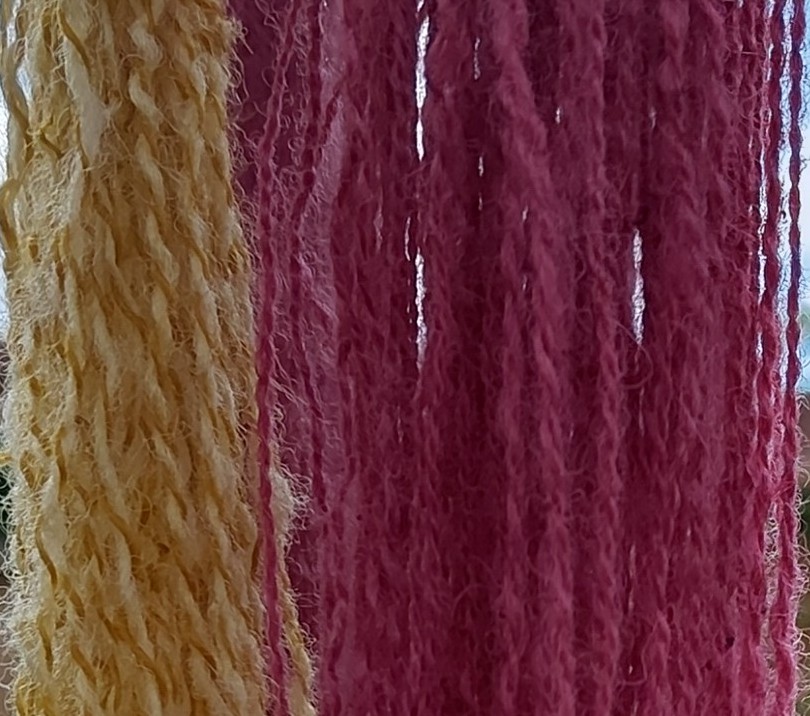
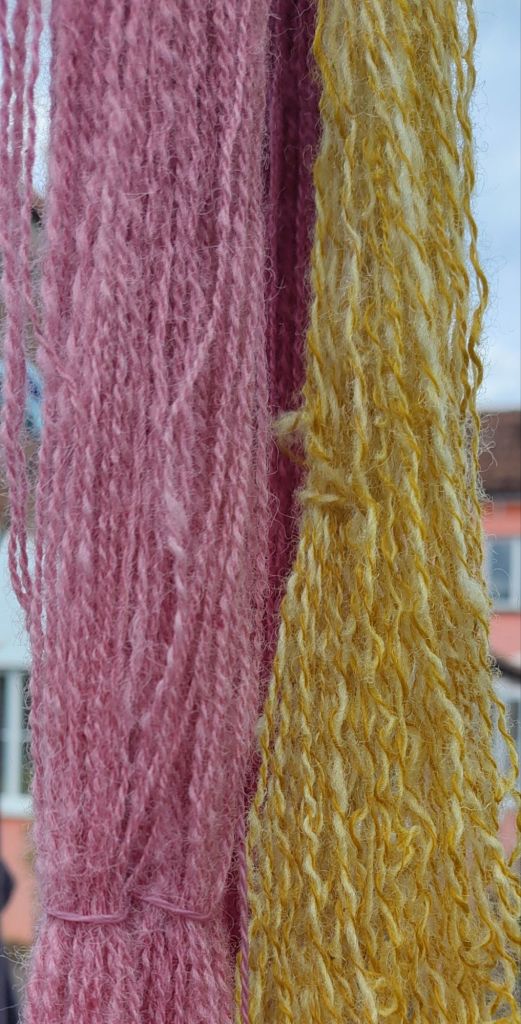
On the left is the mulberry and on the right is the marigold dyed yarn.

Ready to spin

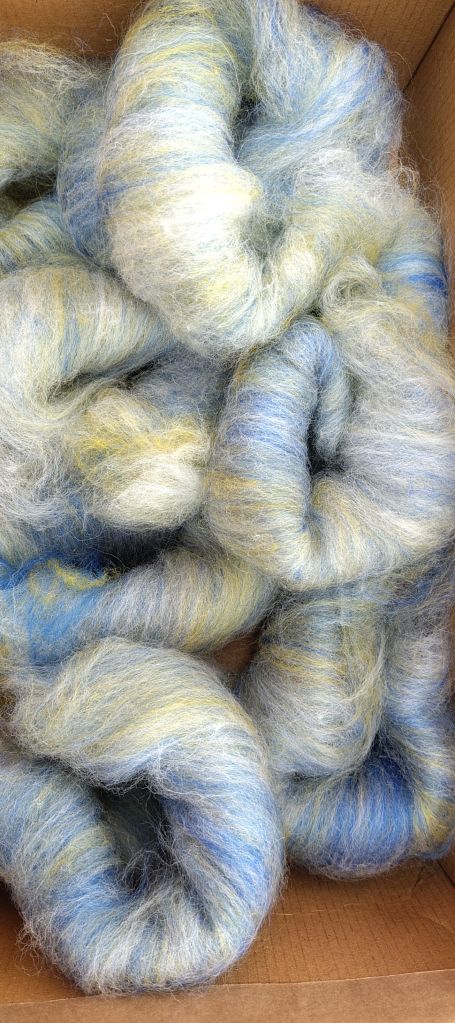
An hour spent blending on the drum carder has got me set for some serious spinning.

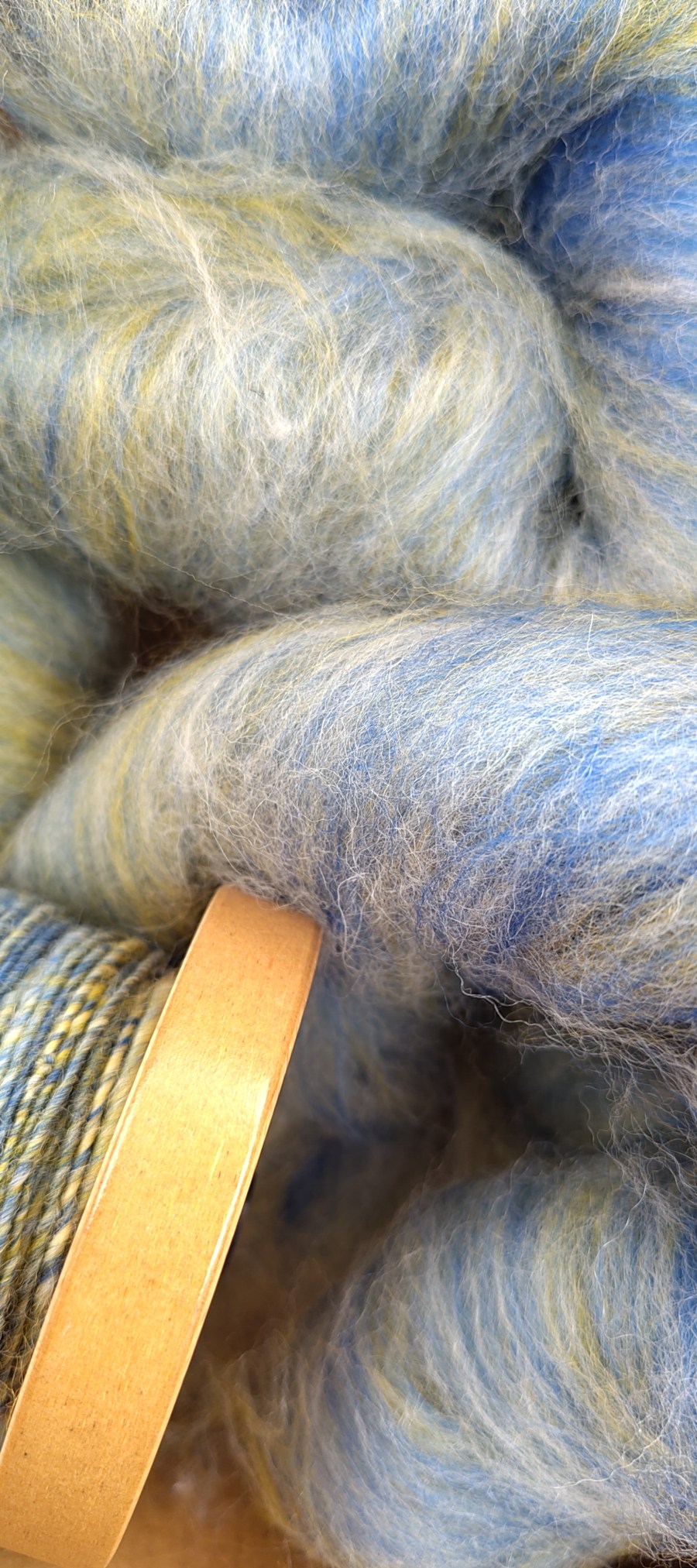
The yellow and natural are broken Merino tops that I picked up at the John arbon Open Day last year.  I’ve blended these in equal parts with a very strong ultra marine blue which I won in my local Guild raffle.

I tested this first on hand carders and it produced a very nice yarn so now I’ve done it in bulk and taken rolags of a batt from the drumcard.

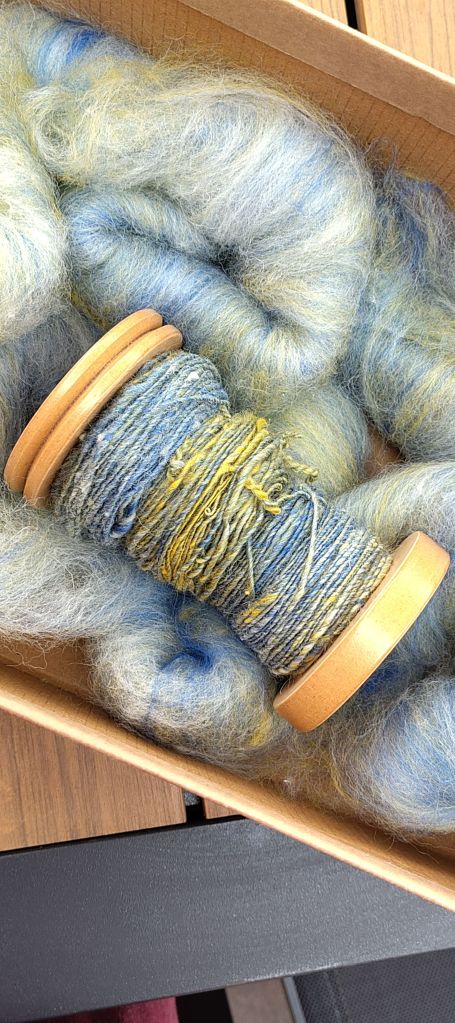
The singles so far.

I’m aiming for a 2 ply hand knit weight yarn, so spun the singles trying to let in a bit more fibre than I usually do. I read once that as you become more proficient at spinning you tend to spin finer, and that does seem to have been the case. Not that I’m claiming to be brilliant at it, just more practiced than I was.

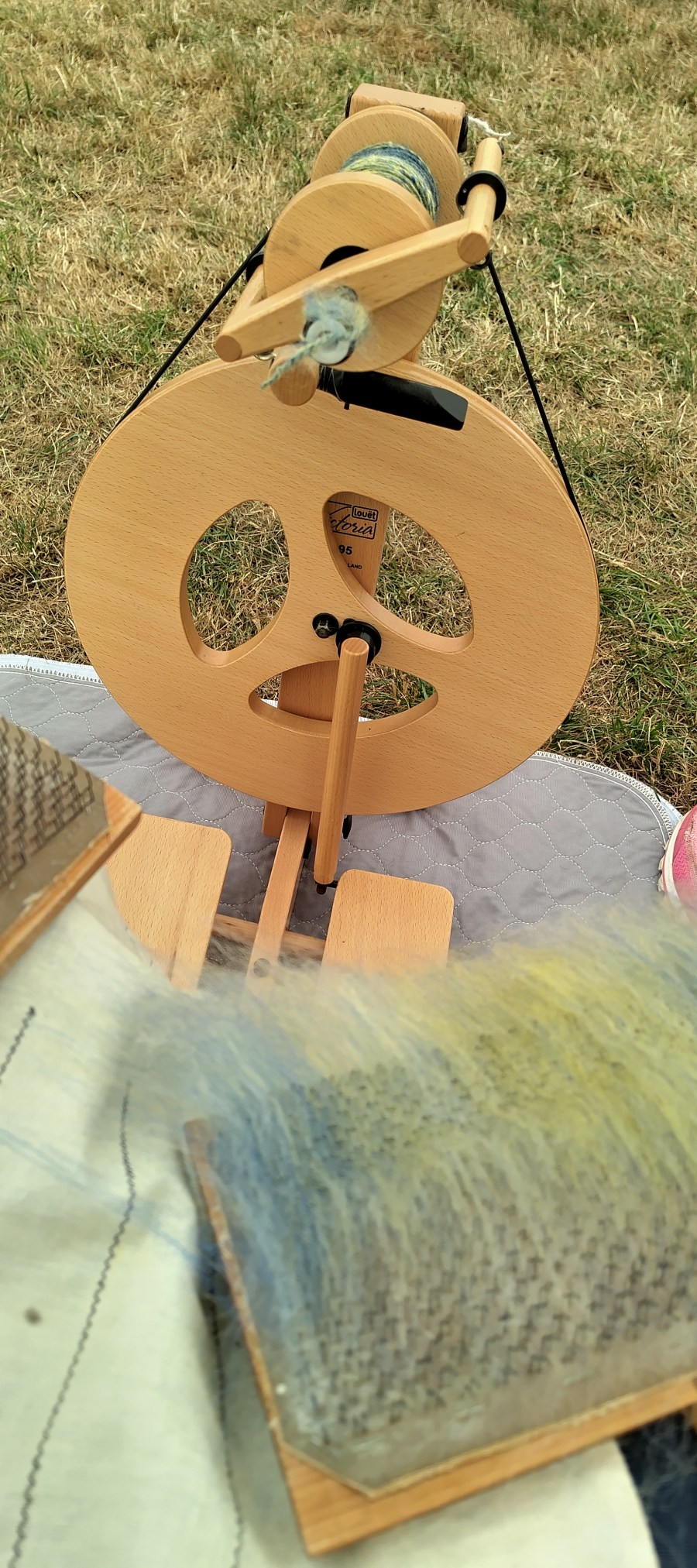
This was spun the 1:8 whorl on my Louet S95 ‘Victoria’, which is the little folding portable wheel I take out to demonstrations. I aim to ply at the same ratio although I know it will probably work out a bit less. I am looking forward to spinning and plying this.

Spinning at the WSRA Steam Rally

Today I’m with the Somerset Guild of Weavers, Spinners and Dyers,  demonstrating spinning at the WSRA Steam Rally in Norton Fitzwarren. I have brought my dinky Louet S95 Victoria with me and a trolley to take it all back across the showground.

 Because plain colour fleece doesn’t always look so interesting to the public I am blending yellows, now and cream tops on hand carders make a heathery yarn. 

https://www.somersetguildwsd.org.uk/

https://steamrally.org.uk/

Blending coloured tops on hand carders

Final sample for my latest book about machine knitting

I think this might be the final sample for my latest book. The manuscript went into the publishers a week or so ago and I’m just working in a few outstanding samples and photos.

Of course machine knitters, well knitters in general, will know that ‘sorting out a sample’ is a shorthand for:

knitting several design swatches

knitting a tension swatch (or three)

working out the garment pattern

knitting it

finding you’ve made a mistake

knitting it again

steaming it

sewing it together

washing it

blocking it

etcetera, etcetera….

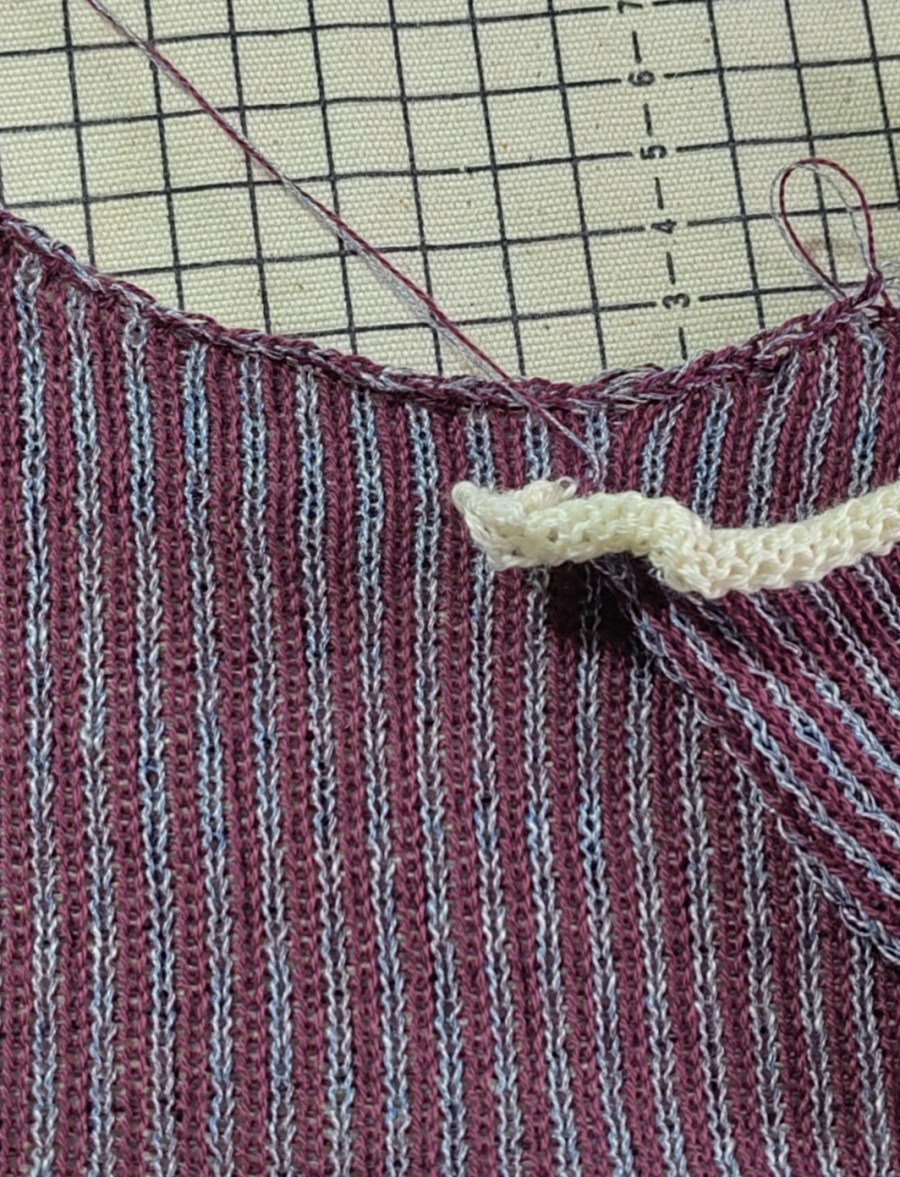
So I am just at the first steaming stage and getting ready to assemble the garment. And of course I’ve had to re-knit one piece because the dratted yarn got caught by the brushes irrevocably and it was easier to restart than try and sort that out. More haste, less speed is so very true in machine knitting. Nice and steady is always the best way.

I’m hoping this garment will be nice enough to go on the cover, but we will see.

Meanwhile let me tell you a little bit about the book. The title is still to be finalised, but it is all about short rows and partial knitting on a machine.  There is a lot in there for beginners, for example the first chapter is all about the principles of short rows and how you knit them and there is a whole basic techniques appendix at the back for additional support. Chapters 2 to 5 offer loads of information, samples, examples and exercises for more experienced knitters to really come to grips for short rows, and to understand how and when to use them for different results.

Chapter 6 has patterns that use short rows as they’ve been described in the earlier chapters, but applied to an item. So from these patterns you actually get to use short rows purposefully to create shape and form combined with colour and surface pattern.

So once it’s published I will obviously be shouting about it,  but keep an eye out and do pop back here for updates.

Somerset Guild of Weavers, Spinners and Dyers Skill Share day

Yesterday, Easter Saturday was the Guild Skill Share. There were many generous members who shared their knowledge and skills in weaving, knitting and spinning related sessions.

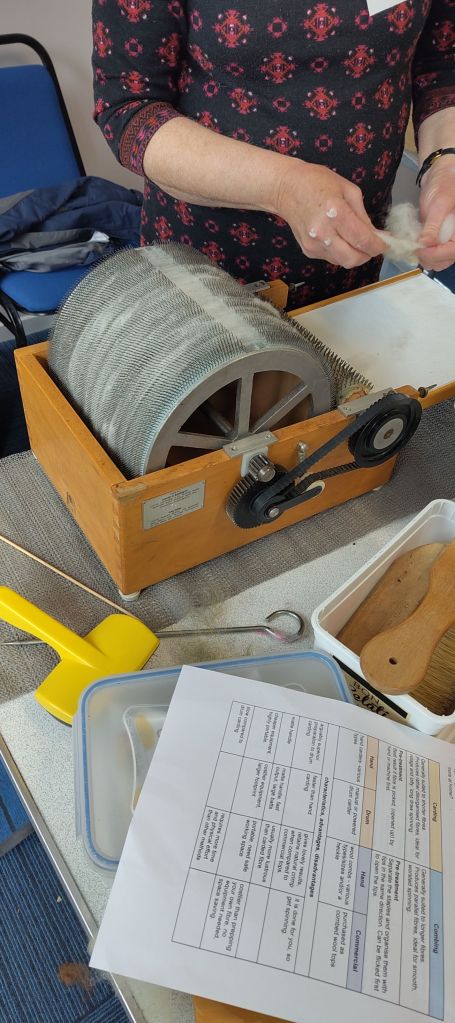
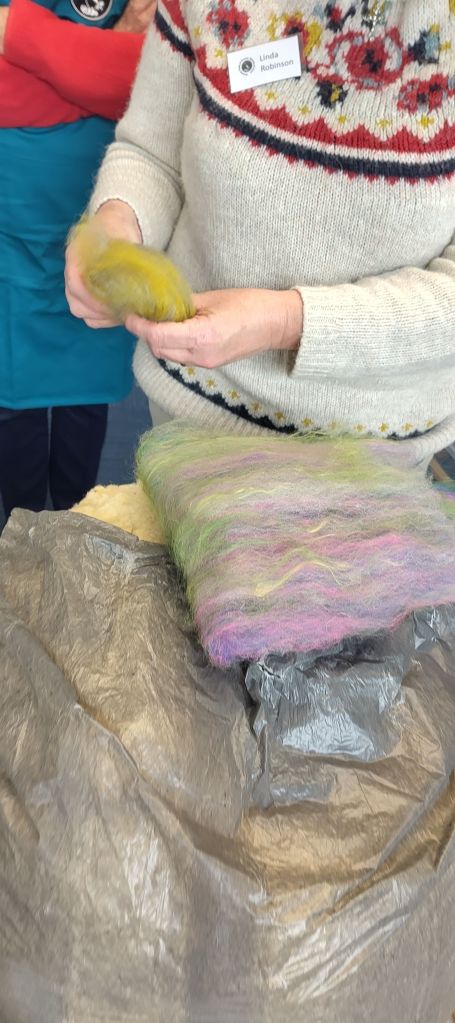
Kathy and I offered a Wool Fibre Preparation day so that members could have an induction on the Guild equipment or bring their own carders and combs etc. along to learn how to use them or just pick up some tips.

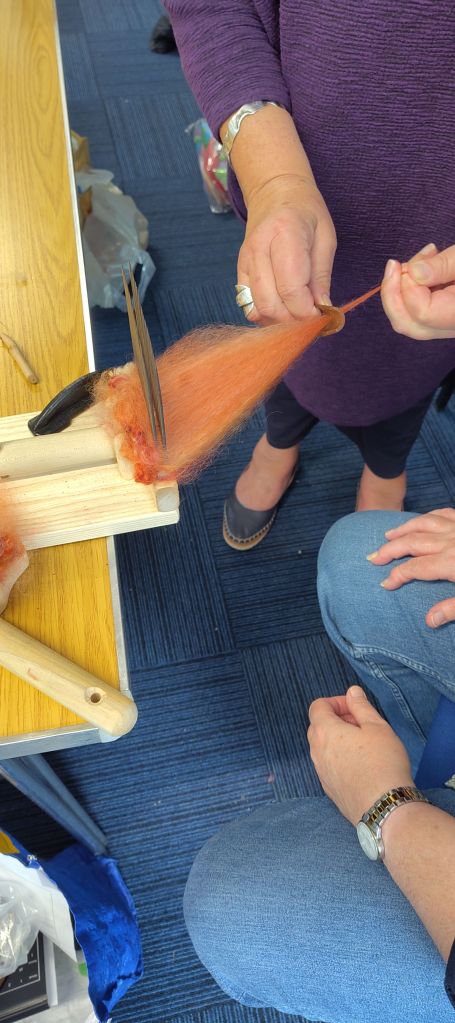
The morning was all about using swing or box pickers and hand and drum carders plus how to use these for blending. After lunch we tackled wool combing using a  pair of English Combs and smaller Valkyrie ones plus blending in a heckle.

We enjoyed running the session and everyone seemed happy. After my initial H&S talk it was me that pricked my finger on the combs!

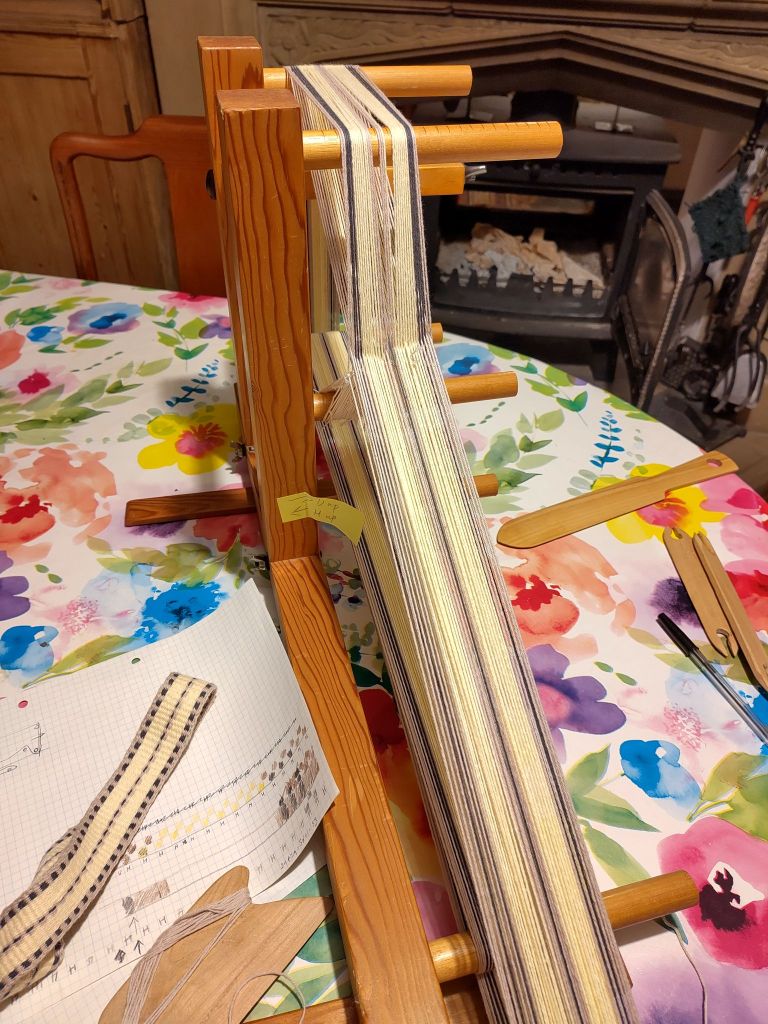
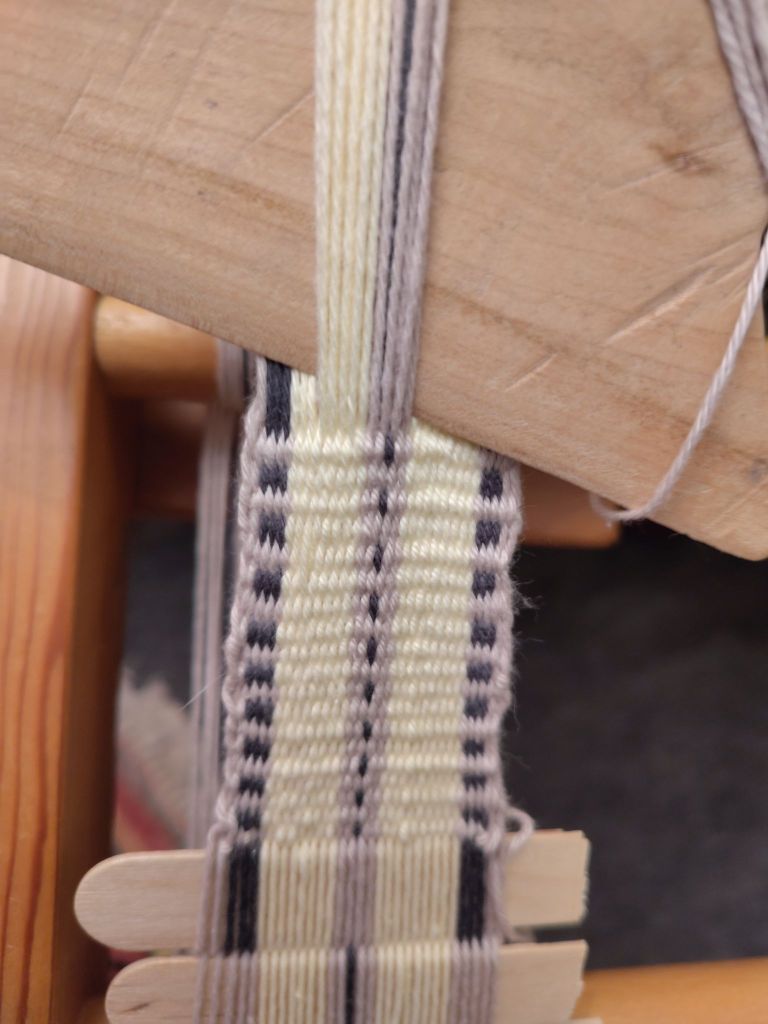
Inkle loom warped up and ready to go

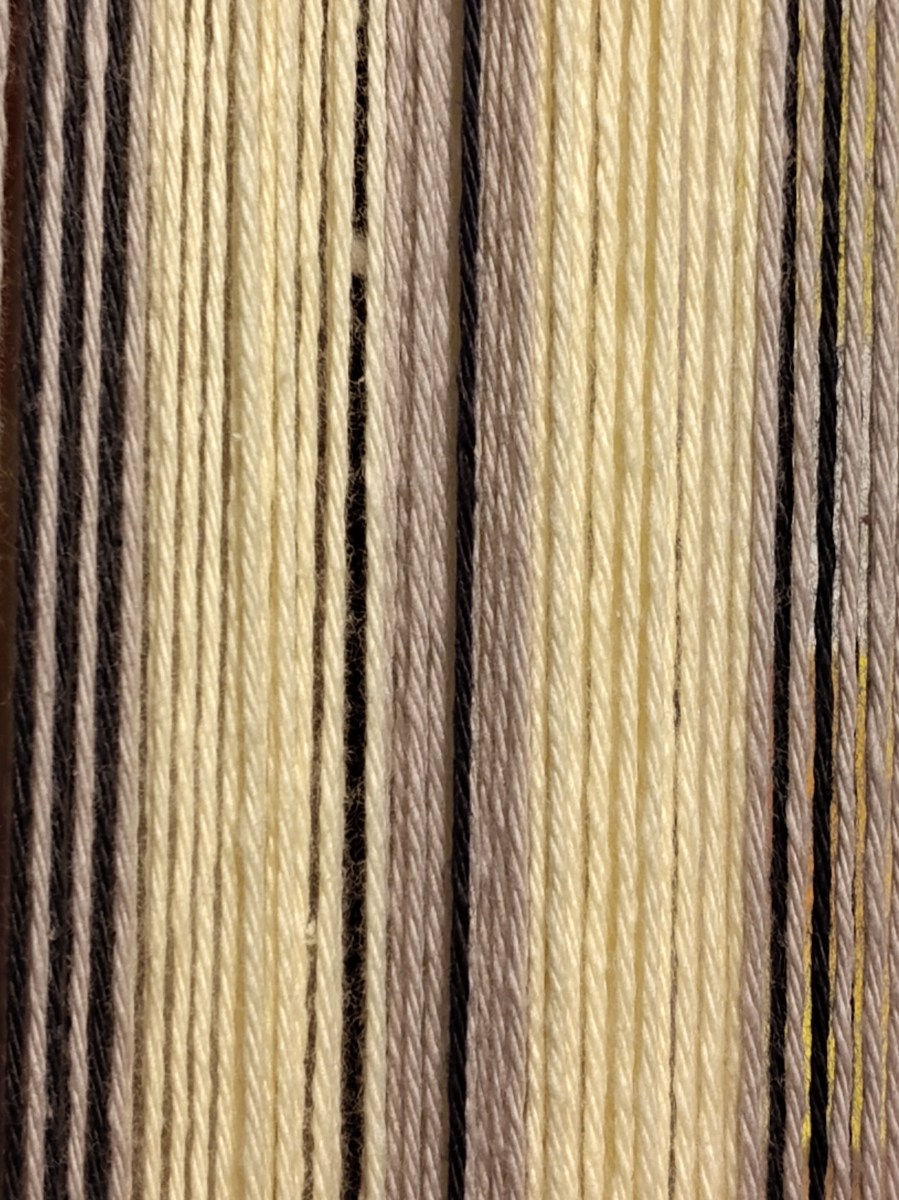
After almost a year I have got round to putting the warp on my Inkle loom to make the second curtain tie I started last April, (and ended up not finishing until July). The yarn is Drops 8/4 cotton.

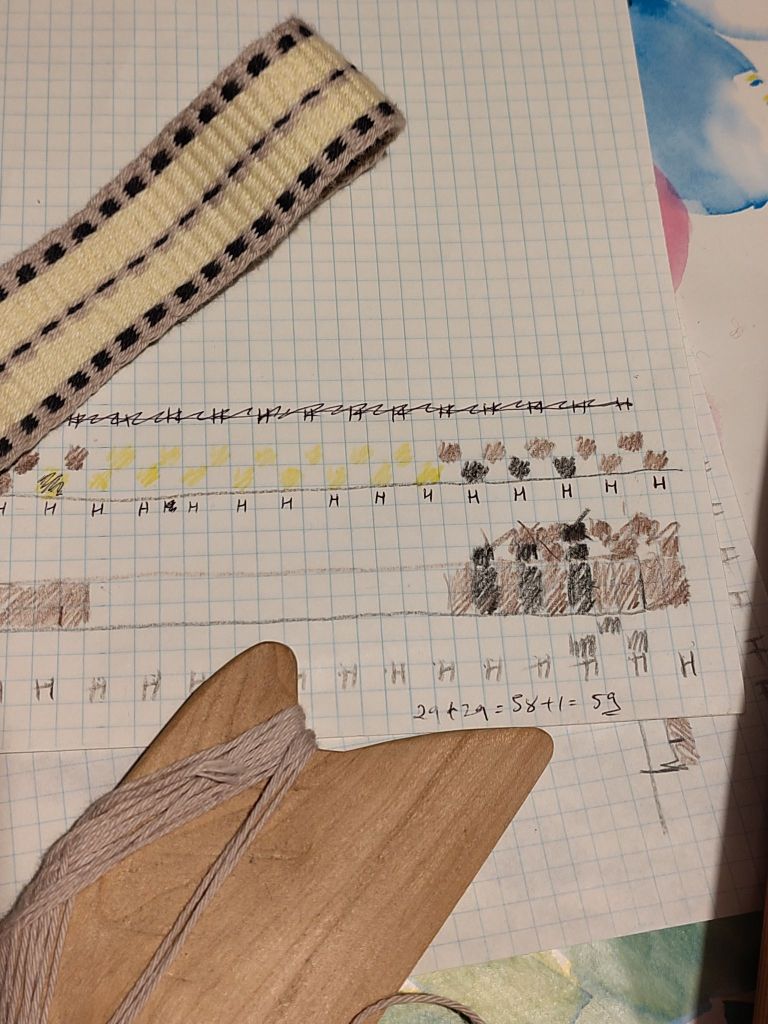
I hope I’ve got the warp threaded according to the pattern, but my notes were a little sketchy but I hope it will approximate it. Fortunately the curtains are at different sides of the room so there won’t be much opportunity to compare.

Of course not only had I forgotten the pattern, I’d forgotten how to put the warp on. So to begin with I put everything over the top bar and had to re-thread the first four or five threads.  Luckily I had saved my heddles so I know I’ve got the right number of threads because I’ve got the right number of heddles.

The first band I made is in the photo. After a wash the cotton becomes soft but still holds it’s shape.

Or really sorted up the process of warping to leave a long tail attached to the first thread and to tie every new thread onto that tail as I worked across the warp. So you don’t have to cut your threads  until get to the end which I really like.

Getting going

Sock mending this evening

It’s a howling gale outside tonight, so the place to be is by the fire doing a bit of mending. The subject is a pair of socks machine knitted from my hand spun yarn. These sticks are like , ‘Trigger’s broom’ from Only Fools and Horses.

I plied the yarn from singles of Alpaca and Texel fibre, but did not include any nylon. Consequently, but after a reasonable amount of wear they have begun to thin and finally the stitches have burst. First of all the big toes went, and now the heels.

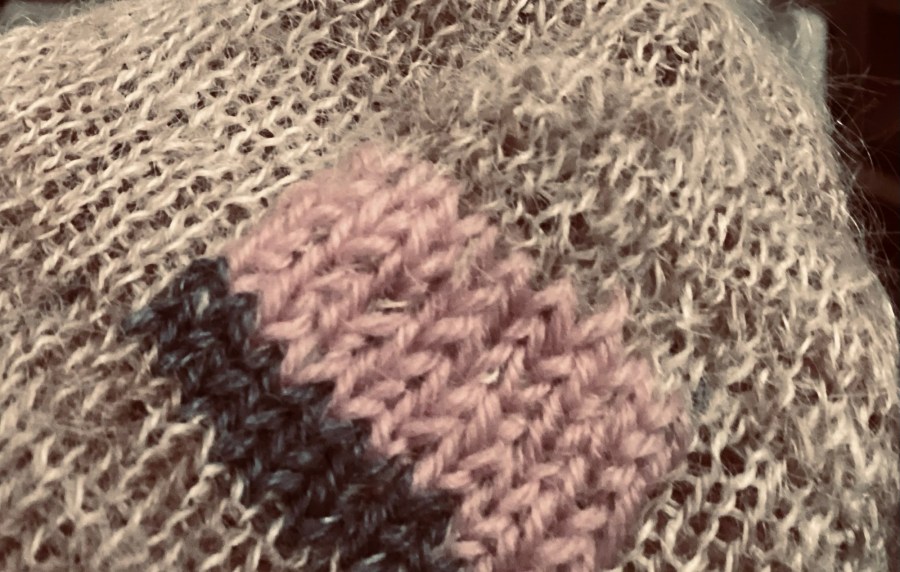
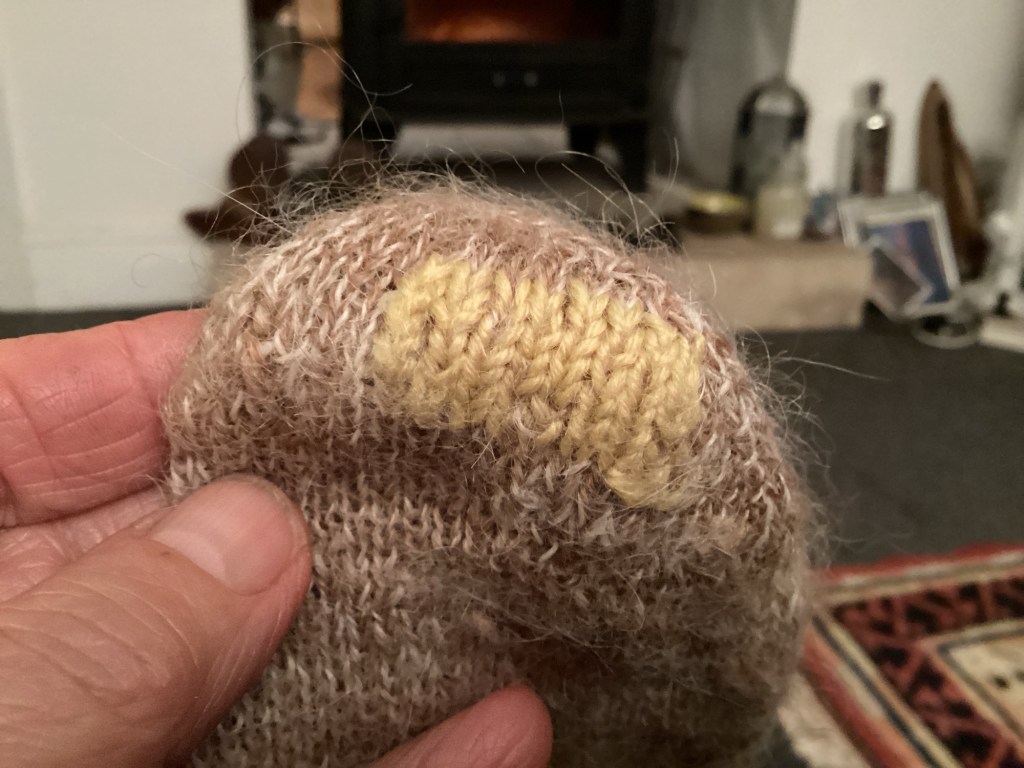
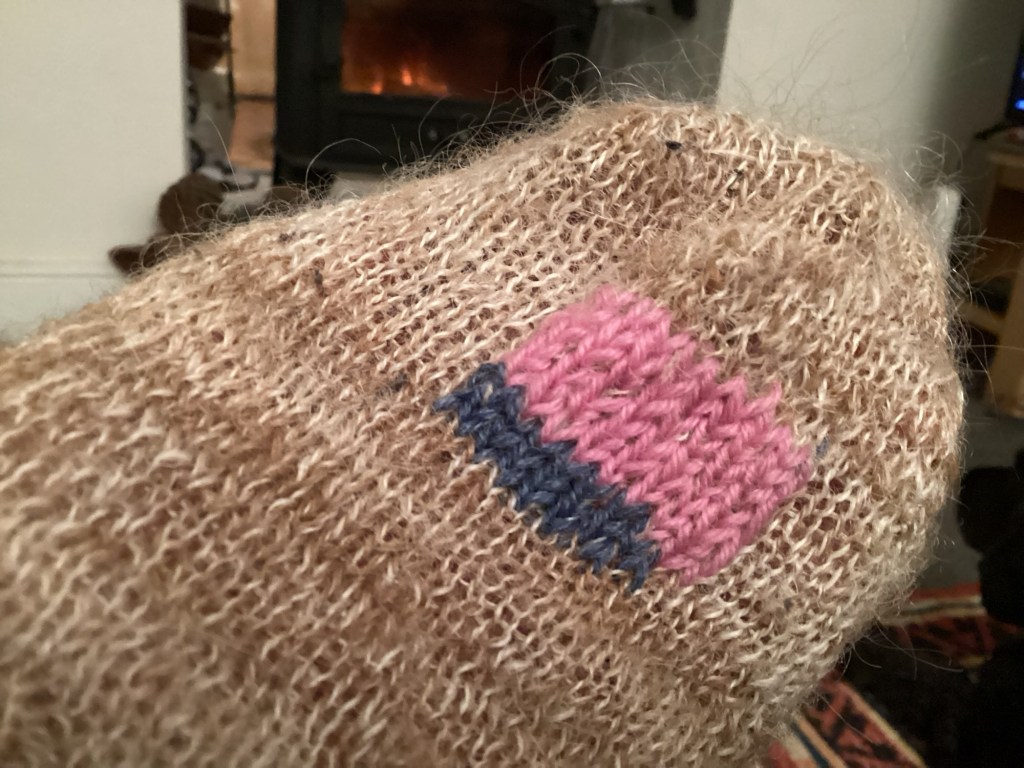
I had a little of the yarn left, but now it’s onto improvised and colourful mending…

The toes that were mended a while ago
Todays heel mending

I used one of those little mending looms for the toe repair, but the heels have been done ‘freehand’ using a technique from a 1970s mending book. I bought this useful book secondhand when a penniless student in the 80s, well before ‘slow textiles’ and ‘visible mending’ became a thing. Since then, useful book has helped me extend the life of many items for reasons of economy and necessity rather than fashion. Now my mending is on trend and it’s good to see the skill encouraged by a plethora of modern books on the subject.

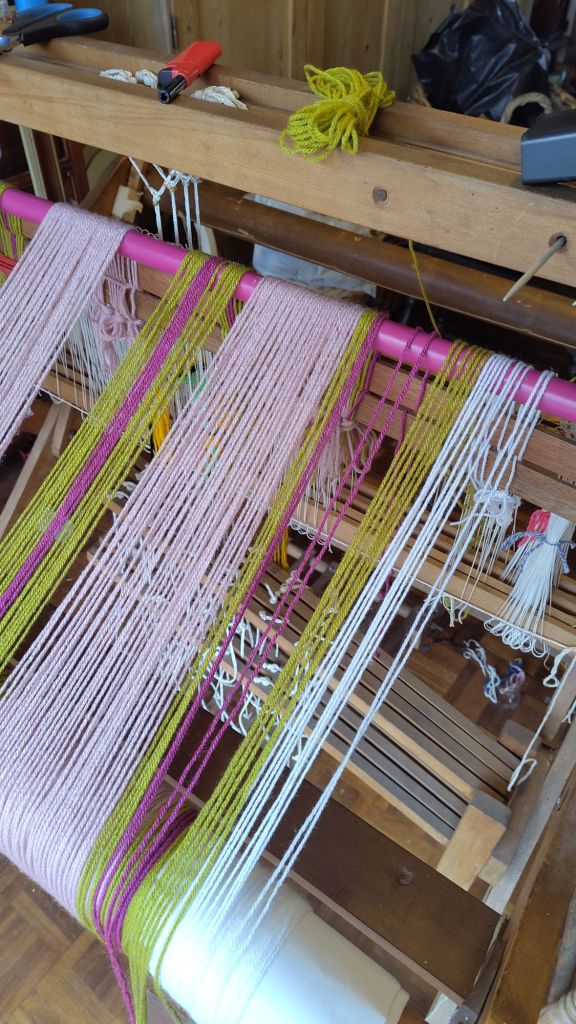
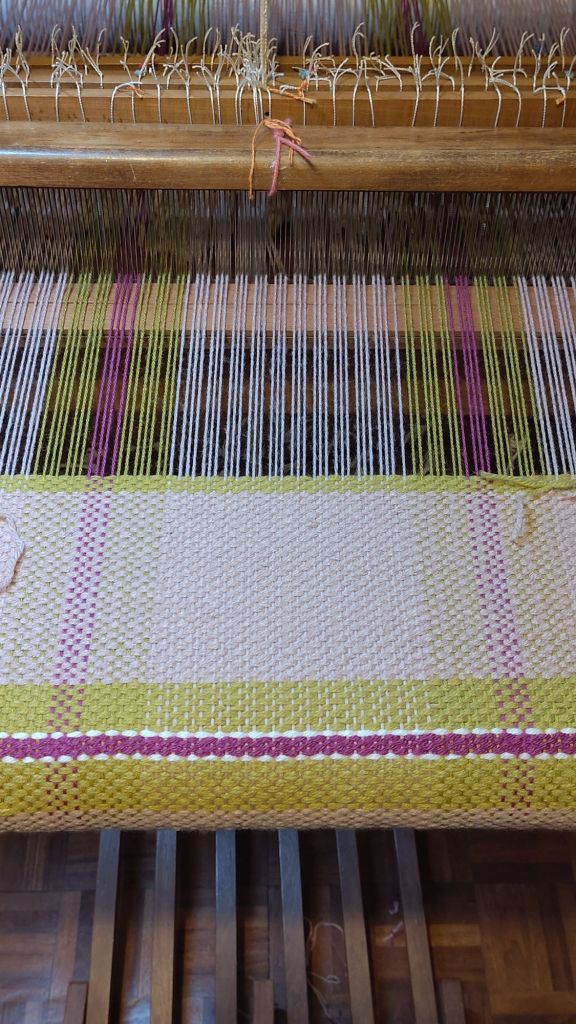
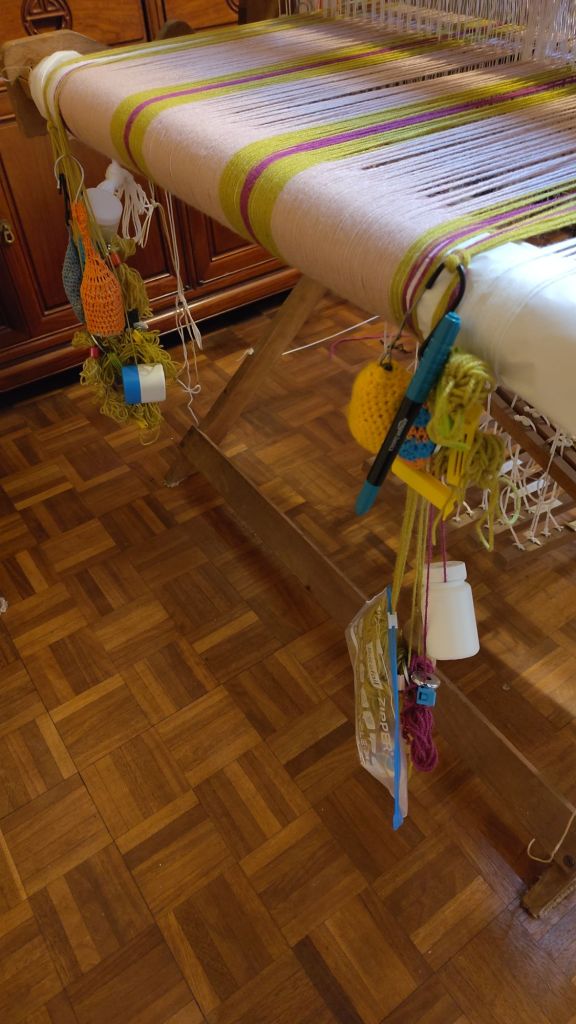
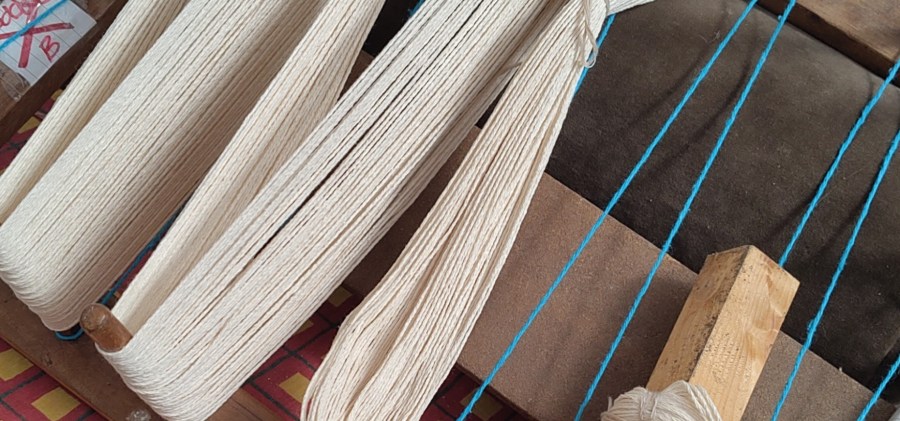
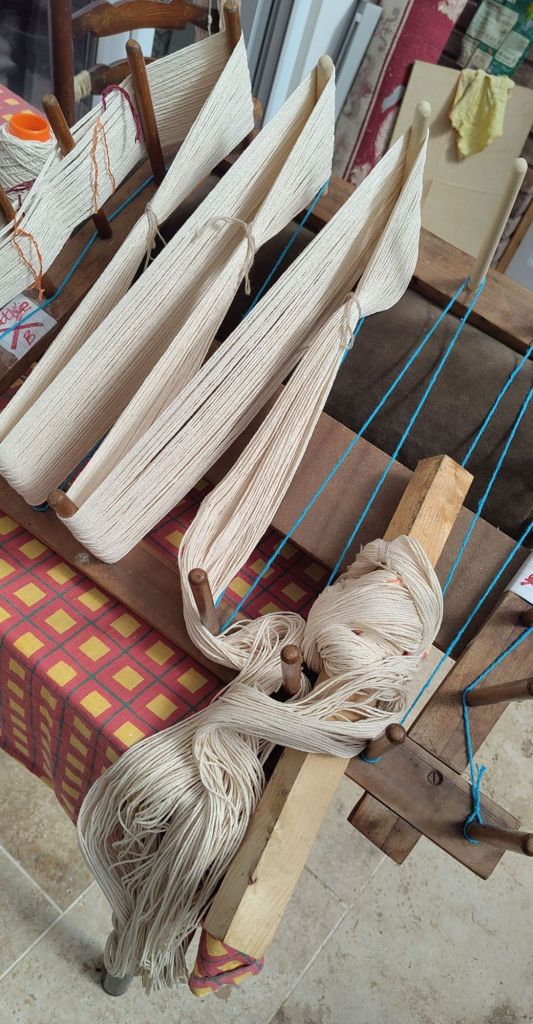
Making a warp for testing out my countermarch loom

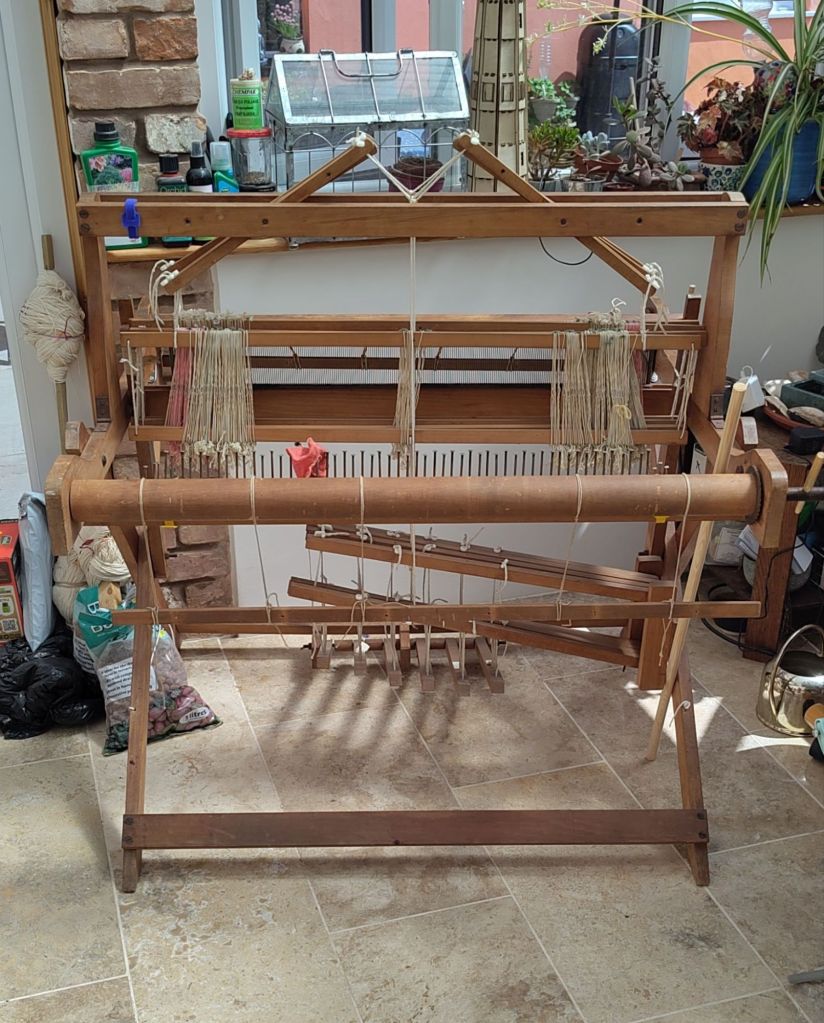
It’s taken me a while, but I have finally made the warp which I will use for testing out my new (to me) countermarch loom.

It’s taken me a while as we have building work going on in the house so I am moving from room to room to escape the chaos. I finally ran out of places to go, so ended up in the conservatory which is HOT. Lots of short breaks needed.

I am in two minds about what to weave. My heart says a fleece rug – I have two in bags in the shed, but my mind says ‘ do you need a rug,?’ What I really need is more tea towels, since my son burned a hole in one of my hand woven ones.

The loom has got an 8 dent reed and I am using a thickish cotton and making a sectional warp because my warping board pegs won’t take more than 80 ends of this. I’ll thread it up as a twill and let myself be guided by the spirit of the day I start to weave.

Winding the warp of the warping board onto a kite stick, as recommended by Peggy Osterkamp

The loom waiting for the warp. I know I’ll be whining about back ache quite soon…

Making the most of the sunshine

How often do we have such gorgeous weather in May in the UK?

So I decided to take advantage of it by having a swim and then sitting down with my spinning wheel to spin up some Jacob’s rolags I’d carded last night. What more perfect way of spending on Friday afternoon.

Ok the garden needs attention and I’ve got plants to plant out and I should be writing and all sorts of things, but sitting in the sun and spinning just seemed undeniable.

See more about machine and hand knitting and hand spinning on my ‘Vikkikit’ YouTube channel.