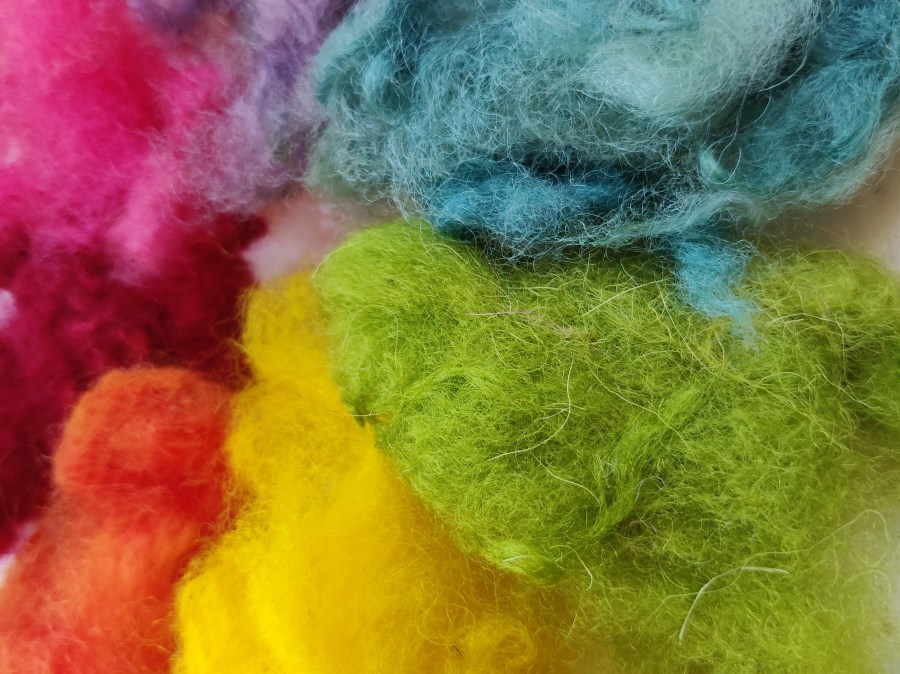
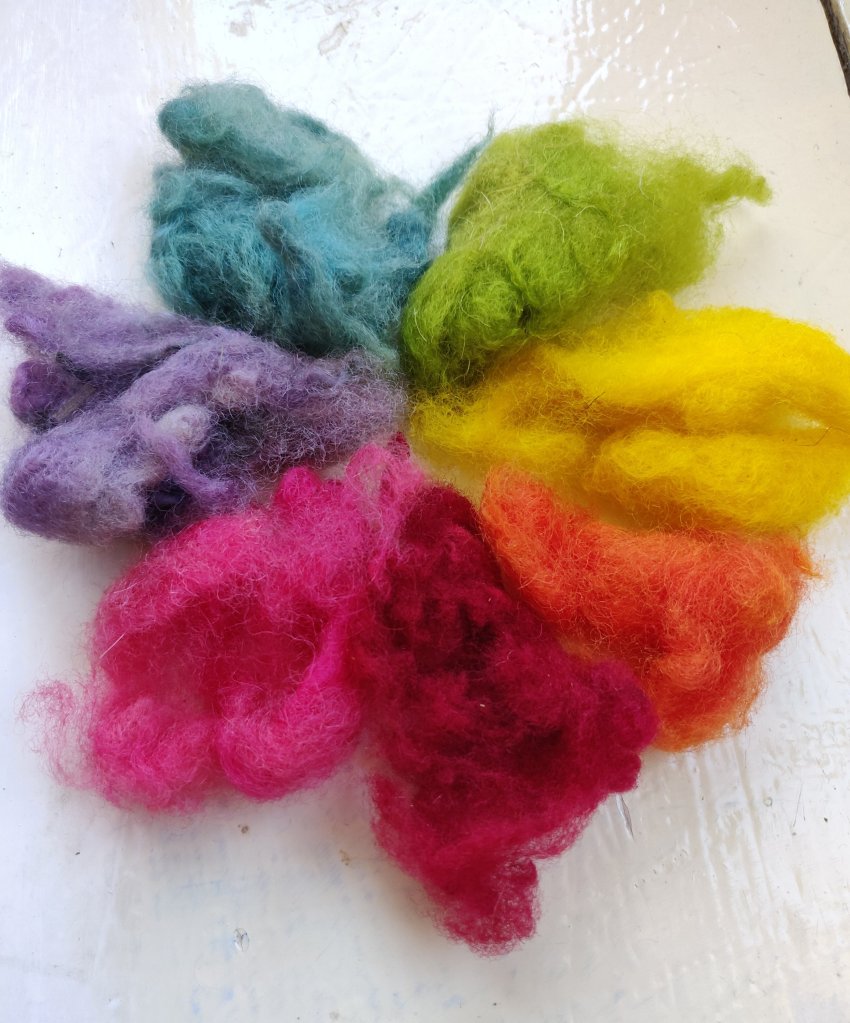
I’ve been dyeing a whole fleece into 100g lots mixing my own colours from primaries from Colourcraft acid dyes bought from George Weil.
I’ve gone into detail about this here, but the colours are zinging.
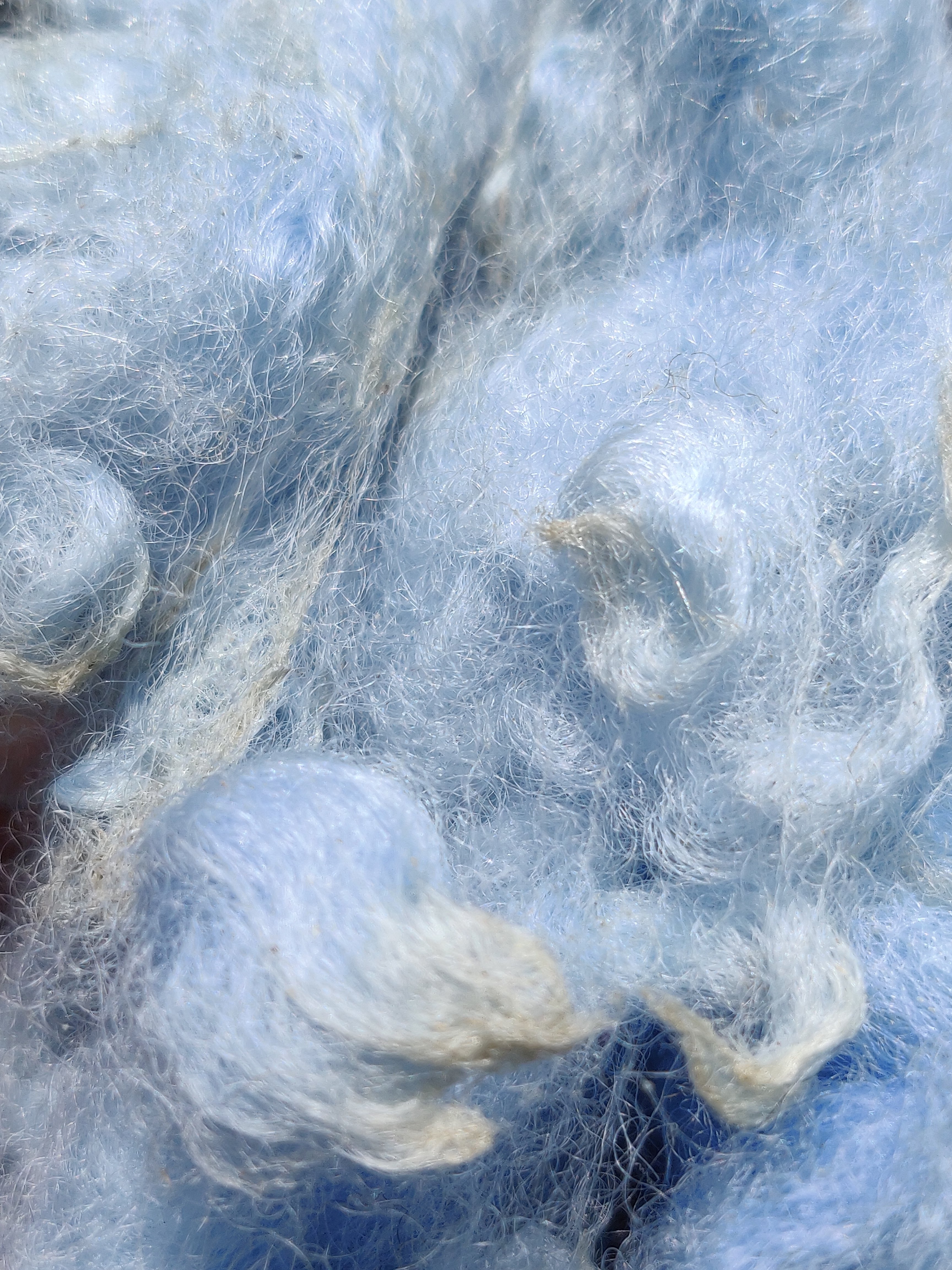
Pink, greens, dark red, yellow and orange. I’ve just completed a blue, but it’s still wet so will have to wait to be added later on. I added another batch of fleece to the finished due bath to exhaust it totally, which gave me a pretty pale blue.
Watch this space for the blues…
Two blues from one dye bath
I’ve also tried stove-top rainbow dyeing. More about that can be found here.
Last week a few of us got together (safely distanced and masked), to take our textiles into the park. I enjoyed myself so much I forgot to take a photo!
The thought of spinning outside in the sunshine encouraged me to use bright colours. So I took along some Shetland fleece I dyed a while ago using acid dyes, (I have written more about dyeing fleece with acid dye here).
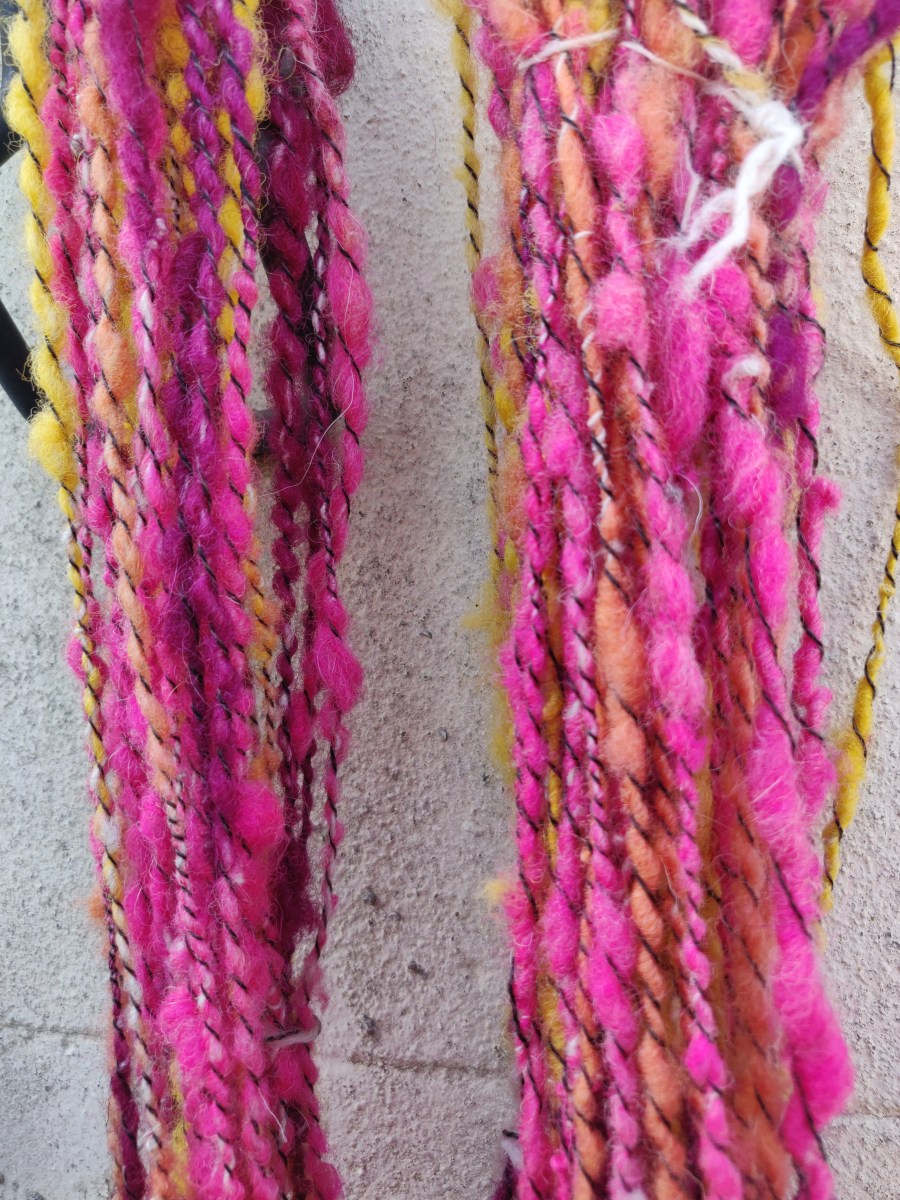
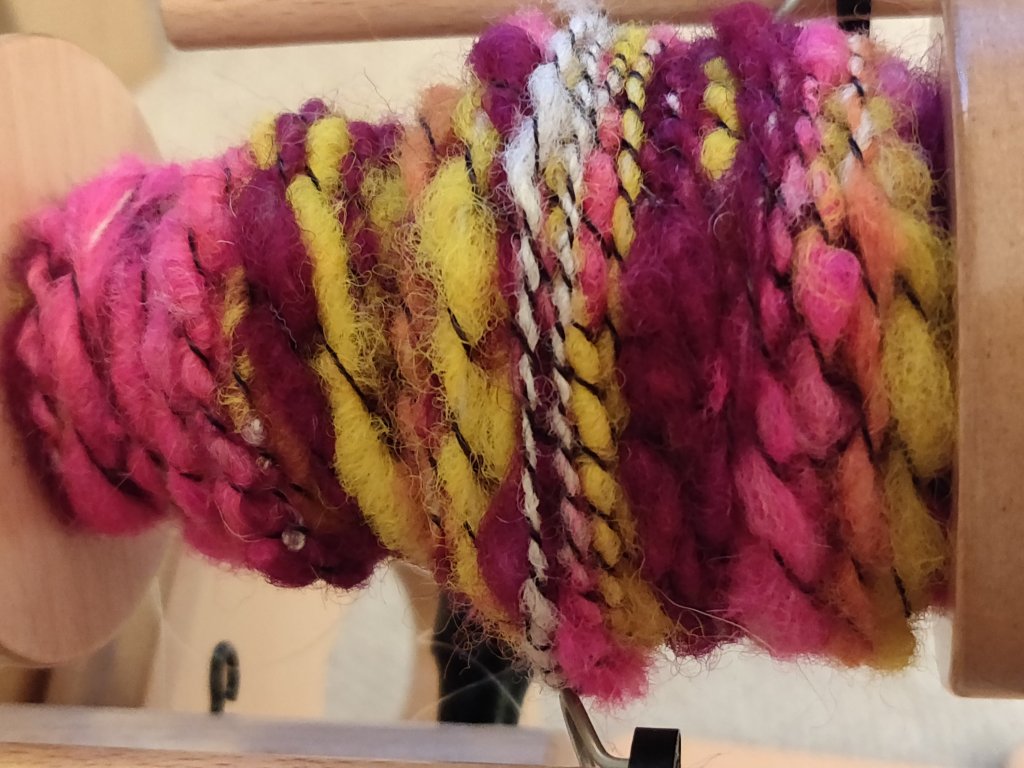
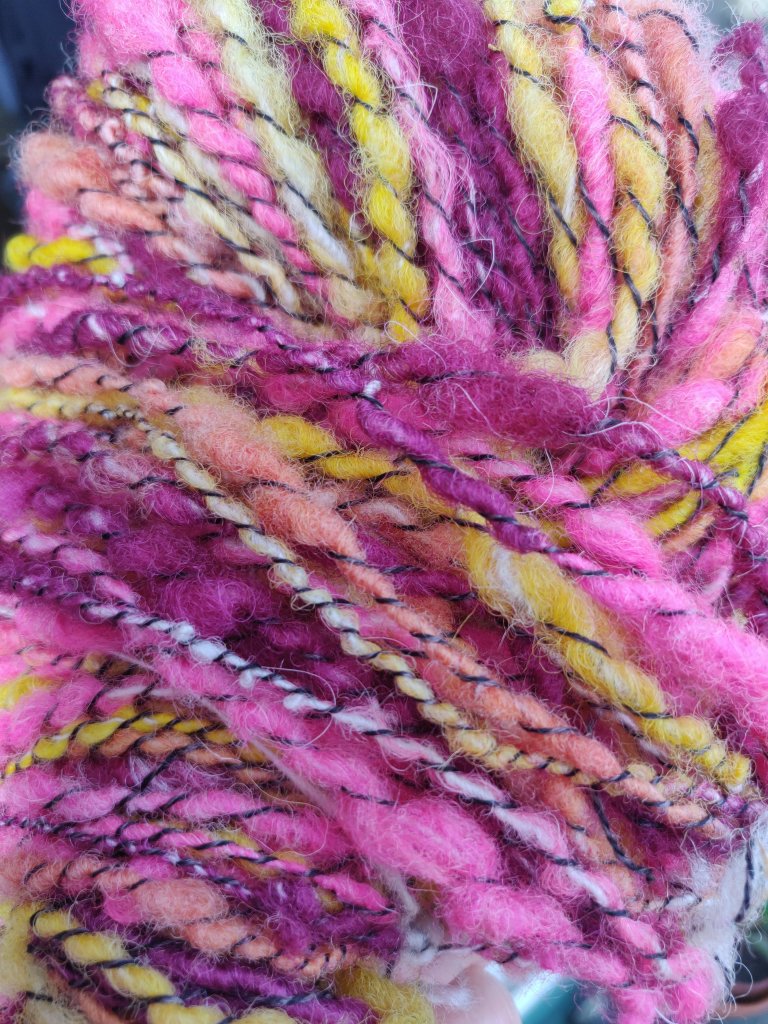
I’d spun up a bobbin of Suffolk fleece that is not very exciting, so I planned to use that as the core for a bright, irregular spun, core-spun yarn to which I would add a charcoal wrapping yarn. All 100%wool. I took my folding Louet Victoria S95 wheel which is a joy to use.
The core yarn was Z twisted quite tight. The wrapping colours were also put on Z twist, and the final charcoal, commercial yarn was S spun over the others.
Photo taken at might, so the colours are not accurate.
After washing and drying the twist the colours hardly muted and it’s come out as lovely yarn.
I’ve wanted a half-scale mannequin for several years, but have always been unable to justify spending the money. I made my own full-sized body double, and several other mannequins for my research, so have lots of experience making real-size ones, but wasn’t sure how to start with a half-scale one.
Luckily I happened upon Leila’s website Grow Your Own Clothes, where she has a great tutorial about making your own half-scale mannequin. I then saw that she has a pattern for a sewn and stuffed on on Etsy. I thought that would be a bit weird, but having taken a good look and having done a lot of work on fitting clothing to the body I realised I could make that! I bought the pattern – thank you Leila for putting it out there, and assembled the materials. https://growyourownclothes.com/2015/08/06/mini-stuffed-dress-form-pattern/
Yes it is fiddly, and you need to concentrate. There are lots of little pattern pieces that have a tendency to blow off the table if the window is open, so I don’t think its something to take on if you can’t leave things out to work on unless you are very well organised. Do read the whole thing through before starting so you get the gist of what you are going to do. The tips and hints given in the pattern are extremely helpful and the instructions are very comprehensive and easy to follow.
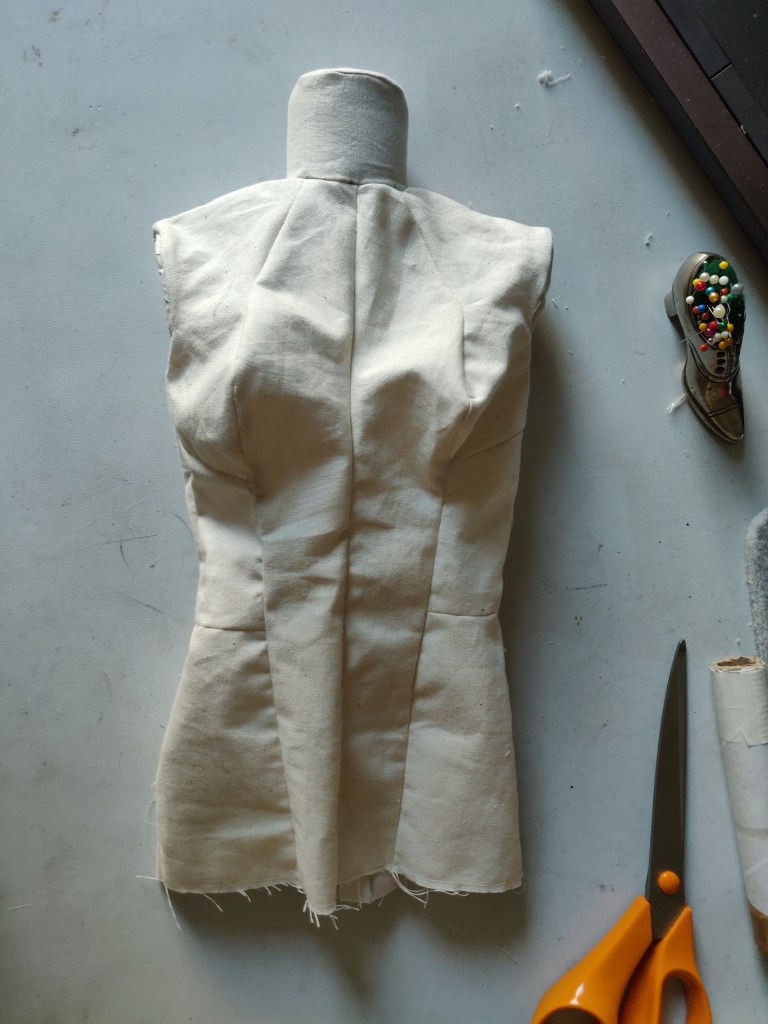
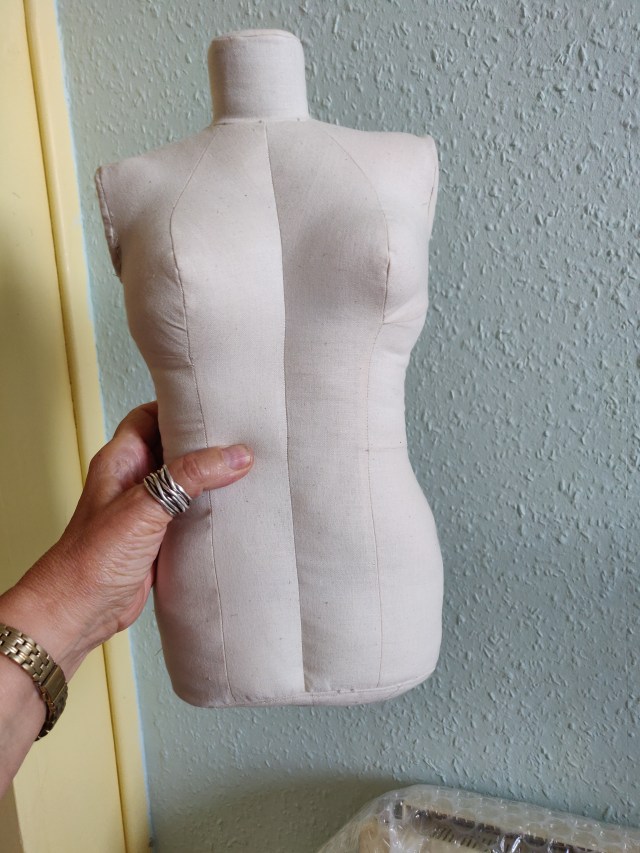
The sewn shell, ready for the base to be put on
Its really important to be as accurate as possible cutting out and sewing the seams. I managed to be reasonably accurate, but can see where I could have done better.
Its a very clever design with a central panel to hold the shape better and a pole insert.
Stiffing is quite a challenge. I can again see where I could improve, and may unpick the base and rework this at a later date, but I am to excited to do this now. I luckily had a sack of carded polyester wadding that I used, but stuffed the shoulders and some other areas I felt might benefit from the behaviour of the fibre with wool that I carded myself. I might re-stuff with all wool – or at least do the next one with wool
Partly stuffed, with the base in place now.
At this point I was a bit frazzled and had burned my finger on the mini-iron and stabbed myself in the palm with the point of a very sharp pair of scissors, so I decided to call it a day. Today I completed the mannequin and am thrilled with the result.
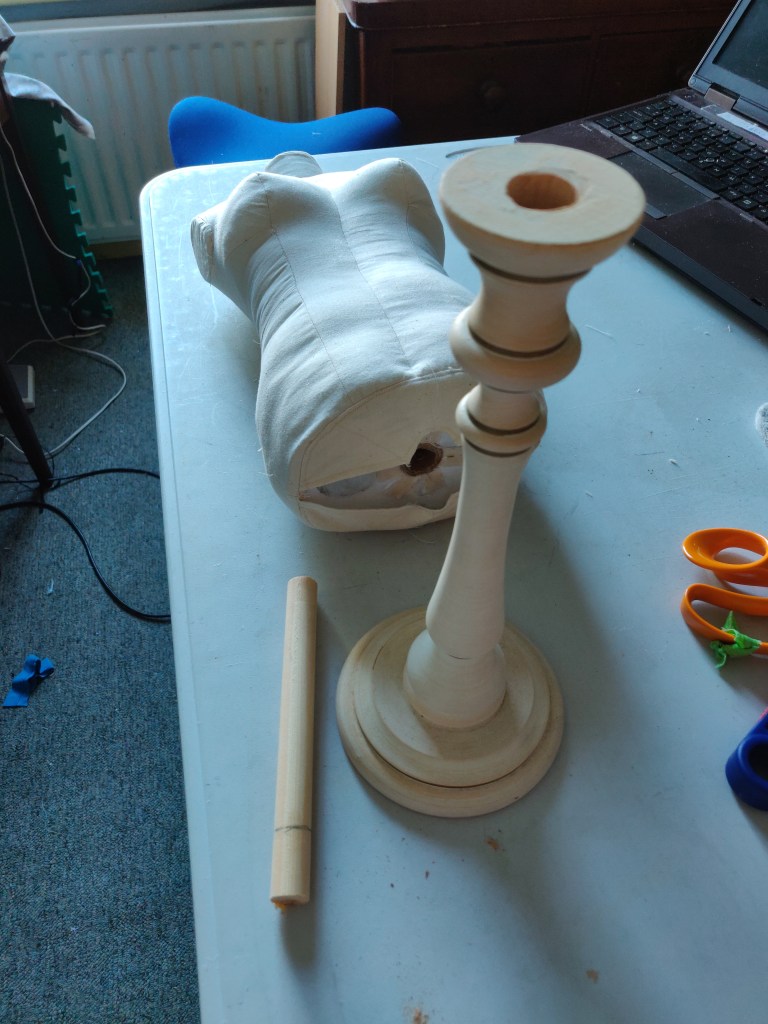
The suggested stand is a cardboard one, but I have just broken the top of a wooden lamp, and realised that this would make a great stand.
The lamp base and dowel that will make the stand.
Almost ready to go on the stand. Just needs the base sewn together.
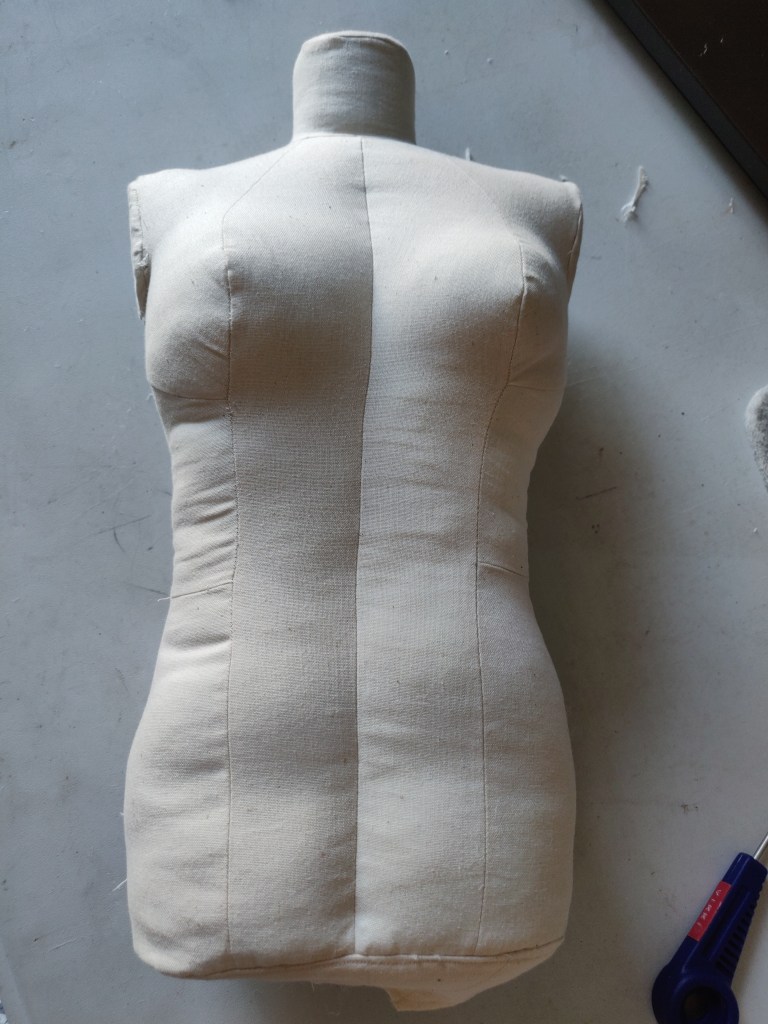
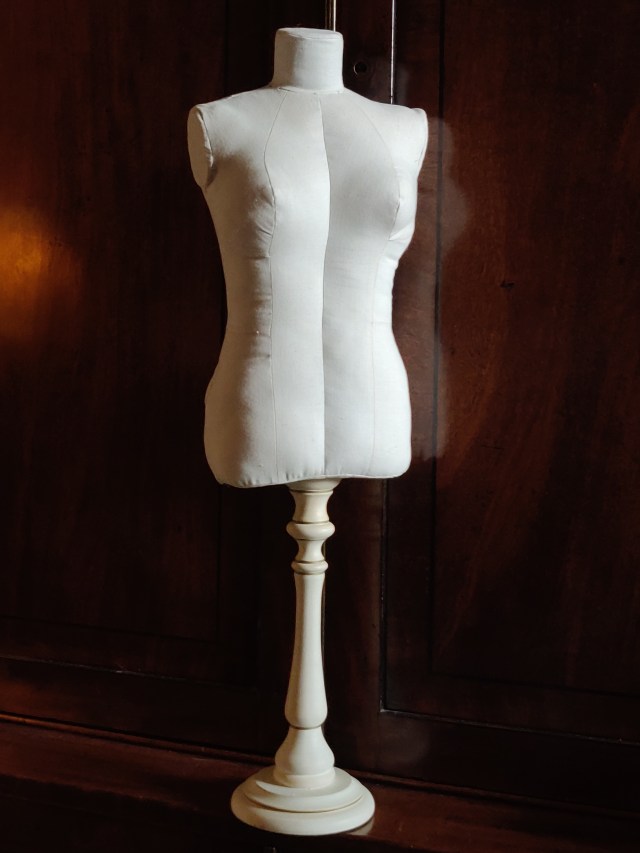
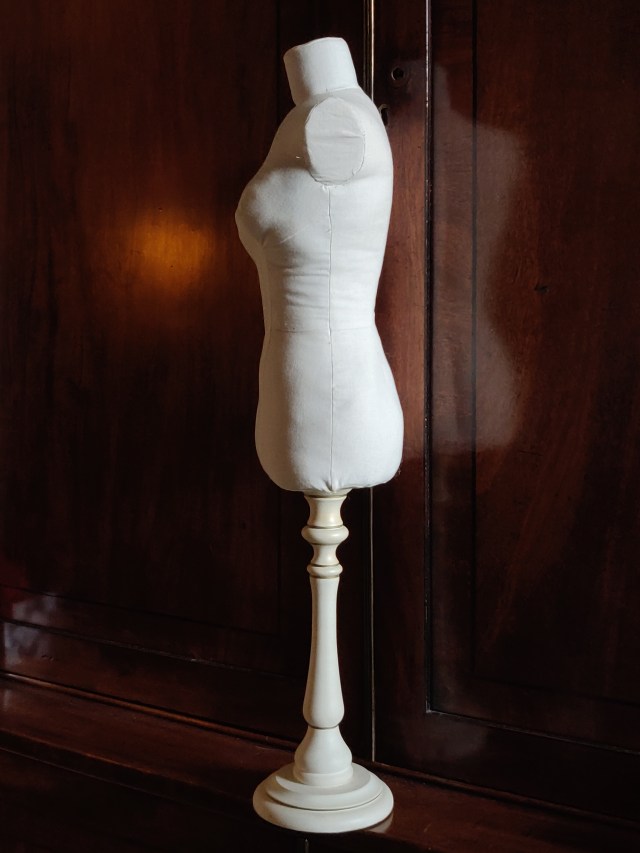
The finished mannequin.
I am pleased, but as I say I am my own worse critic, so can see all the things I wish I had done better. I plan to make another one from the pattern to perfect it. For the moment I am chuffed though.
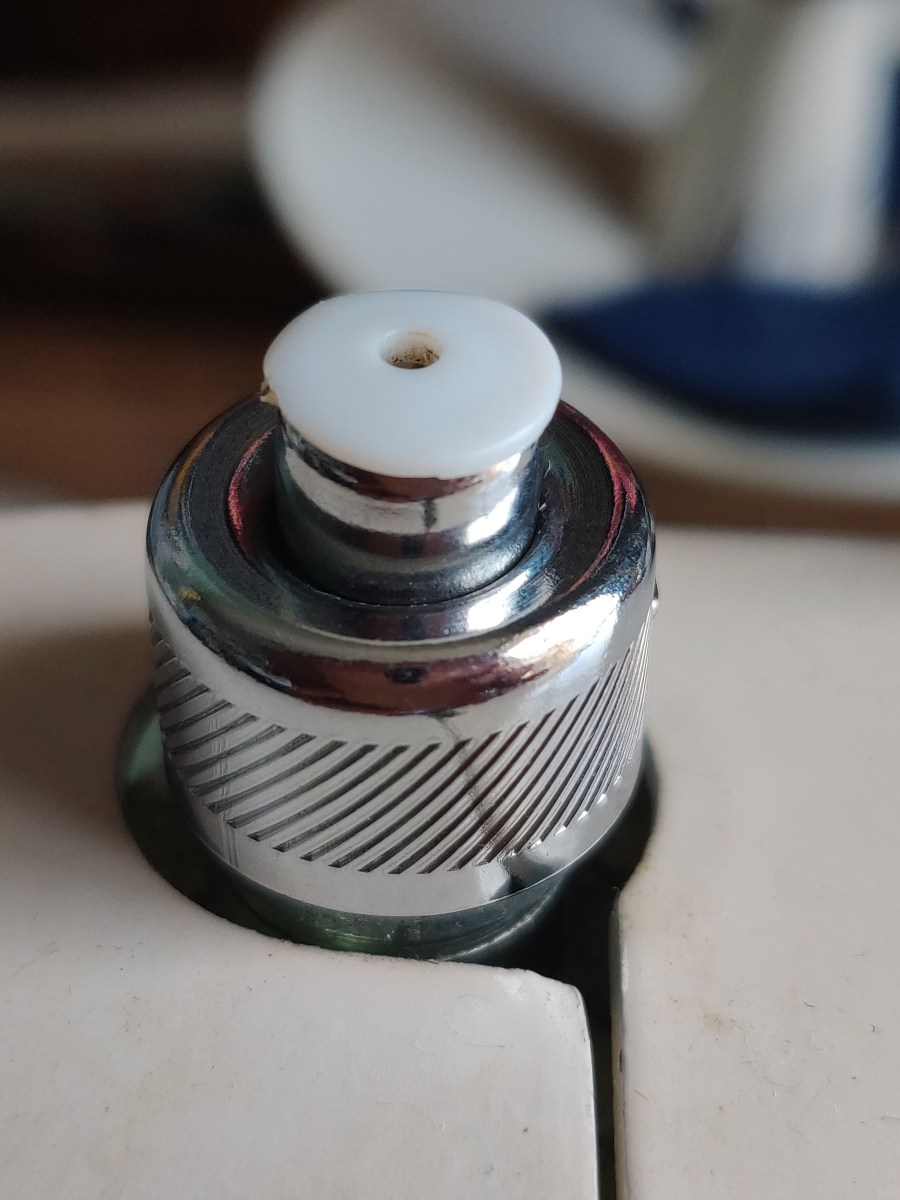
I’ve been having problems with adjusting the foot pressure on my Jones 125 machine. I’ve not seen one like it before and couldn’t work out how to use it. Today I’ve had 3 broken needles and I traced this to the really strong pressure on the foot. My Bernina 1030 doesn’t have this adjustment so it’s not something I work with much.
The pop darner for pressure adjuster on the Jones 125.
Before reading this I’d been twiddling it, popping it up, trying to unscrew it and seeing no difference. After reading this helpful page, it seems the Jones has a ‘pop darner’ style pressure adjuster. The central core pops up when you push down the outer ring, and then you depress the central core in increments to achieve the pressure you want. I imagine the name comes from popping it up to take pressure off when darning (or free embroidering) on the machine. Suddenly it all makes sense. The 3/4 position is so much better for what I am sewing today than all the way down, where it was because I couldn’t work out how to adjust it.
Probably common sense to others, but not to me!
Thank you to the kind person who took the time to write about the different methods of adjusting foot pressure, and for such a clear explanation.
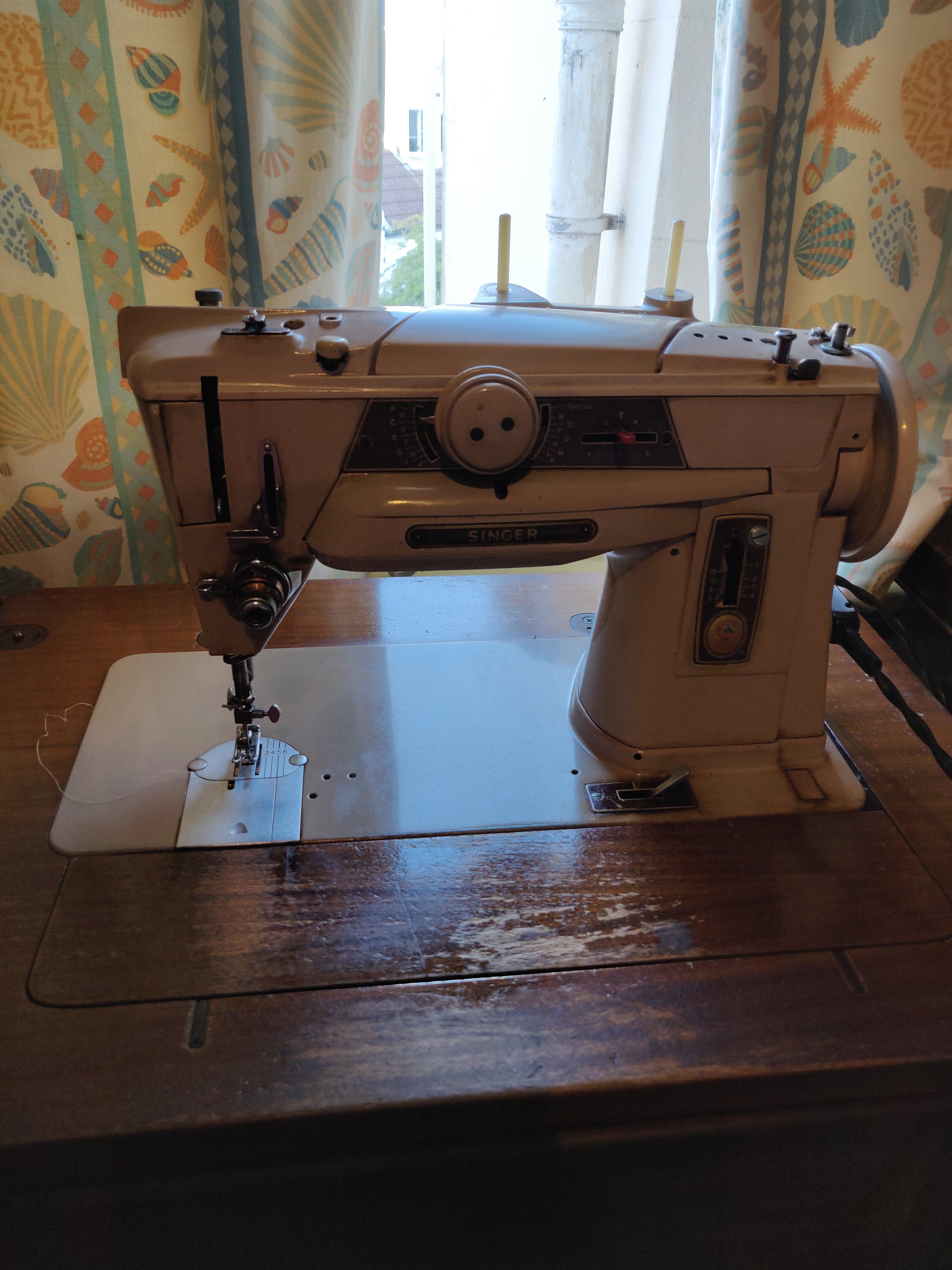
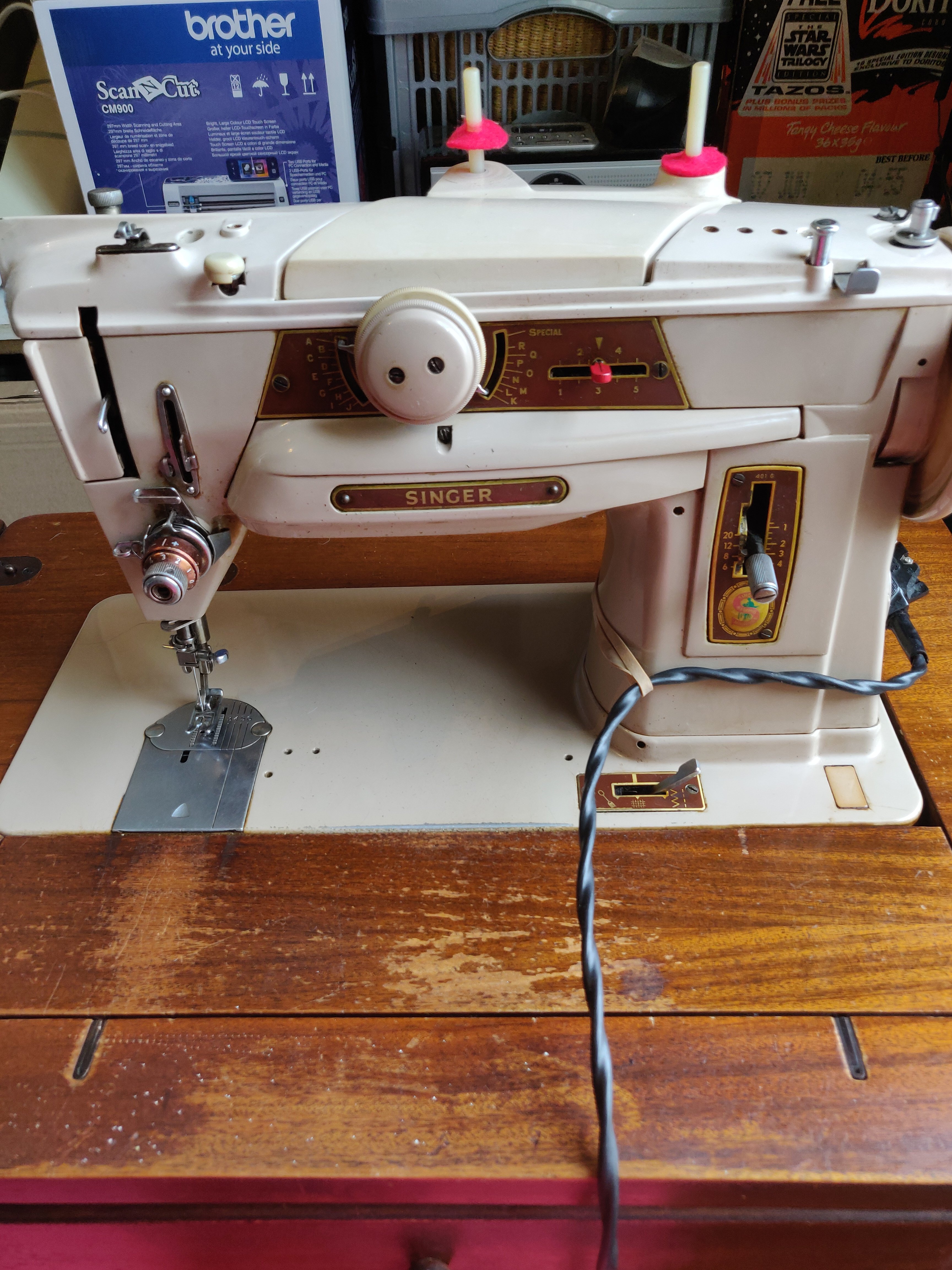
I have been toying with the idea of buying a Singer slant shank machine for a while, and during lockdown I took a punt and bought one reasonably local on eBay. Not the smartest move you might say, sight unseen and all that. I spent quite a time scrutinising the photos very carefully, read up about the machine, and asked lots of questions of the seller. Call it a treat to myself.
Updated with some photos just now, 16:00 4th July
Above, as it arrived, a bit grubb
And below, after a good clean up
Finally I went to collect it – social distanced collecting methods in use and no stopping en route. Its outside is a bit grubby, but its working and has all its accessories down to the lint brush and set of screwdrivers. Its obviously well used, it was owned by a dressmaker before, but I would guess not used for several years. However, its got service labels and having all its accessories indicates to me that it was well cared for and valued. It came in a drop down table, which was perfect as wanted one in a table, but not a massive cabinet.So far I’ve opened it up and cleaned its insides, removed as much old gummy oil – or as I can reach – and given it a thorough oil with light sewing machine oil. The double direction pattern dial was gummed up, and this gentle cleaning and oiling helped to loosen it up so that I could (very carefully) encourage it to move, and now it works freely. Its fascinating to see how the selection mechanism works, not that I am an expert at mechanics, but I can see the little paddle moving and the rise and fall of the selector post (probably the wrong name). I am itching to try out all those amazing built in patterns. I can’t right now as you will see in the next paragraph.The original clam-shell foot pedal is with it, and it did work – sporadically. After a while there was a nasty smell (reminded me of when my Bernina 1030 went into melt down, and when my Brother 950i knitting machine and very, very vintage Kenwood Chef did the same) and the machine would not stop running. Luckily the plug was close to me, so I whipped it out to the socket before any damage was done.My clever son opened the pedal and told me I should have cleaned that out (didn’t even think of it, sorry), and then he replaced a blown capacitor – he is pretty nifty at this and has a stock of electrical bits. The pedal now works – but the connection from the pedal lead to that ‘banana’ plug is dodgy. In addition some of the old plastic has broken away inside the pedal and the plug has a chunk missing which worries me. I’m not confident around electricity having had a few experiences that unnerved me, (see above). He offered to repair the lead and plug (he thought Sugru) and will in time, but I decided to order a replacement so that I could use the machine until then. I will compare them to find which gives the best speed control as some reports say new ones are not as sensitive.The motor seems OK, and my son will clean it at some point. So far the machine has displayed a lovely straight stitch – equal if not better than my Bernina 1030, and far better than the Jones 125.I did hanker after a Singer 411g or 431g but I think the 401g will satisfy me. It was only the chain stitch of these I wanted, but reading about it it sounds to require lot of fiddling to get it right and so that do you leave the machine set up just for that? Seems a waste to me, so I’ve let that wish go for the moment. I also think I remember that my Janome Coverstitch machine will do chain stitch, so maybe that is something to explore. I’m not even sure why I want chain stitch – I’m just a machine nerd (maybe?).Want this space for more chats about the Singer 401g that has joined my machine stable. Its going to be sewing frontline masks once the new pedal arrives.
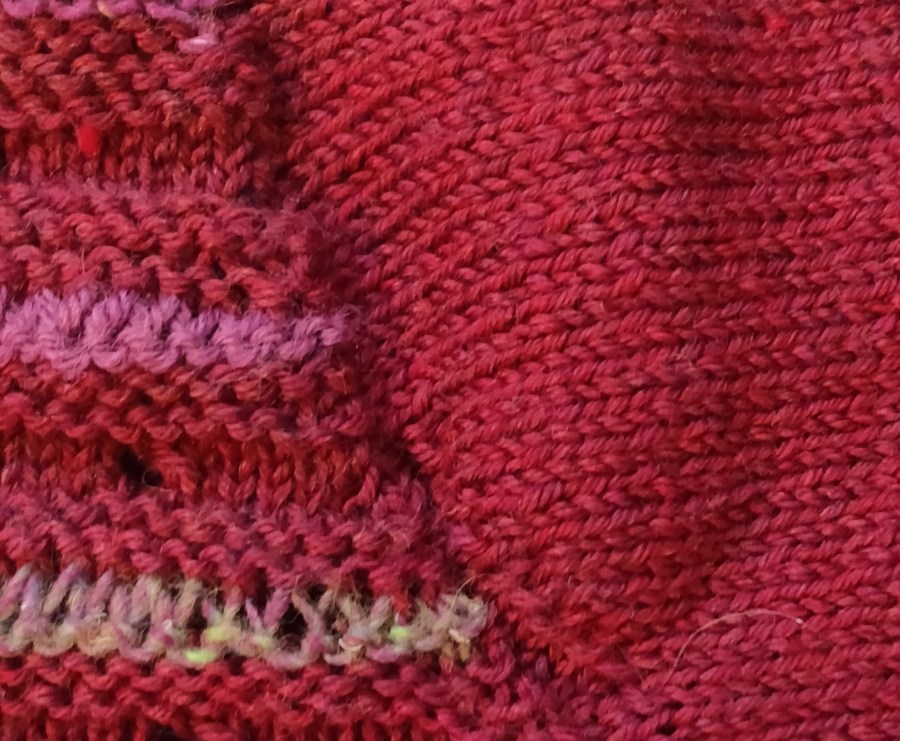
Today I finally completed a top-down jumper I started last December! I bought the main 100% wool yarn in Hereford, and the stripes are worked in two odd balls, one Noro and the other Icelandic. I’m looking forward to hearing it next winter.
Washing (or scouring) raw fleece is not a quick job, I think that’s something all can agree on. It’s also surprisingly contentious. Everyone wants to tell to their method, and you gradually learn that different fleece require different scouring methods, so everyone is probably right!
So I’m going to write about my experience today.
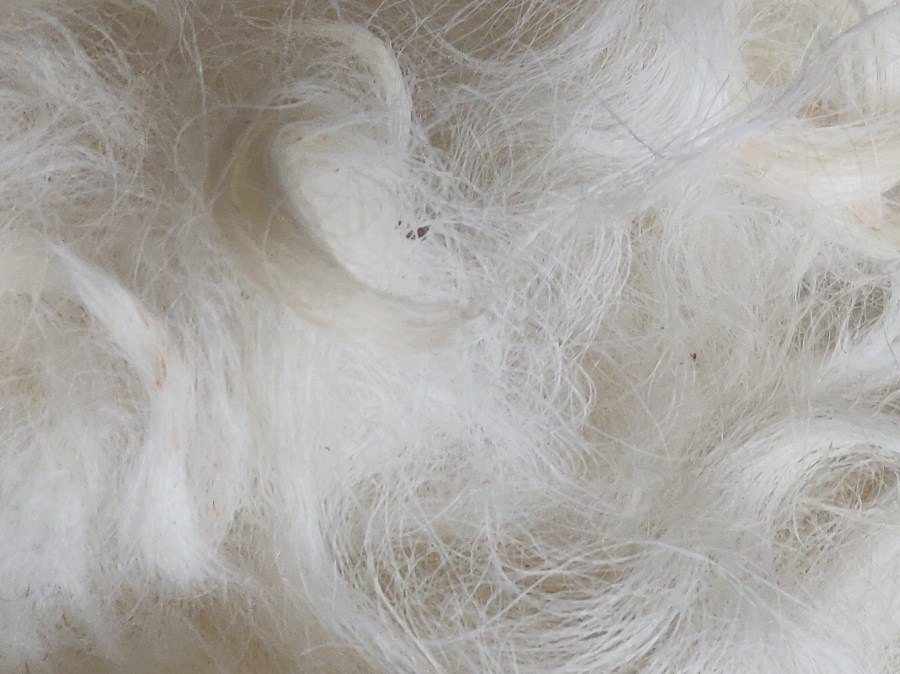
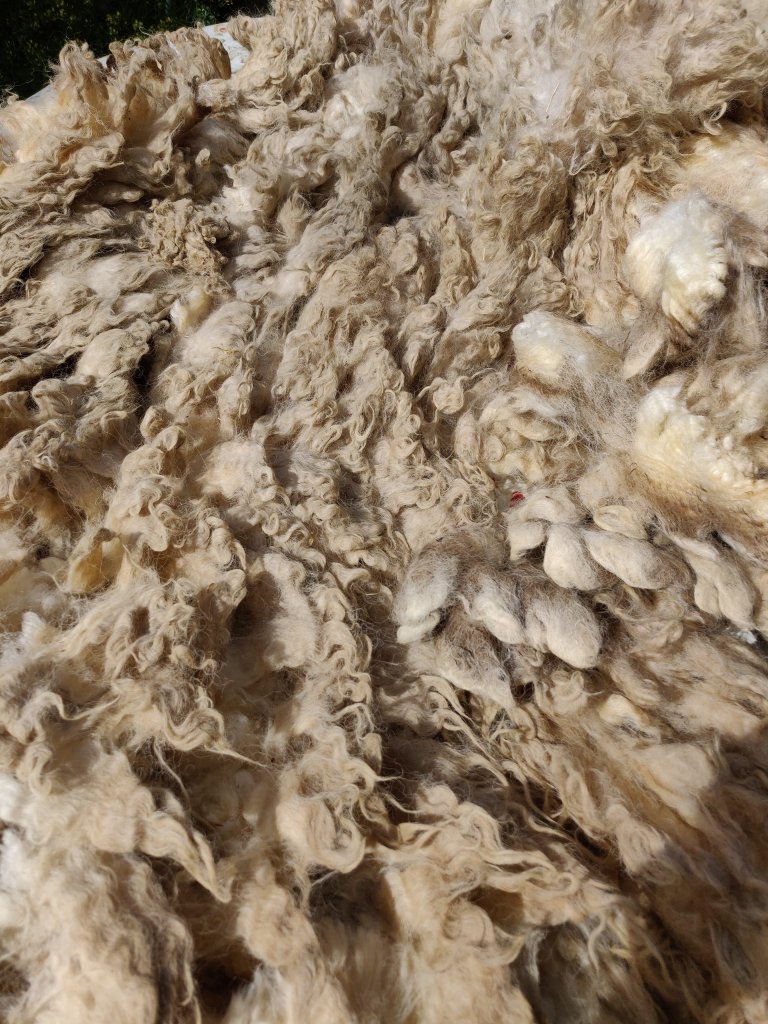
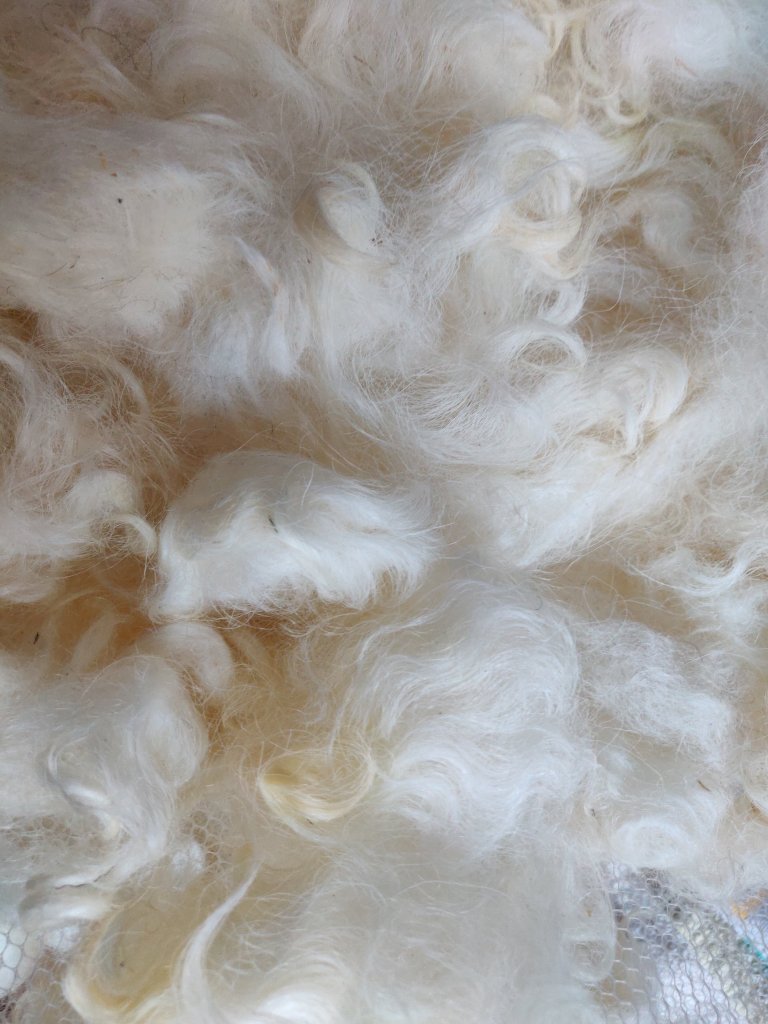
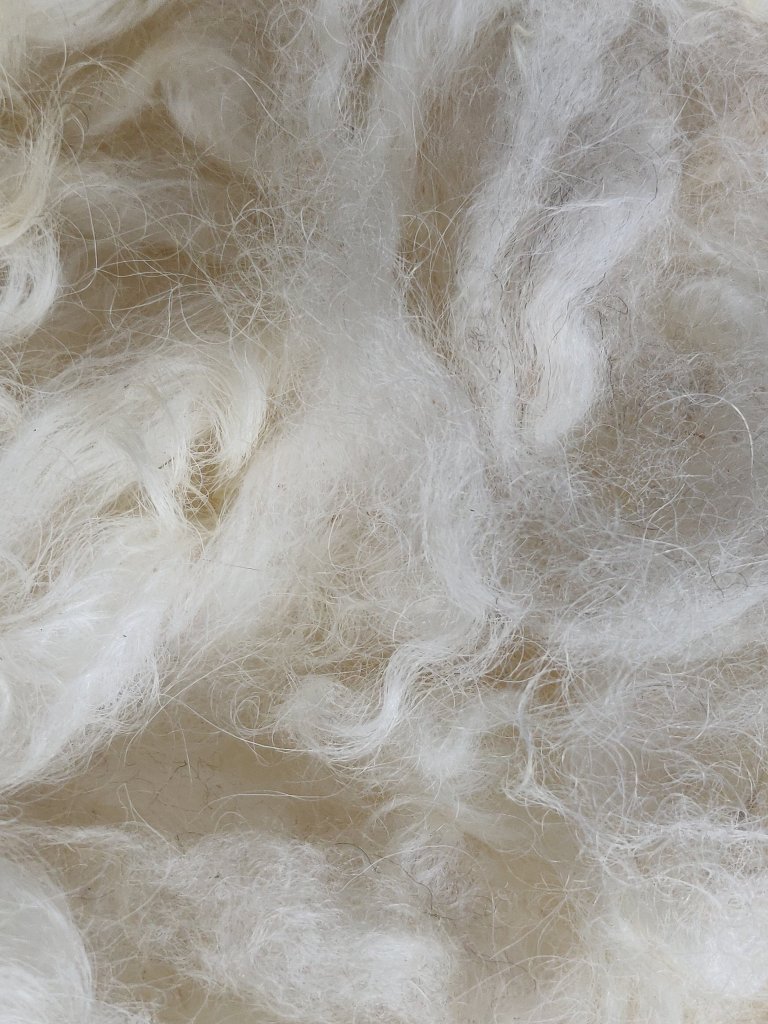
I have been given a rather nice Shetland fleece. Rather nice that is, but filthy. The fleece is very greasy and every single lock is gummed together and dirty at the tip. Underneath however, you can see the gorgeous fibre hidden under the grease-trapped dust and poo.
It doesn’t look too bad here, but thankfully this is not smelly-visionSee what I mean about those yucky tips?
I gave some of it a good hot soak yesterday with plenty of washing up liquid. The water was like oxtail soup (sorry if you like oxtail soup), but after a few rinses it seemed OK.
However, this morning’s inspection showed it to be still greasy and those dratted dirty and sticky tips were still gummed up.
Rather than transfer that gunk to my carder I reluctantly decided to re-wash the fleece. So more really hot water baths followed. The first was so hot I couldn’t put my hand in it, with loads of washing up liquid and a dose of washing soda to break the grease. I always wash the fleece separated into small mesh lingerie washing bags. With this second wash, I opened each bag, one at a time under the water and teased the locks apart, concentrating on those dirty tips to loosen the greasy dirt.
Yes it was time consuming, bit surprisingly gratifying as the dirty came out quite easily with this method. I think because the fleece has just been sheared the dirt hasn’t had to much time to harden-off.
Following on from yesterday’s post. The dough rose well, and I knocked out back and shaped it at about 11pm. For the first time with this sourdough I shaped it onto buns in a round silicone cake tray. Then it went, under a wet cloth and plastic, into the fridge overnight.
This morning the buns hadn’t proved quite enough, so I put the tray on too of the heating oven for 30 minutes to encourage the rise.
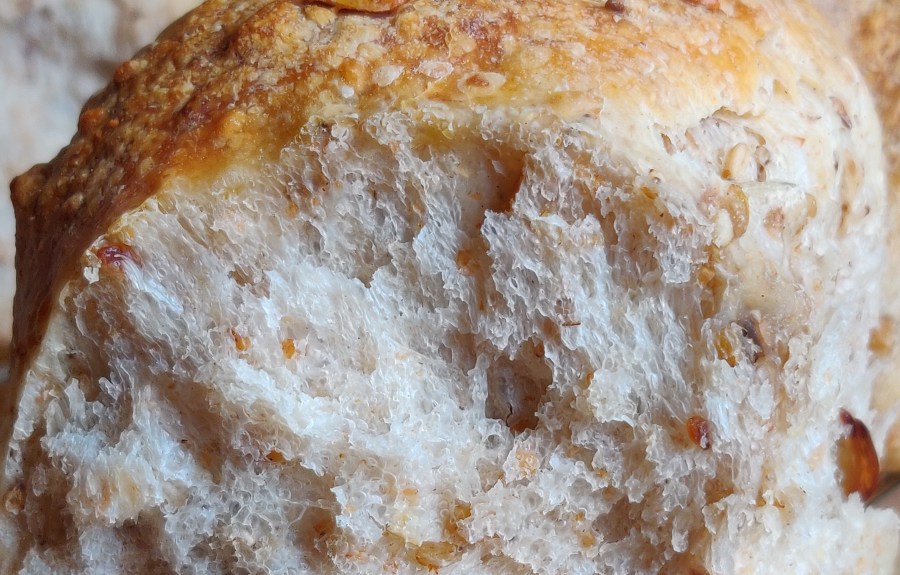
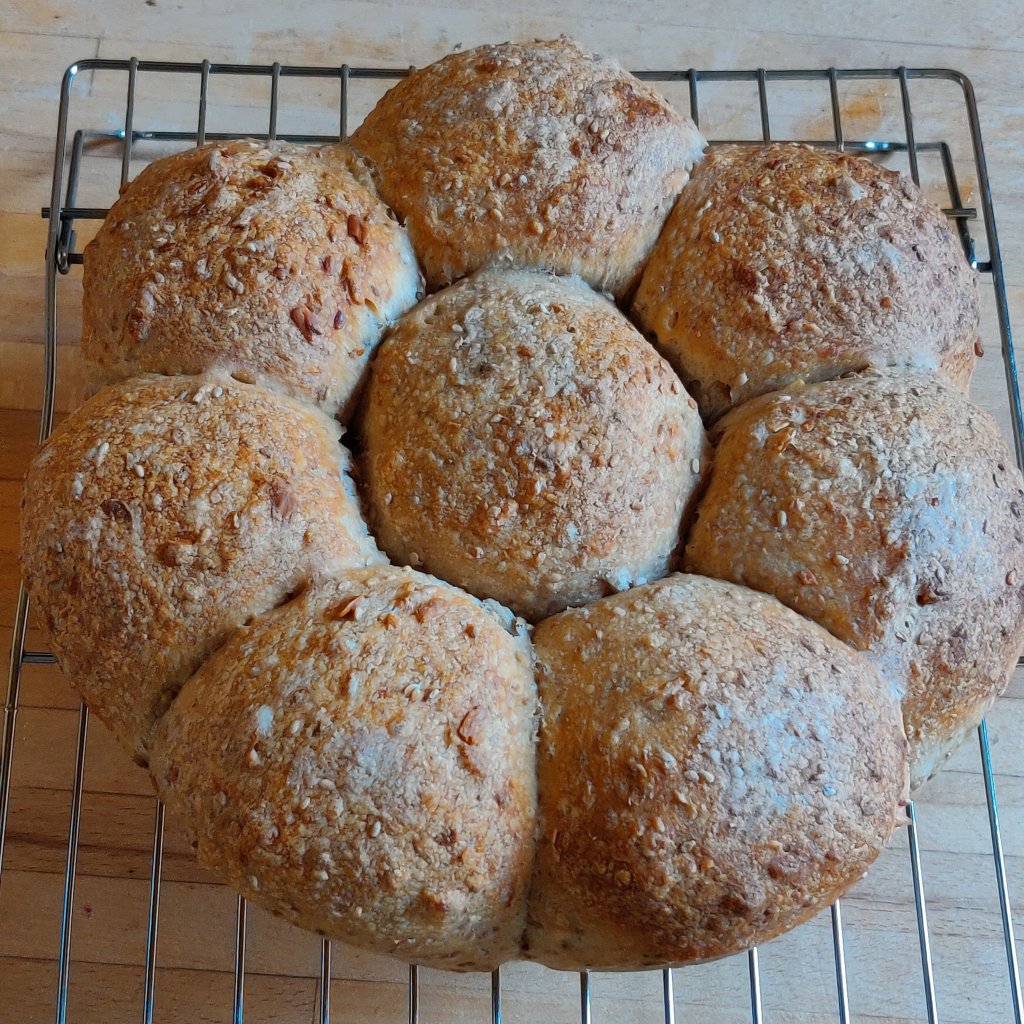
After baking the bin round looked amazing.
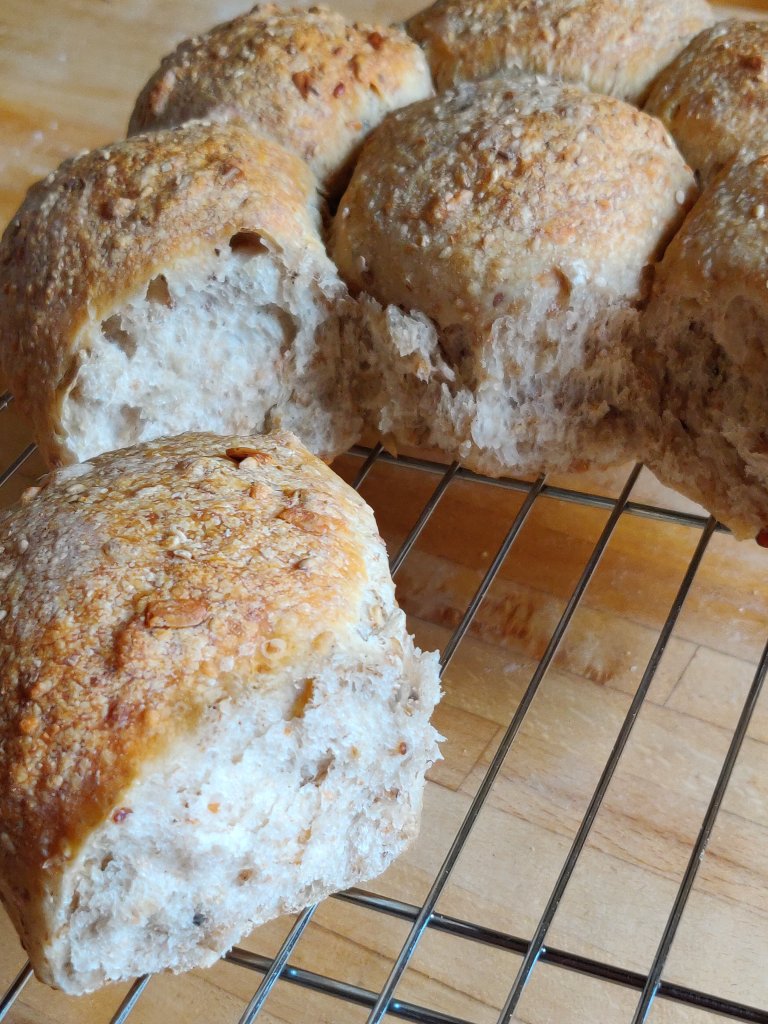
Once cooled I planned to make the tools up for a picnic, and splitting the round revealed a scrumptious centre.
The picnic rolls had pastrami and salad inside, but I opted for raspberry jam on mine!
The family say, “you can make this bread again!”, and I agree.
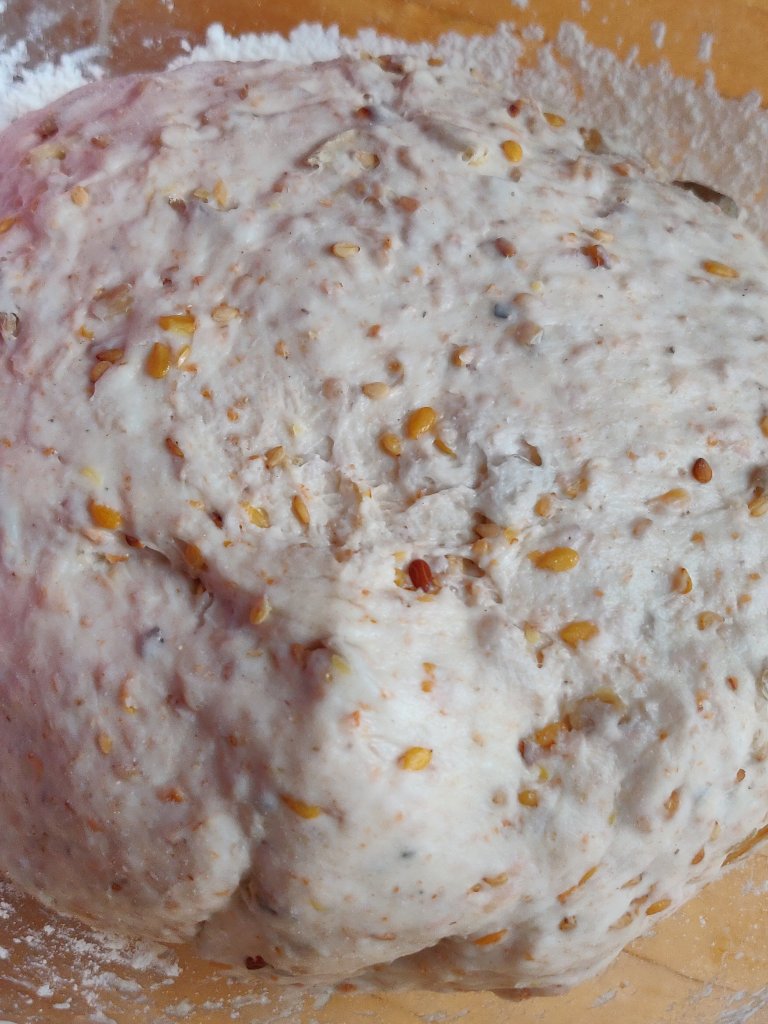
Today’s bread has seeds in it. As a family we love seeded bread, and I’ve made it with commercial yeast, but not with my sourdough starter yet.
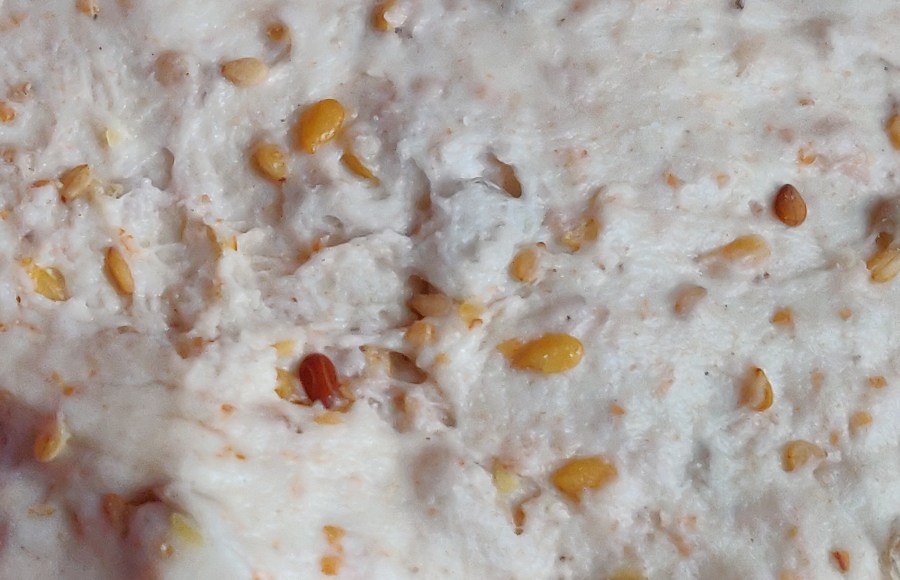
It’s kitchen cupboards yield a variety of seeds; I like to toast them for topping salads and cooked dishes. After a quick glance at a recipe on The Perfect Loaf, over confidence got the better of me. After a quick calculation I opted for 4% flax, 4% sesame and 5% sunflower seeds to add to my normal dough weight. I soaked the flax for about 30 minutes and toasted both sesame and sunflower seeds. After draining the flax I added both to the dough before kneading.
So far, so good. I’m now waiting to see how it proves.
If you are sewing face masks you have probably worked out your own method of sewing them, but I thought I’d share how I batch sew to streamline the process.
Scroll down to the bottom of the page in the link below for the video.