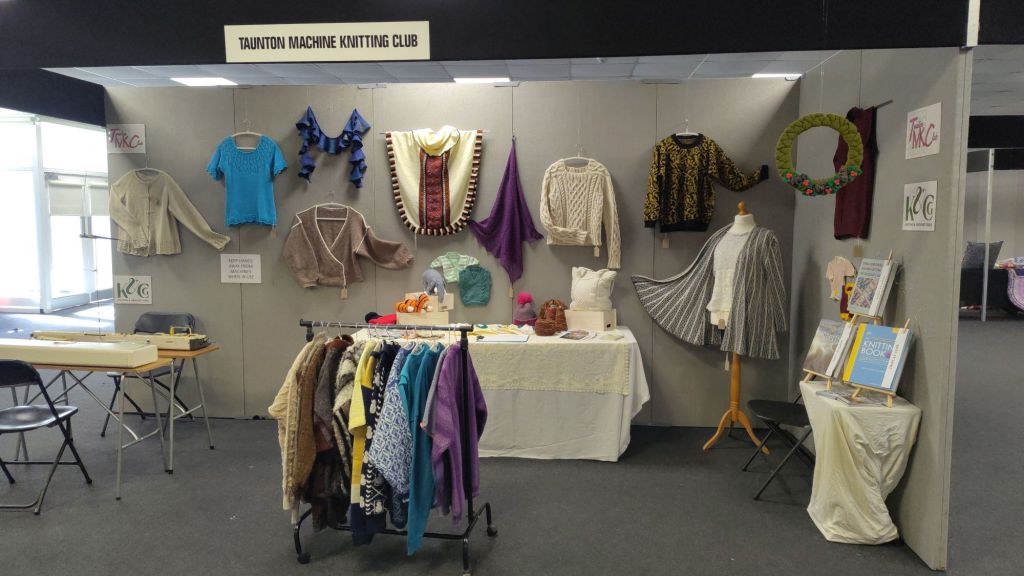
It’s been a busy day today setting up the Taunton Machine Knitting Club stand at Craft 4 Crafter’s exhibition in Exeter. The Club is pleased to have recently become a branch of The Knitting and Crochet Guild, making us part of the wider UK knitting community.
The display features work by most club members including lace, intarsia, knitweave and double jacquard. Throughout the three day exhibition members will be demonstrating different techniques such as cables, bobbles, shaping and short row knitting.
The display is finally ready, and I am not climbing a stepladder again today!
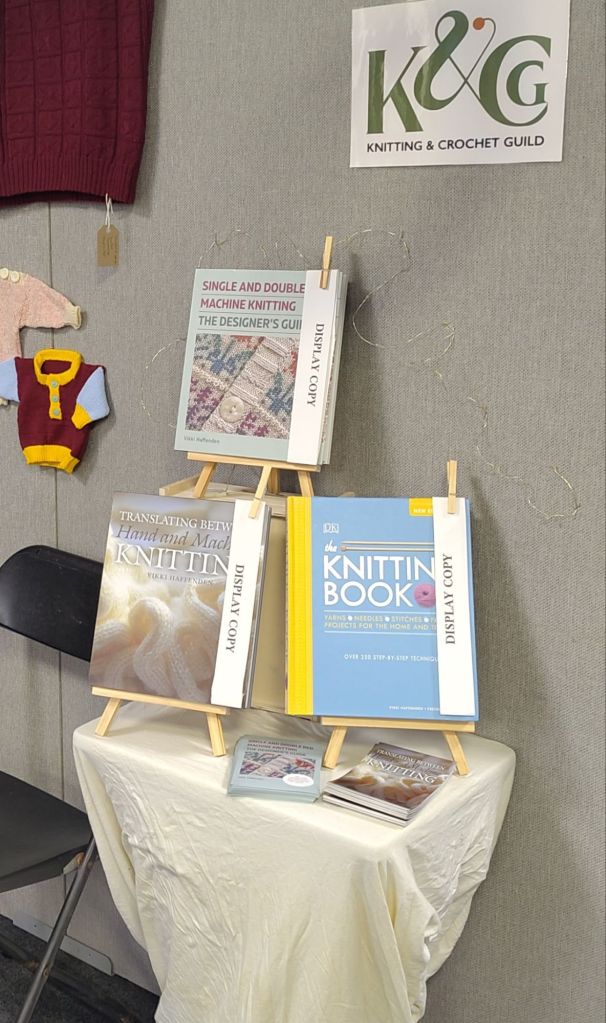
I will be giving a talk on Friday about my books, ‘The Knitting Book’, ‘Translating Between Hand and Machine Knitting’ and ‘Single and Double Bed Machine Knitting; the Designer’s Guide’.
The table will have to be large enough to fit four copies once my latest book, ‘The Machine Knitter’s Guide to Partial Knitting’ is published later this year.
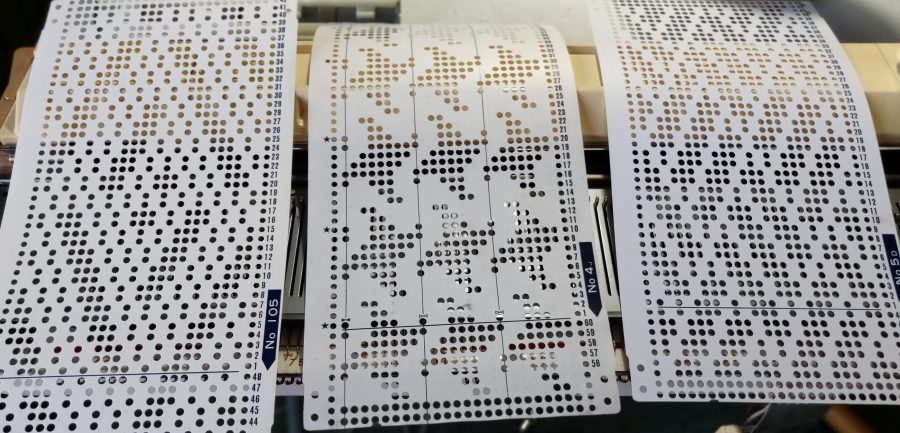
This is something I used to struggle with when first starting to machine knit, and to be honest, it still sometimes needs a bit of thinking before I get it right.
So I put some information together which I hope will be useful to others who find the holes and blanks a bit confusing. It also has some helpful ways to read what is actually being read by the card-reader, rather than what is visible above it.
Lets start with the fundamentals:
Knitmaster/Silver Reed (KM/SR) machines only knit pattern from the punchcard when the side levers are at the triangle and the pattern cam dial is set to the relevant stitch type; F, S, T etc.
Brother machines only knit pattern from the punchcard when the KC dial is set to KC, KCI or KCII, as appropriate to the machine, and when the relevant pattern cam buttons are pressed, MC, tuck, part etc…
However, on both makes the needle positions are the same
Pattern cam setting
Punched holes
Needle position
Blanks
Needle position
2-col-in-a-row
knit with 2nd colour
UWP
knit with MC
WP
tuck
knit
UWP
tuck
WP
slip/part
knit
UWP
slip
WP
On both Brother and KM/SR machines, the punchard line being selected is hidden inside the machine. Seven lines below on a Brother, and five below on a KM/SR.
Brother machines, both punchcard and electronic, pre-select needles before knitting the row. Therefore, the pattern can be interrogated by looking at the needle selection in conjunction with the needle positions listed above.
KM/SRpunchcard machines have a card reader with feelers. These are selected according to the punchcard pattern but the actual feeler action is hidden behind the carriage. The pattern line can be manually interrogated by locking the punchcard.
I think this might be the final sample for my latest book. The manuscript went into the publishers a week or so ago and I’m just working in a few outstanding samples and photos.
Of course machine knitters, well knitters in general, will know that ‘sorting out a sample’ is a shorthand for:
knitting several design swatches
knitting a tension swatch (or three)
working out the garment pattern
knitting it
finding you’ve made a mistake
knitting it again
steaming it
sewing it together
washing it
blocking it
etcetera, etcetera….
So I am just at the first steaming stage and getting ready to assemble the garment. And of course I’ve had to re-knit one piece because the dratted yarn got caught by the brushes irrevocably and it was easier to restart than try and sort that out. More haste, less speed is so very true in machine knitting. Nice and steady is always the best way.
I’m hoping this garment will be nice enough to go on the cover, but we will see.
Meanwhile let me tell you a little bit about the book. The title is still to be finalised, but it is all about short rows and partial knitting on a machine. There is a lot in there for beginners, for example the first chapter is all about the principles of short rows and how you knit them and there is a whole basic techniques appendix at the back for additional support. Chapters 2 to 5 offer loads of information, samples, examples and exercises for more experienced knitters to really come to grips for short rows, and to understand how and when to use them for different results.
Chapter 6 has patterns that use short rows as they’ve been described in the earlier chapters, but applied to an item. So from these patterns you actually get to use short rows purposefully to create shape and form combined with colour and surface pattern.
So once it’s published I will obviously be shouting about it, but keep an eye out and do pop back here for updates.
Reformin, or ‘latching-up’ single bed stitches into a rib structure is sometimes seen as far too time-consuming for a ‘fast’ activity like machine knitting. However, I quite enjoy the process and have written about it and made a ‘workshop’ video of working a 2×2 reformed rib here. I hope you find it of interest and useful.
Hello there. I am keen to know my readers, and meet people who own a copy of either of my knitting books, ‘Translating Between Hand and Machine Knitting’ or ‘Single and Double Bed Machine Knitting; the Designer’s Guide’. Obviously meeting people in person might be tricky, so I have been wracking my brains about how to do this and settled on trying to set up an image gallery of people who own a copy of one of both of these books.
It would be wonderful if you could post a photo of yourself holding your copy, and with your knitting machine as well if it works for you. If you prefer not to be in the photo yourself, a photo of your copy of the book sitting on top of your knitting machine would be lovely, and a piece of your knitting as well maybe? Please also add a brief review if you have time, its always useful to get an insight into how readers see what I have written and feedback helps me develop my approach for future books.
I can only think of Facebook or Instagram, but I’m sure you will have other favourite places to post. It would be good if you could add the hashtags shown below so that I can find your posts. I will start the ball rolling on Instagram.
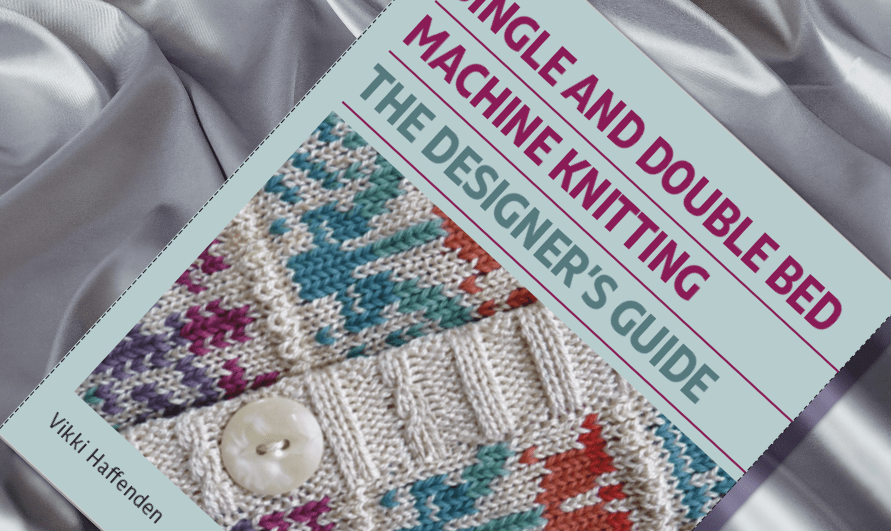
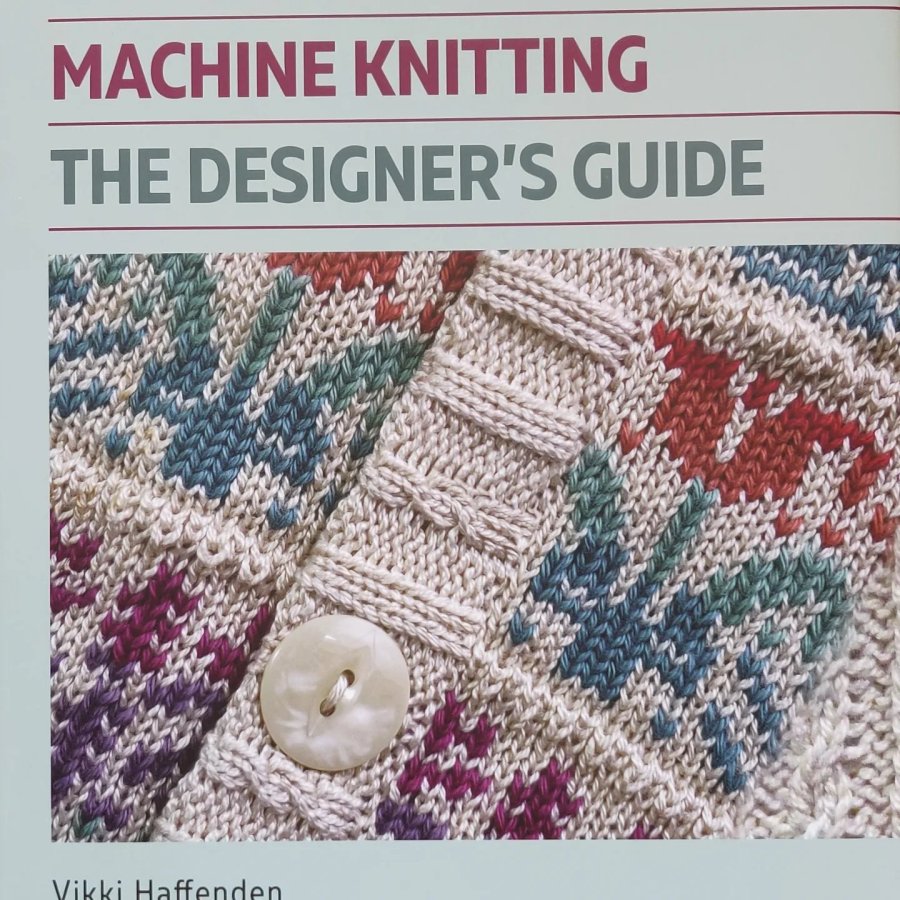
November’s edition of Machine Knitting Monthly has a great review of ‘Single and Double Bed Machine Knitting; the Designer’s Guide’. Amongst other nice things, they mention the broad scope of the book’s contents. I deliberately wrote so that it is suitable for any machine owner from Brother to Passap with lots of hints and tips to work on different types of machines. Thank you Machine Knitting Monthly!
I found this review on Facebook ‘Machine Knitting’ group, and have to share it. I was so thrilled that this reviewer ‘got’ the book so thoroughly.
Book Review: Translating Between Hand and Machine Knitting by Vikki Haffenden ☆☆☆☆☆☆☆☆☆☆ 10:10 “This book ought to be mandatory reading for every new machine knitter!” -me “This book needs to be on every machine knitter’s manuals shelf, in pride of place, no matter if you use Silver Reed or Brother!” -me “Where was this book when I was desperately trying to learn how to design lace/translate lace cards between Brother and Silver Reed?!?!” -me
This book is absolutely essential equipment as far as I am concerned! It starts out covering and comparing materials and equipment for knitting, both hand and machine versions. The pictures will blow you away and they only get better. Please, at this point, re-read the title. It does not state ‘pattern’ in the title. Next it goes into stitch construction and compares hand and machine and final product of each. This book give equal time to both! It goes into yarn fiber types, yarn construction(spinning), yarn types (boucle vrs worsted). The details are absolutely in depth and extremely easy to understand with stupendously clear focused pin-pointed and highlighted photography and exemplary diagrams that compare every aspect of stitches, fabric, mechanics, of hand and machine knitting. It breaks down differences between brands when there are differences, and does not favor either. There are some references to Toyota and Passap, but the main info concerns Silver Reed and Brother. This covers every type of cast-on and cast-off that I could remember!! It isn’t a how-to… it compares them and shows some GREAT visuals of them on and off the needles. Refer to your manual for specifics on how-to cast-on and cast-off. Basically, this book compiled most of the answers to questions I have asked in the past, questions I have hunted down answers to, and questions that I hadn’t even thought to ask. It is utterly fantastic. Only the very last chapter goes into translating PATTERNS between hand and machine…
Buy it! Buy it NOW! I can not say enough how much you need this book! How much I needed this book… now if I can just convince her to write one on Passap… No! I have no affiliation with the author… I wish I could say I know her.
Since reading it I have replied, so let’s hope we can converse about knitting I the future.
I am now part way through proofreading my latest book. It’s a lot knottier checking double bed as well as single bed instructions!
The book covers, without stating the obvious, single and double bed machine knitting techniques and design. Brother, Silver reed/Knitmaster are the main machines, but Passap machines are also included in some sections.
Step by step instructions are illustrated as well as explained in the text and at the end of each chapter there is a Design Studio exploring how to develop the techniques discussed in the first part of the chapter.
It’s got to be done before Christmas, so early mornings and late nights are the order of the day. I’m baking mince pies when taking a rest from the screen.
If you enjoyed Translating Between Hand and Machine Knitting, or are looking for the definitive book on machine knitting I think to will want this book. You will be able to pre-order soon so keep an eye out.
‘Single and Double Bed Machine Knitting’; The Designer’s Guide‘ will be published in Spring 2023. Yippee.







 Vikki Haffenden