What do you sit on when at your spinning wheel?

This is a question I often ask other spinners, as I can get quite uncomfortable if I don’t set myself up on the right chair for the wheel I am using. I must admit to being a bit of a voyeur at my local spinning group, because I like to watch how others set themselves up and see how they work their wheel, its fascinating to watch different techniques. I never stop learning!

I have several wheels that all have different height flyers and orifice, so have found that I need to change position depending on which I am using. The lowest is my vintage double drive lace wheel (single, tiny treadle, named Penny) which comes in at just above knee height, followed by a Louet Victoria (Vicky, single drive, double treadle) and then my single treadle, double drive Ashford Traditional (Hamish). I’m considering adding a double treadle kit to him, but he has been stained mahoghany by the former owner and I don’t think I could bring myself to do that to the new treadles.

The highest orifice is on my double treadle Ashford Traveller (Dora), which is the one I use most. The Traveller is easy to manoeuvre around the living room, has a small footprint, and I’ve added a jumbo flyer as well as a wide ratio standard, so its pretty versatile. I just wish it was a double drive as I prefer this set up, but you can’t have everything. One day I might come across a double drive Traveller and have the spare cash to make the upgrade.

I digress – apologies, but I do that a lot.

Back to chairs. After attempts at trying other set ups, I’ve found a dining room chair best for the Traveller – with a firm cushion at my back and one on my lap. The back cushion supports my lower back, encouraging me to stay upright, and also pushes my bum forward so that I don’t get compression from then front edge of the chair seat pushing into the back of my knees. The lap cushion helps to prevent neck and shoulder strain. An added perk is that I seem to spin a more consistent yarn when using the lap cushion.

Before I discovered that this type of chair worked for me I was sitting in a soft armchair, albeit an high and upright one. Trouble with this was I had to have lots of cushions to sit forward, and then, although my lower back was OK, my bum tended to slide forwards because the soft seat didn’t support the backs of my thighs enough to keep upright. Plus the seat is quite narrow and I got neck strain from avoiding the arms when I worked long-draw or was plying.

So I am now reasonably comfy on the dining room chair with the Traveller, but I think I’d be better with a slightly lower seat. Its just the palaver of carrying chair and wheel to a good position where: it doesn’t rock on the edge of the rug, there is a table near me to put mycup of tea on, the dog won’t walk through my fibre, and I can see the TV – not too much to ask I feel.

Working on the low lace wheel I use a nursing chair that is only 12″ (about 26cm) from the floor. This chair has a big seat and no arms, whilst the back is quite high so its a good shape for spinning. The back is a good height, but I’d like it a bit narrower to allow full movement in my shoulders.

The Traditional is in another room and I use a swivel office chair with adjustable everything. This is good, but is sadly an ugly (and patchily faded) royal blue and too heavy to carry from room to room. So its not an option for the living room where I like to spin in the evenings watching TV with my partner.

My Louet Victoria (Vicky) is a folding, portable, lightweight wheel for use outdoors or at workshops, so sometimes when using her there is no choice about where I can sit. If I can take a chair with me, I have a very lightweight aluminium folding directors chair that doesn’t have that awfully uncomfortable bar across the front under my knees. I like to take a cushion for the seat to make it super comfy and this helps me sit upright. It also keeps my bum warm if the day is cold. However this type of chair has arms – but they are pretty low and wide apart and I seem OK on this.

I’ve tried a backless stool and ended up with terrible back ache, so thats not an option for me. I am toying with the idea of a traditional ‘spinning chair’ with a low seat and narrow back, but the seats all seem really small, and I am worried my bum will overflow the sides!

So that is a summary of where my spinning chair experiments have led me.

Sometimes, depending on my overall muscular-skeletal day-to-day twinges I find working the treadle wearing a soft shoe rather than barefoot alleviates foot and knee pains. But I love spinning barefoot outdoors in warm weather.

Colour-changing yarn spun from a distaff

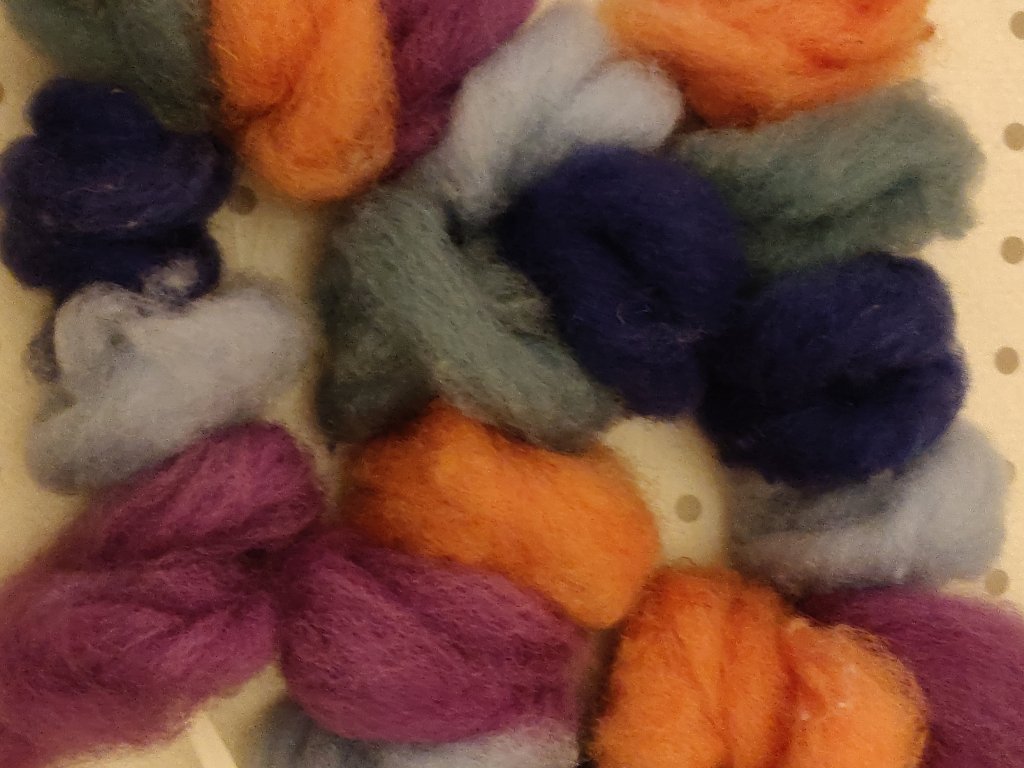
I’ve had a number of different colour hand dyed carded batts sitting waiting for me to find inspiration. They are all from fleece I have scored and carder myself, so are a mix of Shetland, Suffolk and Texel, with maybe a little Alpaca blended into some of them. Some are in 200g amounts, some less. I’d got a bit stuck about how to use them until I saw a useful tip by Anna from my spinning group that she has put on YouTube.

Before you start, select a group of colours that work together. After a designing session during which I wrapped different colours together, I chose five: orange, pale green, mid blue, pale blue and lilac.

Anna used a combination of hand dyed and commercial roving, but the principle is the same with your own carded batts.

1. First of all split the roving/batt into the required lengths, (I just used the whole length of the batt of my drum carder).

2. Then split each length lengthwise into 4, (or more, depending on the thickness of the roving/batt).

3. Next, lay out the colours lengthwise, next to each other in the order you want to spin them into yarn. Test this beforehand to see how they mix throughout one repeat of a yarn, and if this works for your chosen outcome, such as knitting.

4. Repeat the colour sequence three more times so you have a table full of ‘stripes’ of fibre. If you have more than four lengths let colour, carry on until all are used up.

5. Now this is the clever part. I have hand spun colour changing yarns before and got the sequence wrong because I put it all away in a box between spinning sessions. To keep the sequence do the following.

6. Take a metre + long length off ribbon and tie a pencil or empty pen across one end. This is your fibre-stopper. Tie a hand-sized loop on the other end. This is your distaff.

7. Starting at one end of the ‘stripes’, wind each length off fibre into a loose roll and slip the looped end of the ribbon through the centre hole. Carry on doing this, working methodically through the fibre lengths, keeping the colour order as mapped out in your ‘stripes’.

8. You will end up with a ‘necklace’ of colour ordered fibre rolls on the ribbon. Tie the ends together to stop the fibre sliding off.

The dyed fibre arranged on the ribbon distaff before spinning

Now to can put them in a box and they won’t get muddled. To start spinning, simply lift the necklace out, untie the ends, and slip the loop over your hand. It acts as a distaff and will hold your fibre nicely as you spin each colour.

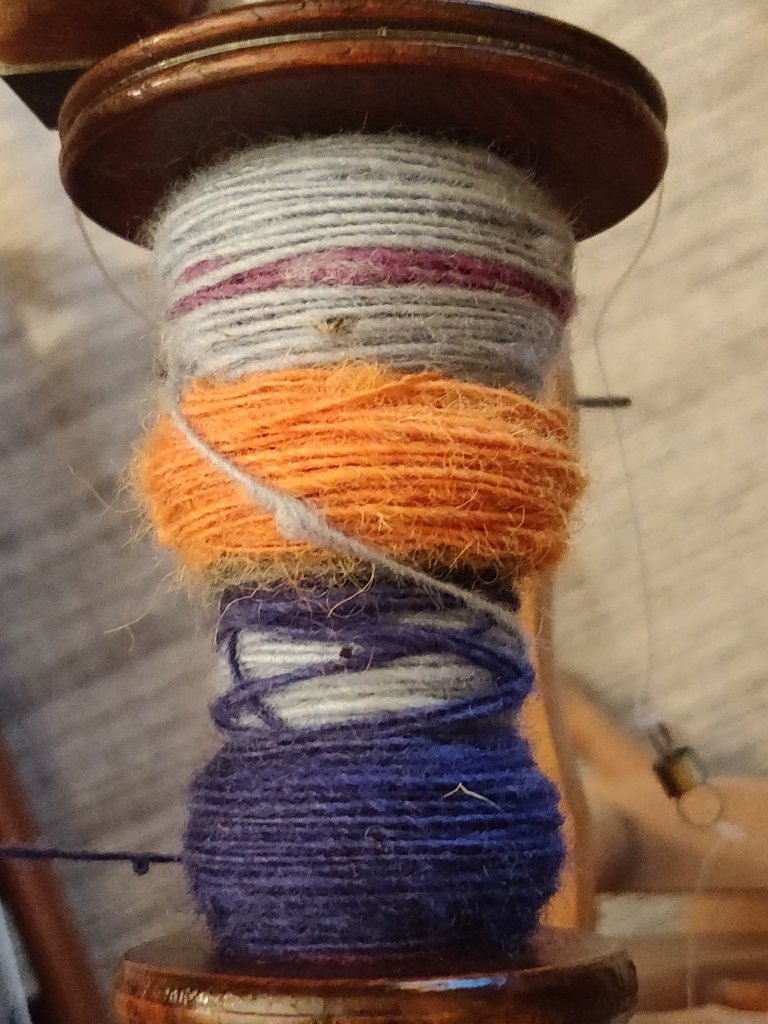
Spinning the lengths into singles

What a great tip!

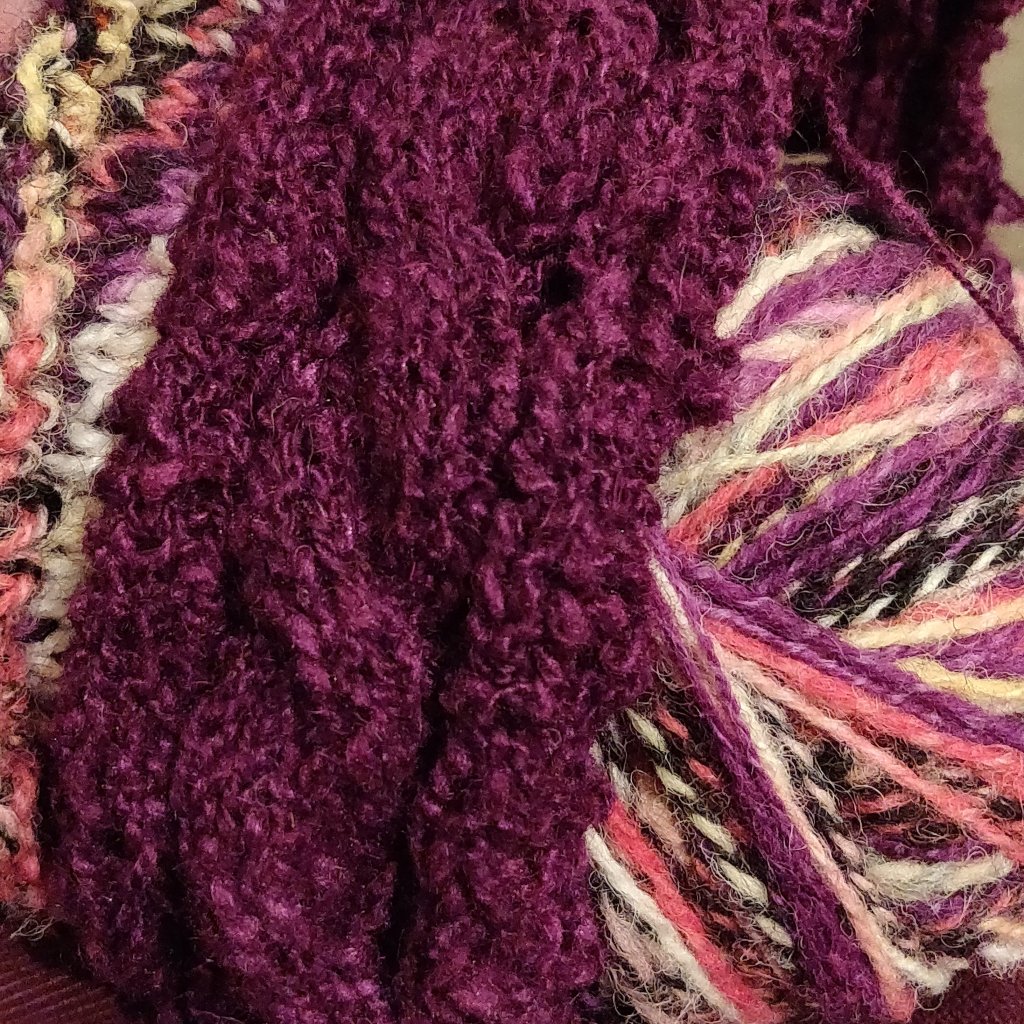
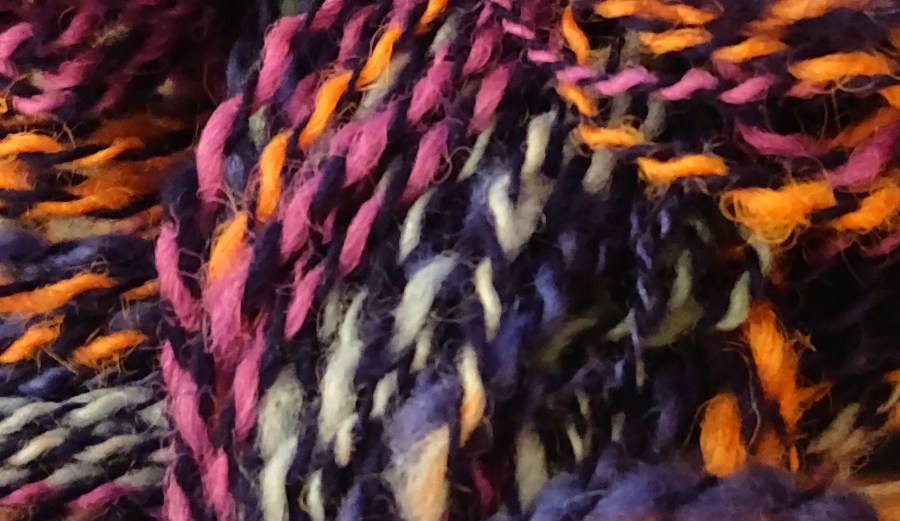
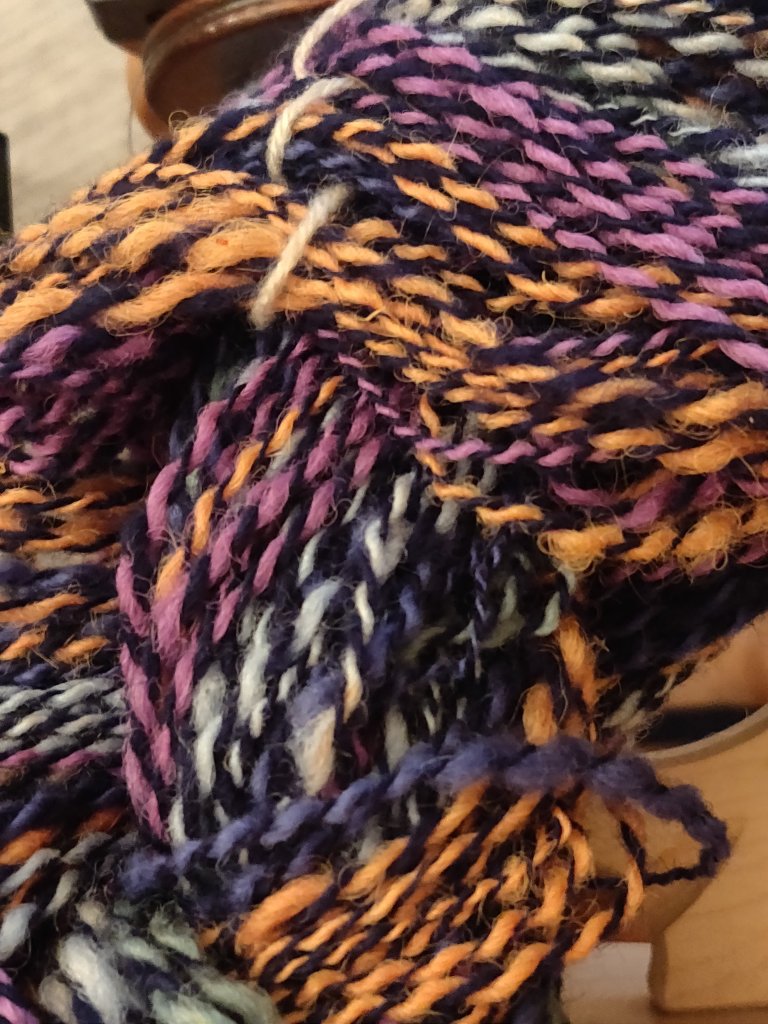
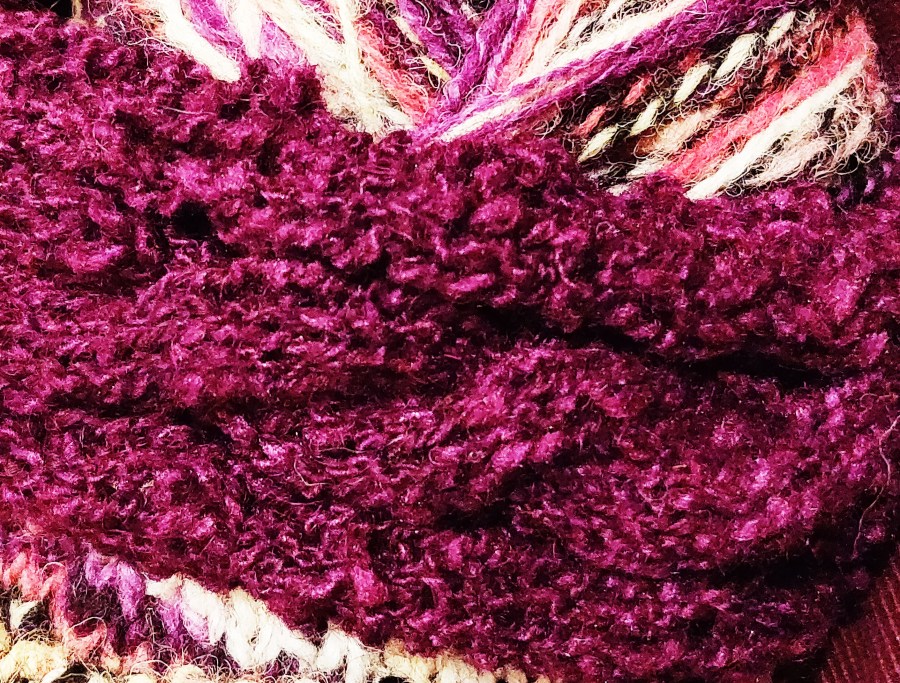
I plied the colour changing yarn with a single spun made from navy blue Corriedale. This made a lovely marl yarn that to me resembles stained glass windows. I can’t wait to see what it looks like knitted.

The plied yarn

Here is the link to Anna’s video

Photoshoot in the rain

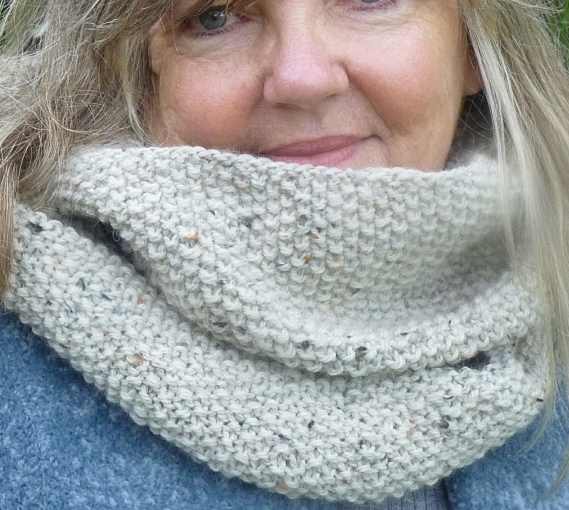
Today was the deadline for an Infinity Scarf pattern that I had been commissoned to write at short notice, you know the sort of thing that happens!

Anyway, as I’d only finished knitting it last night we had to do the photoshoot today, even though it was raining and grey. So we set off with a collection of coloured umberellas, plastic bags for camera stuff and my nifty, home made, shower-cap camera raincover! Luckily I had been clearing out the bathroom cupboard yesterday and unearthed a bundle of those freebie ones from hotels. I knew they would be useful some day. The other thing they are great for is proving bread, but I digress…

Finding a model at short notice was not easy, but my lovely friend Jo came up trumps, and offered to stand in the rain before shooting off to see her Mum.

It was fun anyway, because I love photoshoots; seeing your knit design come to life on a person is so rewarding.

As always there were loads and loads of shots to sift through, but it was well worth braving the rain for such a nice photo.

I will be releasing the pattern on this website once it has been published later on in the Autumn so do drop back if you would like to knit the scarf. There will be a page for the Infinity Scarf with the pattern, hints and tips on working the pattern, and tutorials for the various knitting techniques used. Techniques used in the pattern, including a great stretchy cast on, are also featured in my popular knitting ‘bible’, The Knitting Book.

…and here is the final image I selected, and I’m pretty pleased with the result!

Thanks once again to Jo for her stoicism and humour.

Rose petal dye anyone?

Update:

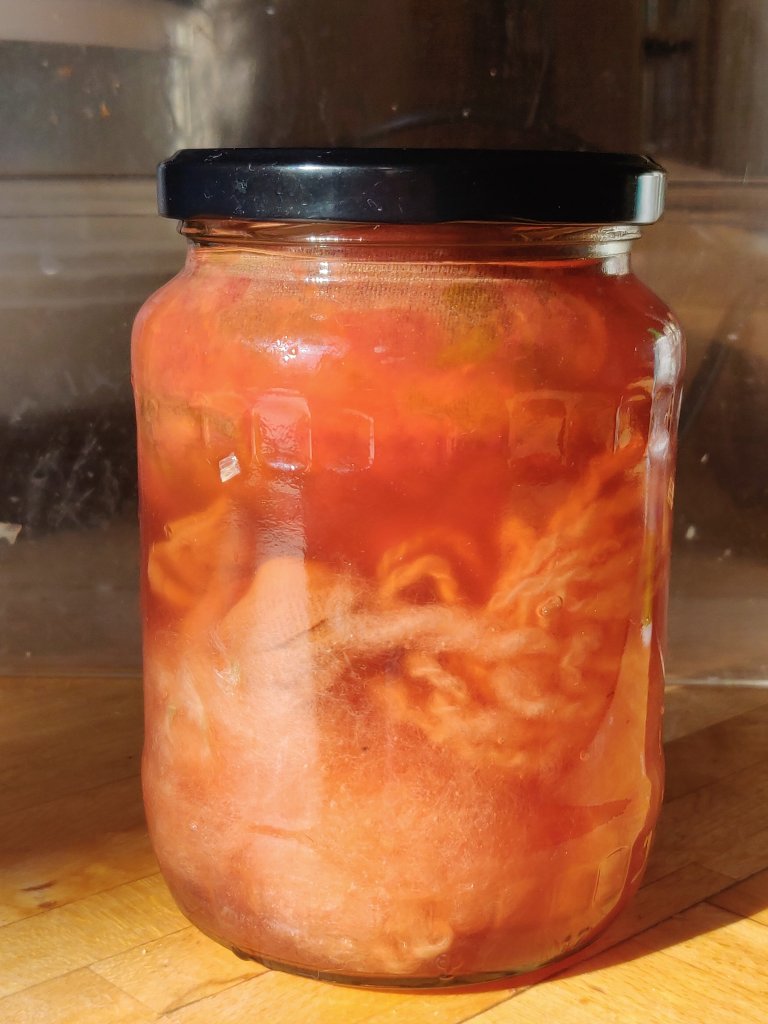
The weather has turned so I have taken both sample skeins out of the dye. The results are shown below.

Over ripe strawberries on hand spun Dorset fibre on the left and dark red rose petals on handspun Shetland fibre the right.

Original post

My lovely husband gave me roses a week ago, but sadly they have drooped and begun to drop petals. I’ve decided to use the petals for dyeing; they were a lovely dark red and I hope I’ll get at least a pale pinky-brown from them.

The main thing I have learned is not to overheat petals – or any red natural dyes for that matter – as that seems to make them brown.

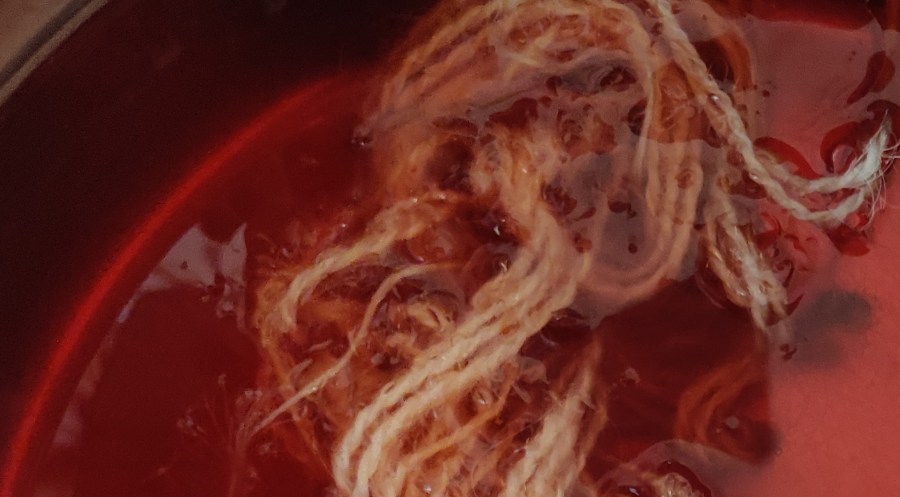
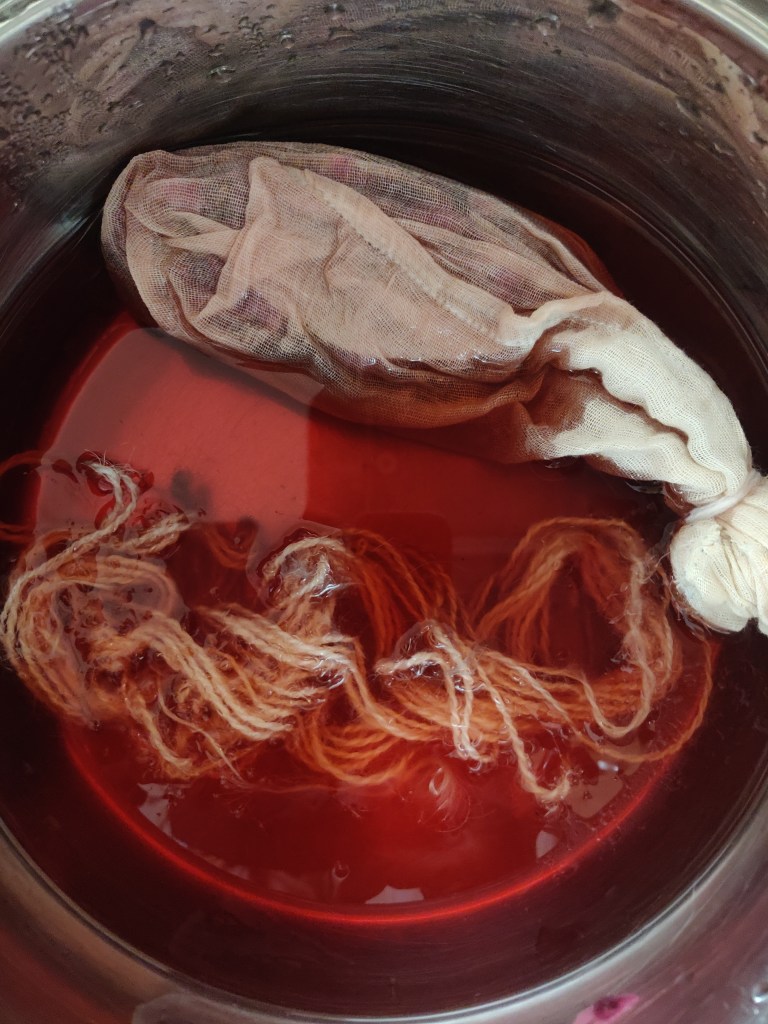
I tore up the petals and covered them in cold water, then added a little salt and white vinegar to the pot before gently heating it to below a simmer. I left the petals overnight to steep and strained the liquid off this morning. After that I put the drained petals into a muslin bag, returned this to the pan and added a skein of wet mordanted yarn to the cold liquid before reheating to a mid range temperature.

Hand spun Shetland yarn in the pan – hand spun never seems to take the dye as well as commercially spun yarn, but its more fun to try with my own yarn.

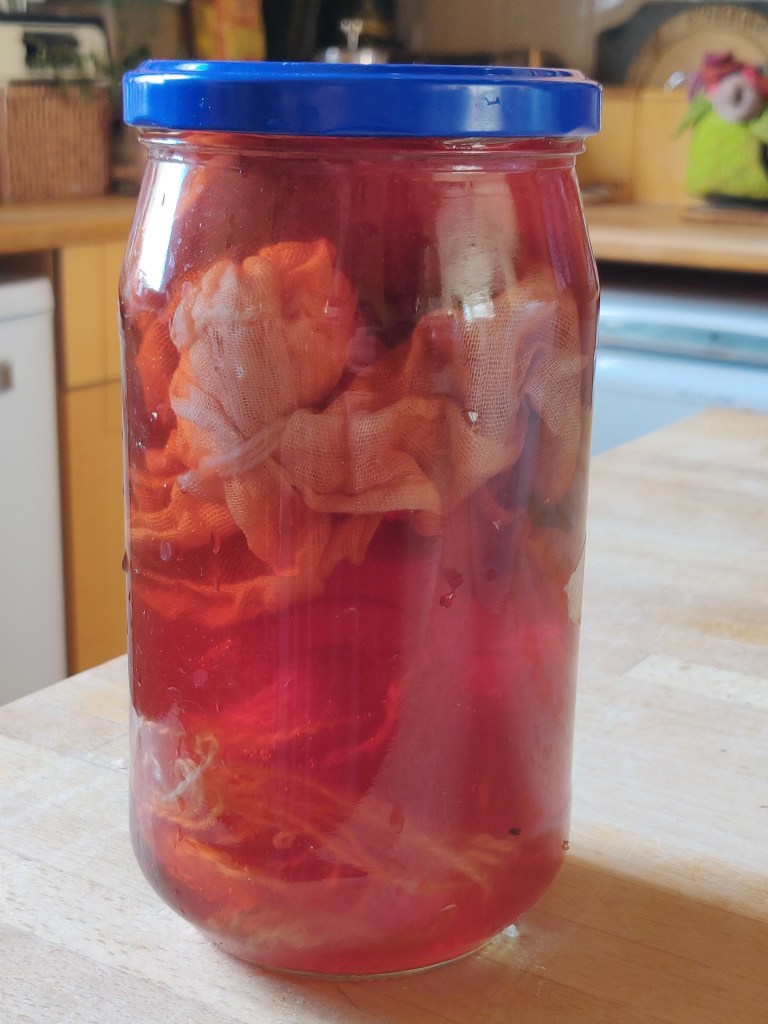
After heating the dye I poured the contents of the pan into a large lidded jar and have left it to steep for as long as it needs…

The dye looks jewel-like in the glass jar, but I bet I get a brown yarn!

I’ve also put some over-ripe strawberries into a solar-dyeing jar next to the rose petals.

The dye smells wonderful!

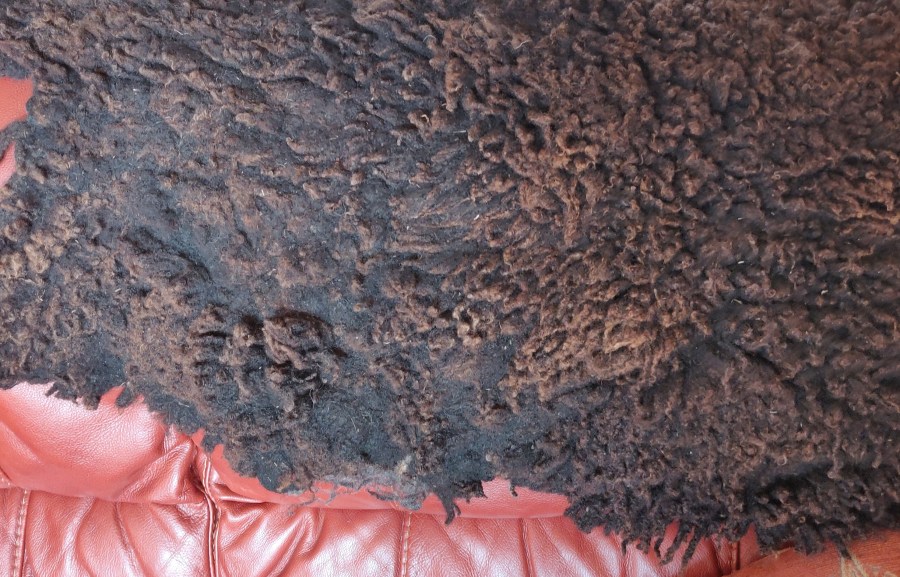
No sheep died for this rug.. (plus an update of new photos)

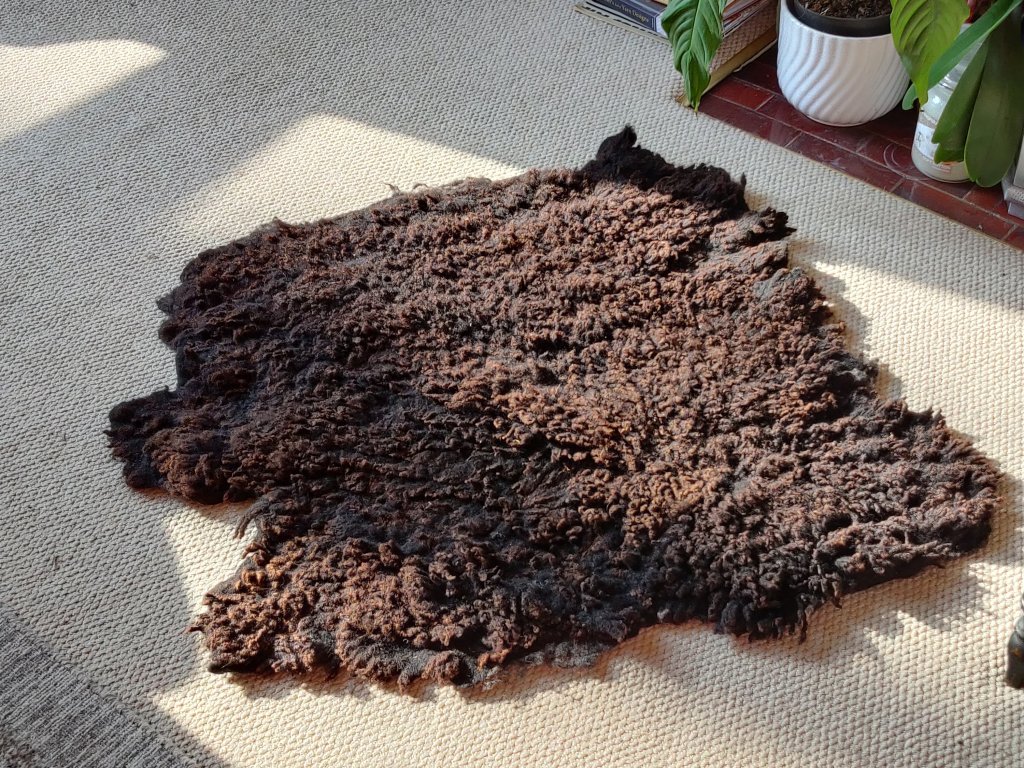
I made my first non-destructive, felted ‘sheepskin’ rug yesterday. Why I chose the hottest day of the year is beyond me. Well – it was meant to be a ‘sorting wool in the shade’ time, but a cotted mid-section of a pretty black Shetland fleece inspired me to take control and made something useful from it.

Floor rug or sofa rug, I can’t decide.

After cleaning as much VM as I could stomach from it – yes I know, I will live with the little bits forever now – I started to make the rug. I didn’t take any photos until it was done because it was a truly filthy job and I didn’t want to touch anything and needed a shower afterwards.

Update 13th August 2020

I made another one from a bi-coloured Shetland fleece and took a couple of photos,shown below

I laid the portion of fleece face down on the garden table and sewed together any holes – using wool yarn. I shaped it using this as well, so drew bits together and firmed up the edges.

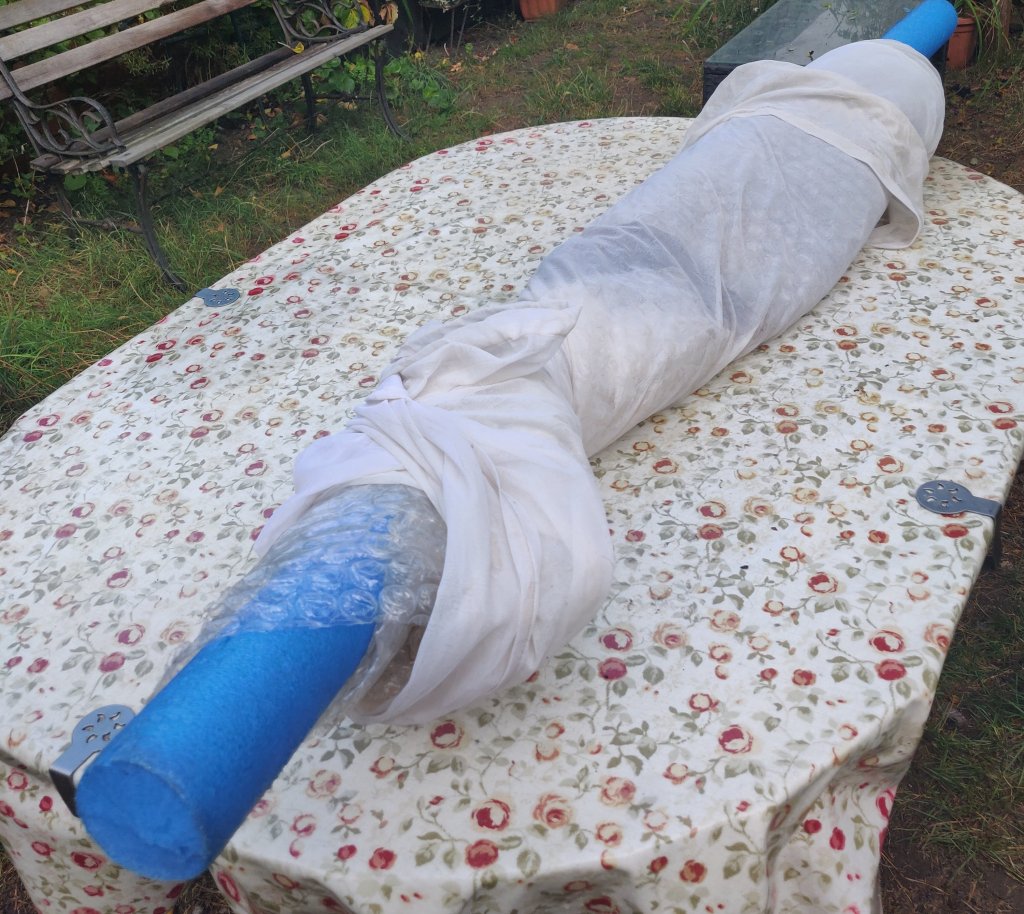
After lifting the fleece I put an old net curtain on the table and then a layer of of bubble wrap, ( I have to fight to keep a stock of this as my husband throws it out when parcels arrive). On top of this I laid the firmed up fleece face down.

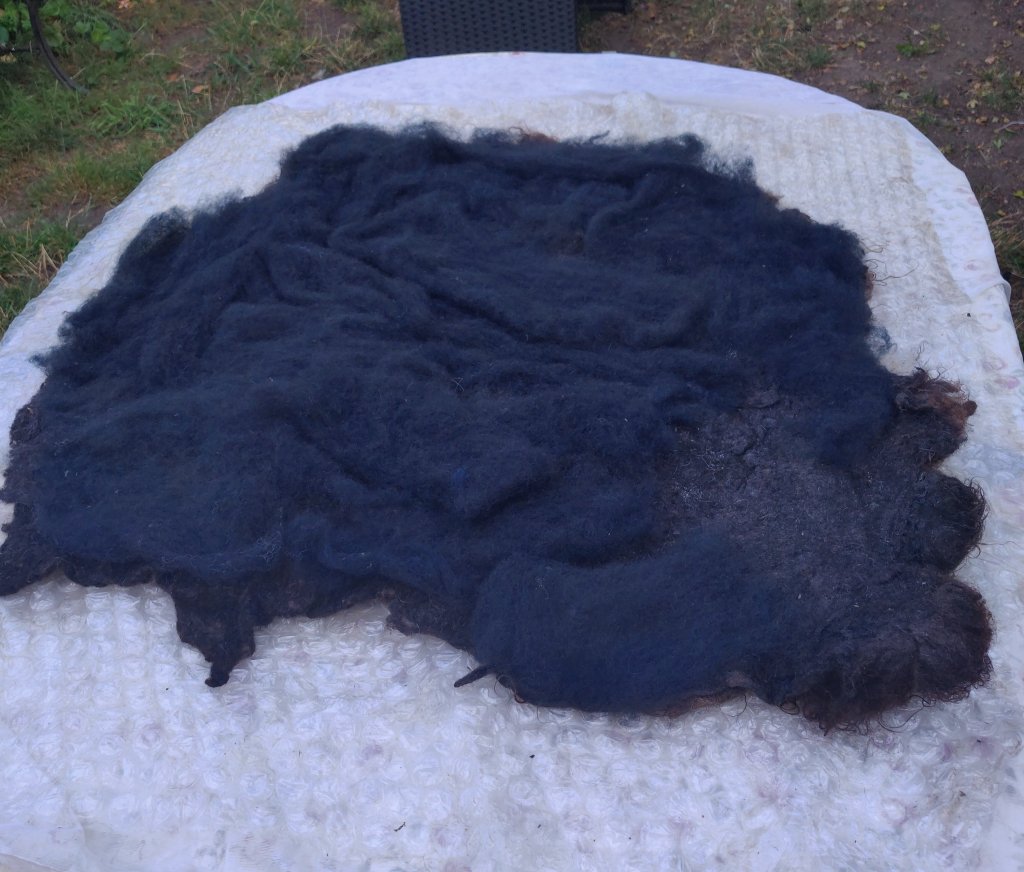
Next I laid layers from my own carded batts of black Shetland across the back. This wasn’t from the same fleece, but from last years equivalent. I did a quick and dirty carding session to get the batts, once through and no picking of bits etc. I criss crossed these to make a firmer backing. Over these I laid a thin layer from a batt of Blue Faced Leicester I had in my store cupboard.

Laying on the backing fibre

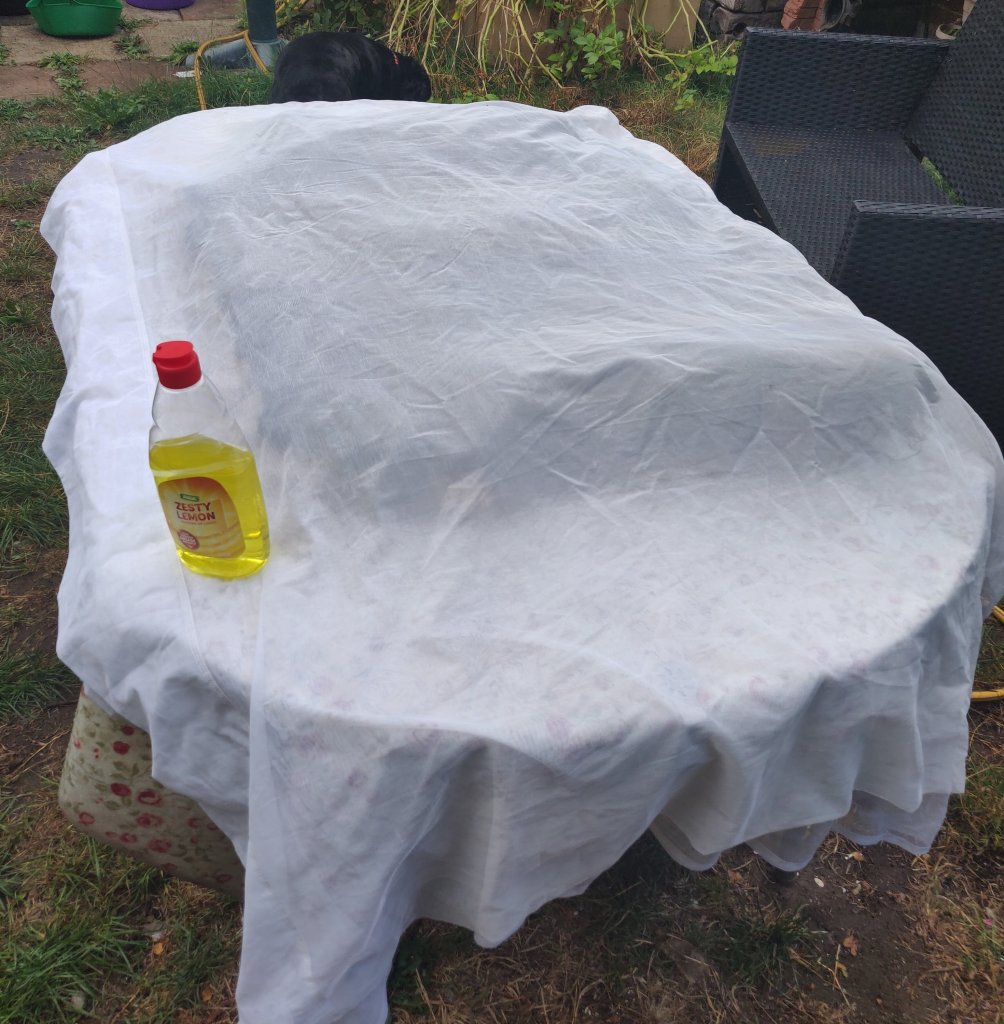
Over this I laid another old net curtain, and dribbled boiling water over it all, and some washing up liquid. Then I tightly rolled it around a pool noodle and rolled it back and forth lots of times – for a minute at least. This was the filthy part, as the dirt came out in spurts. Yuck.

Ready to roll
I find rolling the package really difficult as I’ve not got a large enough hard surface in the garden, so the table had to do. It would be a lot easier on decking or concrete.

I opened it all up, checked the felting and added more hot water and rubbed and kneaded any suspect places with a bar of soap to get them felting. The re-rolled for another minute, and repeated it all again.

Of course it still needed washing, which was another filthy job, but finally it was all done!

Drying it took a day in the sunshine. Now its on the sofa, yipee.

Spinning outdoors

Is it risque? It’s certainly liberating. Given the restrictions on meeting up indoors, going to the park seemed the the perfect way to meet up when we can’t go to our normal groups.

This is the second one I’ve organised and it was lovely way to spend a Friday afternoon. I took my portable Louet wheel and others brought wheels, drop spindles, knitting and crochet. And a picnic lunch!

Shade was mandatory as it was so hot, and we found a generous tree that have us a shady space big enough for plenty of social distancing.

I’m taking the photo…
So someone kindly took one of me

I took along a sack of stove-top rainbow dyed fleece as described on my Dyeing Wool page. It’s a little coarse, but in nicely formed locks, so I am flick carding it and spinning it quite thick for use in a rug, (maybe)?

Exhausted after another long fleece-washing session and mulling over the costs and benefits of Power Scour and Fibre Scour

We had a few rainy days recently so I put a lot of fleece to soak outside – hoping the rain water would help the process along. The catch of course was that I then didn’t want the waste the opportunity that the glorious weather we had today offered for washing the fleece in the garden and getting a head start on the drying.

When will I learn? Four hours later I do have a load of lovely white fleece hanging up to dry on meshes, but I am exhausted.

Because I had soaked the fleece in cold water for a few days, I had to wash it by slowly heating it in batches in a pot on a stove. I wish I had an old Burco boiler – my Mum used to use one for washing the bed linen. I will keep an eye out for one. Using pots meant that I had to do four batches. I have two big maslin pans I use for this and for dyeing, so after heating the first one, the second could be warming whilst the first was cooling sufficiently for me to handle it.

It was a pretty filthy fleece and the overnight cold water soak had really helped loosen the dirt, but I still had to give each batch two washes before rinsing twice.

I’ve invested in both Fibre Scour and Power Scour for washing fleece, as well as working with washing up liquid. I’ve not tried Kookaburra or any other as I haven’t found them for sale in the UK. The results of both of the ‘professional’ scourers I have tested are very good, there is no doubt about it. But, and its a big BUT, is it financially worth it?

This was the first lot I have washed using Power Scour, but because I did all the fleece with this, I don’t have any of the same fleece washed in any other way to compare. However, the Power Scour has done a good job. It doesn’t foam up so is easier to use than washing up liquid. Price-wise per wash some people claim its no more expensive than using washing up liquid, but in the UK the 473ml (16 oz) bottle of Power Scour cost me £21! OK, they claim you only need a tablespoon to wash a pound of fleece, using around 2 gallons of water (that is 15ml to wash approximately 450g of fleece in 9 litres of water), but I think this will still work out more expensive than using washing up liquid.

UPDATE 11th August 2020
The Unicorn website recommend using 1 tablespoon of Power Scour to 2 gallons of water (15ml to 9 litres of water) when washing in a washing machine. As those of us in the UK don’t generally have top-loader washing machines this is not usually an option for us, but it is useful to know the water to detergent ratio as opposed to the fibre weight to detergent ratio.

https://www.unicornclean.com/fibre

2 gallons being equivalent to 9 litres is neat as that is the capacity of my maslin pans. My fleece was in batches of around 250-300g, so I used 10ml per batch). My frugal soul overrode my experimental spirit and I have to admit that I did the second wash in washing up liquid.

I also added a few drops of Tea Tree oil to the second wash for its antibacterial properties, and lovely clean smell. Fibre Scour already has Tea Tree oil as an ingredient which is a plus for me, as well as the clever bottle that measures the dose each time.

Power Scour ingredients are listed as:

Nonionic and Anionic Surfactants, Propylene Glycol or Ethanol, Copolymer, Lavender Fragrance & Filtered Water.


POWER SCOUR COST

Lets do the maths: At 15ml per wash you can get between 31 and 32 washes out of the 473ml bottle of Power Scour. If 15mls wash 450g fleece this means you can wash up to 14 kilos of fleece with one bottle (assuming you only do one wash using Power Scour).

My bottle of Power Scour cost £21 (including post and packing). Divide £21 by the number of washes (31) makes it about 68 pence per 450g wash, or £1.50 per kilo of fleece.

So how does this compare to washing up liquid?


WASHING UP LIQUID COSTS

Washing up liquid ranges between £5.64 per litre for Method, £3.56 for Ecover, £2.88 per litre for Fairy, down to £1.78 for supermarket own brands (all prices for Tesco website 30th July 2020).

Lets work with Fairy as it is pretty like Dawn, the one recommended by many spinners in the US. I will work with the regular sized 625ml bottle, not the giant one (it will offer a bit of a saving if you opt for that size, in the same way that buying a gallon of Power Scour should save on cost per wash).

I reckon you need a pretty good squirt of Fairy to wash even 100g fleece. I count 1-2-3 whilst squirting and find this about right. I’ve just measured this and it comes out as 20ml of washing up liquid (give or take a bit for the size of the nozzle and the viscosity of the liquid).

Lets do the maths again: At 20ml per wash you can get between 31 and 32 washes out of the 625ml bottle – so far so similar! However, here is the difference, if 20ml is needed to wash 100g fleece you can only wash up to 3 and a bit kilos of fleece with one bottle of Fairy, (assuming you only wash the fleece once).

A 675ml bottle of Fairy costs £1.80 at Tesco. Divide £1.80 by the number of washes (31) makes it about 6 pence per 100g wash, or 60 pence per kilo of fleece. Hmm, that seems a big difference; less than half the cost per kilo of Power Scour.

So unless my amounts or maths are totally off the mark, washing up liquid is clearly cheaper to use that Power Scour, even when the amount of washing up liquid used to wash a kilo of fleece is significantly more than Power Scour.

FIBRE SCOUR COSTS

Fibre Scour recommends 20ml to 10 litres of water – but does not give a fibre weight which I find really annoying – you can wash 10g or 500g of fibre in 10 litres! So lets opt for the 500g.

Lets do the maths: At 20ml per wash you can get 25 washes out of the 500ml bottle of Fibre Scour. If 20mls wash 500g fleece this means you can wash up to 12.5 kilos of fleece with one bottle (assuming you only do one wash using Fibre Scour).

My bottle of Fibre Scour cost £14.99 (including post and packing). Divide £14.99 by the number of washes (25) makes it about 60 pence per 500g wash, or £1.20 per kilo of fleece. Marginally cheaper than Power Scour, but no real economic challenge to washing up liquid.

Lets return to the fact that the results of both Fibre Scour and Power Scour are very good, there is no doubt about it. They also seem to make the washing a lot easier, removing the dirt more thoroughly and getting the stains out. But is it worth it?

CONCLUSION

In believe the reviews that compare the cost as ‘not that different’ are based on purchasing Power Scour in the US, where it is considerably cheaper than in the UK. US websites advertise it at around $19 for the 473ml bottle, whereas the cheapest I could find it in the UK was £19.99. $19 is about £14.50 at current exchange rates. Still pricey to my mind, but more in line with the Australian Fibre Scour which costs £12 for a 500ml bottle in the UK.

I wish I could afford to use either Fibre Scour or Power Scour for all my fleece as I do like the result. I’ve opted to purchase another bottle of Fibre Scour as it is a better financial option in the UK.

I look forward to a time when increased sales volume might mean that the ‘professional’ products come down to a more reasonable price. However, until then I shall be saving these for either extremely dirty (but what I hope are good quality fleece), or my ‘best’ planned and purchased special fleece, whilst continuing to use washing up liquid for everything else. I will mostly likely always use washing up liquid if a second wash is needed.

If there is a UK based chemical/cleaning company out there who would like to venture into ecological raw-fleece-washing territory it would be wonderful to hear from you.

There is more about my experiences scouring raw fleece here