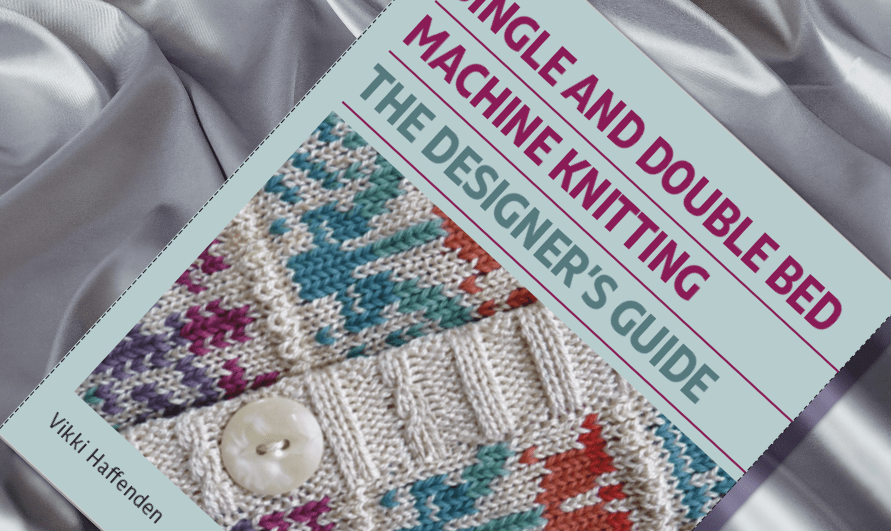
Thank you to Sue, ‘Little Miss Drop Stitch’ on YouTube, for purchasing and taking the time to review my book, ‘Single and Double Bed Machine Knitting: the Designer’s Guide’ in her video entitled, ‘Is Single and Double Bed Machine Knitting Worth It? Honest Review!‘ Just to be clear, I have no connection with the reviewer and have not solicited the review.
It was good to hear that although with only brief experience on an Addi circular knitting machine she stilll found the book useful and informative. Describing the book as ‘comprehensive’, she continues to say the she found the book, ‘…more beginner friendly than it states’. In the book I warn readers that some familiarity with machine knitting was assumed whilst writing, (otherwise half the book would have had to be filled with absolute basics) so this was great to hear.
I had focused my writing on broadening design opportunities for knitter’s by explaining the technical capabilities of the machines in close combination with exploring different methods for creating unique surface patterns, so it was heart warming to hear positive references made to my explanations of ‘the technicalities of design’ and examples of, ‘…the artistry that is behind it’. I am fortunate to have had a design training, been a professional designer and lectured in knit design, and it felt natural to me that I should include examples of simple techniques and accessible exercises for readers to try out for themselves should they so wish. So it was lovely that Sue commented how unusual it is to find design methods included in knitting books, and that she valued this insight into degree level design process without having to go to college for the experience.
Of course a lot of the design methods described in the book can be applied to designing hand knits as well as machine knits, so I hope she finds it useful despite not having yet taken the plunge to purchase a machine. Sue comments on my explanation that many of the machines/models are discontinued which whilst sad, is true. However, there are new machines available and the main difference between the metal models is analogue, (punchcard) or digital surface pattern preparation and transmission. New machines with plastic beds tend not to have automatic surface pattern mechanisms, but offer similar patterning results using manual intervention.
Once you start exploring machines remember that there is nothing wrong with purchasing secondhand. Indeed, the standard gauge machine shown in the step-by-step instructions in the book is a discontinued model, and the mid-gauge is secondhand. Provided they are complete, have been kept in regular use and not mistreated or allowed to rust, even older models have life left in them and are still going strong. Sponge bars will usually need replacing, but DIY options can save money on these. Keeping you machine oiled is fundamental maintenance whatever its age or model.
Facebook is a good meeting place for machine knitters, there are lots of groups where advice is readily given. If you have a local Machine Knitting group, contact them to ask if they know of any machines for sale locally, or even to borrow (some may lend/hire them out to keen newbies). The advantage of this is that most machine knitters love to share their knowledge so you would be in the right place to ask advice about any machine you might find elsewhere, such as online market places. The Knitting and Crochet Guild has a machine knitting arm which is also a good source of information and advice with its own online machine knitting journal. If you are a hand knitter and decide to embark on a machine knitting journey, do take a look at my other book ‘Translating Between Hand and Machine Knitting’ which might help you make connections; it does just what the title says.
Please keep an eye out for my next book, which is entitled, ‘The Machine Knitter’s Guide to Partial Knitting: Seamless Pattern, Shape and Form’ and will be published in Spring 2026 by the Crowood Press. This is an in-depth look at using the holding technique on single and double bed flat knitting machines. Although the book focuses on Knitmaster/Silver Reed and Brother machines, the techniques apply to any machine that has holding capabilitiethers and there is particular reference to the popular Silver Reed LK150 mid-gauge machine. The second half of the book includes a chapter of patterns that exemplify the techniques explained earlier, including several for the LK150.
 Vikki Haffenden