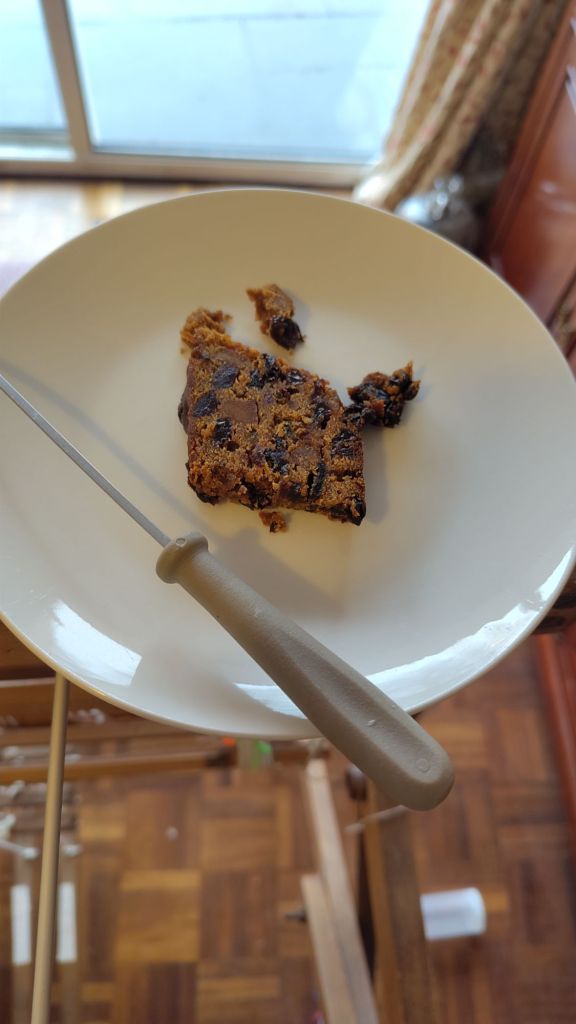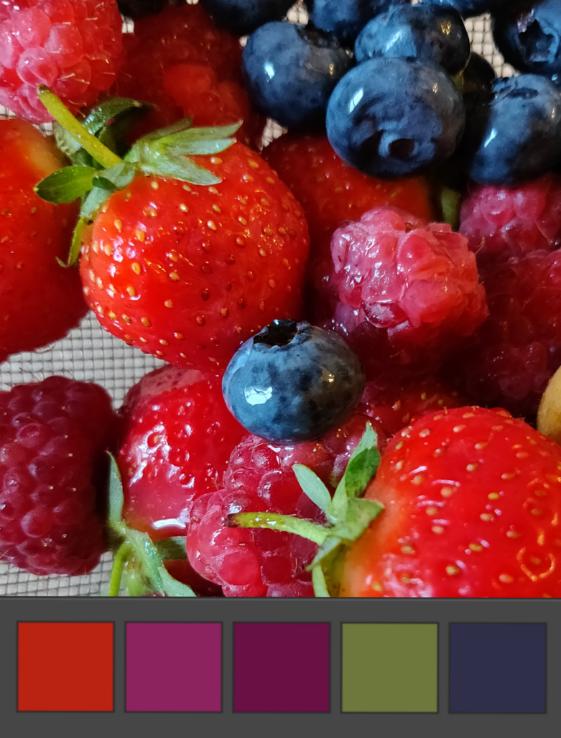
image of fruit with colour chips extracted from image

Talking to Techknitters Machine Knitting Club

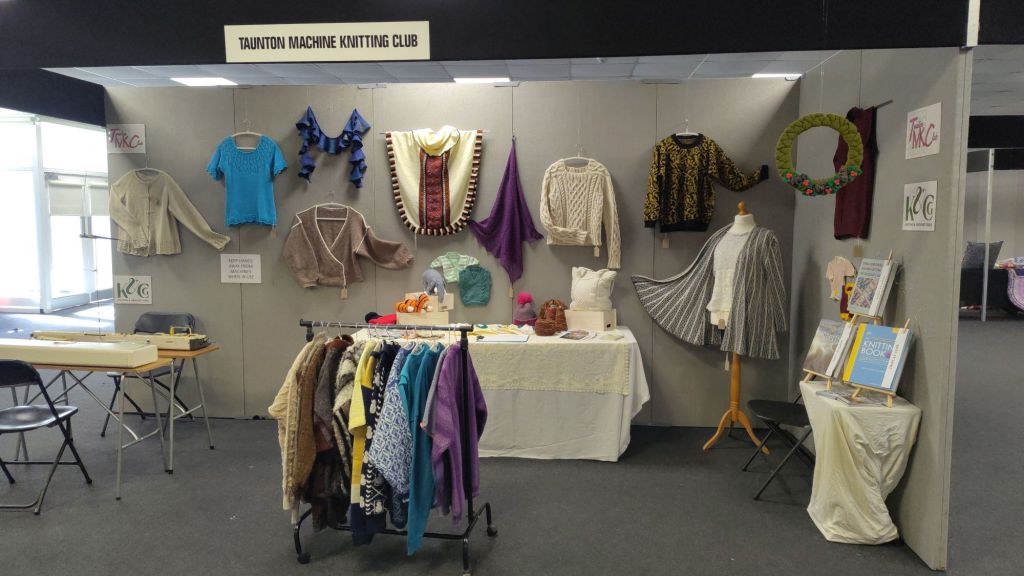
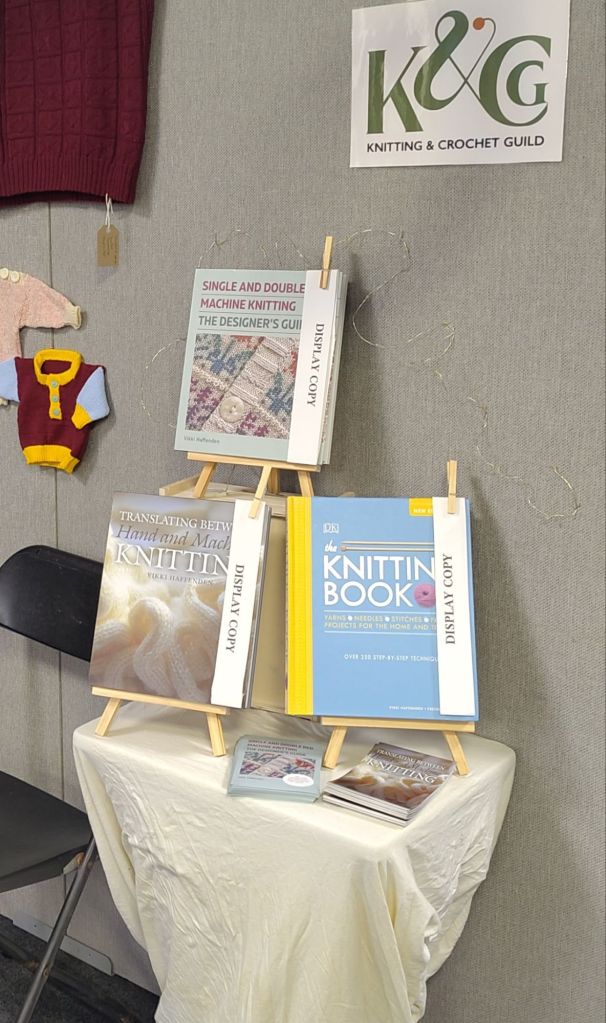
On Monday I had the pleasure of talking to Techknitters Machine Knitting Club in Chicago about my book ‘Single and Double Bed Machine Knitting; the Designer’s Guide’. Although this was published in 2024 the UK, it was not published in the USA until 2025 and I was due to talk to the group in December of that year. Moving house and having a lot of building work in progress meant that I couldn’t manage an online talk at that time, so we rescheduled. The new date came around quickly, doesn’t time fly?

Although several members indicated that they already have the book, I decided to discuss the overall content of book for those who do not yet have a copy. During this I explained my thinking behind the plan of the book and the main intention behind my writing. Following on to this, I concentrated on snippets from each chapter.

One of the reviews of the book mentioned that it is unusual to find design development and process included in a knitting book, so I took this comment as the focus of the rest of my talk working with material from the chapters, ‘Designing with Colour’ and ‘Finding Inspiration and Designing Pattern’.

This section of the talk started by looking at extracting colour inspiration from one of the images used in the book, and then reviewing a sample from the book that had been designed using these colours to work stripes. The practical part of the talk was about selecting yarns, designing another stripe, and revising and developing the design. Each step was shown and design rationales discussed. The sample was knitted and a finished and steamed version was reviewed to which the group gave feedback on how it might be improved/adapted. All in all it was an enjoyable experience.

I will be talking to the group again in August about my latest book, ‘The Machine Knitter’s Guide to Partial Knitting; Seamless Patter, Shape and Form’ which is due to be published in Spring 2026 by Crowood Press.

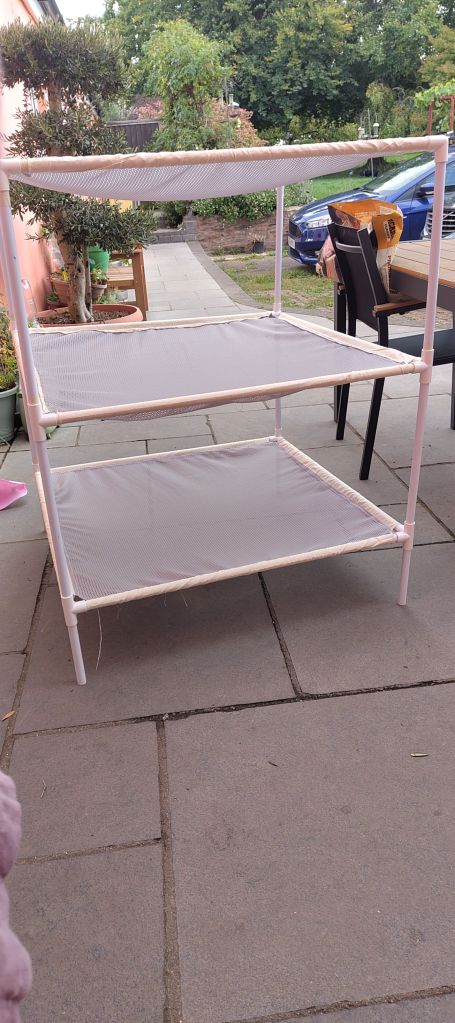
After a year’s wait I have finally completed the fleece-drying rack

I planned this project of a collapsible fleece-drying rack over a year ago. Setting is always difficult as it requires a lot of space and works best if air can circulate to as much of the fibre as possible. I toyed with the idea of folding herb drying racks, but the ones I found were small, flimsy and expensive. I’ve seen others use those plastic crates with open mesh sides, but couldn’t find any of those locally, plus they take up space when not in use. 

So I decided to design and make my own. My brief was:

freestanding

reasonably lightweight and portable

widely spaced shelves

a large surface area so that the fleece could be opened up to speed drying

collapsible so could be folded down and packed into a bag when not in use

Designing the rack and working out the specs took some thought. I ended up with a plan for a three shelf rack, each shelf being approximately 80cm square. I intended to use plastic pipe and elbow joints for the frame and mesh fabric for the shelves. Mesh fabric would allow air to circulate, and if made from synthetic fibre, would dry fast itself and hopefully reduce the likelihood of mould whilst packed away.  Each of the mesh shelves would have sleeves sewn along all four sides through which the pipes of the frame would be inserted. Then the pipes would be connected via the 3 and 4-way joints, putting the shelf under tension. In this way the shelves would stabilise the whole structure.

I already had some plastic piping left over from making a collapsible niddy-noddy, but bought the rest from Wickes, then cut it all into the correct lengths. I borrowed a plastic pipe cutter to do this, which gave nice neat and smooth cuts which would facilitate threading the pipe into the shelf pockets. The 3 and 4-way joints came from ebay, as I couldn’t find them locally. However, if you decided to make one of the racks, do try a local plumbing store if you have one first, before going online.

So I had the frame and it fitted together, but then winter came so fleece washing ceased and access to my sewing machine was limited by building work. But I went ahead and ordered 3m of fine mesh fabric for the shelves in anticipation of getting started when I could.

Sadly, when I finally got to sewing the shelves, the mesh proved to be too fine, overstretchy and delicate, so it was back to the drawing board. This time around I sourced a much sturdier, low-stretch mesh fabric on eBay. It was pricier, but fitted the bill really well. Luckily I found some seconds of the danger fabric, which helped keep the cost down. I also decided to use Calico I already had to sew smooth, non- stretchy sleeves for the pipes so that it would make it much easier to slide the shelves on and off the pipes. The sleeves would also make a stable attachment to the between shelf and pipe, and hopefully reduce stretching and drooping of the central, mesh shelf. As usual, cutting out and sewing took some time because I was doing it around other things.

Finally it all came together. Probably too late to test on a fleece this year, but it might work in the greenhouse if necessary. I hope the shelves will not droop under a layer of damp fleece. I spin it after washing, so hopefully it will support the weight.

I guess it would also work for herb drying.

If you would like the instructions for making this fleece drying rack I will add them in a few weeks time.  Please pop back to this page to download the instructions.

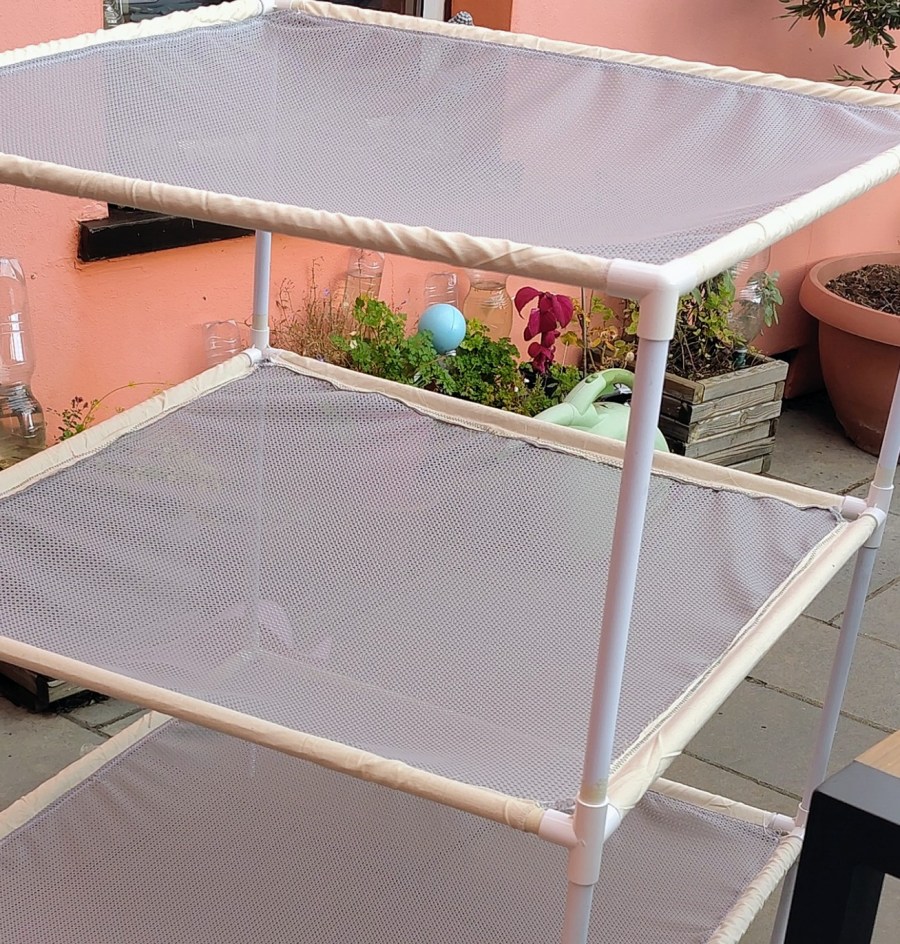
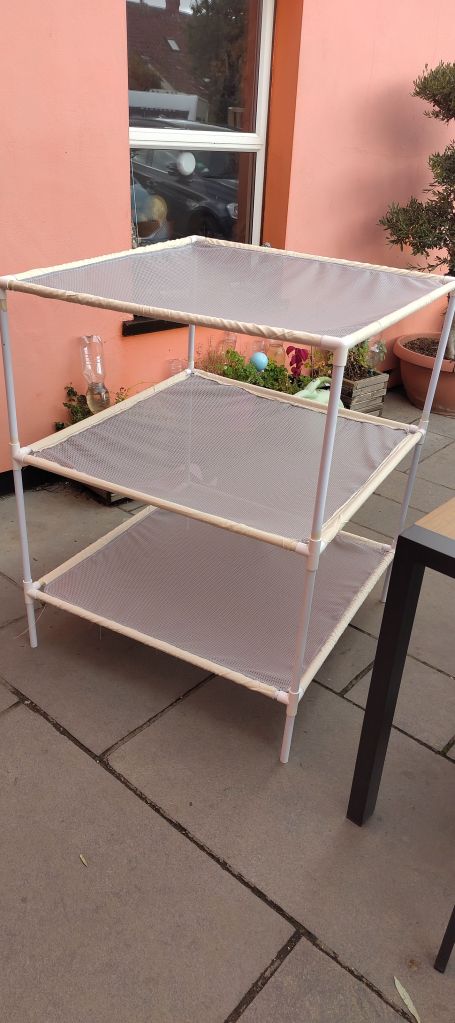
The finished rack
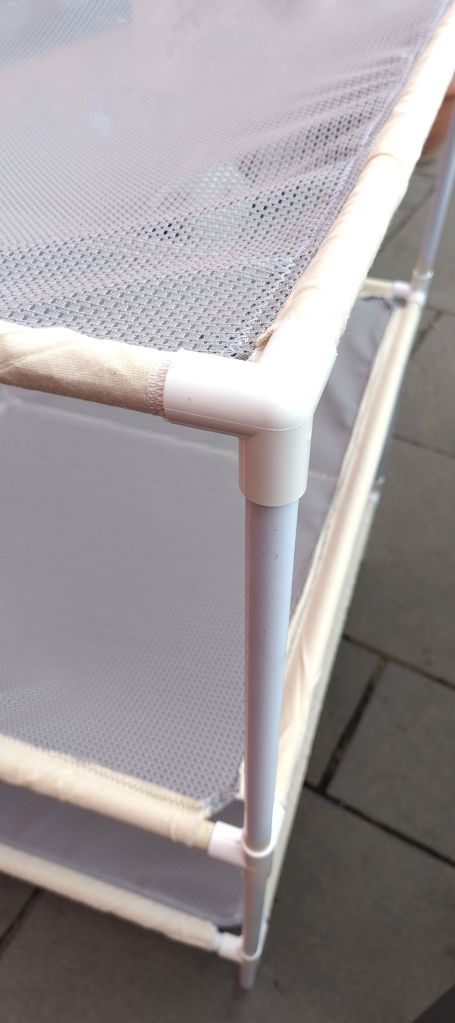
The top, 3-way joints
Middle 4-way joints
Legs are interchangeable, so the shorter ones could go in the middle if desired

A bit of cotton dyeing using home made tannin extract

I posted recently about solar dying wool with mulberries and I thought I’d now have a go dying some commercially spun cotton that I have already, and conveniently, put up into hanks. There are six 50g hanks, so I am hoping for 300g of lovely coloured cotton to play with.

I don’t dye cotton often, but I do know that it requires tannin as a mordant. Well, being a bit disorganized, if I’ve got any commercial tannin mordant I can’t find, so it was a relief when after a quick look in Jenny Dean’s Colours from Nature, I found that bramble leaves and twigs contain tannin. A bit more research on the internet suggests that mulberry leaves also contain tannin. It looks like this is going to be a multi-day effort.

DAY 1

One thing we have in plenty in the garden and surrounding fields is brambles and of course we have a mulberry tree, so I went on a little foraging trip. I collected a basket full of mulberry leaves and brambles which I chopped up and boiled for an hour as instructed in the book.

DAY 2

I left these to soak overnight and have just strained the liquor off into a pan and slightly reheated this.

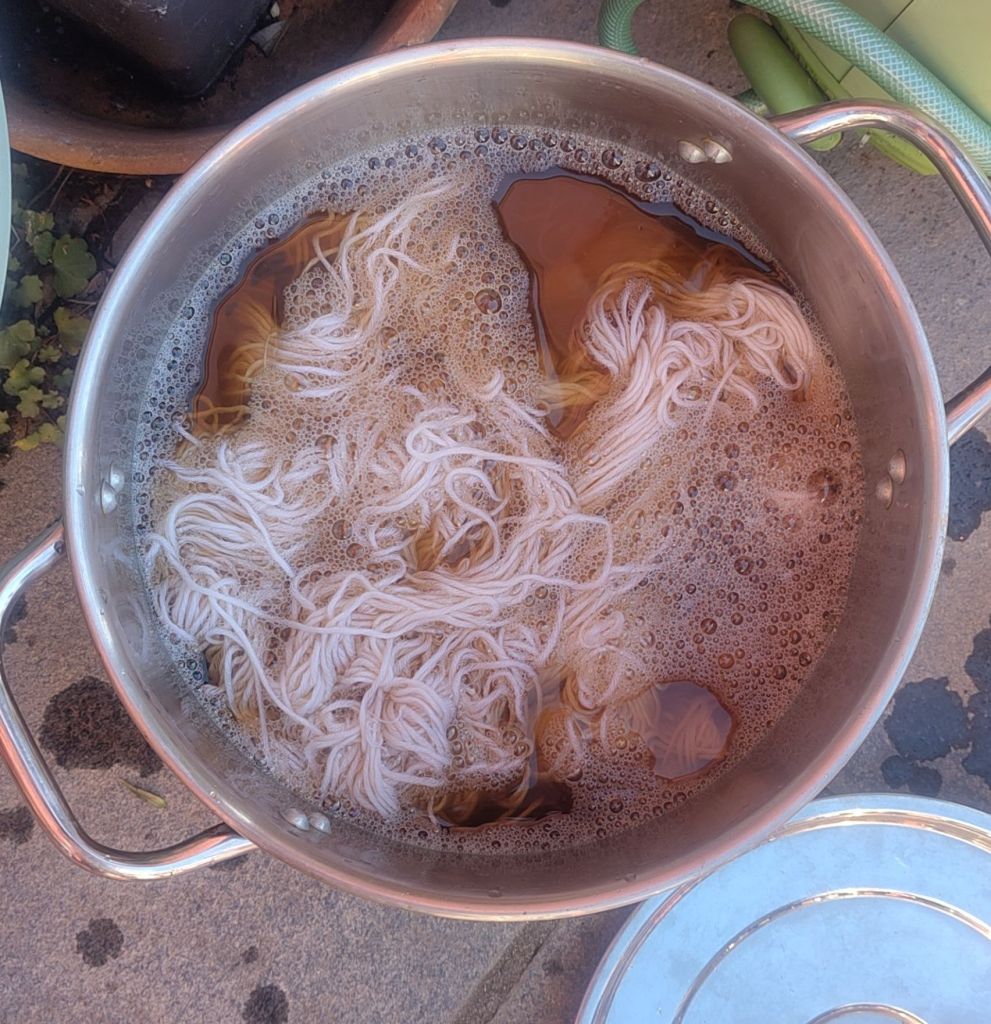
I’ve just submerged the damp cotton hanks in the tannin liquid, and will leave this for 24 hours for the cotton to absorb the tannin. According to Jenny Dean there is a likelihood this will stain my white cotton and is bleached white slightly yellow, so we will see.

Hanks of cotton soaking in the home made tannin solution

Hopefully the mulberry dye will accommodate this and give me a nice color.

DAY 3

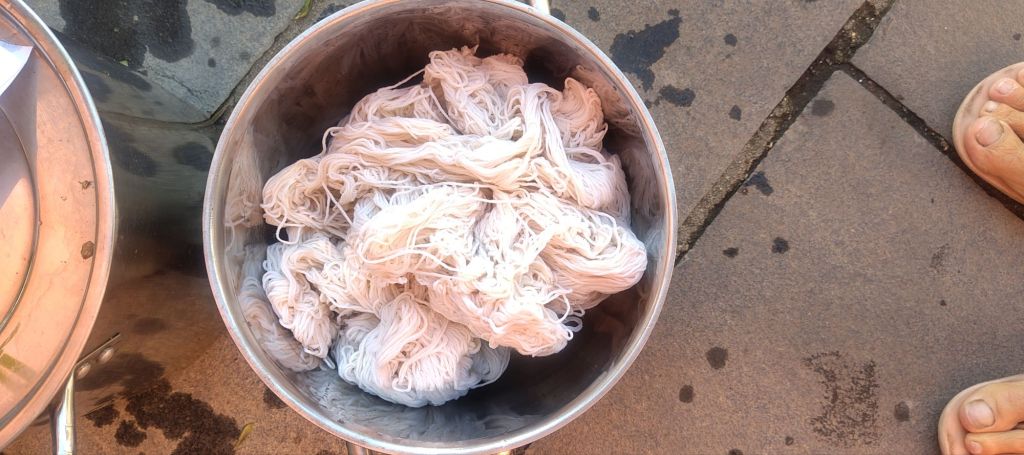
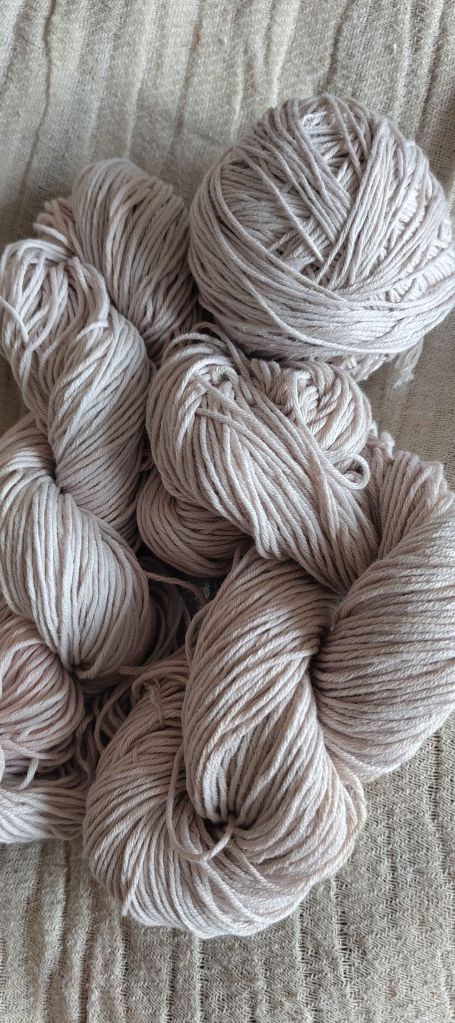
The cotton yarn after being soaked in tannin solution, a slight cream cast

After the tannin soak the cotton had taken on a slight creamy colour, not too bad at all. Maybe it didn’t take the tannin?

Straining the cooked and soaked mulberries to release the dye colour

I had prepared 1.5kg of mushy mulberries that weren’t really edible by cooking them up in some water and leaving them to soak and give up their colour overnight. I thought I was ready to get in with the dyeing, but luckily at this point I went back to Jenny’s book. Only then did I  realised that the cotton needed to be soaked in an alum mordant after the tannin. How did I miss this before?

The recommended amount is 4 tsp alum and 1.5 tsp of washing soda per 100g of fibre. Dissolve the alum and soda in enough water to cover the fibre,  and bring to a simmer. Then leave it to soak and cool for 12-24 hours.

DAY 4

NOW I can put the hanks in the dye..

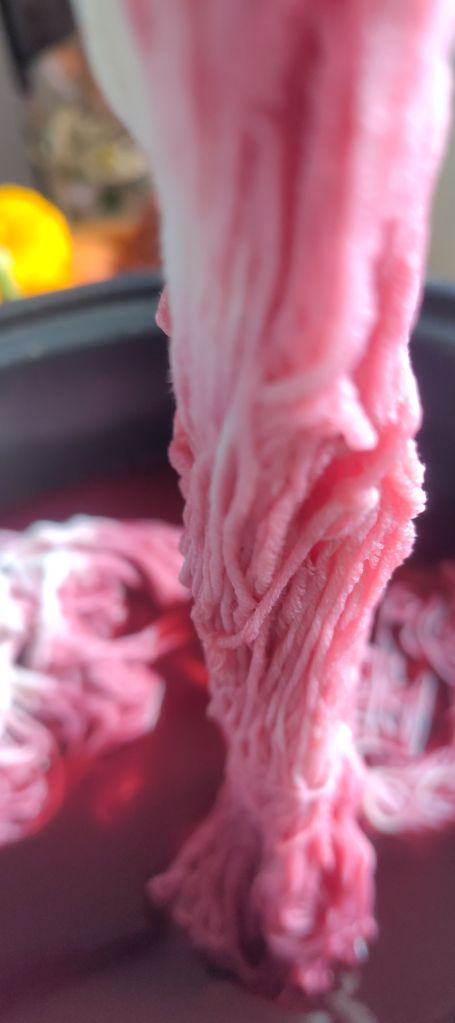
This afternoon I took the yarn out and rinsed it. Then strained the mulberry liqour and put it in the old slow cooker I use for dyeing. I added some salt (not sure why but seemed to remember it helps the dye take) and then added enough water so that the liquid would cover the fibre. After that I immersed the yarn in the dye.

Fingers crossed it will work.

First dipped hank… Now it needs to sit in the dye overnight…but we all know it’s probably going to wash out…

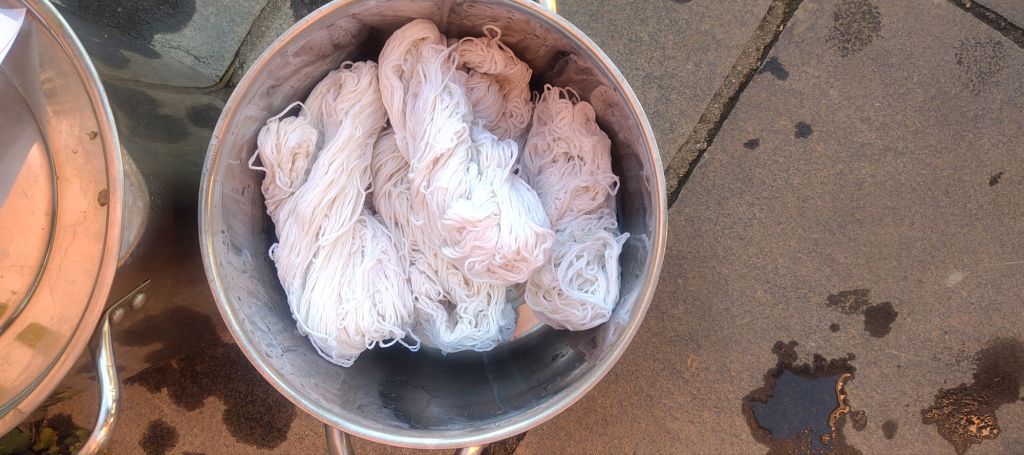
Well, the hanks came out looking lovely, but as predicted, the colour mostly washed out. It’s not a bad colour, it’s very a pale, lilacy grey, just not the pink I hoped for.

The final colour, a pale lilac grey.

Solar dyeing from the garden waste

As mentioned in my previous post we have a lot of fruit in the garden, a large amount of which is from a prolific Mulberry tree. I’ve made jam,  jelly, syrup, sauce, dried them and made fruit leathers. Plus Ross is making wine from three kilos of them.

One of the problems with mulberries is they have big pips and a stalk that is difficult to get out. Many of the things I’ve made have involved cooking the fruit up and then putting it through a Mouli or nylon sieve to get the pulp and juice and then working with that. As we have a lot of apples I use the windfalls to make pectin and sometimes add a few apples to give some body to the pulp.

Of course you end up with a lot of mulberry mush with pips and stalks in it. However this still retains the really strong color, and staining ability, that the complete mulberries have. So I decided to do some dying with the pulp. Last year I solar dyed with raspberries, which gave me a gentle pink, so this year I worked with the mulberry pulp in a similar manner. I use my own handspun yarn and solar dying with the mulberry pulp, which gave a pretty, pale crimson. I boiled up the mulberry mush again with a bit more water and added any berries that hadn’t been good enough to go into the jam. When I thought I got as much color into the liquid that I was going to get I strained the liquid off through a fine sieve, being careful not to squash the pulp through as well. The liquid went into a big jar with 1% alum solution, some salt and a dash of white vinegar. After a good stir  the dye jar was ready. 

Before I started all this I had put a 100g hank of handspun wool  yarn to soak in hot water with washing up liquid and a little bit of soda. Although the yarn had been washed already, this extra soak and the soda in particular, removed any remaining oil, ready for it to take the dye. The yarn had been spun and plied 2ply from a Lleyn fleece.

After rinsing and removing extra water from the yarn I put it damp into the dye jar, put the lid on and gave it a good shake to distribute the dye around you the yarn. My plan was to shake the jar every day whilst it sat in the sun for a week to ten days, but I forgot so the hank is a slightly lighter colour one end, which is pretty but not a solid color I had intended.

I follow the same process with marigold petals that I’d gathered  when deadheading the marigolds I’d grown this summer. These had been left to dry and were cooked up and strained in the same way as the mulberries. After removing this yarn, which was only a small hank, from the dye jar I found that one of the singles had taken the color much better than the other. This is because the 2 ply yarn on the bank was plied from two different fleece singles that were on odd bobbins, and I don’t remember which  forever either were from. So an interesting dye experiment, but lacking the control of knowing the fleece type.

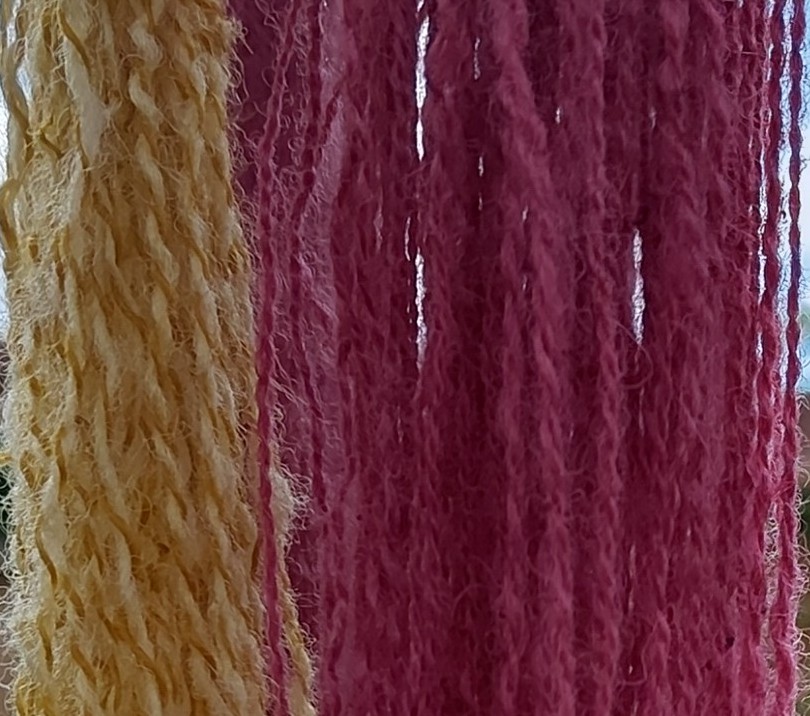
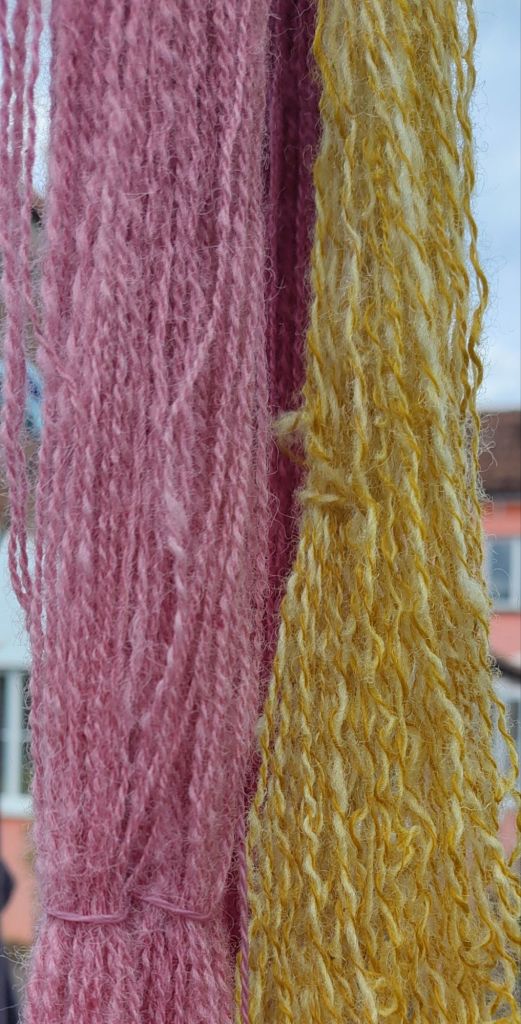
On the left is the mulberry and on the right is the marigold dyed yarn.

Ready to spin

An hour spent blending on the drum carder has got me set for some serious spinning.

The yellow and natural are broken Merino tops that I picked up at the John arbon Open Day last year.  I’ve blended these in equal parts with a very strong ultra marine blue which I won in my local Guild raffle.

I tested this first on hand carders and it produced a very nice yarn so now I’ve done it in bulk and taken rolags of a batt from the drumcard.

The singles so far.

I’m aiming for a 2 ply hand knit weight yarn, so spun the singles trying to let in a bit more fibre than I usually do. I read once that as you become more proficient at spinning you tend to spin finer, and that does seem to have been the case. Not that I’m claiming to be brilliant at it, just more practiced than I was.

This was spun the 1:8 whorl on my Louet S95 ‘Victoria’, which is the little folding portable wheel I take out to demonstrations. I aim to ply at the same ratio although I know it will probably work out a bit less. I am looking forward to spinning and plying this.

Testing the set of home made pectin

I think I have another post about this, but here goes with my latest version.

Windfalls, some were smaller and more bruised than these

We have a prolific harvest this year, so jam and other preserving is under way. Because there are several punnets of raspberries waiting to cook, I need more pectin. So I made another batch from the windfalls from the apple trees. I cut all the bruising and bugs out, and cut the pieces into 2cm chunks. Then squeezed 2 lemons and put the juice and the squashed peel into a saucepan with the apples with water to just about half way up.

Cook them until they are soft and squash them into a mush. Then strain through a muslin overnight.

Pectin after straining, such a lovely colour..

I am tempted to squeeze more juice out, but that will make the pectin cloudy, it’s up to you. 

Now check for the set of the pectin. You can put small, equal amounts of sugar and pectin into a saucepan, stir, boil and rest.  But I out the two ingredients into a ramekin  and cook in the microwave for 40 seconds on full power. Take it out and stir. Repeat.

A nice form set, I couldn’t resist licking the spoon – and the blob!

Whichever cooking method to have used, drop a blob onto a chilled saucer and if it sets into a soft lump, the pectin is ready to bottle. Otherwise, return it to the saucepan and boil to reduce then retest.

Bottle the pectin in a sterilised bottle, (use the microwave for the glass bottle, but boil the metal lid).

Once cooked, store in the fridge for up to 4 weeks. Can also be frozen in a plastic container.

I use about a third to half a cup to 500g fruit when making soft fruit jam, but always test for the set before bottling jam.

Happy jam making.. 🙂

Spinning at the WSRA Steam Rally

Today I’m with the Somerset Guild of Weavers, Spinners and Dyers,  demonstrating spinning at the WSRA Steam Rally in Norton Fitzwarren. I have brought my dinky Louet S95 Victoria with me and a trolley to take it all back across the showground.

 Because plain colour fleece doesn’t always look so interesting to the public I am blending yellows, now and cream tops on hand carders make a heathery yarn. 

https://www.somersetguildwsd.org.uk/

https://steamrally.org.uk/

Blending coloured tops on hand carders

Final sample for my latest book about machine knitting

I think this might be the final sample for my latest book. The manuscript went into the publishers a week or so ago and I’m just working in a few outstanding samples and photos.

Of course machine knitters, well knitters in general, will know that ‘sorting out a sample’ is a shorthand for:

knitting several design swatches

knitting a tension swatch (or three)

working out the garment pattern

knitting it

finding you’ve made a mistake

knitting it again

steaming it

sewing it together

washing it

blocking it

etcetera, etcetera….

So I am just at the first steaming stage and getting ready to assemble the garment. And of course I’ve had to re-knit one piece because the dratted yarn got caught by the brushes irrevocably and it was easier to restart than try and sort that out. More haste, less speed is so very true in machine knitting. Nice and steady is always the best way.

I’m hoping this garment will be nice enough to go on the cover, but we will see.

Meanwhile let me tell you a little bit about the book. The title is still to be finalised, but it is all about short rows and partial knitting on a machine.  There is a lot in there for beginners, for example the first chapter is all about the principles of short rows and how you knit them and there is a whole basic techniques appendix at the back for additional support. Chapters 2 to 5 offer loads of information, samples, examples and exercises for more experienced knitters to really come to grips for short rows, and to understand how and when to use them for different results.

Chapter 6 has patterns that use short rows as they’ve been described in the earlier chapters, but applied to an item. So from these patterns you actually get to use short rows purposefully to create shape and form combined with colour and surface pattern.

So once it’s published I will obviously be shouting about it,  but keep an eye out and do pop back here for updates.

Preserving time is almost here

The warm spring and early summer has meant that everything’s cropping madly in the garden a bit early.

So to get a match on jam making I’m making a batch of pectin from the wind for apples. If you’ve made jam before you will know that pectin helps soft fruit jam set. I’ve made it before and then forgot about it as we didn’t have any windfalls  from our two apples trees worth speaking of, so I bought commercial pectin. However, after we moved here with lots of fruit trees and seeing all the wind falls and the piles of blackcurrants and mulberries saying, “make me into jam”,  reminded me that I can make my own.  Hence there is a large pot smelling very ‘appley’ bubbling on the stove right now.

Simmering windfall apples to make pectin for settng soft fruit jam

If you’ve never made your own pectin it’s very, very simple. You just chop up the little windfall apples into  chunks about two, two and a half centimeters size.  Core, peel, all goes in, then put them in a big saucepan and cover with water. Bring to the boil and simmer for about two hours, until mushy.  Then strain the whole lot through a muslin bag overnight or for about 6 hours. Give the muslin bag a good squeeze to get all the liquid out.

The liquid that you’ve strained out is the pectin and the apple pulp in the bag can be put in the compost bin. Return the pectin to the pan and reduce it until a bit thicker. There is a test with alcohol to check if it is strong enough, but I boil it with a little sugar and test the set as if it were jam and that has worked fine for me. I store the pectin in sterilised jam jars in the fridge and use within two or three weeks, but you can also freeze it, in which case it lasts about four to five months.

Just got to make all that jam now.

Enthusiasm is trumped by poor organisation

When we moved house I had only the first few centimetres worked of a rather intricate (for my level of skill) pattern on my big Inkle loom. So I carefully tied it all down, added tape and made it secure on the loom. Wrapped it in bubble wrap etc etc. and it travelled fine.

The first 4cm of pattern before I had to pack the loom.

Sadly, whilst unwrapping it, I somehow managed to cut the warp! Idiot….

So the loom and dangling warp has languished in the conservatory for the best part of a year, unloved and testament to my incompetence. Today I decided, was the day to grapple with this and repair the warp. I refused to be beaten by it and started to analyse what needed to be tied to what. Luckily I had the written threading pattern to follow.

And I’ve done it! Only two mis ties hat to be undone and retied. I think that it will be OK. I’ve put in several pieces of card to re-tension and organise the warp and it looks good to go.

So I go to wind the shuttle, and realise I have no idea where the weft thread is! It’s somewhere in the loft in a box of unlabelled yarns, and believe me there must be about 20 of these… So do I want to go and search for it? Probably not today. That’s a job for later…