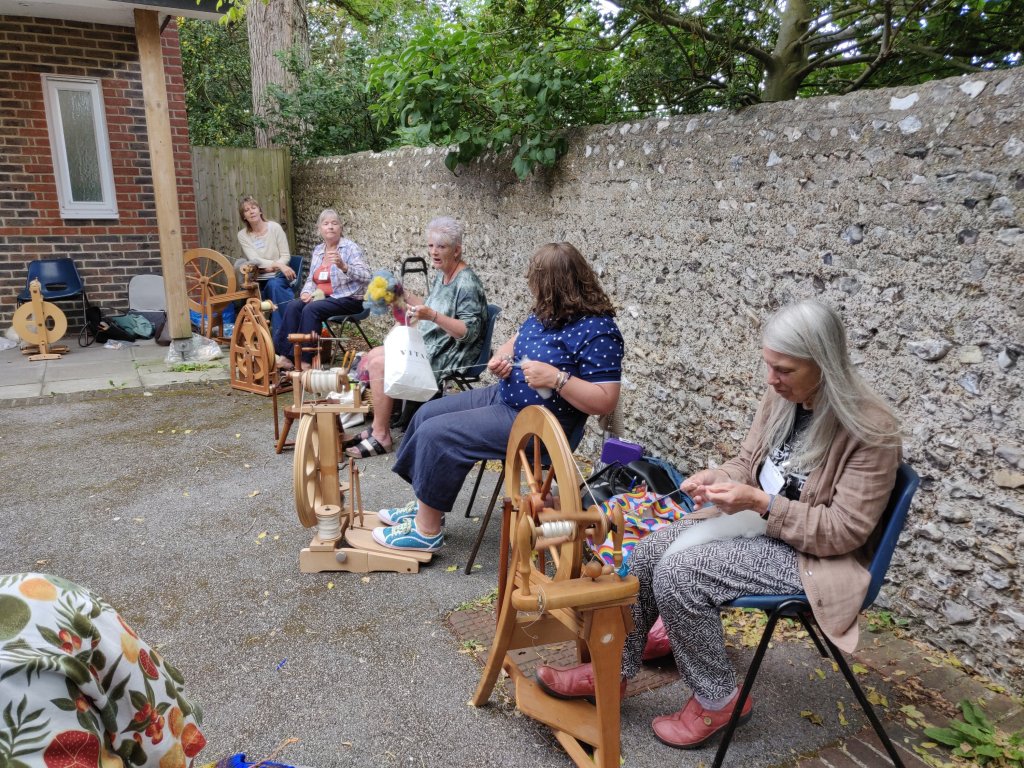
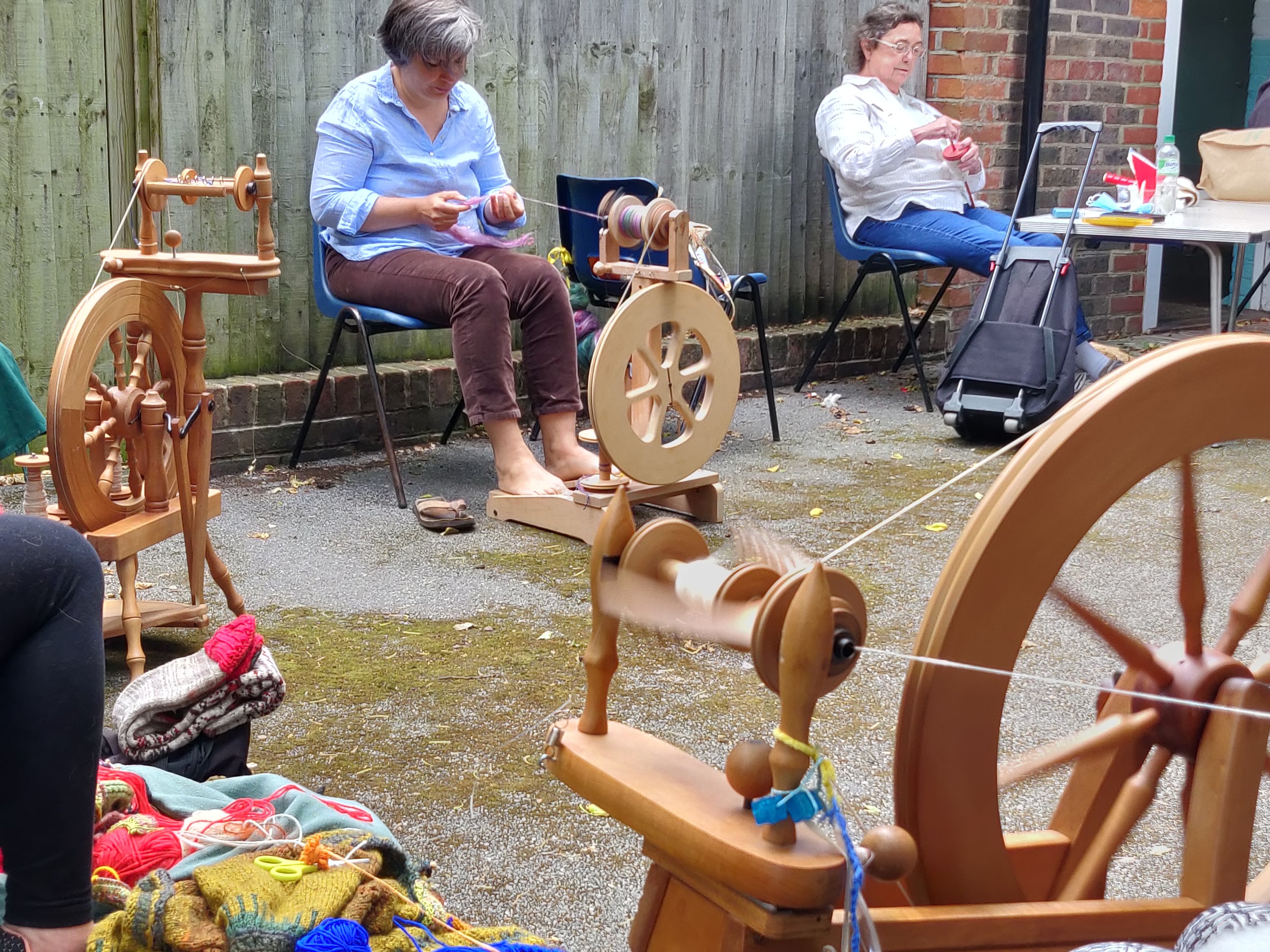
Our local Textile Arts Group (TAG), finally managed to meet today. Eight of us met up with Covid secure arrangements and as the weather was sunny we were in fact able to sit outside the hall to spin, knit and talk.
It was lovely, and everyone has been busy learning new things and perfecting their skills during lockdown.
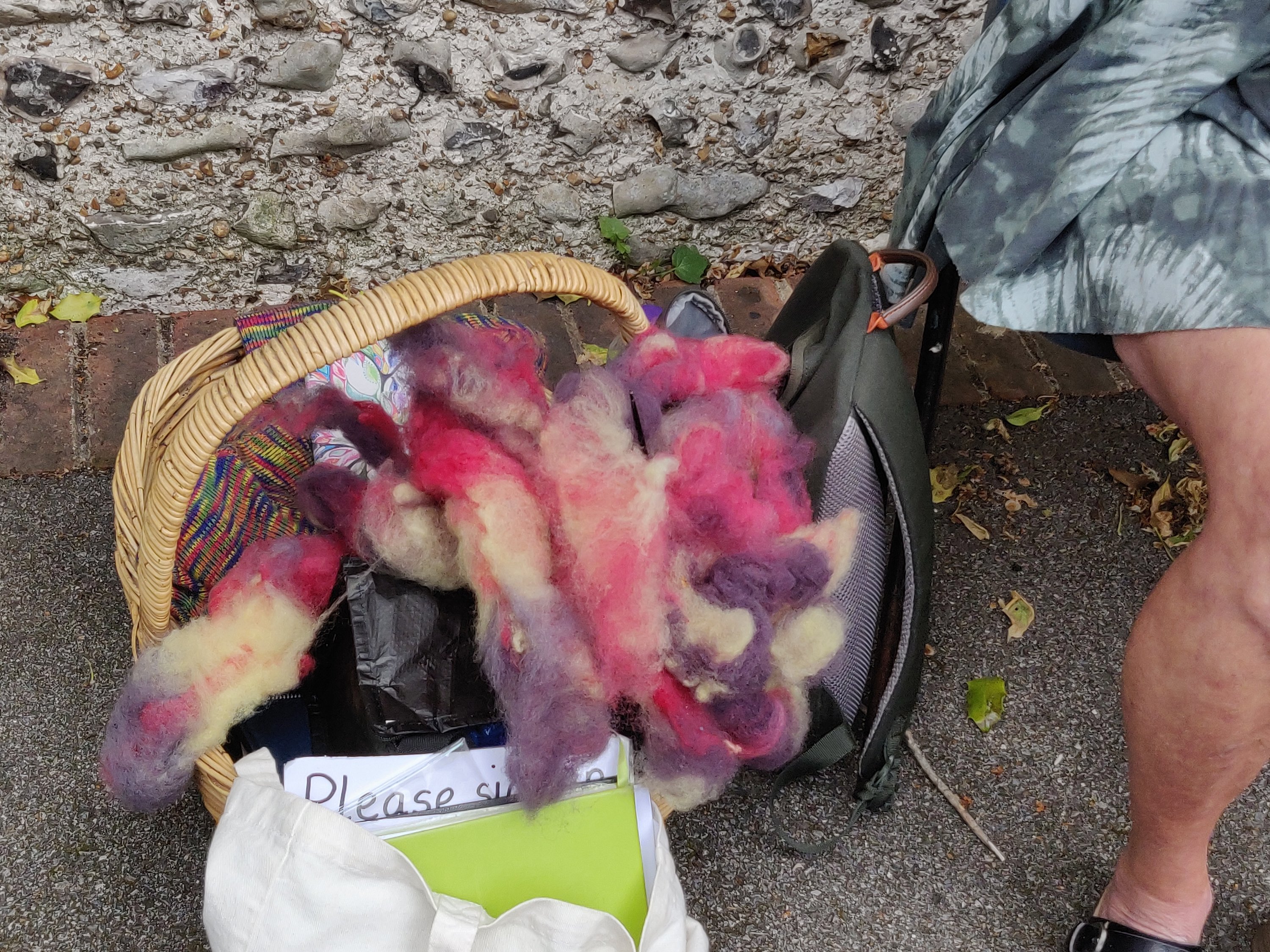
Wheels all going madlyNatural dyed fibre
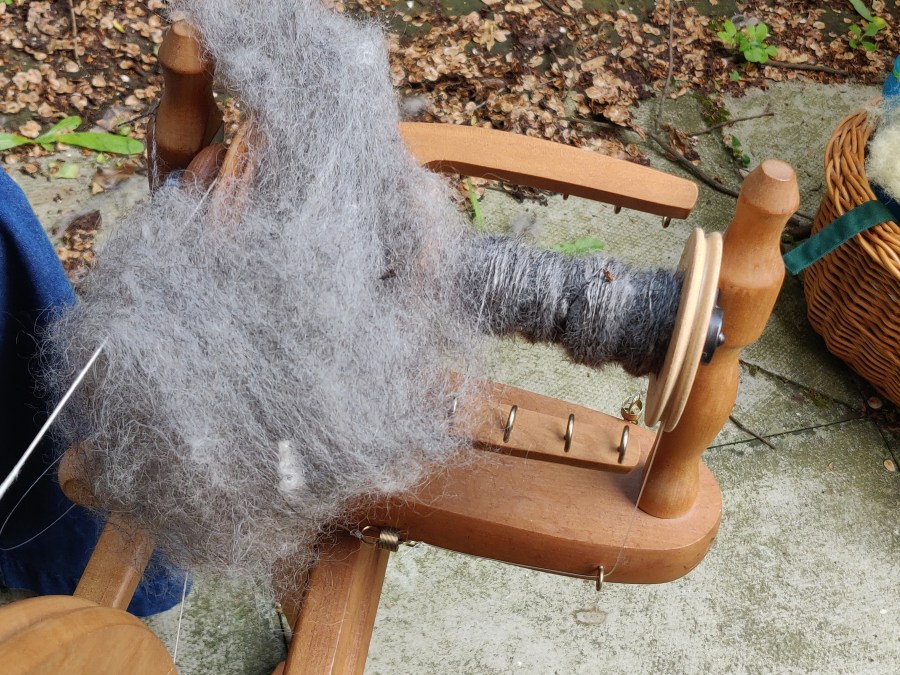
I took my Louet Victoria folding wheel and spun up a bag of Suffolk fibre that will be used as the core for a fancy yarn.
New members are always welcomed. If you live near Brighton and like to know more, or would like to come for a taster session, do get in touch.
Although I promised myself not to get any more fleece until I had emptied my cupboard, I’ve cheated . Well only a bit. Over the winter I have used a lot up, but not all of it!
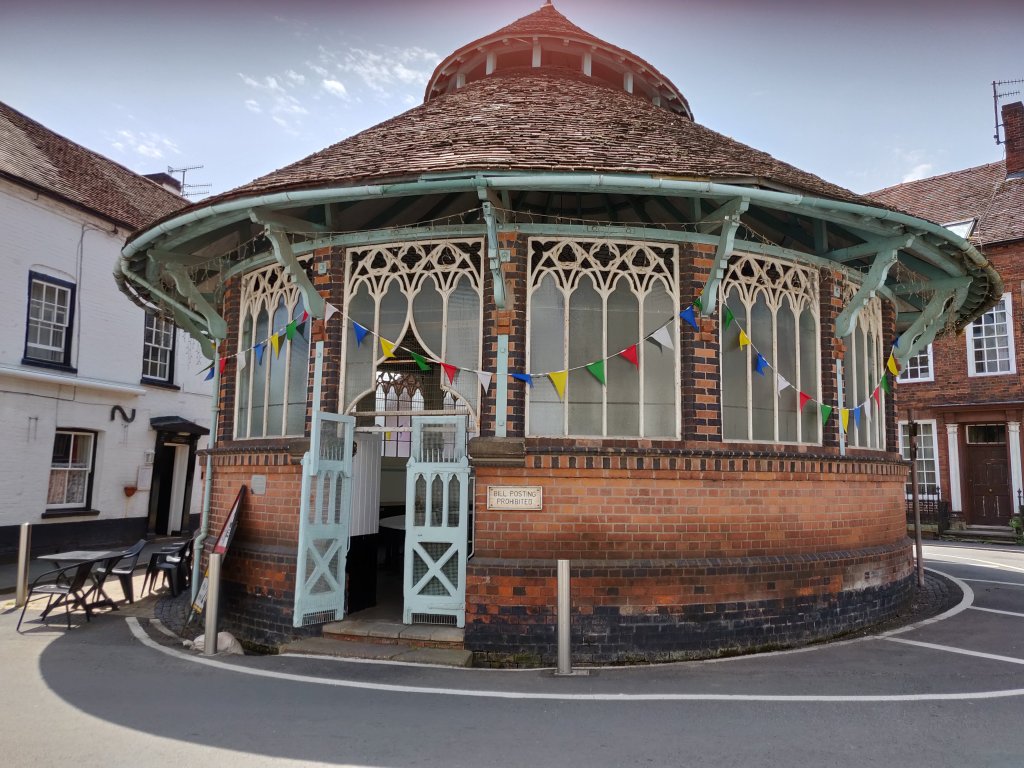
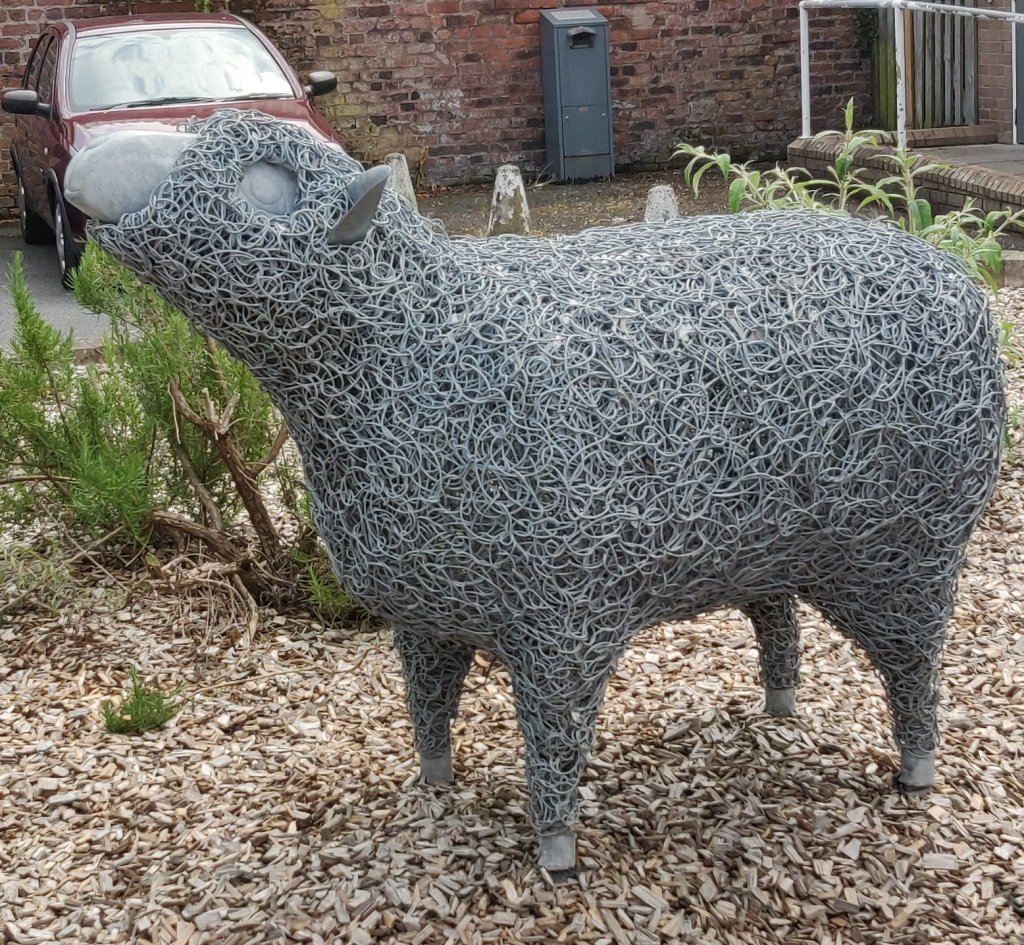
Having been to Herefordshire and seen the Ryeland sheep sculpture in Leominster I read up about the Ryeland breed and wanted to try a fleece. From what I understand the Ryeland was one of the breeds that can from the Romans crossing their imported Merino sheep with local British breeds. This is probably why they look like Teddy Bears with dense fleece. This breed was instrumental in the success of the British wool trade in the Middle Ages and after, which laid the foundations for wealth in Britain, especially in Herefordshire. Fascinating stuff!
The Old Market hall. Tenbury Wells.Sculpture of a Ryeland sheep in Leominster.
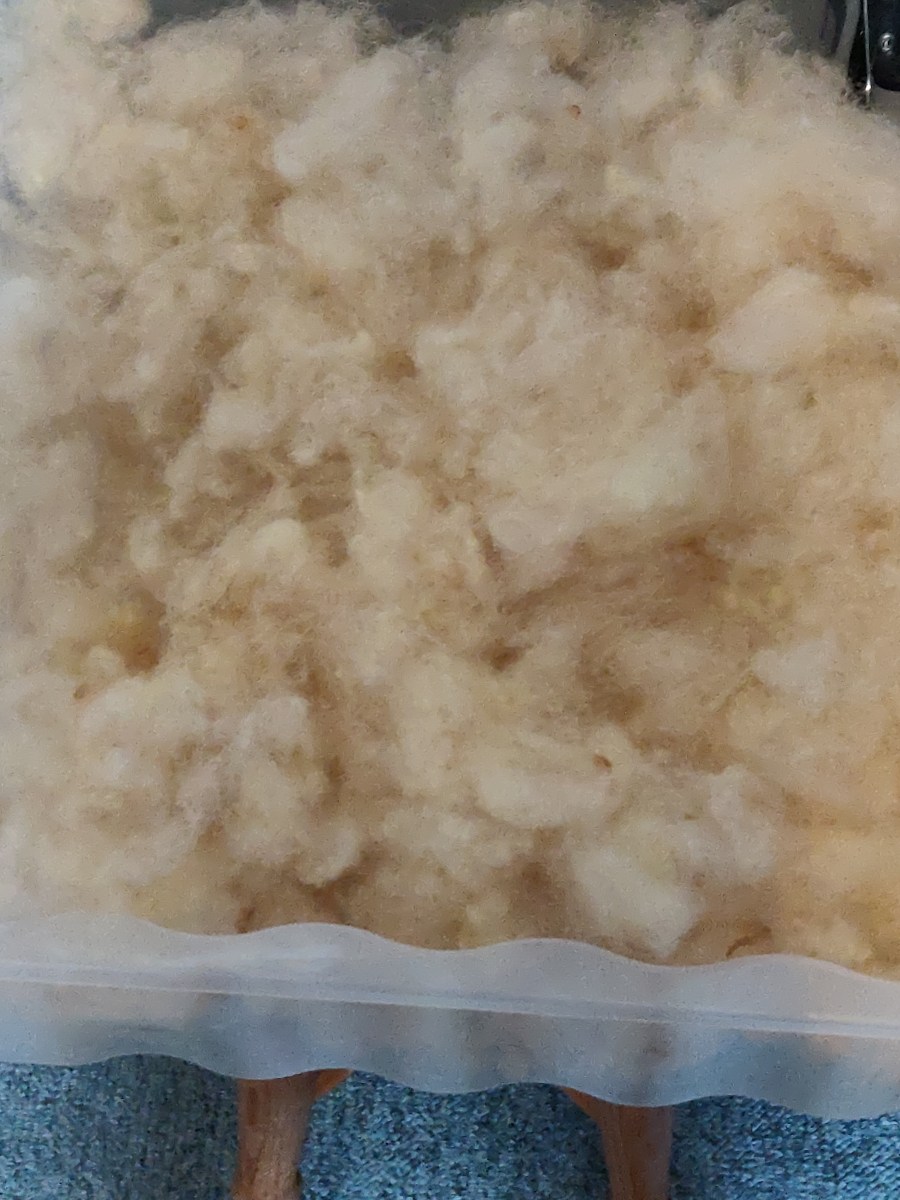
The long and the short of it is that I now have a Ryeland fleece to play with. I sorted out today and have started to wash it with promising results. Not to much VM, but a bit yellowed – the name for this escapes me right now, is it ‘yoked’? I’m guessing its last years crop.
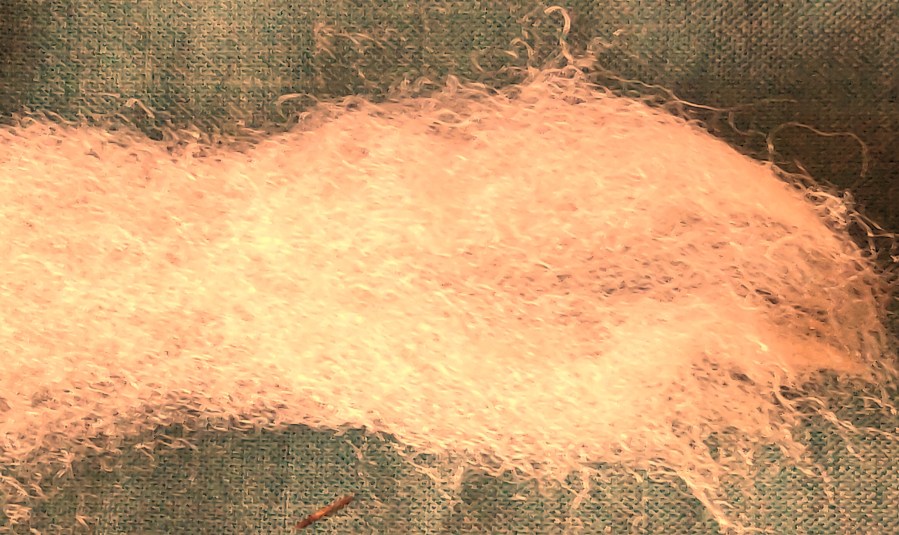
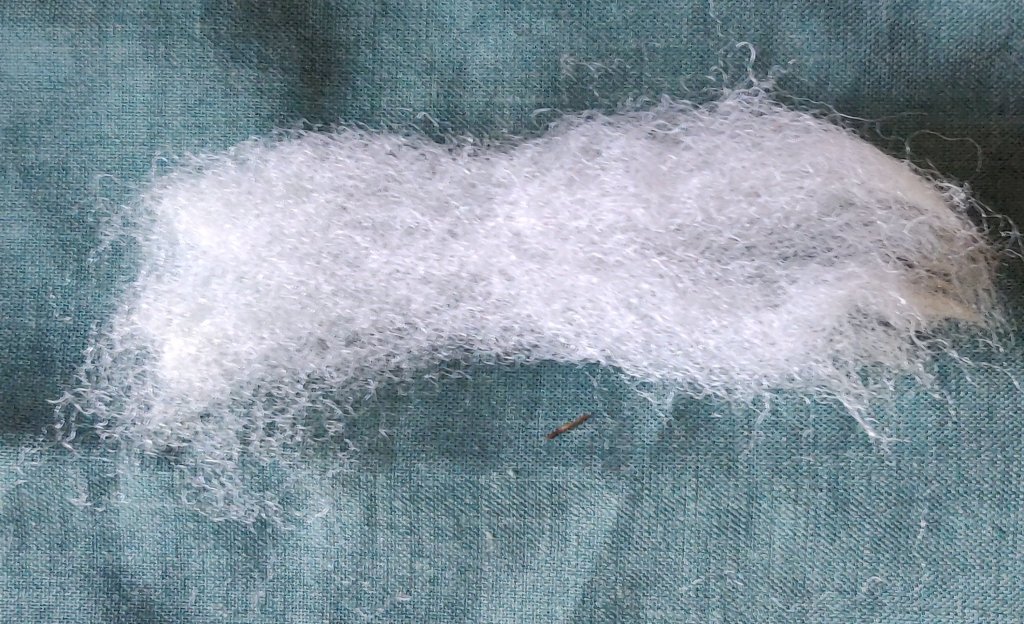
You can see a staple in the photo, and i’ll post once I start spinning. I plan to spin Long Draw, ply and then to dye it.
Washed Ryeland staple. Its about 3.5 inches when straight, but is quite crimpy. Yummy.
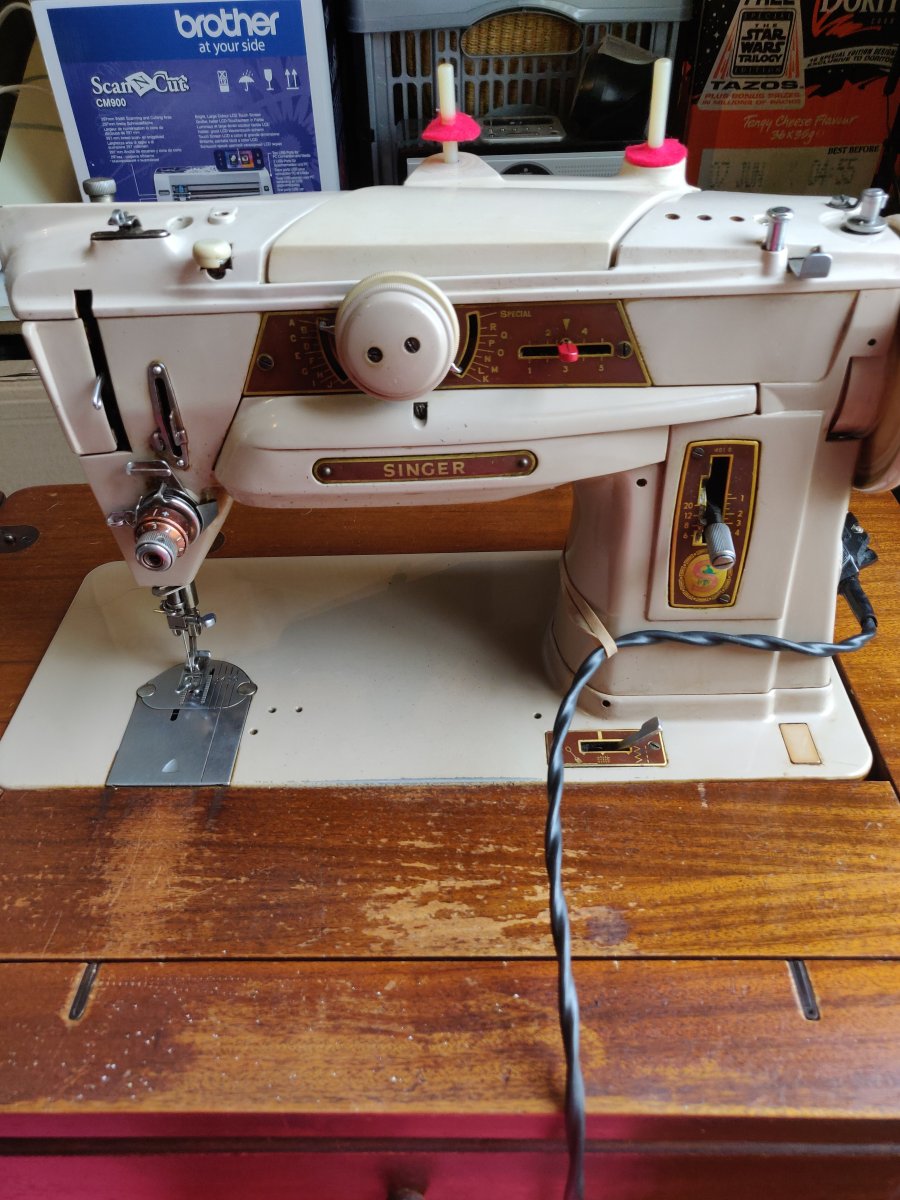
A while ago I posted about this new acquisition. I’ve not been able to use it much recently as I have two knitting machines up. I’m busy writing my latest book on machine knitting which has to take priority.
Before going any further I must point out that the machine now had been rewired and has a new for pedal, so is not as precariously wired as in the photo any longer.
However, I need to plant out my tomato plants and have to make grow bags for them, so it out came! I’d forgotten how great it is to sew with. It went through six layers of hessian without batting an eyelid. The big ‘but’ was that I had forgotten it’s little foibles.
When start a seam on my Bernina I go forward, back and then sew the seam. Singer-babe is different, she needs special measures. To prevent that worrying sounds of jammed threads in the bobbin and a jammed feed, I’ve learned to drop the foot 1cm or so into the seam, sew backwards and then go forward. The manual clearly explains this point, but who reads manuals? Once I remembered this, all went well.
I’m still annoyed that I can’t get her to use metal bobbins. Plastic ones were in the box when I got the machine, and I really dislike these. So I invested in several metal ones to fit, but they don’t work well at all. I’ve adjusted bottom and top tensions to try to get a good stitch, not nothing works. So it’s back to the plastic ones before they all go out the window.
Anyone else have this problem, or have any advice to offer?
UPDATE. May 2021
I the problem I was having with the bobbin was that the thread was not looking over the bobbin, but catching around it instead. I found a video by Andy Tube on You Tube which explained how to check the thread gap on the bobbin case, which prompted me to check mine. Oh yes, it was way out.
I can see how this happens; the black spring that holds the bobbin case in place has a tempting little finger that looks as if it should be used to lift the spring up. BUT DON’T. That is clearly one of the ways it can get out of line. So with the help of a feeler gauge and Andy’s helpful video I think I have largely fixed the problem.
Andy suggested that the bobbin case might be worn, and that also might be contributing to the thread dropping underneath. So I have ordered a new one. After all, it is probably 50 years old, ( this machine was made in the late 1950 early 60s. Maybe it’s had a new bobbin case in that time, but maybe it hasn’t!
I still haven’t solved why the zig zag stitch missed sometimes, that is my next challenge.
UPDATE July 2021
Ok another update.
I think the zig zag daily is because the needle arm is slightly out of line. Another Andy Tube video shows how to fix this, so that my next challenge.
I have a large sack of Texel fleece that had been making me feel guilty for a while. It’s not the most soft of fleece so I decided to blend it with some Alpaca that has also been lurking in the cupboard. Unfortunately the Alpaca (from an animal called Kiki), has quite a bit of VM in it, but it is deliciously soft.
Picking and hand picking got a lot of the VM out, but sadly not everything. I carded both the Texel and Alpaca separately and then split the batts and layered them up in alternate layers; one wool, one Alpaca etc, and put them back in smaller batches through the drum carder.
As my carder is quite coarse I do a second run through for most fibres. So I did it for these batts. I think I probably should have done a third run, but I was afraid of over-carding the fibres and decided they had blended well enough. The result is a little uneven!
I’ve spun two small samples, one thick singles sort of semi-woollen and the other long draw woollen spun.
I’m now perfecting, (ha ha) my long draw technique with several hundred grams of comb waste that I have carded up. Hopefully by the time I get through that I will be proficient enough to tackle long draw spinning that large amount of Texel/Alpaca fibre!
I’ve hand knitted small samples of the both yarns The thicker spun on 6mm needles and the long-draw spun on 5mm needles
Left: Long draw spun yarn hand knitted on 5mm . Right: Thicker semi-woolen spun hand knittedon 6mm needles.
I belong to a local community textile group, and we have just launched our new website. Please take a look and see what we have been doing. Of course that has not been a lot since April 2020 as much of what we do involves going to outside events to share skills and demonstrate.
Lets hope the coming year will allow us to start doing this again. Meanwhile we have been meeting (in 6’s only) during the summer to spin outdoors, but the latest lockdown, along with the colder, shorter days has put a stop to that. Online meetings are OK, and I have organised a few, but its not the same!
We hope to be able to take ourselves along to demonstrate natural dyeing, eco dyeing, spinning, and fibre preparation at Bentley Wood Fair near Ringmer in September. Allan will hopefully demonstrate his fascinating nettle fibre preparation methods, and we will all be suitably masked and socially distanced of course.
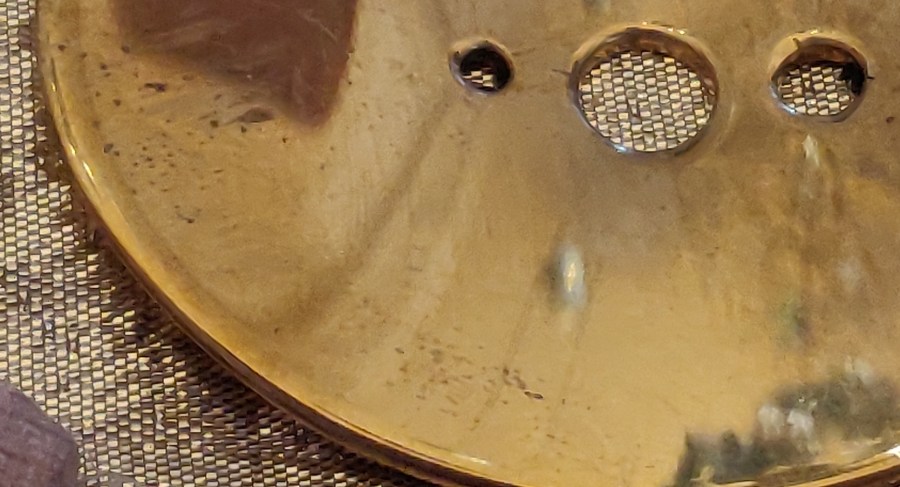
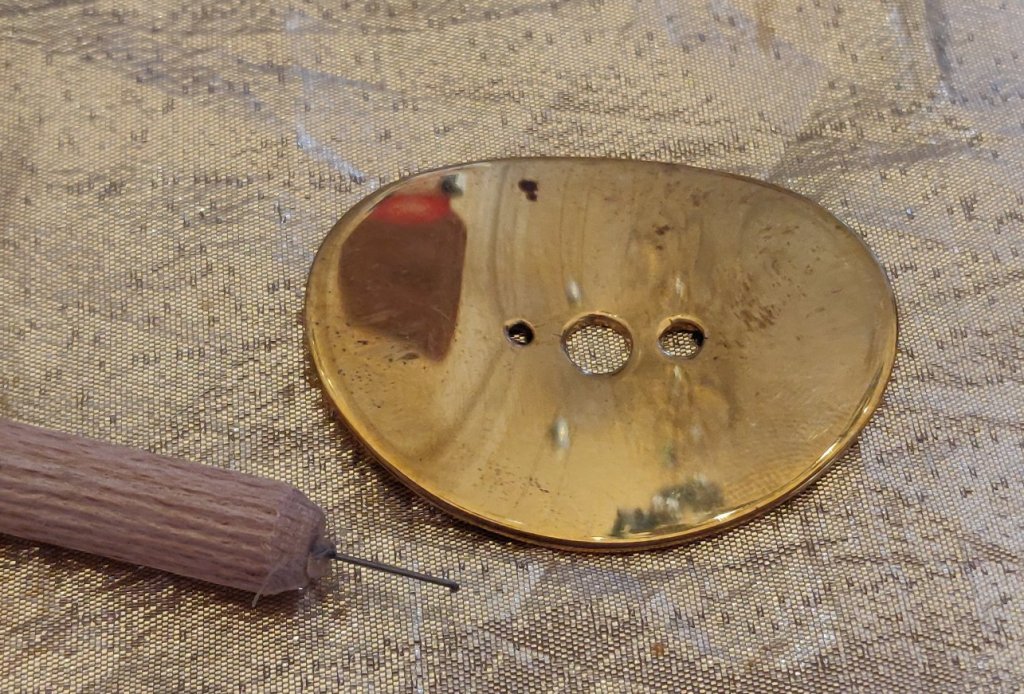
I’ve got various tools that I have been using as a dizz, but there have always been shortcomings. I’ve found it difficult to get the holes smooth enough in wooden ones I have, even after quite a lot of use. I also use a big coat wooden button, (same problem with the holes), and the plastic button I used snapped in half.
The wooden coat button is nicely concave, and I like that feature. When I saw the curved brass ones made by Majacraft I became covetous. So imagine my joy on receiving one from my son as a present at Christmas!
The little hook is great. I used an 18gge knitting machine needle before
Apparently the two smaller holes (1.5mm and 3mm) are for fine and coarser wools and the largest one is for colour blending fibres as you ‘dizz’.
I’ve had a number of different colour hand dyed carded batts sitting waiting for me to find inspiration. They are all from fleece I have scored and carder myself, so are a mix of Shetland, Suffolk and Texel, with maybe a little Alpaca blended into some of them. Some are in 200g amounts, some less. I’d got a bit stuck about how to use them until I saw a useful tip by Anna from my spinning group that she has put on YouTube.
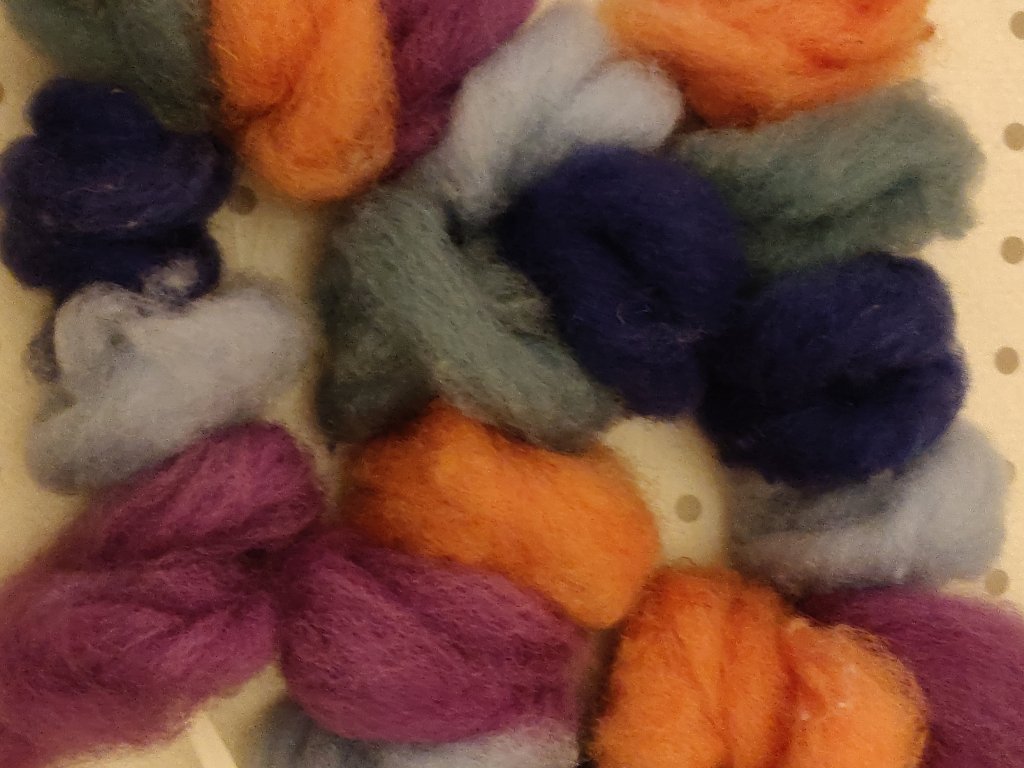
Before you start, select a group of colours that work together. After a designing session during which I wrapped different colours together, I chose five: orange, pale green, mid blue, pale blue and lilac.
Anna used a combination of hand dyed and commercial roving, but the principle is the same with your own carded batts.
1. First of all split the roving/batt into the required lengths, (I just used the whole length of the batt of my drum carder).
2. Then split each length lengthwise into 4, (or more, depending on the thickness of the roving/batt).
3. Next, lay out the colours lengthwise, next to each other in the order you want to spin them into yarn. Test this beforehand to see how they mix throughout one repeat of a yarn, and if this works for your chosen outcome, such as knitting.
4. Repeat the colour sequence three more times so you have a table full of ‘stripes’ of fibre. If you have more than four lengths let colour, carry on until all are used up.
5. Now this is the clever part. I have hand spun colour changing yarns before and got the sequence wrong because I put it all away in a box between spinning sessions. To keep the sequence do the following.
6. Take a metre + long length off ribbon and tie a pencil or empty pen across one end. This is your fibre-stopper. Tie a hand-sized loop on the other end. This is your distaff.
7. Starting at one end of the ‘stripes’, wind each length off fibre into a loose roll and slip the looped end of the ribbon through the centre hole. Carry on doing this, working methodically through the fibre lengths, keeping the colour order as mapped out in your ‘stripes’.
8. You will end up with a ‘necklace’ of colour ordered fibre rolls on the ribbon. Tie the ends together to stop the fibre sliding off.
The dyed fibre arranged on the ribbon distaff before spinning
Now to can put them in a box and they won’t get muddled. To start spinning, simply lift the necklace out, untie the ends, and slip the loop over your hand. It acts as a distaff and will hold your fibre nicely as you spin each colour.
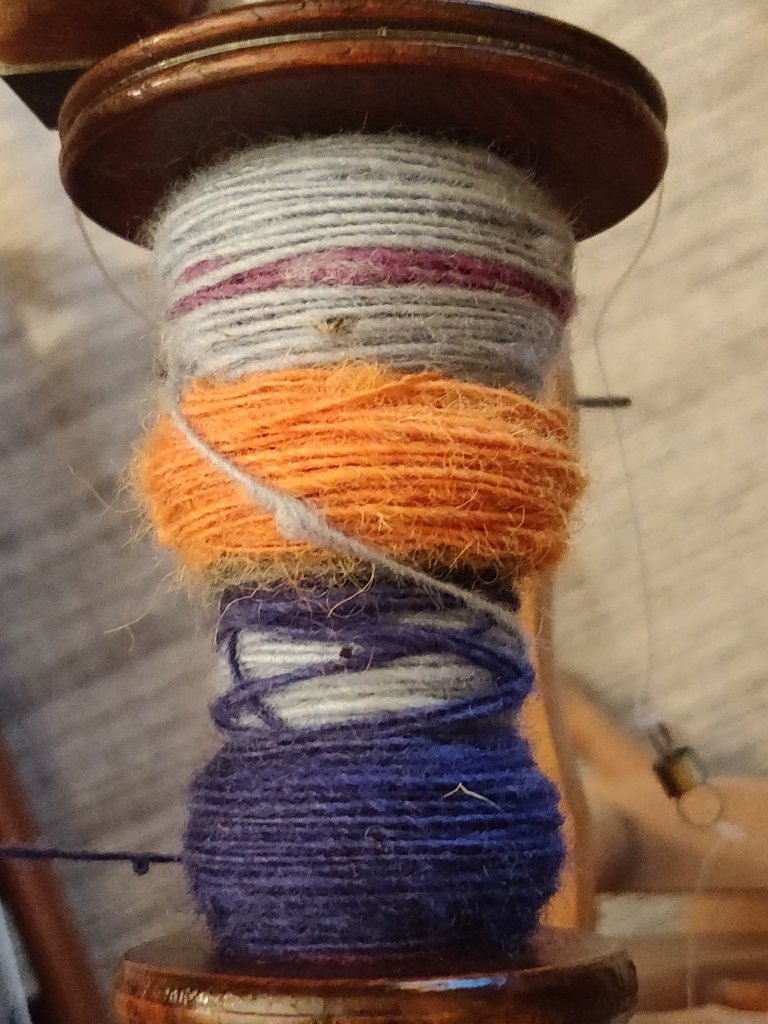
Spinning the lengths into singles
What a great tip!
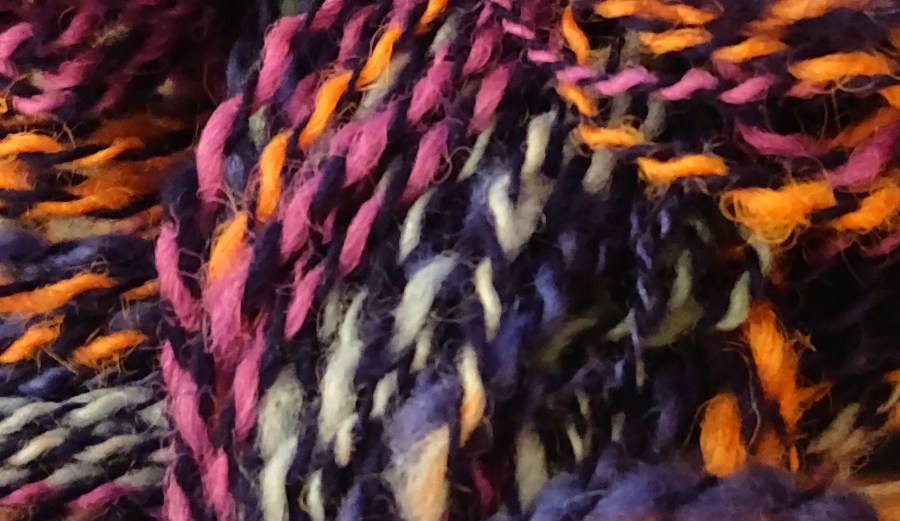
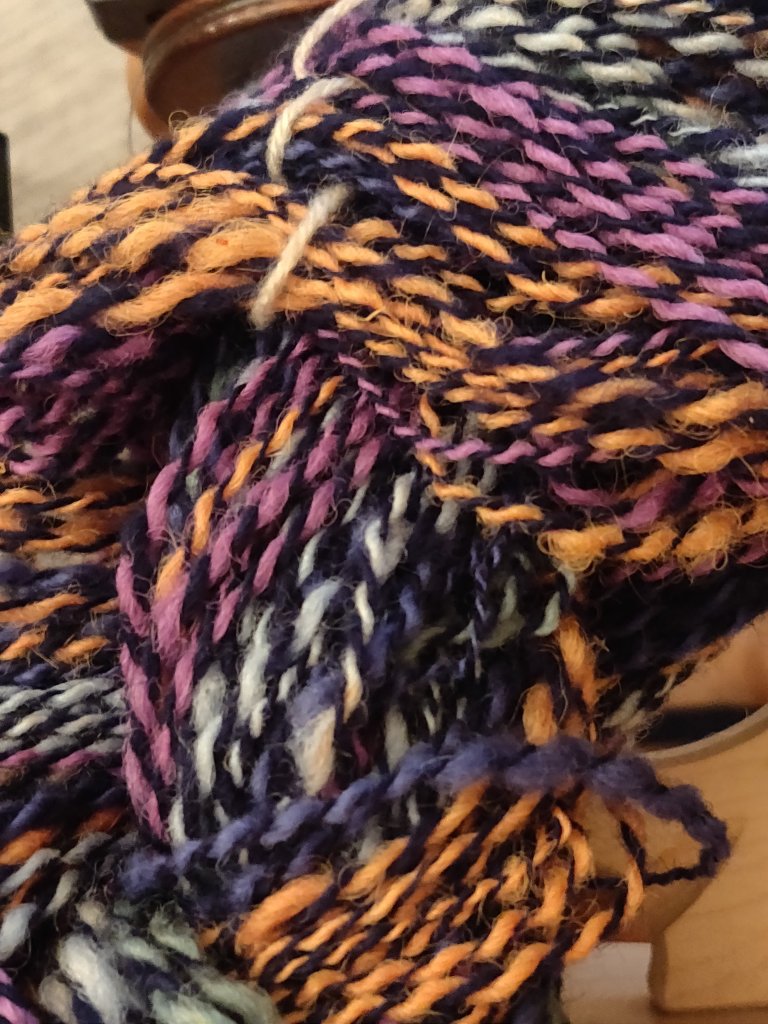
I plied the colour changing yarn with a single spun made from navy blue Corriedale. This made a lovely marl yarn that to me resembles stained glass windows. I can’t wait to see what it looks like knitted.
I have been doing quite a bit of drum carding of raw fleece I have gathered over the summer, and whilst doing this I recorded a couple of videos of the process.
This is the first one; picking and running the fibre through the carder the first time
I always put the batt back through the drum carder. I find this second carding makes a much nicer fibre for spinning. The second video covers doffing the fibre, splitting it and putting it back through. After this you can either take the batt off, as shown in the video below, or use a diz to take it off in a continuous roving. To do this, only separate one end of the batt (to the width of the diz), and pull the fibre off in a spiral as the drum reverses around.
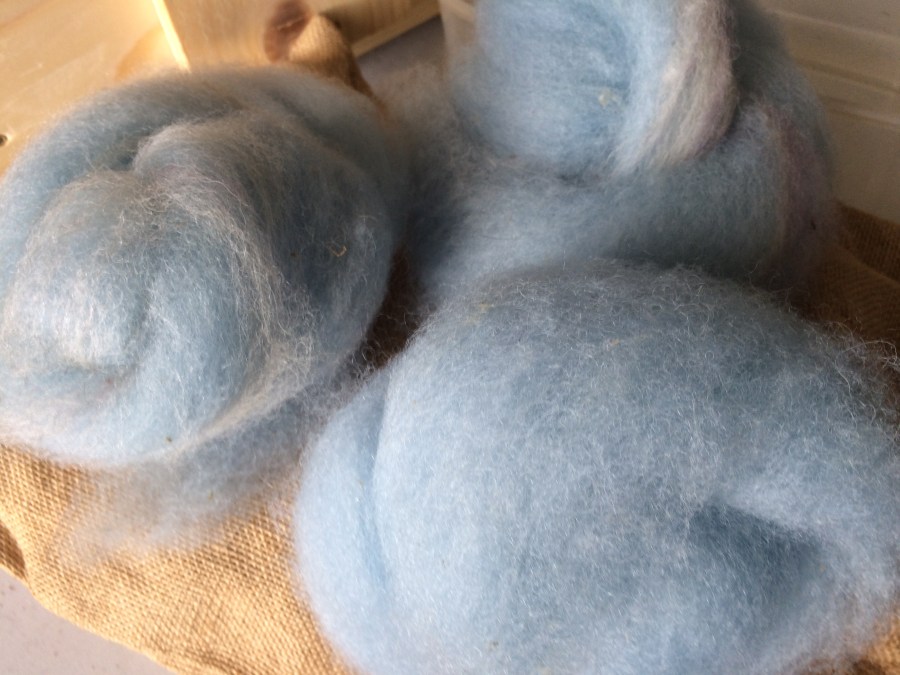
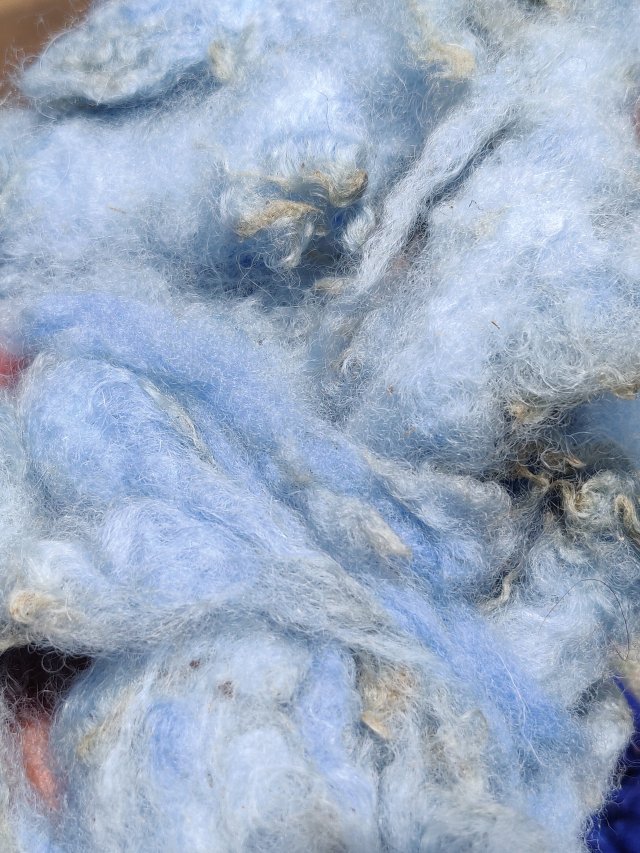
The wool is from a Dorset sheep, and I have hand-dyed it in acid dye to this rather pretty duck-egg blue.
The second video shows doffing the fibre and putting it back through the carder after splitting and drafting to thin it out.
I haven’t spun this fibre into any meaningful amount of yarn as yet. That is a pleasure I am saving for later.
In the video below you can see the fibre being picked prior to the carding.
Aplologies for the portrait aspect filming of this video!This was the fleece just after dyeing
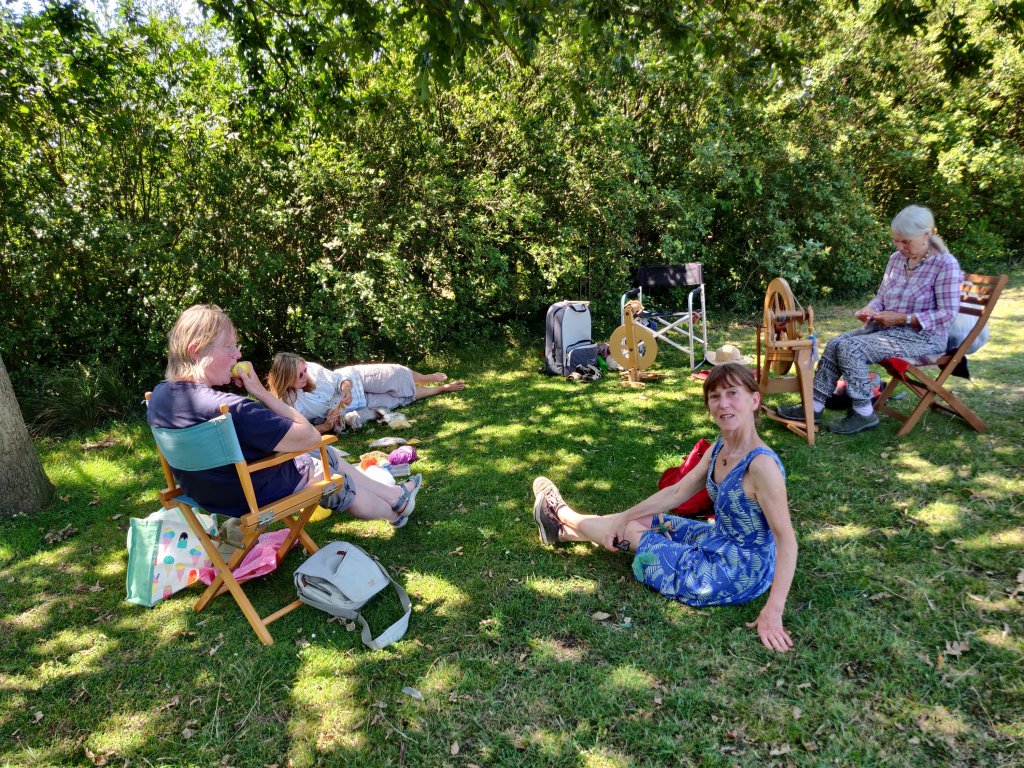
Is it risque? It’s certainly liberating. Given the restrictions on meeting up indoors, going to the park seemed the the perfect way to meet up when we can’t go to our normal groups.
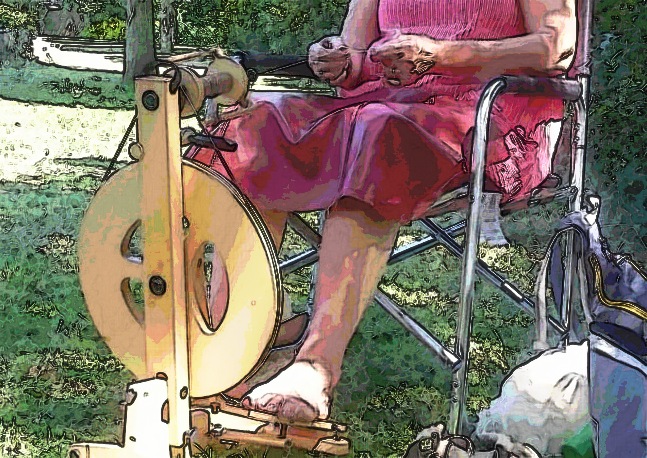
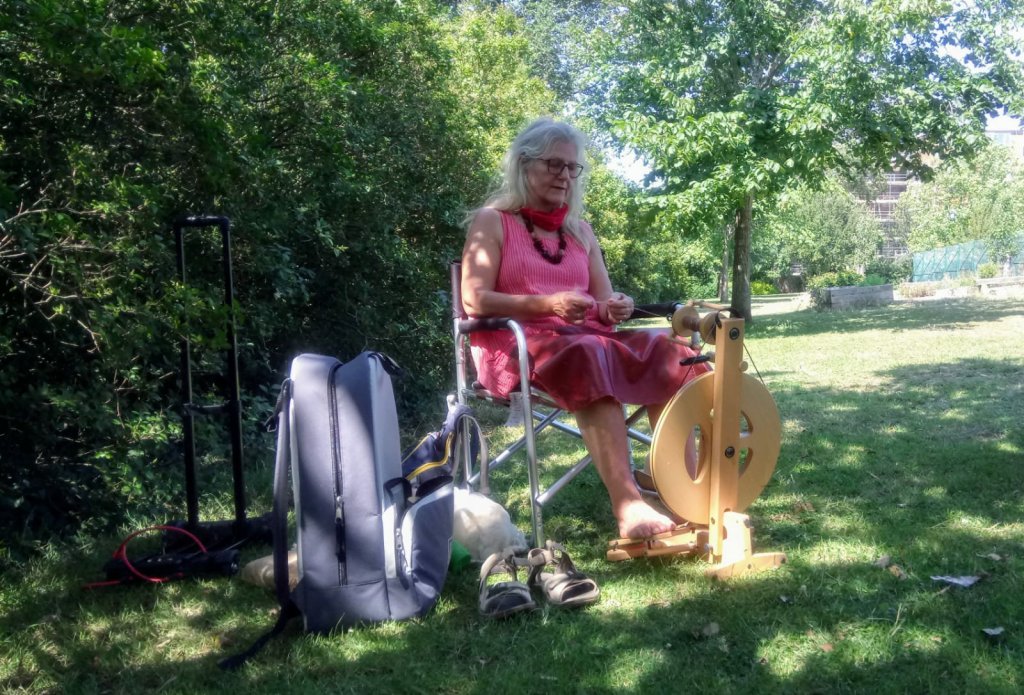
This is the second one I’ve organised and it was lovely way to spend a Friday afternoon. I took my portable Louet wheel and others brought wheels, drop spindles, knitting and crochet. And a picnic lunch!
Shade was mandatory as it was so hot, and we found a generous tree that have us a shady space big enough for plenty of social distancing.
I’m taking the photo…So someone kindly took one of me
I took along a sack of stove-top rainbow dyed fleece as described on my Dyeing Wool page. It’s a little coarse, but in nicely formed locks, so I am flick carding it and spinning it quite thick for use in a rug, (maybe)?


 Vikki Haffenden