Ready to spin

An hour spent blending on the drum carder has got me set for some serious spinning.

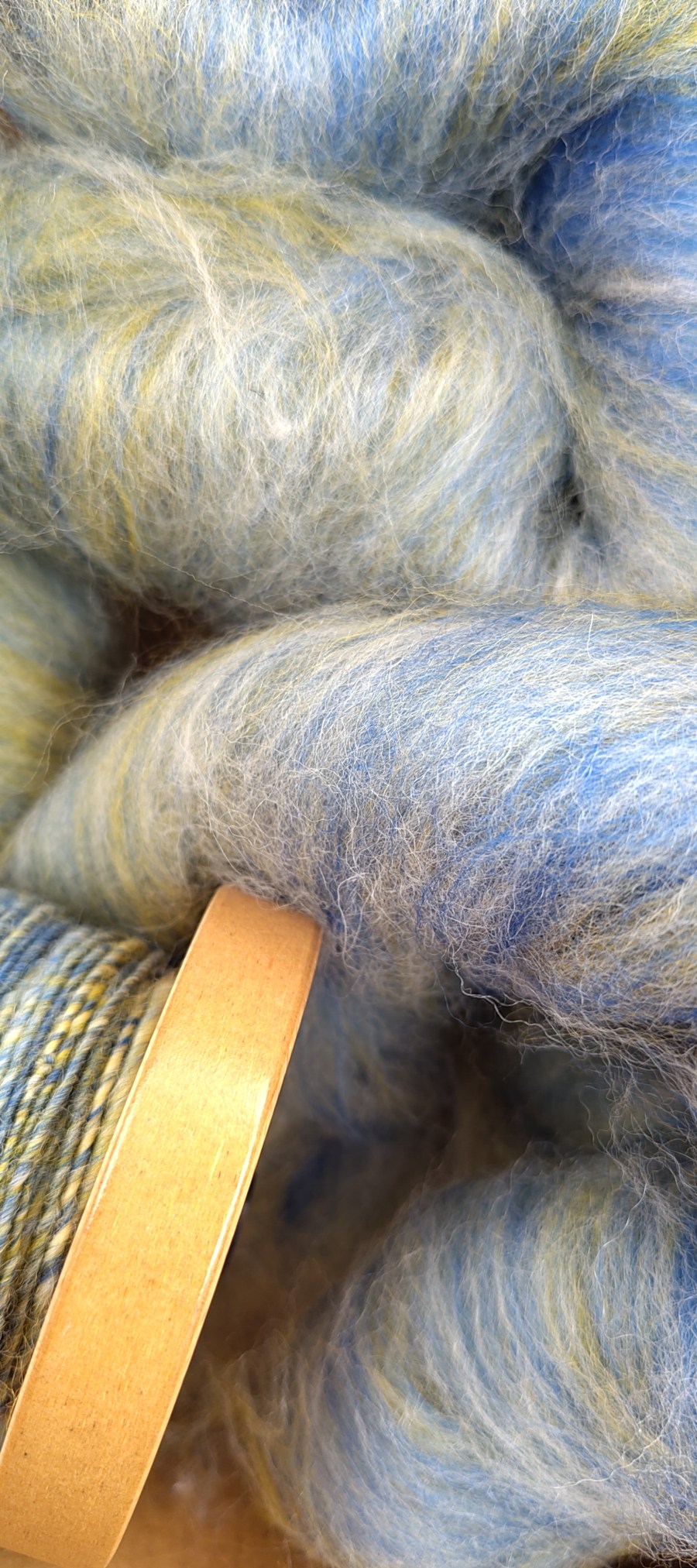
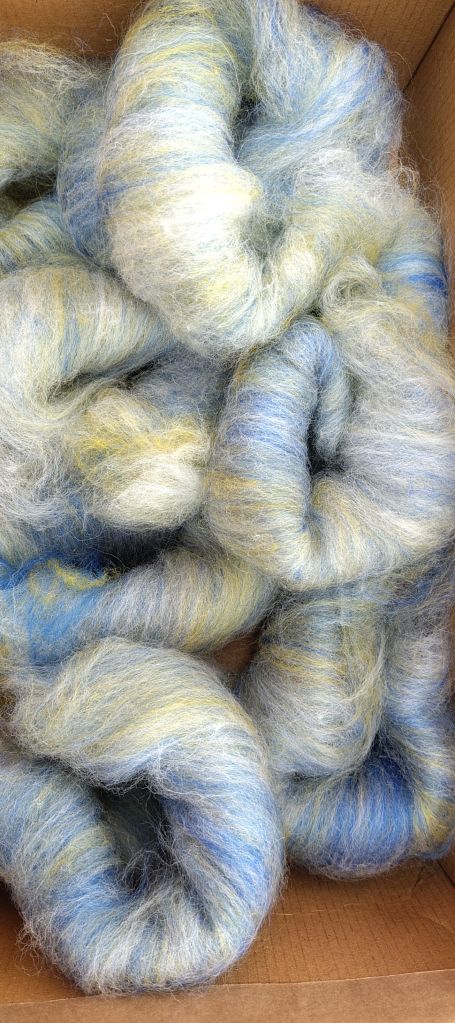
The yellow and natural are broken Merino tops that I picked up at the John arbon Open Day last year.  I’ve blended these in equal parts with a very strong ultra marine blue which I won in my local Guild raffle.

I tested this first on hand carders and it produced a very nice yarn so now I’ve done it in bulk and taken rolags of a batt from the drumcard.

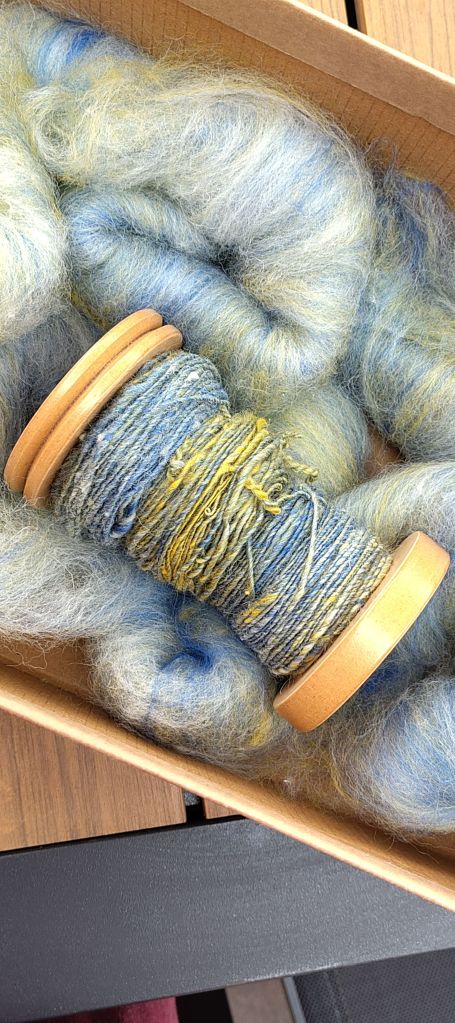
The singles so far.

I’m aiming for a 2 ply hand knit weight yarn, so spun the singles trying to let in a bit more fibre than I usually do. I read once that as you become more proficient at spinning you tend to spin finer, and that does seem to have been the case. Not that I’m claiming to be brilliant at it, just more practiced than I was.

This was spun the 1:8 whorl on my Louet S95 ‘Victoria’, which is the little folding portable wheel I take out to demonstrations. I aim to ply at the same ratio although I know it will probably work out a bit less. I am looking forward to spinning and plying this.

Final sample for my latest book about machine knitting

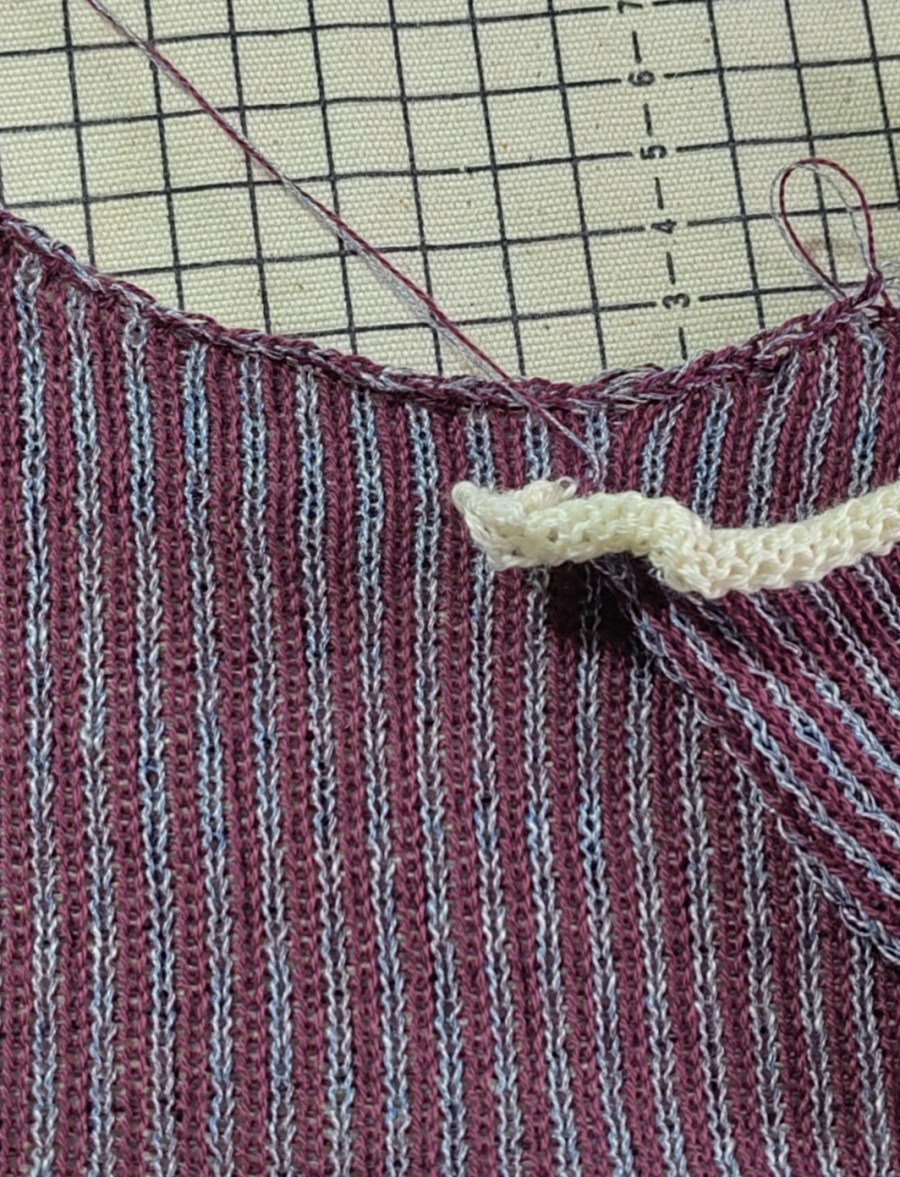
I think this might be the final sample for my latest book. The manuscript went into the publishers a week or so ago and I’m just working in a few outstanding samples and photos.

Of course machine knitters, well knitters in general, will know that ‘sorting out a sample’ is a shorthand for:

knitting several design swatches

knitting a tension swatch (or three)

working out the garment pattern

knitting it

finding you’ve made a mistake

knitting it again

steaming it

sewing it together

washing it

blocking it

etcetera, etcetera….

So I am just at the first steaming stage and getting ready to assemble the garment. And of course I’ve had to re-knit one piece because the dratted yarn got caught by the brushes irrevocably and it was easier to restart than try and sort that out. More haste, less speed is so very true in machine knitting. Nice and steady is always the best way.

I’m hoping this garment will be nice enough to go on the cover, but we will see.

Meanwhile let me tell you a little bit about the book. The title is still to be finalised, but it is all about short rows and partial knitting on a machine.  There is a lot in there for beginners, for example the first chapter is all about the principles of short rows and how you knit them and there is a whole basic techniques appendix at the back for additional support. Chapters 2 to 5 offer loads of information, samples, examples and exercises for more experienced knitters to really come to grips for short rows, and to understand how and when to use them for different results.

Chapter 6 has patterns that use short rows as they’ve been described in the earlier chapters, but applied to an item. So from these patterns you actually get to use short rows purposefully to create shape and form combined with colour and surface pattern.

So once it’s published I will obviously be shouting about it,  but keep an eye out and do pop back here for updates.

Enthusiasm is trumped by poor organisation

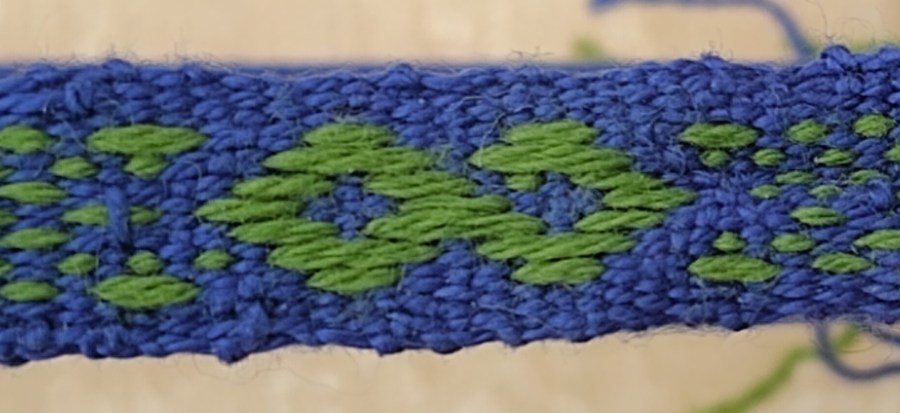
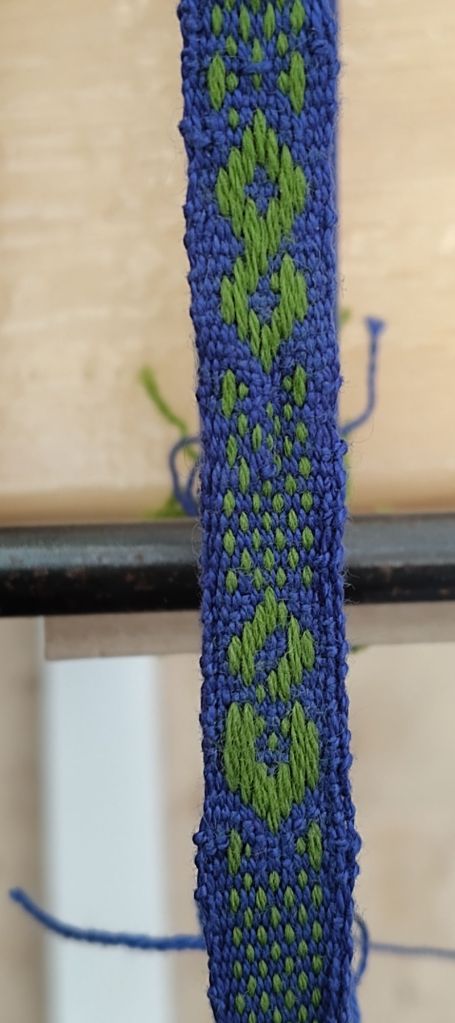
When we moved house I had only the first few centimetres worked of a rather intricate (for my level of skill) pattern on my big Inkle loom. So I carefully tied it all down, added tape and made it secure on the loom. Wrapped it in bubble wrap etc etc. and it travelled fine.

The first 4cm of pattern before I had to pack the loom.

Sadly, whilst unwrapping it, I somehow managed to cut the warp! Idiot….

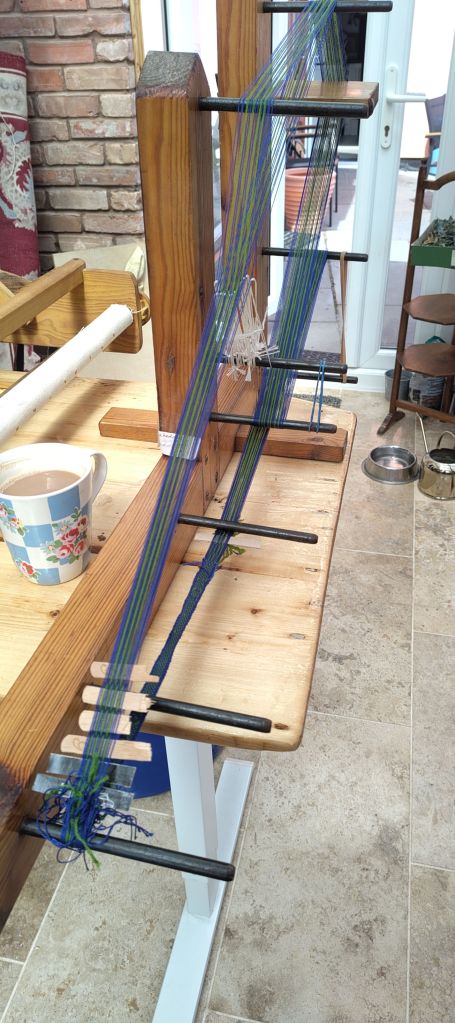
So the loom and dangling warp has languished in the conservatory for the best part of a year, unloved and testament to my incompetence. Today I decided, was the day to grapple with this and repair the warp. I refused to be beaten by it and started to analyse what needed to be tied to what. Luckily I had the written threading pattern to follow.

And I’ve done it! Only two mis ties hat to be undone and retied. I think that it will be OK. I’ve put in several pieces of card to re-tension and organise the warp and it looks good to go.

So I go to wind the shuttle, and realise I have no idea where the weft thread is! It’s somewhere in the loft in a box of unlabelled yarns, and believe me there must be about 20 of these… So do I want to go and search for it? Probably not today. That’s a job for later…

Making a warp for testing out my countermarch loom

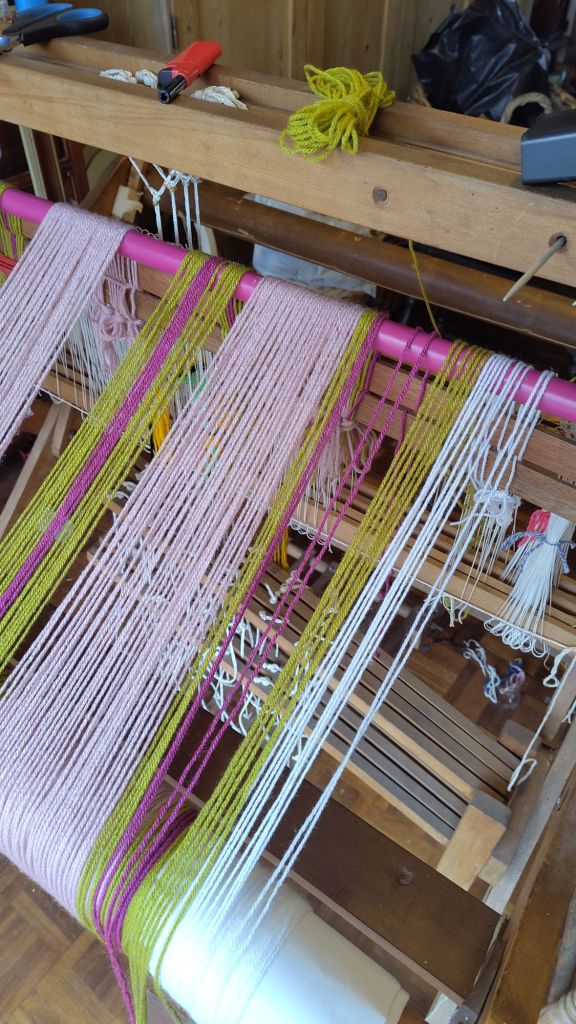
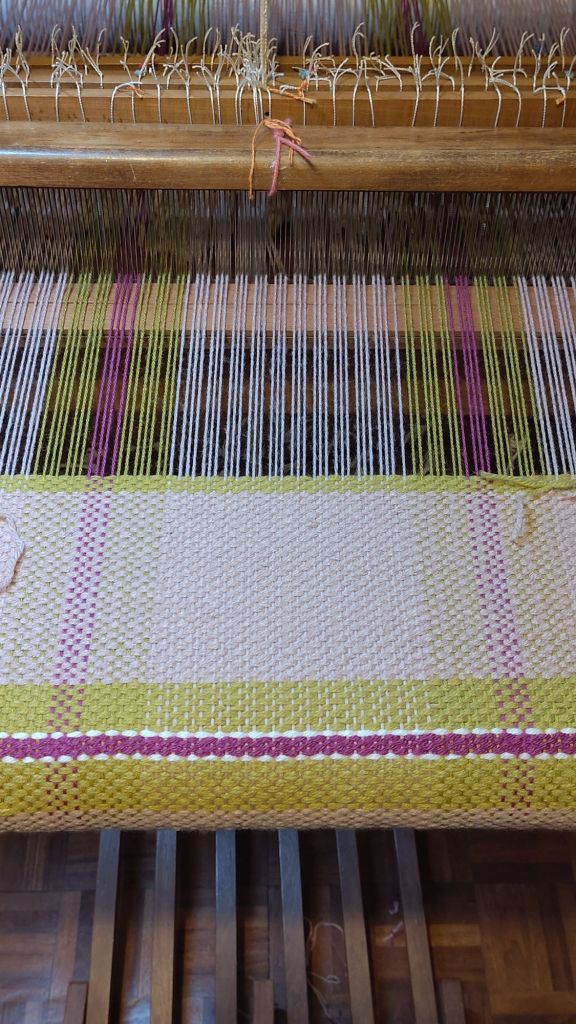
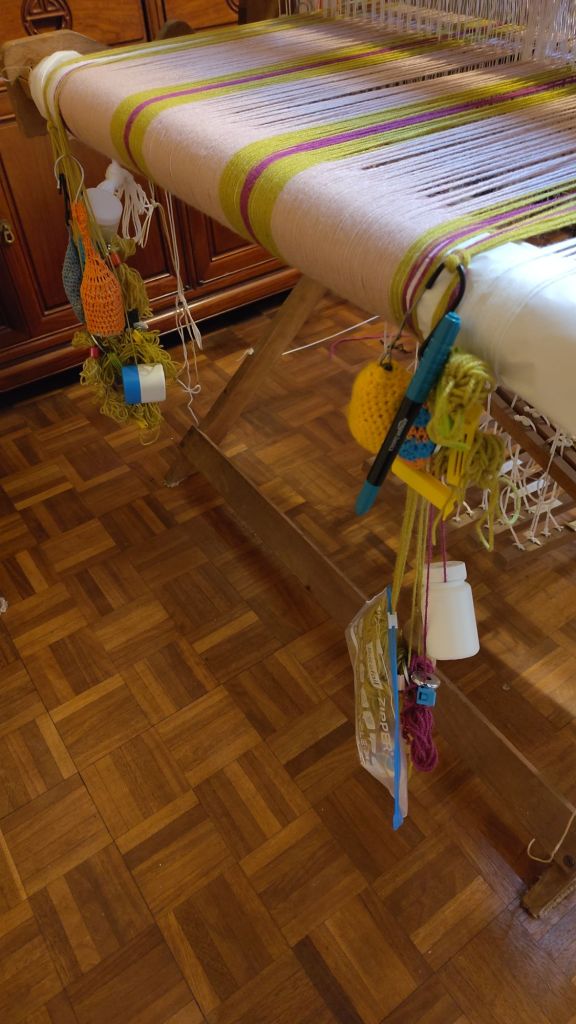
It’s taken me a while, but I have finally made the warp which I will use for testing out my new (to me) countermarch loom.

It’s taken me a while as we have building work going on in the house so I am moving from room to room to escape the chaos. I finally ran out of places to go, so ended up in the conservatory which is HOT. Lots of short breaks needed.

I am in two minds about what to weave. My heart says a fleece rug – I have two in bags in the shed, but my mind says ‘ do you need a rug,?’ What I really need is more tea towels, since my son burned a hole in one of my hand woven ones.

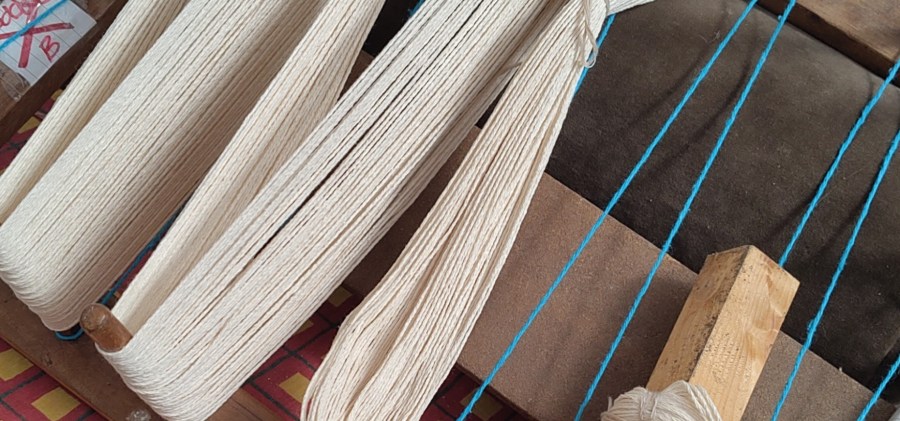
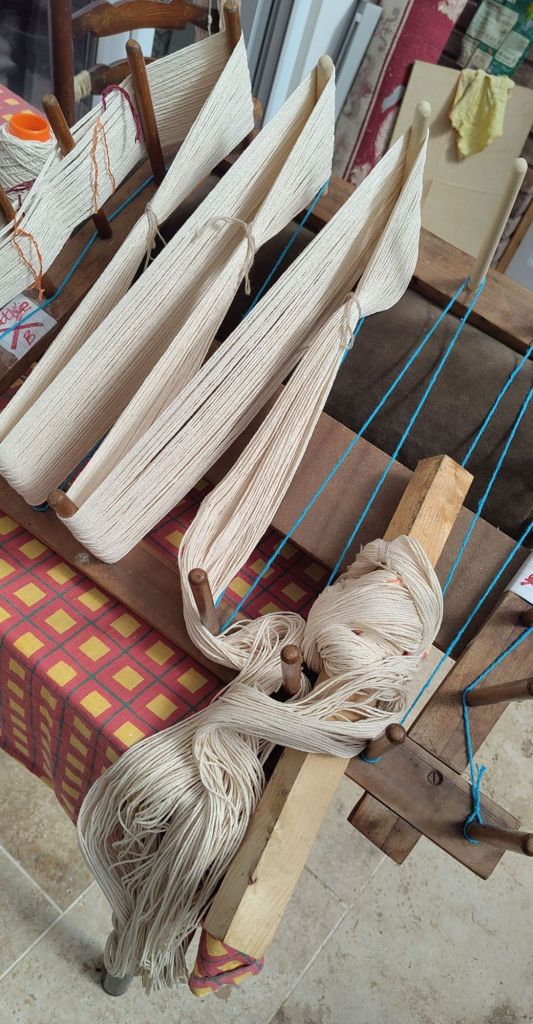
The loom has got an 8 dent reed and I am using a thickish cotton and making a sectional warp because my warping board pegs won’t take more than 80 ends of this. I’ll thread it up as a twill and let myself be guided by the spirit of the day I start to weave.

Winding the warp of the warping board onto a kite stick, as recommended by Peggy Osterkamp

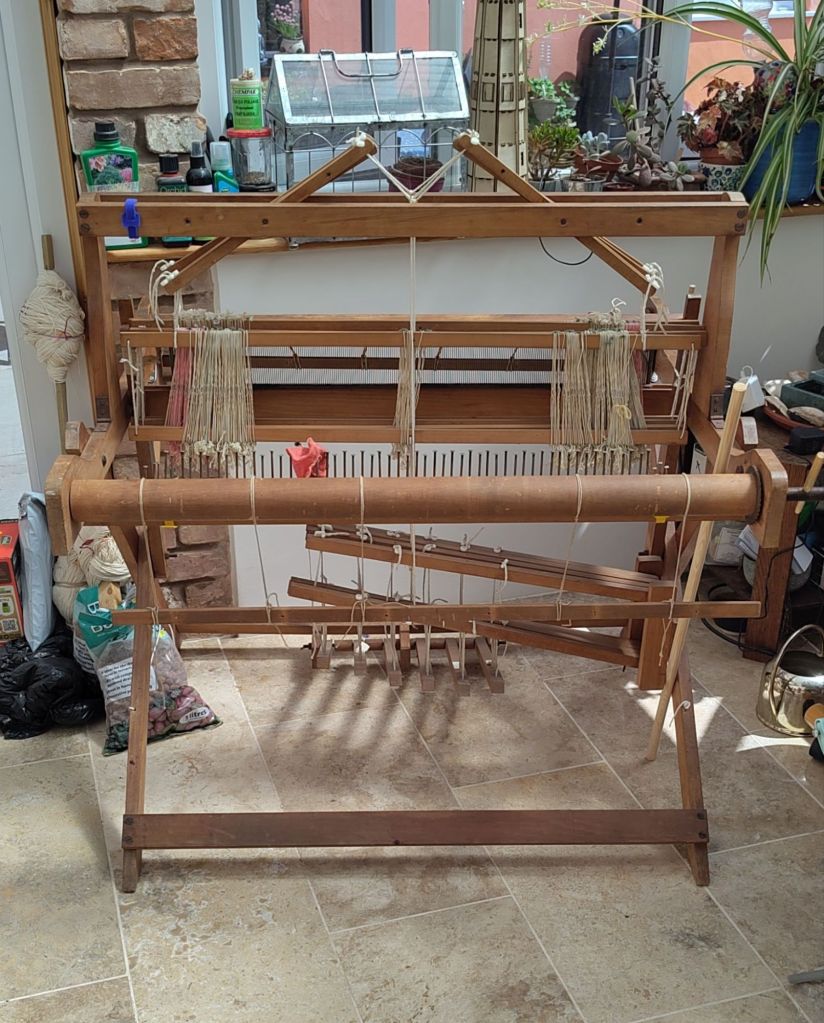
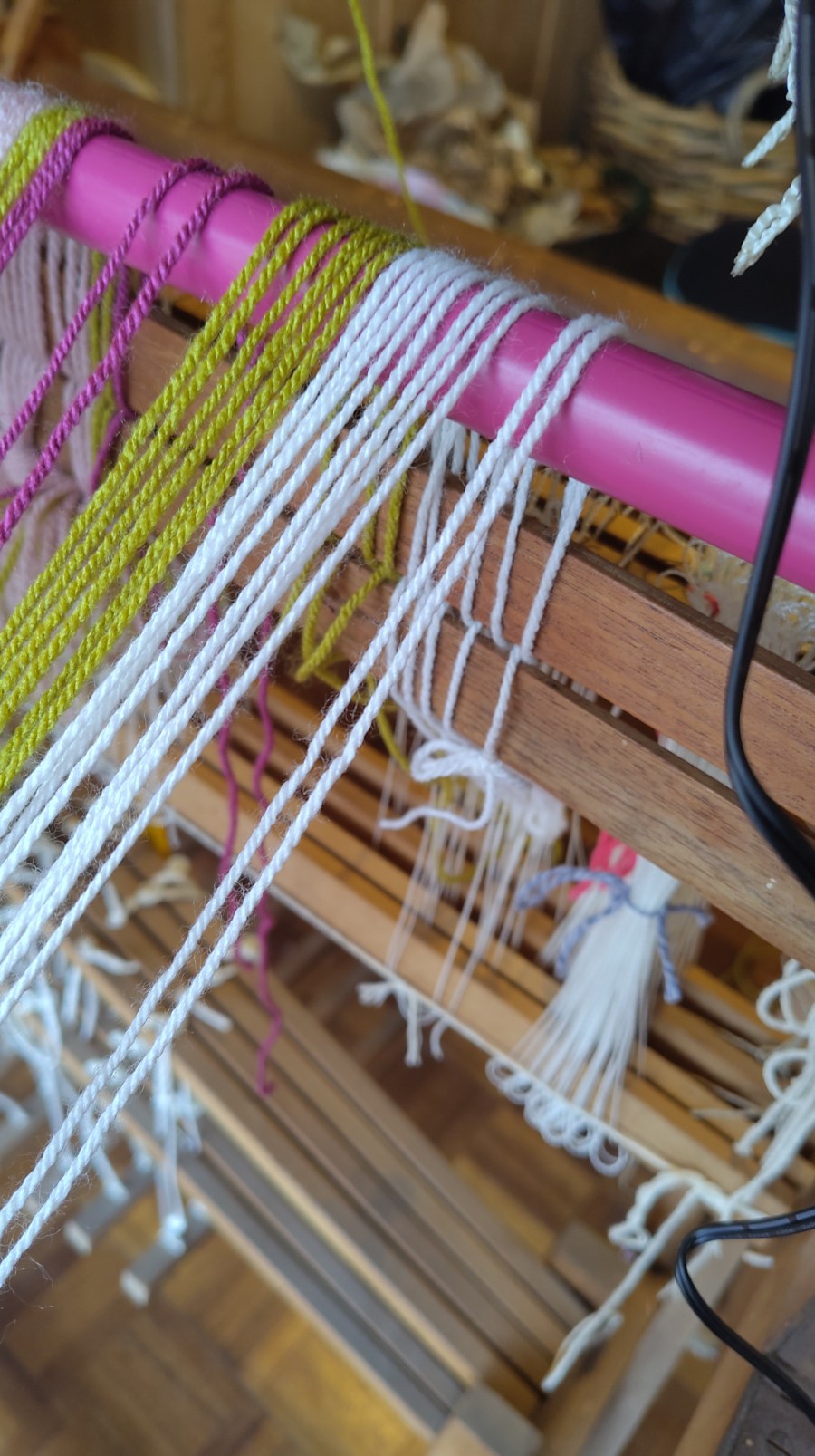
The loom waiting for the warp. I know I’ll be whining about back ache quite soon…

Reforming ribs on a knitting machine

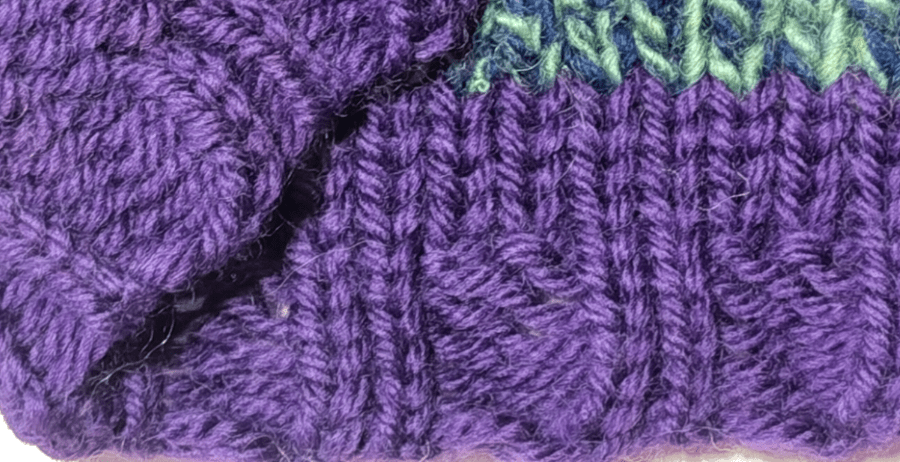
Reformin, or ‘latching-up’ single bed stitches into a rib structure is sometimes seen as far too time-consuming for a ‘fast’ activity like machine knitting. However, I quite enjoy the process and have written about it and made a ‘workshop’ video of working a 2×2 reformed rib here. I hope you find it of interest and useful.

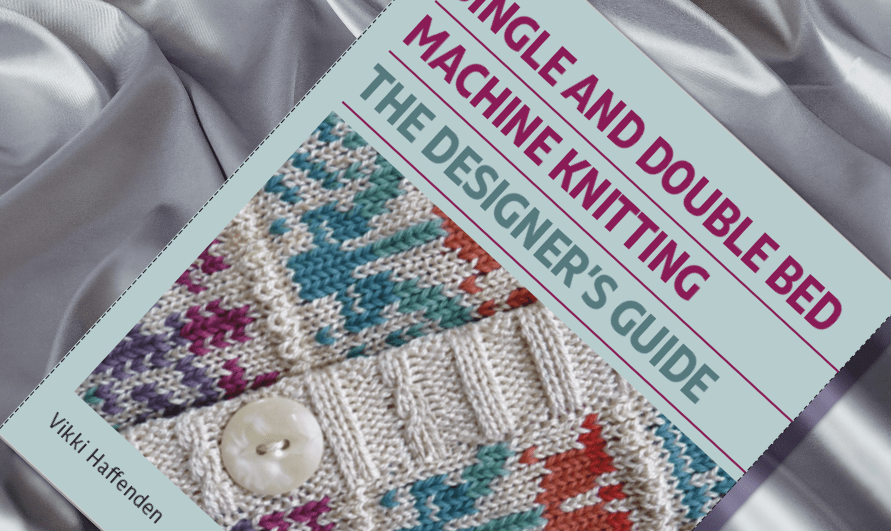
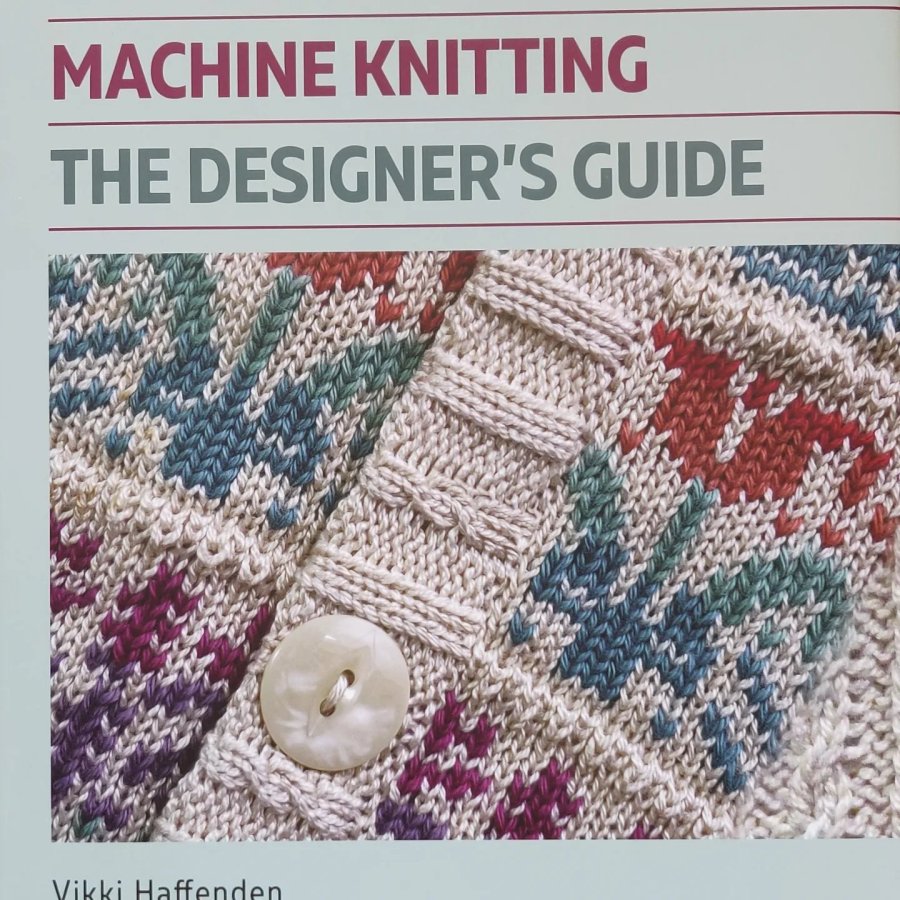
Cover of Singel and Double Bed Machine Knitting: the Designer's Guide

How to meet my readers…?

Hello there. I am keen to know my readers, and meet people who own a copy of either of my knitting books, ‘Translating Between Hand and Machine Knitting’ or ‘Single and Double Bed Machine Knitting; the Designer’s Guide’. Obviously meeting people in person might be tricky, so I have been wracking my brains about how to do this and settled on trying to set up an image gallery of people who own a copy of one of both of these books.

It would be wonderful if you could post a photo of yourself holding your copy, and with your knitting machine as well if it works for you. If you prefer not to be in the photo yourself, a photo of your copy of the book sitting on top of your knitting machine would be lovely, and a piece of your knitting as well maybe? Please also add a brief review if you have time, its always useful to get an insight into how readers see what I have written and feedback helps me develop my approach for future books.

I can only think of Facebook or Instagram, but I’m sure you will have other favourite places to post. It would be good if you could add the hashtags shown below so that I can find your posts. I will start the ball rolling on Instagram.

Hashtags   #vikkihaffenden, #TBHMK, #SDBMK, #vikkiknit, #crowoodpress, #machineknitting

When you post a photo, do feel free to leave me a message pointing to it on this page.

‘Single and Double Bed Machine Knitting; the Designer’s Guide’

The advance copy of my new book arrived today, and you can see some pages from the book here.

Meanwhile here is a quick look at the book.

I have made a more in depth video introduction to the book, and if you would like to watch this, please keep on scrolling down the page.

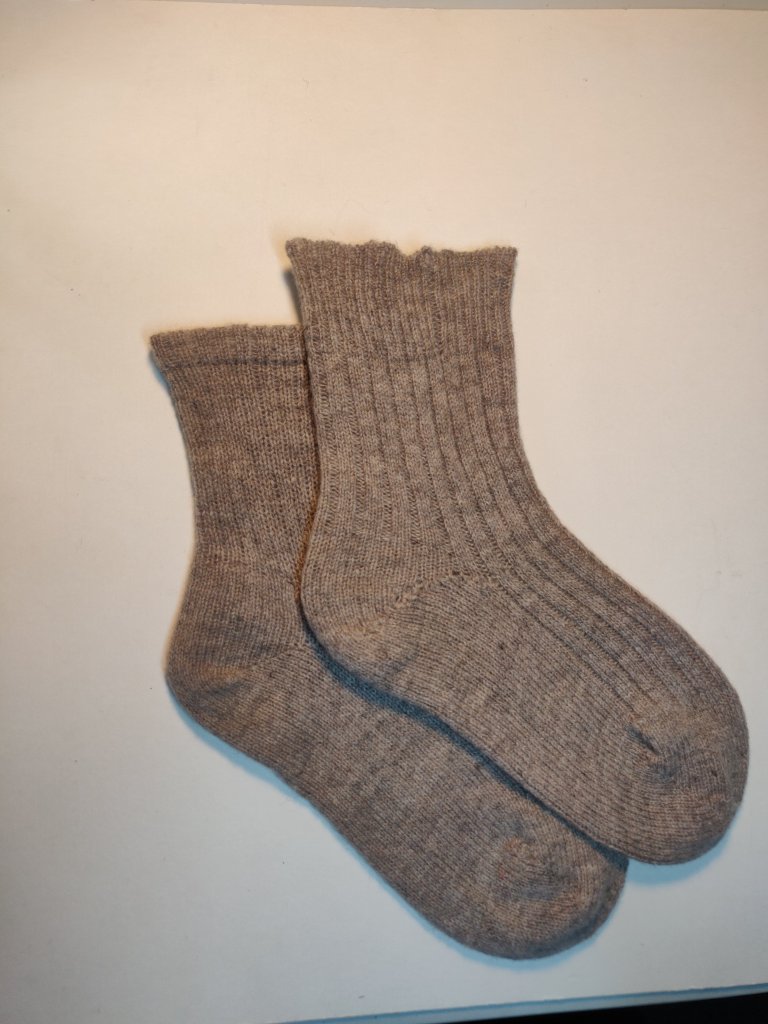
Seamless machine knit socks

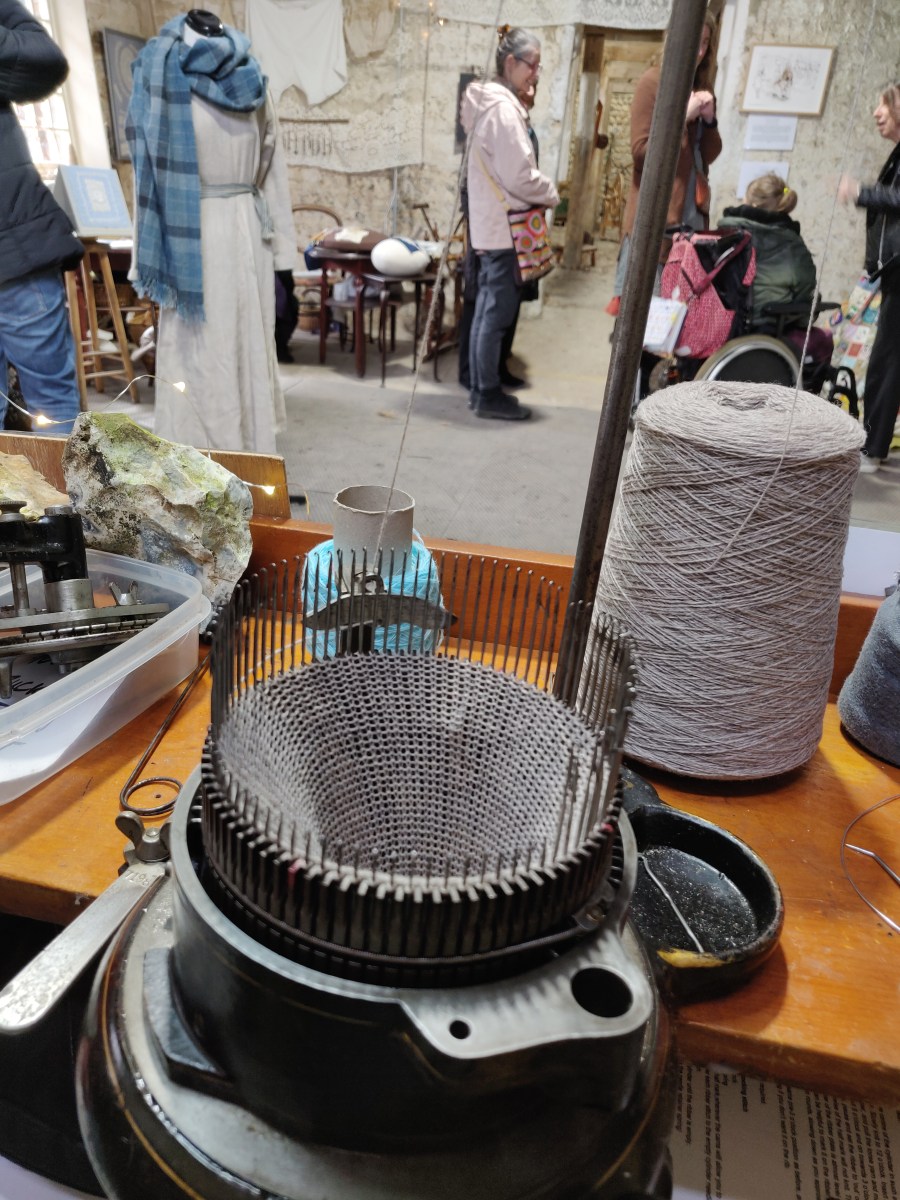
Slow and steady is best when demonstrating live!

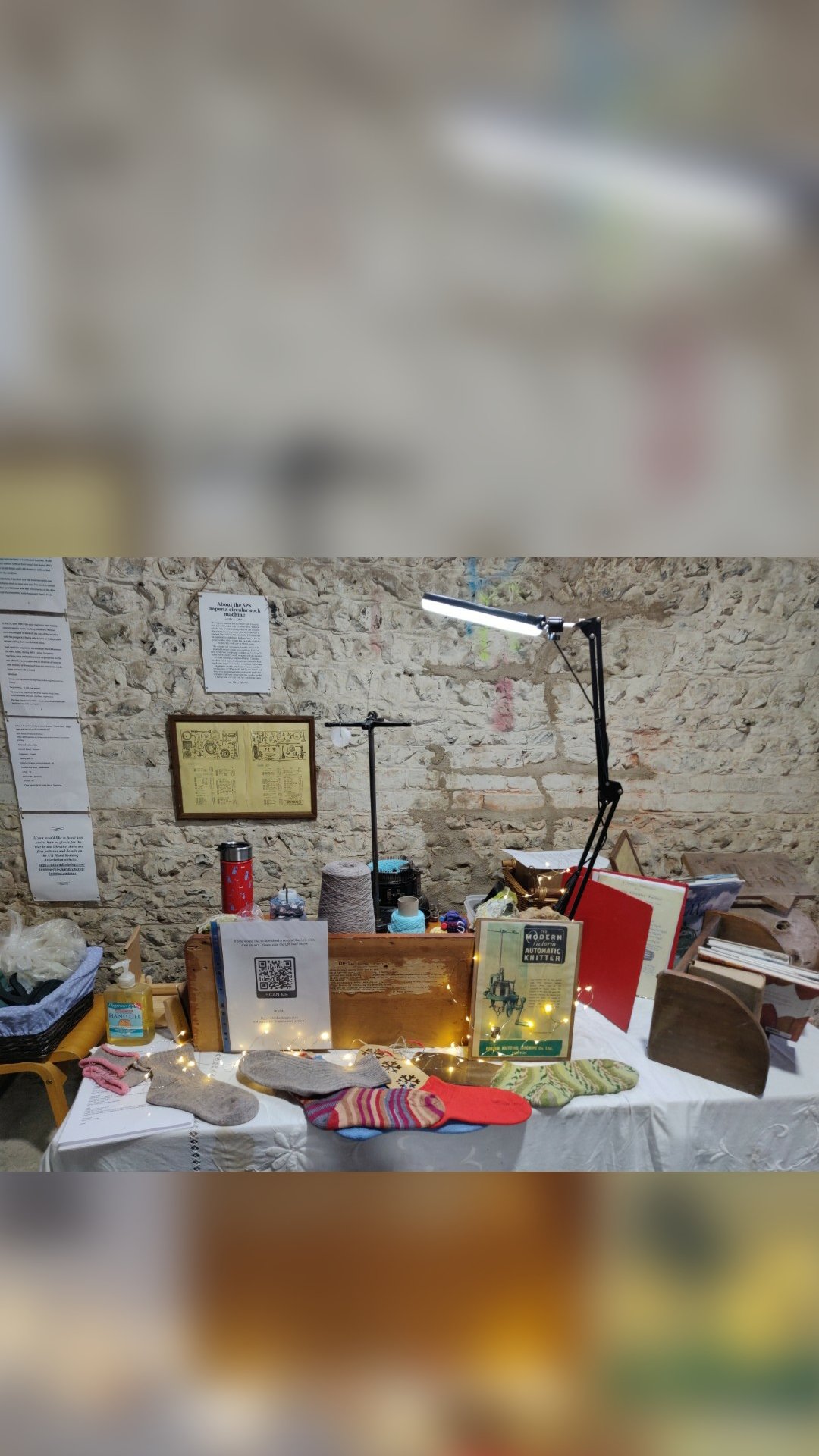
This was taken at Traditions in the Making, a Heritage Craft event at Stanmer Park, Brighton. With lots of volunteers from local community textile group Woolly Umbrella, alongside the CSM there were demonstrations of flax processing, lace making, weaving, inkle looms, wool fibre preparation (hand and drum carding), embroidery and wool and flax spinning.

The CSM is an Imperia with an 84 slot cylinder and gm here I am knitting a sock in traditional 3ply sock wool; no nylon. This was the nearest we could get that was most like the wool probably used originally on the machine. Although I have knitted on it with hand spun I felt that demonstrating required enough concentration without the worry of irregular yarn!

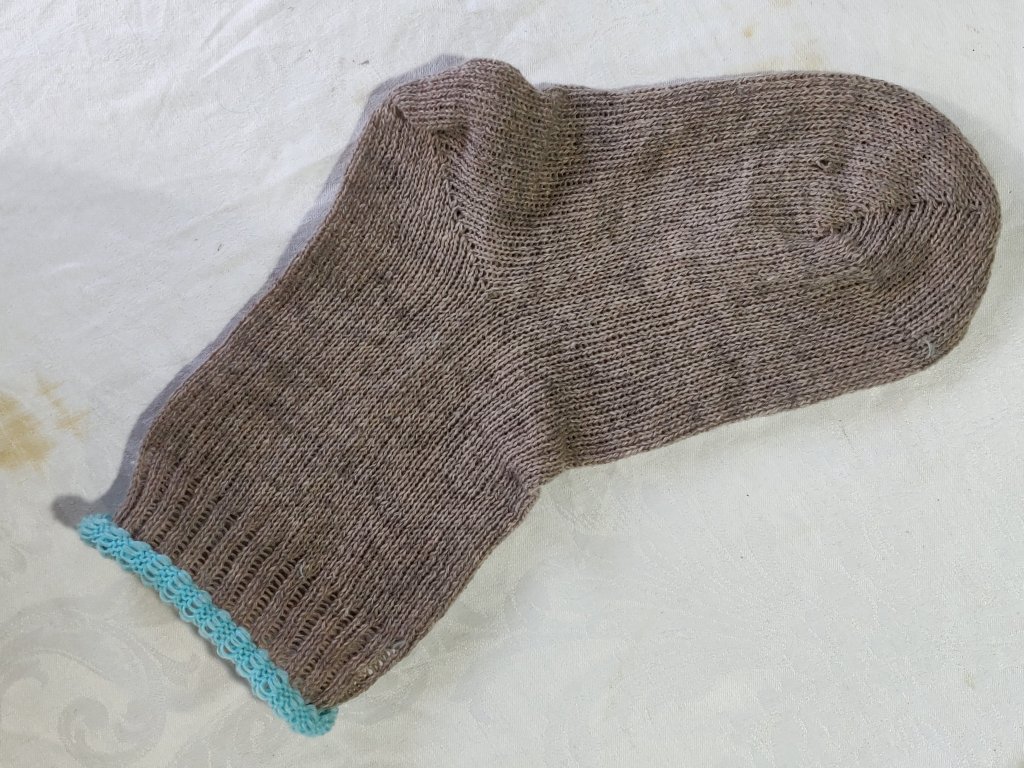
Two types of socks in the 3 ply yarn, fake rib and true rib.

In a brave, but foolish, moment I decided to try a toe-up sock at one point. It wasn’t too bad at all, and I am quite pleased with the result.

Toe up sock, still waiting to be hand finished

Proofreading ‘Single and Double Bed Machine Knitting; the Designer’s Guide’

I am now part way through proofreading my latest book. It’s a lot knottier checking double bed as well as single bed instructions!

The book covers, without stating the obvious, single and double bed machine knitting techniques and design. Brother,  Silver reed/Knitmaster are the main machines, but Passap machines are also included in some sections.

Step by step instructions are illustrated as well as explained in the text and at the end of each chapter there is a Design Studio exploring how to develop the techniques discussed in the first part of the chapter.

It’s got to be done before Christmas, so early mornings and late nights are the order of the day. I’m baking mince pies when taking a rest from the screen.

If you enjoyed Translating Between Hand and Machine Knitting, or are looking for the definitive book on machine knitting I think to will want this book.  You will be able to pre-order soon so keep an eye out.

‘Single and Double Bed Machine Knitting’; The Designer’s Guide‘ will be published in Spring 2023. Yippee.