
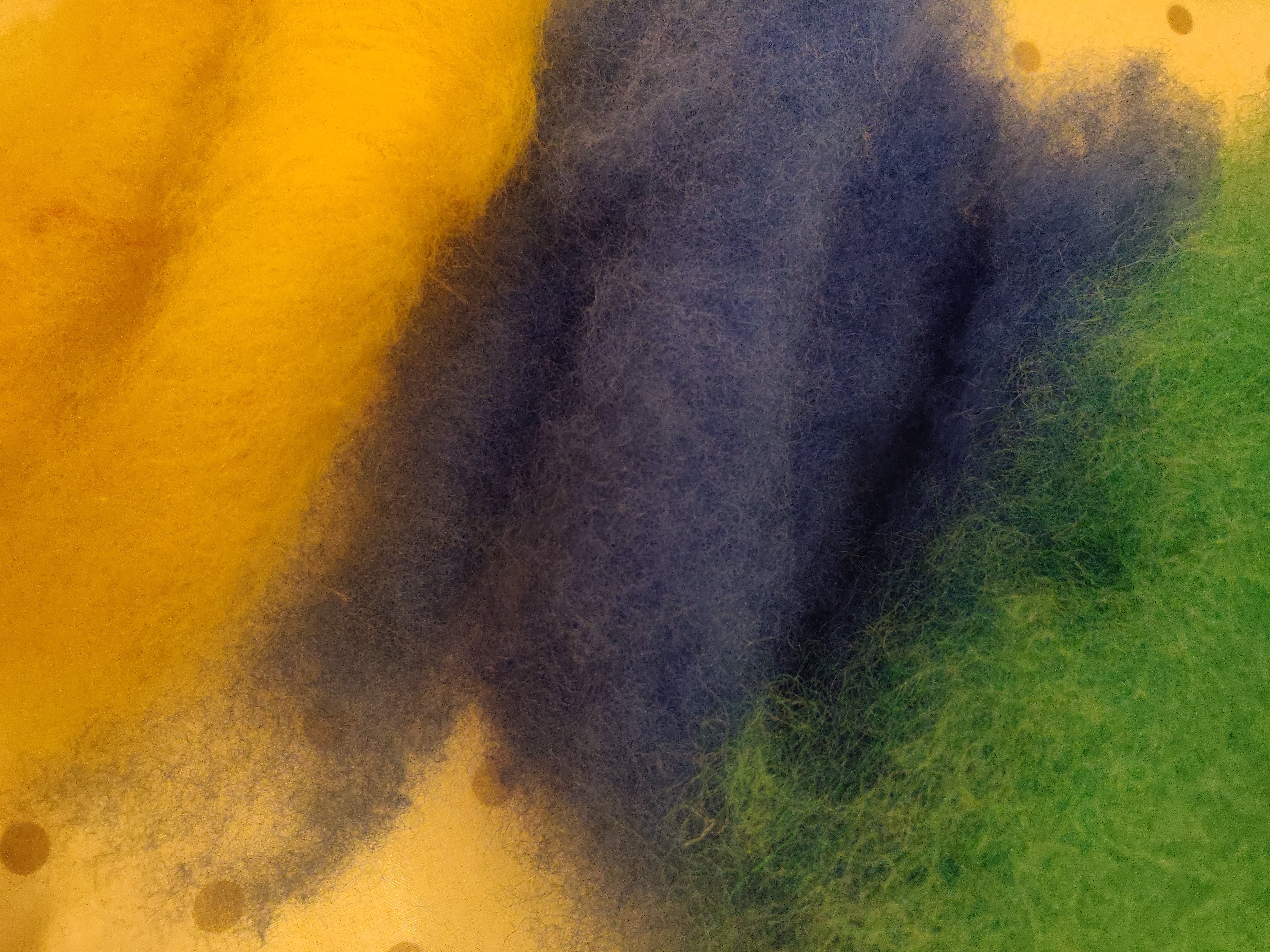
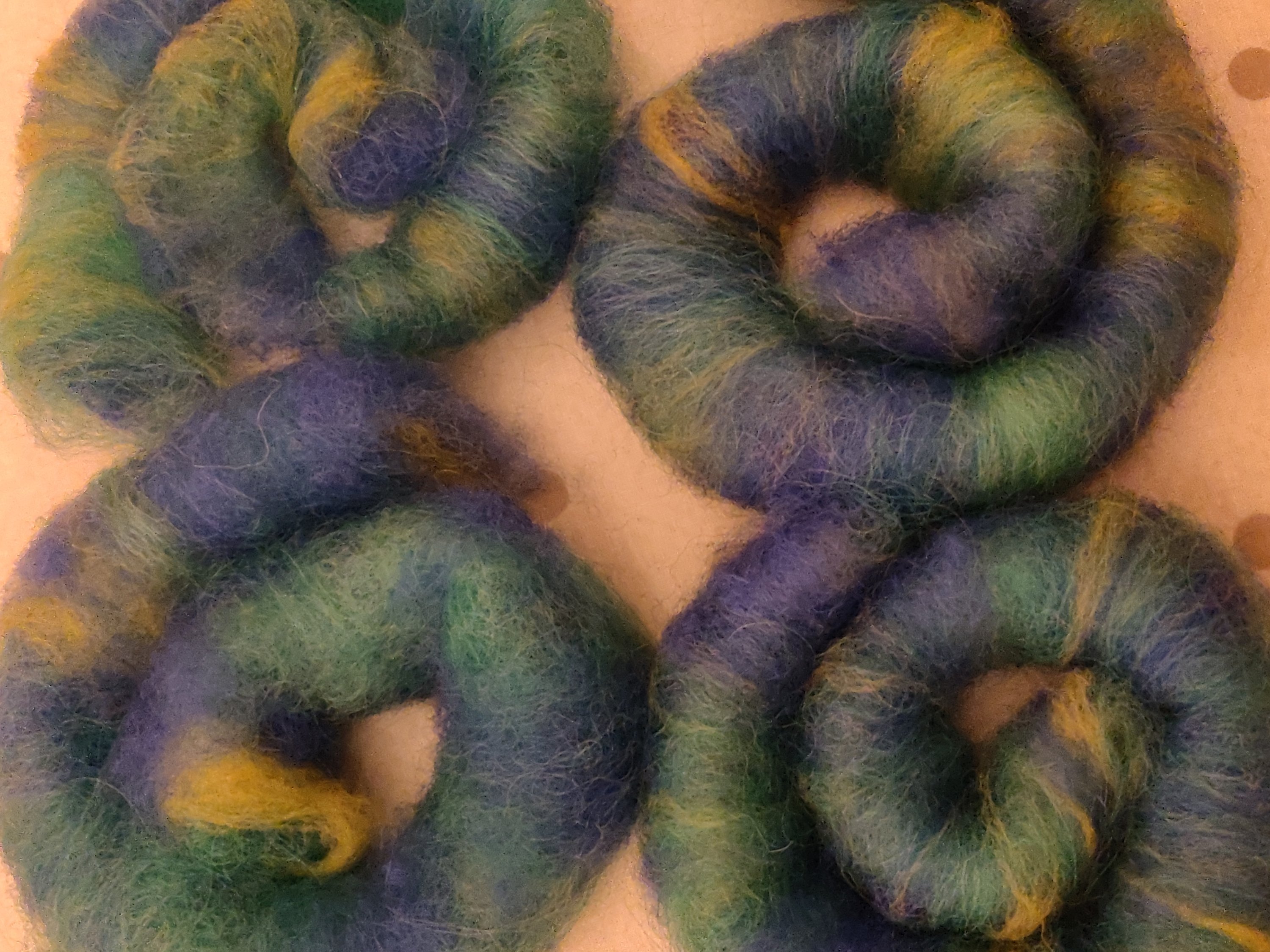
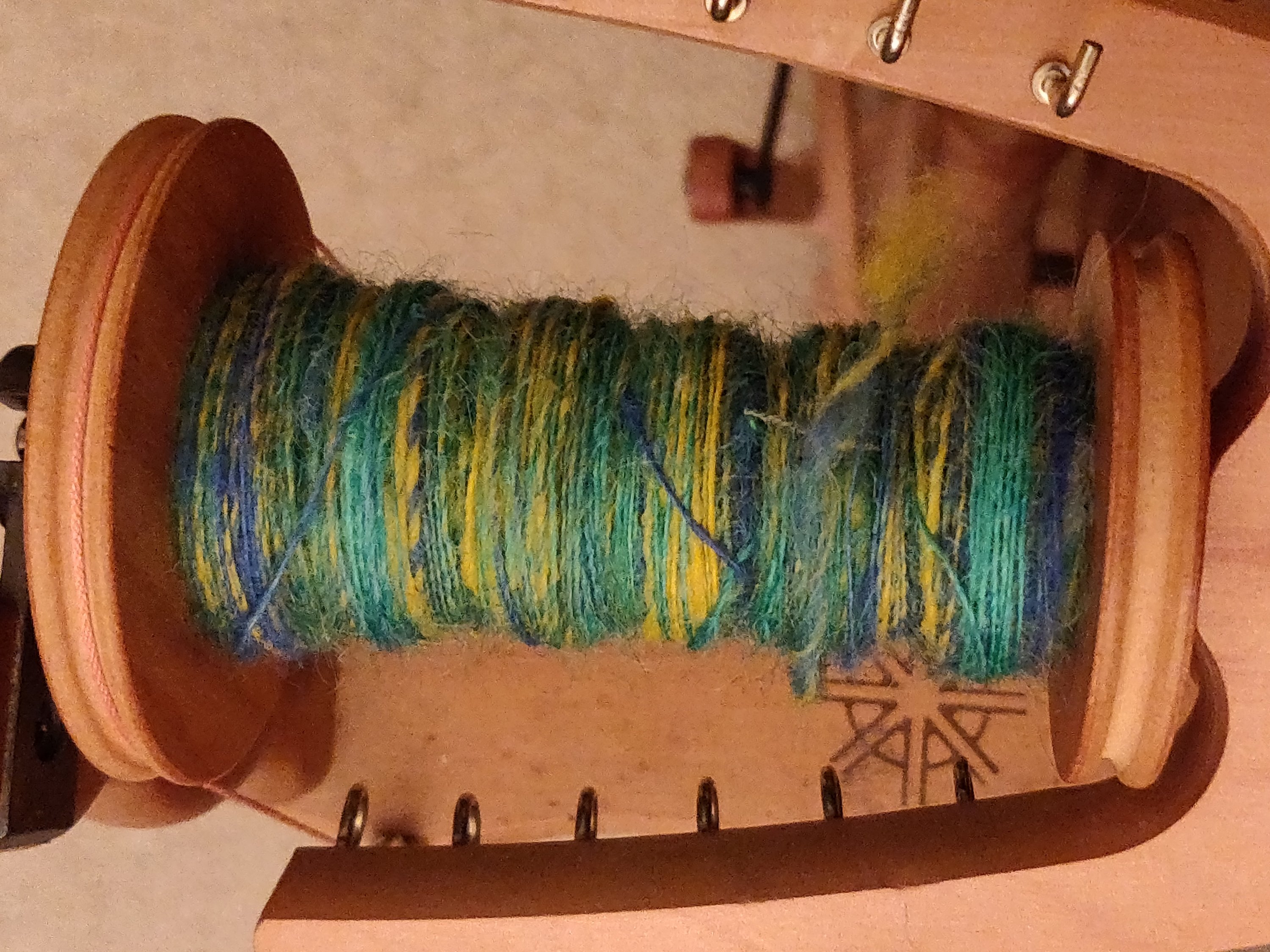
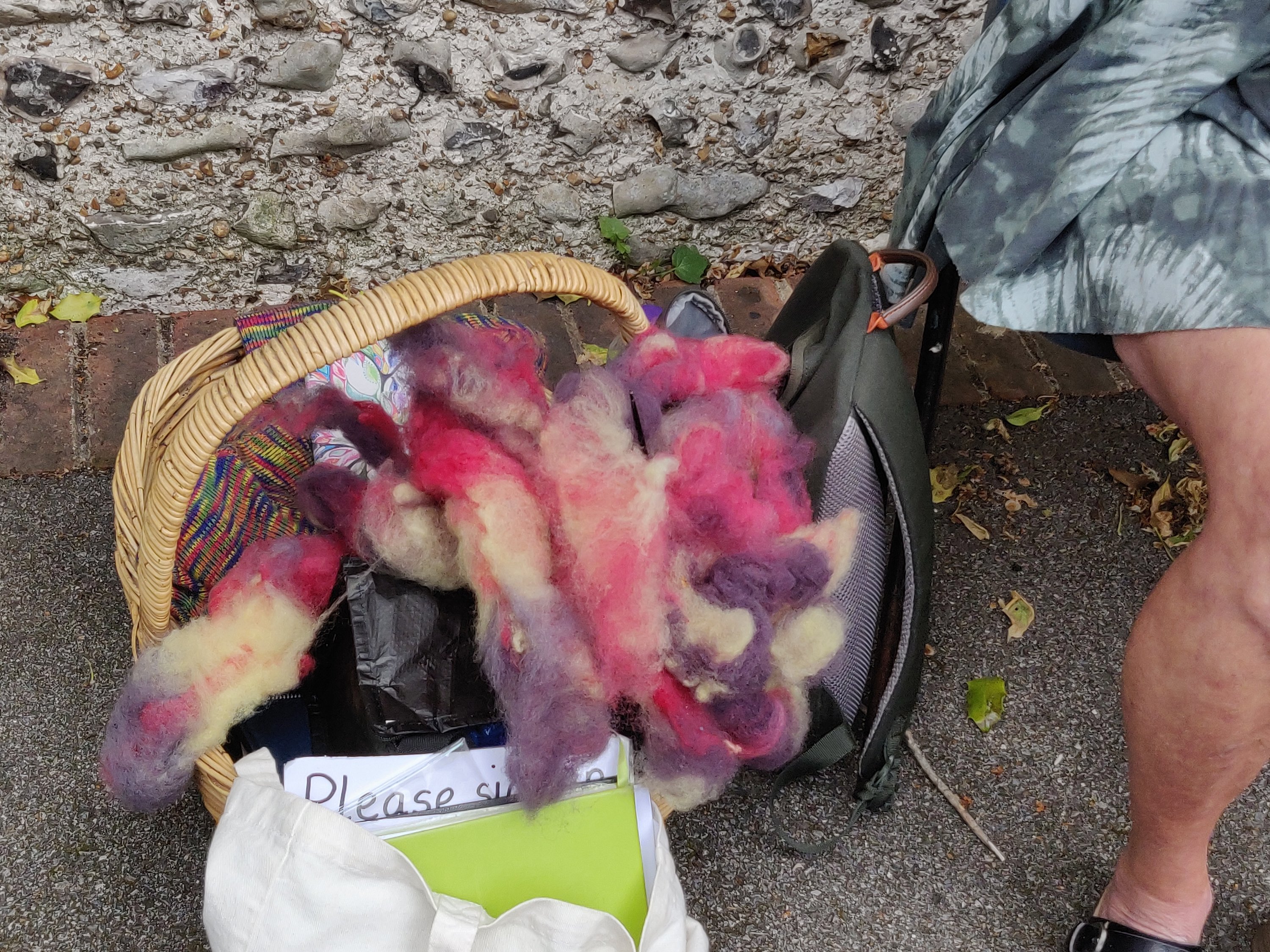
A happy hour or so spent hand carding hand dyed fleece, whilst watching tv. Then using my home made blending board to make the next batch of rolags to spin more of my ‘Greenfinch’ variegated singles.
Category: spinning
Spinning a balanced yarn
The fleece I am working with is not brilliant, but I am using it to practise making a balanced, soft spun woollen yarn for knitting. To do this I read up on Mabel Ross’ method, and with a little tweaking to suit my preferred yarn handle, it worked!
Mabel Ross worked it out for us and it is quite logical really. You do need to know your wheel’s ratios, work consistently with your draft and count your treadling to start with, so if thats not your style, don’t go there.
I was aiming for around 2tpi in the finished yarn, but actually increased this a little after the first samples.
The equation is to do with spinning the singles at the tpi you want and then plying them to get the final tpi you want. Its really helpful to remember that if you spin your singles Z, when you ply them S you will be unwinding some of the single’s twist. (update- I have subsequently spun some yarn at a much higher tpi using a 1:10 whorl that has come out soft after a similarly balancing plying method. Maybe I’m getting it…)
I worked backwards from my 2tpi goal.
For example: I was working with a 1:6 whorl, therefore one revolution of my wheel would turn the bobbin 6 times. I was spinning ‘Z’ twist with a long draw of 12″.
First of all I needed to know how many treadles to the 12″ draft would give me the tpi I required. Yes I know I’ve muddled metric and imperial, but it still works.
Number of treadles = (required tpi x planned draft length)/ divided by wheel ratio (which i know will be 6)
tpi of my singles = tpi of my plied yarn divided by number of plies
II reckoned that if I want 2tpi in the plied yarn, I needed to spin the singles at around 4tpi.
The equation I worked with using MR method to find out how many treadles I needed to a set draft length was:
tpi = (wheel ratio x treadles)/divided by draft length.
Go back to the earlier question of how many treadles?
Number of treadles = (required tpi x planned draft length)/ divided by wheel ratio (which i know will be 6)
which came out as
tpi (4) x draft (12″) = 48/6 = 8.
So 8 treadles using the 1:6 whorl to a 12′ draft should give me 4tpi. in my singles…
Well I wrote this post a while ago, and since then have done some spinning. It was not successful, way to soft and loose spun for my taste, but a balanced yarn – no twisting and it knits without bias.
I upped singles tpi a little and also the ply by a smaller amount and the yarn improved. and stayed balanced! A lesson learned.
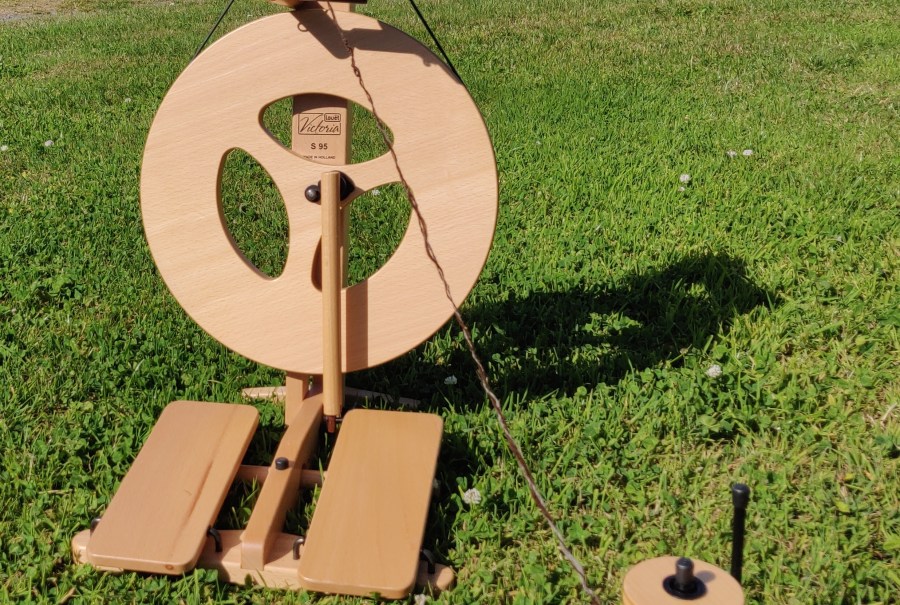
Plein-aire spinning
A bit like outdoor anything – providing its not raining or freezing – spinning is enhanced by the open-air. I took my little Louet wheel with me whilst on holiday on the Pembroke coast recently. We were being careful and avoiding towns etc in our caravan sitting on a farm, so there was plenty of opportunity to spin in the lovely sunshine. It seems ages ago now, but was so refreshing.

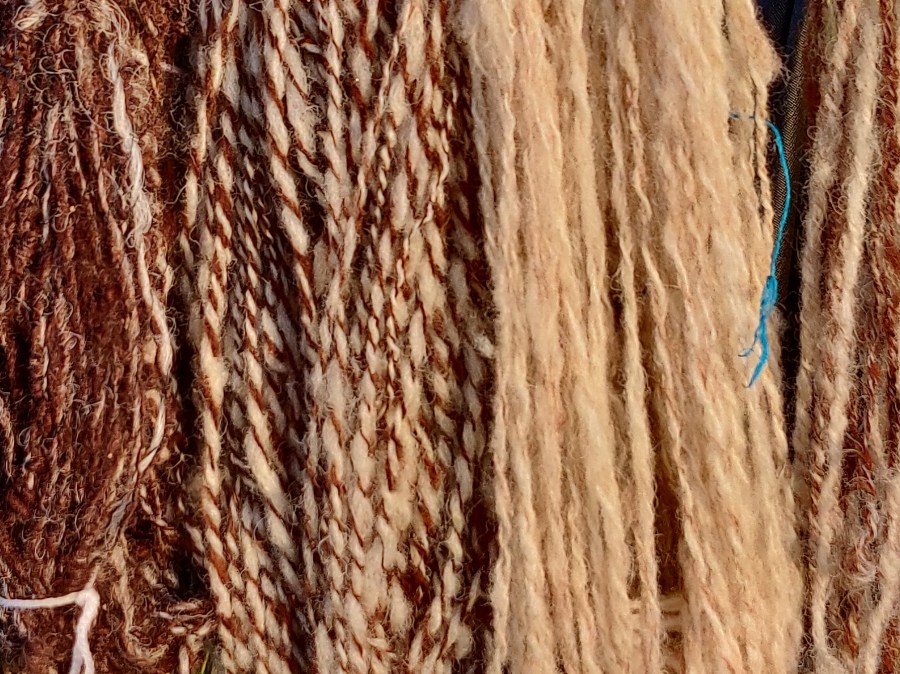
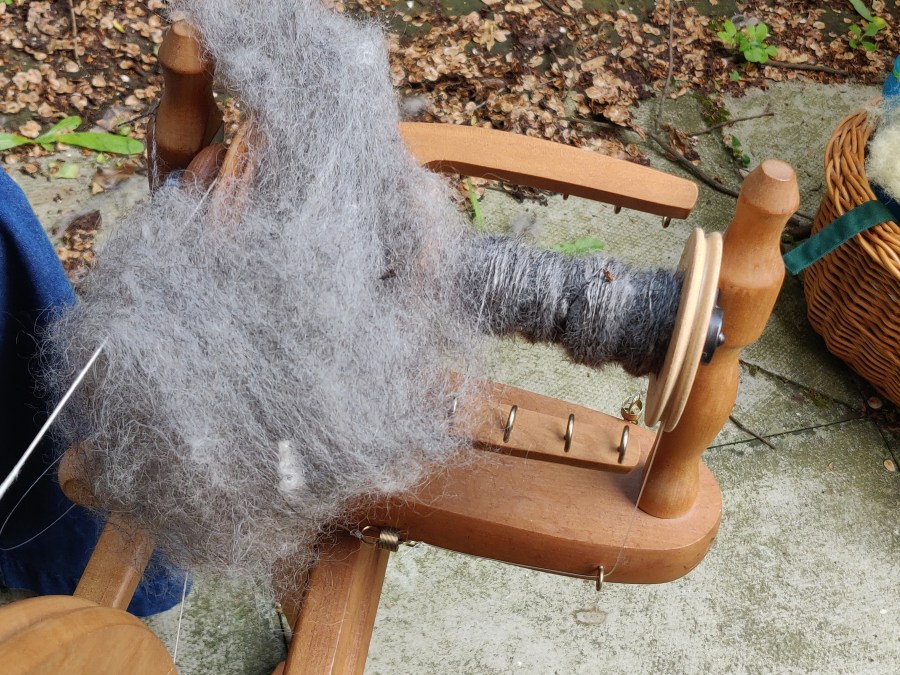
I took a bag full of mixed colour Jacob’s fleece and sorted it into dark and light before hand carding it. Ifirst of all spun a skein of cream to test the tpi and grist I was aiming at and on a rainy day decided to dye it with the onion skins from our soup.
All very earthy!
I can’t resist a marl yarn, so plied the colours into variations on this.

First ‘in person’ TAG meeting of 2021
Our local Textile Arts Group (TAG), finally managed to meet today. Eight of us met up with Covid secure arrangements and as the weather was sunny we were in fact able to sit outside the hall to spin, knit and talk.
It was lovely, and everyone has been busy learning new things and perfecting their skills during lockdown.
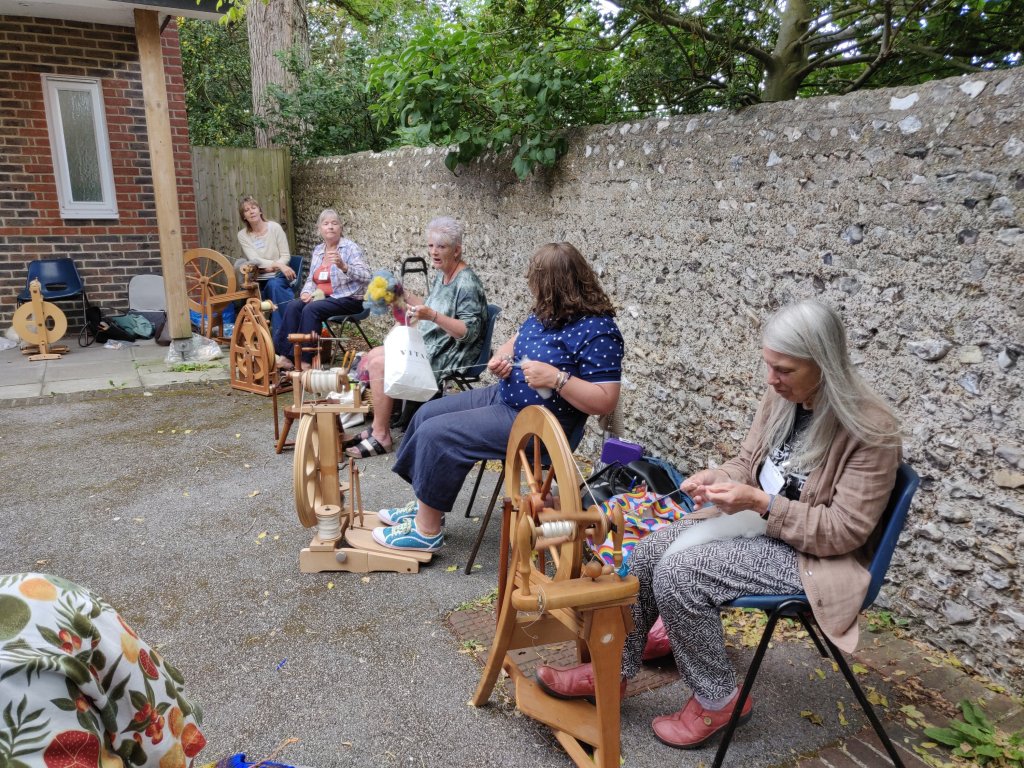
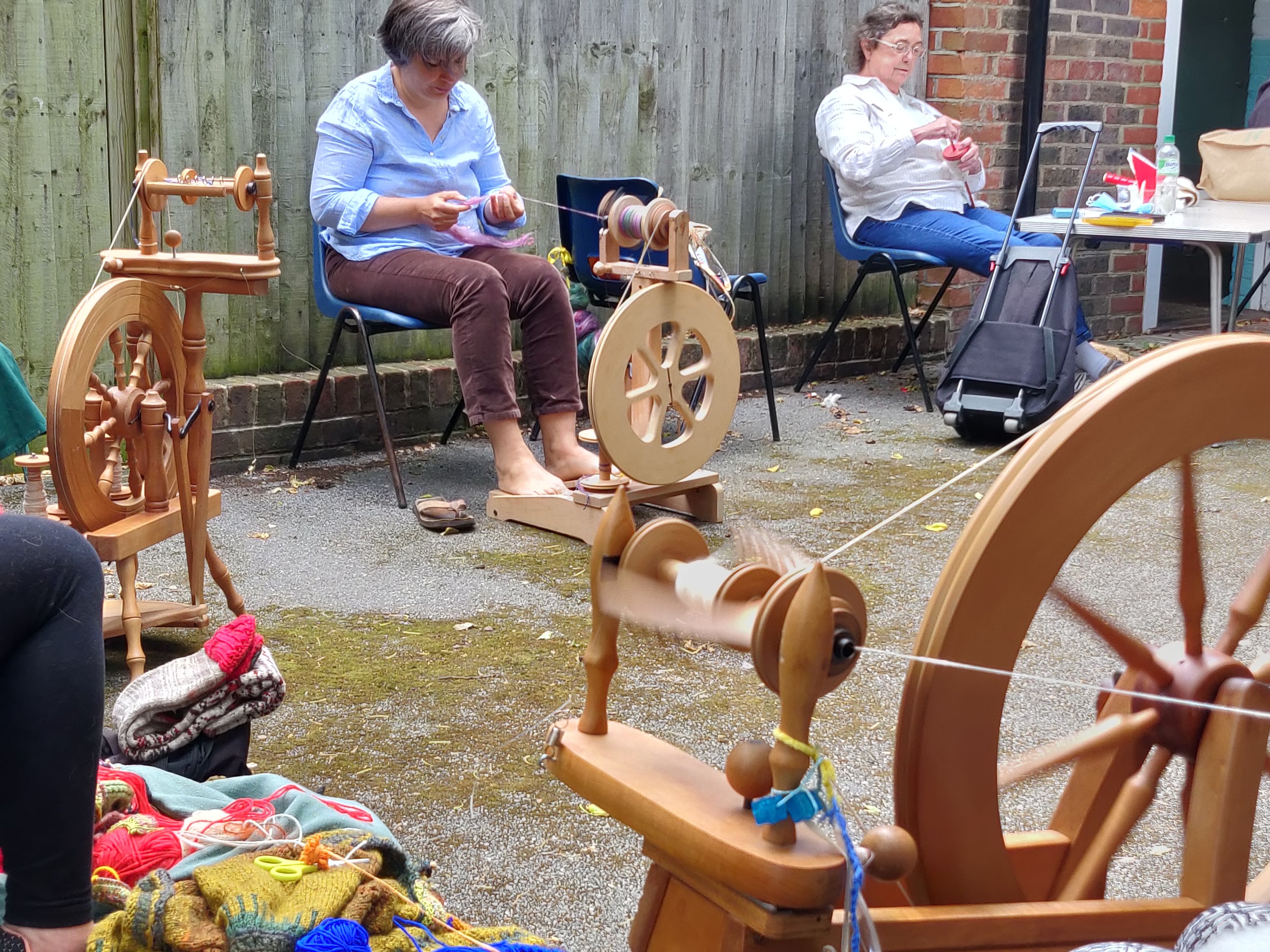
I took my Louet Victoria folding wheel and spun up a bag of Suffolk fibre that will be used as the core for a fancy yarn.
New members are always welcomed. If you live near Brighton and like to know more, or would like to come for a taster session, do get in touch.
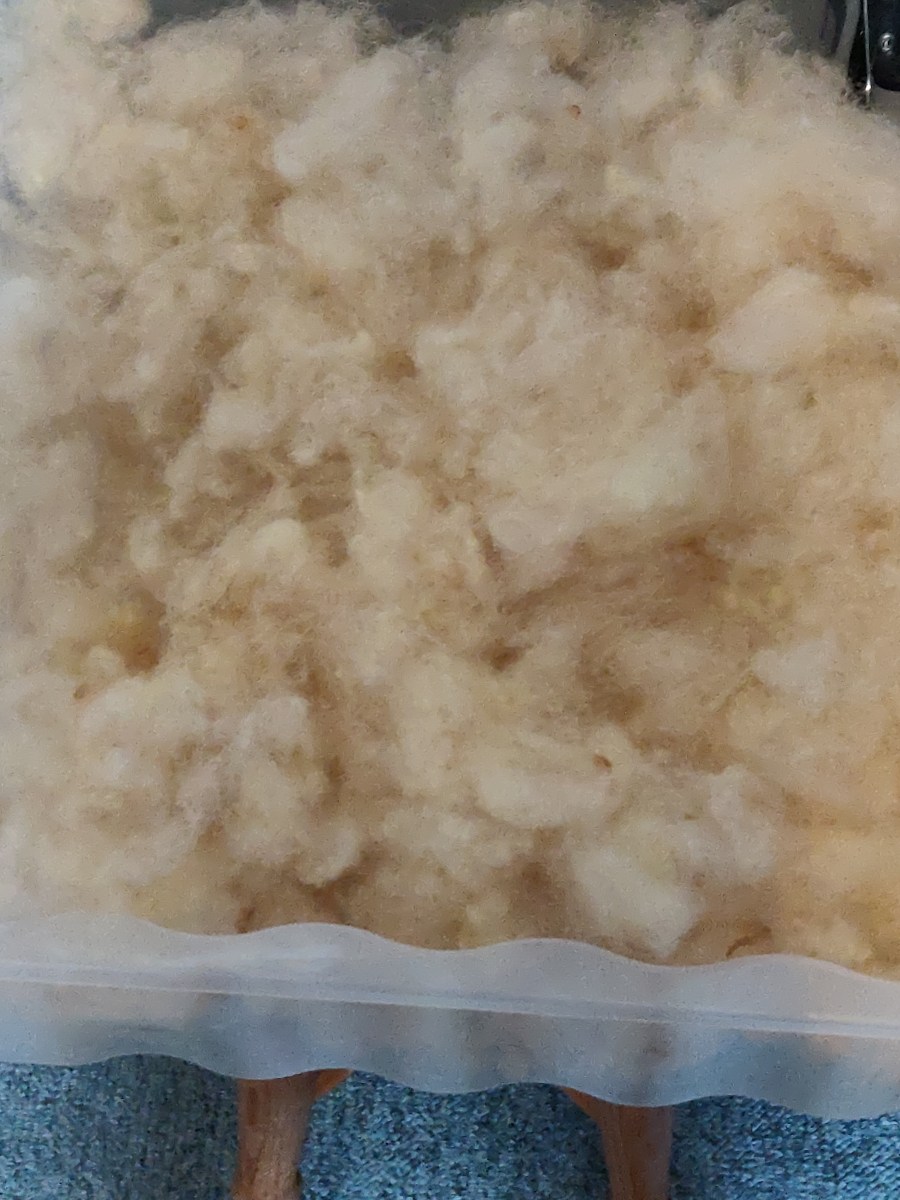
Picking fleece for a marathon carding session
I have a large sack of Texel fleece that had been making me feel guilty for a while. It’s not the most soft of fleece so I decided to blend it with some Alpaca that has also been lurking in the cupboard. Unfortunately the Alpaca (from an animal called Kiki), has quite a bit of VM in it, but it is deliciously soft.
Picking and hand picking got a lot of the VM out, but sadly not everything. I carded both the Texel and Alpaca separately and then split the batts and layered them up in alternate layers; one wool, one Alpaca etc, and put them back in smaller batches through the drum carder.
As my carder is quite coarse I do a second run through for most fibres. So I did it for these batts. I think I probably should have done a third run, but I was afraid of over-carding the fibres and decided they had blended well enough. The result is a little uneven!
I’ve spun two small samples, one thick singles sort of semi-woollen and the other long draw woollen spun.
I’m now perfecting, (ha ha) my long draw technique with several hundred grams of comb waste that I have carded up. Hopefully by the time I get through that I will be proficient enough to tackle long draw spinning that large amount of Texel/Alpaca fibre!
I’ve hand knitted small samples of the both yarns The thicker spun on 6mm needles and the long-draw spun on 5mm needles


Spinning fine yarns for machine knitting
If you have seen some of my earlier posts about machine knitting and spinning you might realise that I am keen to put the two together. I was given a fleece that is long-staple, not-very crimped and quite lustrous, but I don’t know what breed it is from. Its also quite coarse with well defined locks. The first batch I stove-top rainbow dyed, and spun from flicked locks. It worked OK, and I got a reasonably fine yarn. I also have a lovely soft, long staple Alpaca fleece, so I worked with the two as separate singles to ply together. This yarn worked at tension 8 on a standard gauge knitting machine.
However, I was determined to get it thinner. I started with the Alpaca, and after hand carding the fibres, spun it worsted using a double drive wheel with the lace flyer and was so pleased with the results. I got a 28wpi singles from the Alpaca which was quite dense, not light an airy, but I wanted it to match the coarser fibre’s density. To prepare the long-staple wool I decided to comb the locks on wool combs. At first I was slow, because although I have done this before I’ve not practised a lot. It was exciting to find I got faster quite quickly and began to get some lovely long slivers coming off the comb. After spinning in the same set up as the Alpaca, I have also managed to get the rather coarser wool to produce a 28wpi singles, so I am pretty pleased as this will give around 14wpi 2ply.

I have plied all of the yarn, and am waiting for the second skein to dry. Meanwhile I have knitted a tension swatch on the Knitmaste SK840 and can get it to knit at either tension 5 or 6. Tension 5 is a nice looking stitch, but the handle is stiff, so I opted for tension 6 instead. I probably should have tried between the two, but when each metre of yarn takes so long to prepare and spin I was reluctant to use too much on sampling at this stage. I will add photos of the fabric once I have given it a wash and steam.

Woolly Umbrella, new website
I belong to a local community textile group, and we have just launched our new website. Please take a look and see what we have been doing. Of course that has not been a lot since April 2020 as much of what we do involves going to outside events to share skills and demonstrate.
Lets hope the coming year will allow us to start doing this again. Meanwhile we have been meeting (in 6’s only) during the summer to spin outdoors, but the latest lockdown, along with the colder, shorter days has put a stop to that. Online meetings are OK, and I have organised a few, but its not the same!
We hope to be able to take ourselves along to demonstrate natural dyeing, eco dyeing, spinning, and fibre preparation at Bentley Wood Fair near Ringmer in September. Allan will hopefully demonstrate his fascinating nettle fibre preparation methods, and we will all be suitably masked and socially distanced of course.
The Knitting Thingamabob – mending a Knitmaster 700 carriage and knitting socks
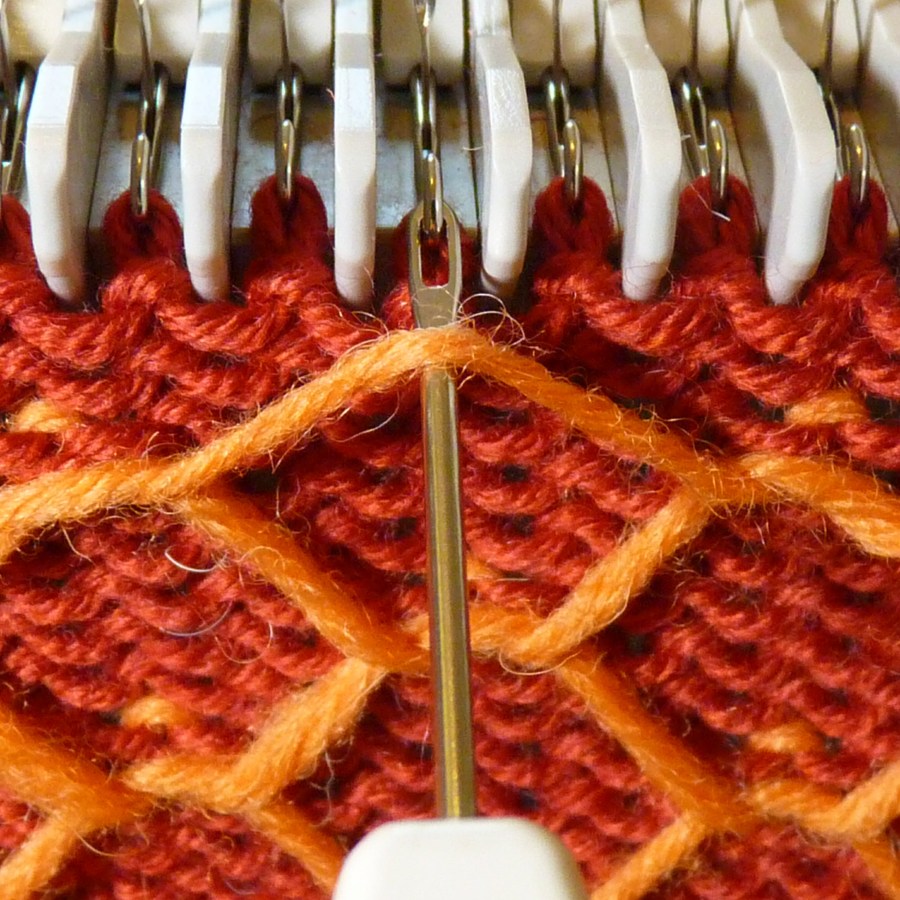
Replacing the tension dial on the carriage of a Knitmaster 700, some tricks and tips to make this easier. Knitting socks and hand spinning yarn for machine knitting socks.
Follow my podcast on Spotify, Google Podcasts or iTunes.
Show Notes:
Although an older model, the Knitmaster 700 is a lovely machine. It is a punchcard machine and ball bearings so it slides very smoothly on the bed. One really nice feature is that it will knit intarsia without using a special carriage. Two white levers on the left and right of the carriage activate the intarsia setting.
Whilst knitting the sock, I found the tension dial was unreliable and replaced this with a secondhand assembly and this records doing this.
‘The Answerlady and Jack’ on YouTube are life-savers for machine repairs.
A trick for reassembling the carriage when it is difficult to get the tension assembly back into the carriage so that it will turn all the way round.
Never use metal things to poke inside your carriage unless you know what you are doing!
Mend the plastic carriage cover or any other plastic cracks, chips etc with epoxy resin glue. If you leave the cracks, particularly if they are around a metal screw head, they will quickly deteriorate and bits will break off.
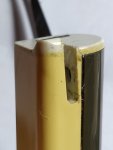
Inside the carriage handle, around the screw hole 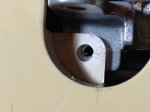
Inside the carriage, the mounting screws
Don’t use spirit on the plastic parts of the machine, use a slightly damp cloth to wipe these parts. Metal areas can be cleaned with surgical spirit (rubbing acohol) with a drop two of oil in it. This leaves a film of oil after cleaning. Make up a small jar and keep it with your maintenance tools so that it is always to hand. Use soft cloths and cotton buds to clean your machine.
Keep your machine oiled for the best performance, oil the bed every 100 or so rows. Invest in proper sewing machine oil or knitting machine oil.
Sock knitting on the knitting machine. Not being a keen hand knitter of socks, I revisit machine knitted socks made from wool yarn. Short row heels, short row or decreased toes?
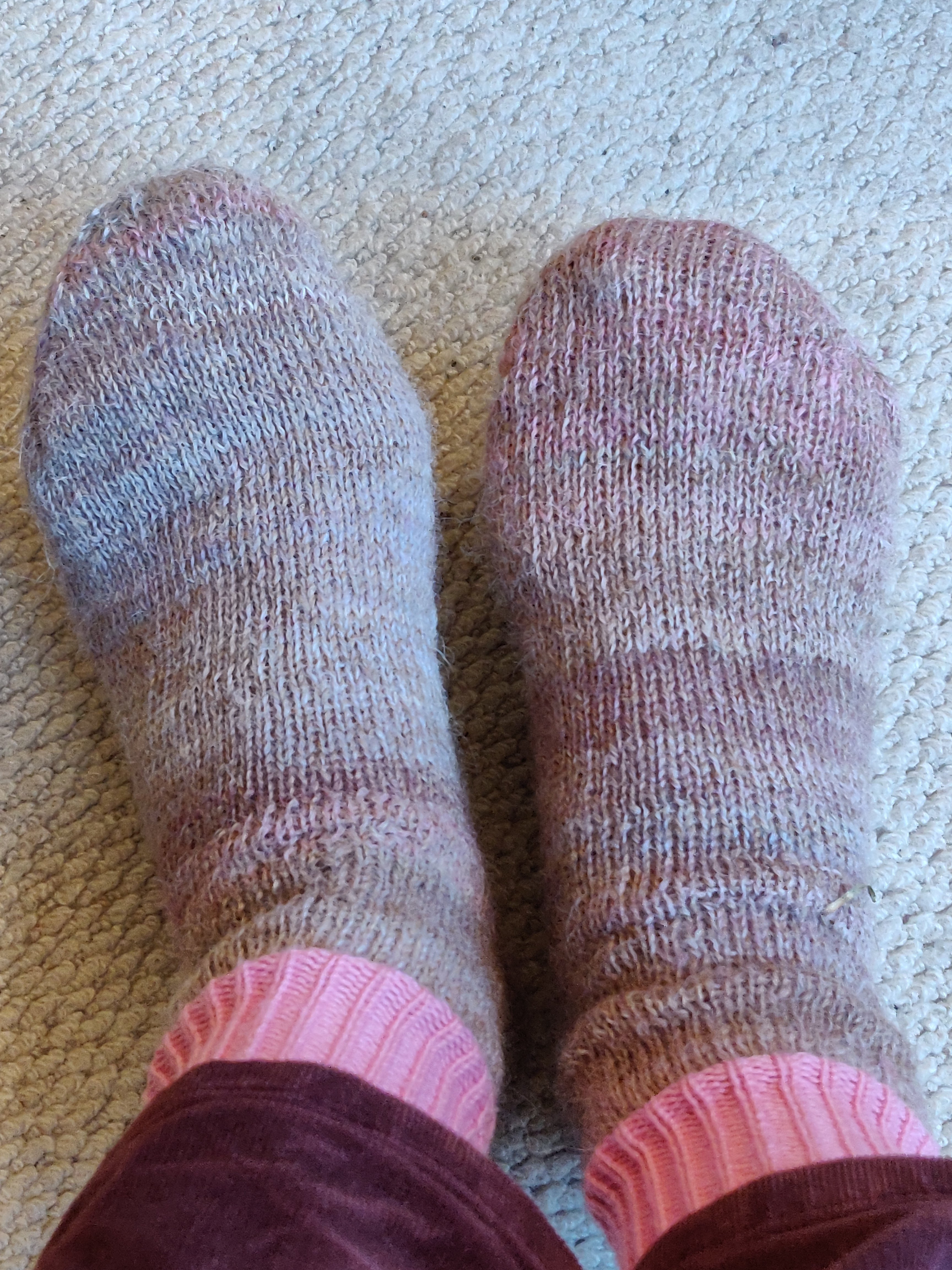
Hand spun yarn for socks. Yarn spun from locally sourced fleece of indeterminant type, but definitely ideal for socks. To save time washing this filthy fleece I used stove-top dyeing to clean and rainbow dye the fleece. The resultant locks were nice to spin, but made a rather hard yarn.
Spinning yarn for 4.5mm standard gauge knitting machine on an Ashford Traveller, semi-worsted or maybe semi-woollen?
Use a waxing disk when working with hand spun on a knitting machine.
Combining commercial spun wool with hand spun wool when knitting a sock.
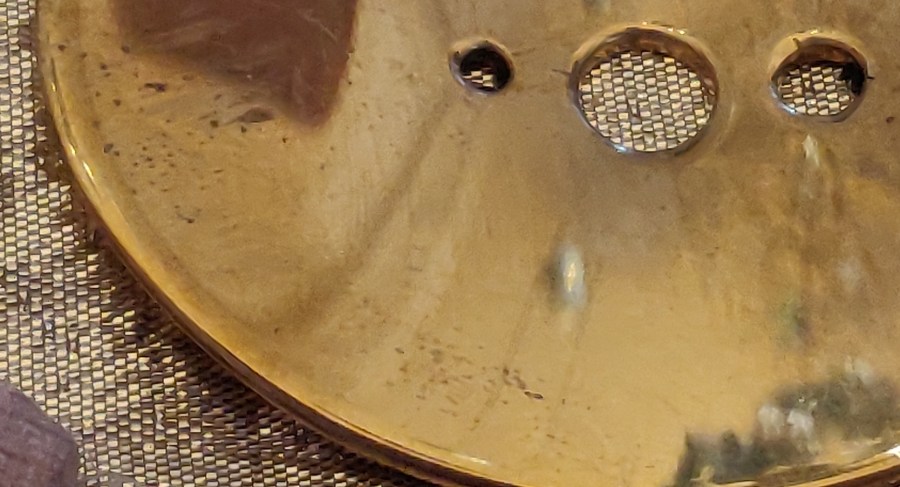
I got a Majacraft dizz for Christmas!
I’ve got various tools that I have been using as a dizz, but there have always been shortcomings. I’ve found it difficult to get the holes smooth enough in wooden ones I have, even after quite a lot of use. I also use a big coat wooden button, (same problem with the holes), and the plastic button I used snapped in half.
The wooden coat button is nicely concave, and I like that feature. When I saw the curved brass ones made by Majacraft I became covetous. So imagine my joy on receiving one from my son as a present at Christmas!
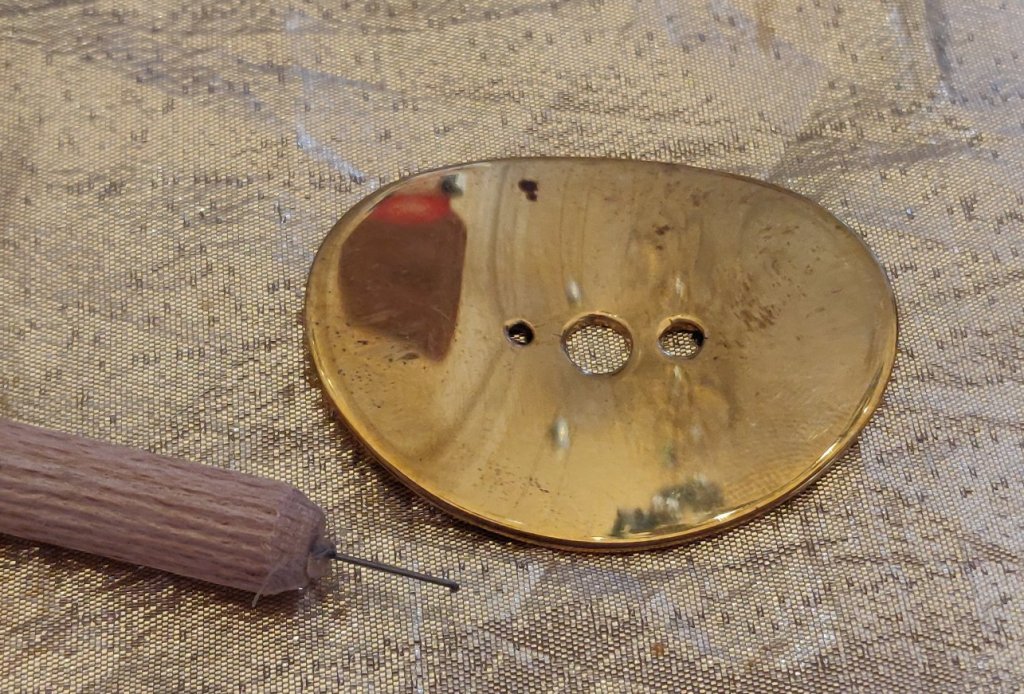
Apparently the two smaller holes (1.5mm and 3mm) are for fine and coarser wools and the largest one is for colour blending fibres as you ‘dizz’.
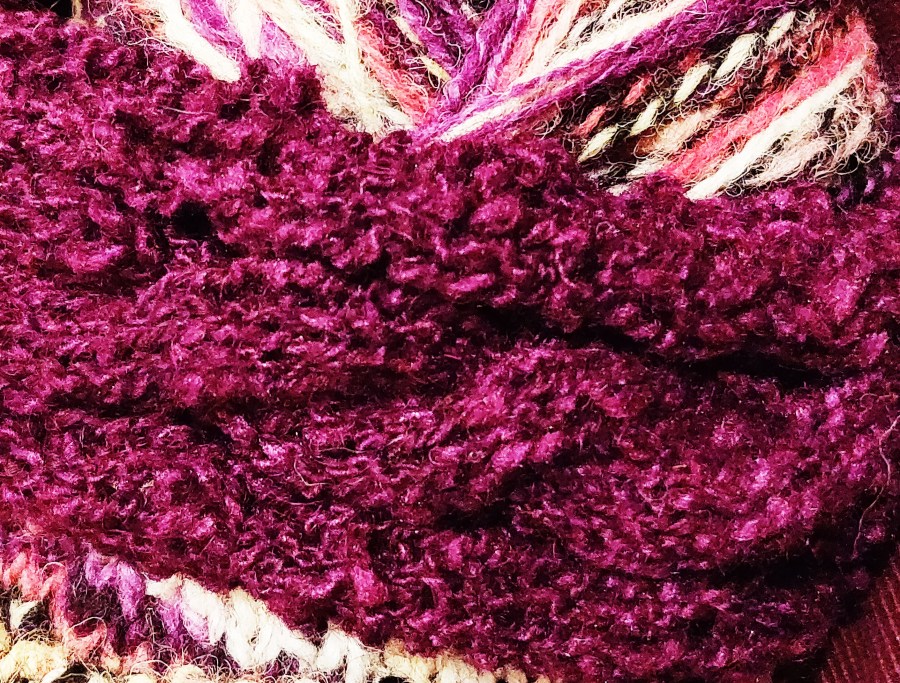
Half way through knitting a hat with hand spun yarns
Having a few smallish quantities of hand spun yarn I decided to dye them.
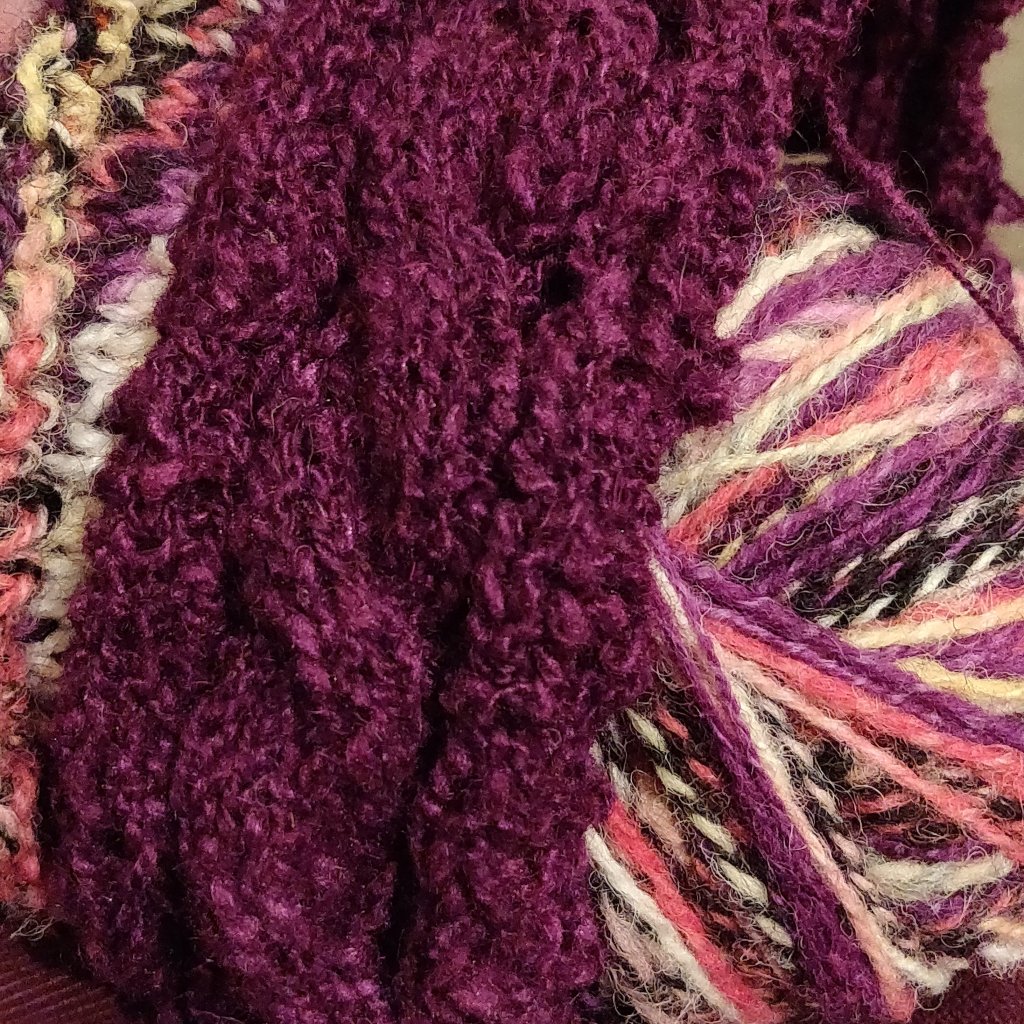
The first was about 30g of blended tussah silk/wool singles that I’d then plied with itself. This is a slightly textured yarn with an interesting matte surface owing to the silk content. It took the deep purple dye beautifully, although the different fibres had varying take up of colour, so it isn’t quite even.
The second was a black and cream space spun yarn, plied with a solid cream. The solid is made from 50g of cream Suffolk fibre, woollen spun into singles. The second singles, with which this is plied, was prepared on a drum carder in alternating stripes of the same cream yarn and stripes of black Belwin fibre. This 25g batt was then woollen spun into singles, after which the two yarns were plied together into a 50g hank. This combination created a pretty spaced marl effect along a yarn which is reasonably even in thickness throughout.
The completed yarn was dip dyed in the same dye pot as the silk/wool yarn, plus another pink dye I had on the go. It was dipped a little into some yellow as well. Over-dyeing this black and cream marl yarn gives the impression of many more colours than there really are.
I’ve used the silk/wool as a band for a hat and the over dyed marl as the crown.
 Vikki Haffenden