I have been planning to join this group for ages – the time has now come. 11th May is in my diary as the next meeting.
Brighton and Hove Textile Art Group (TAG)

I have been planning to join this group for ages – the time has now come. 11th May is in my diary as the next meeting.
Brighton and Hove Textile Art Group (TAG)
Yesterday was a busy day, and included a two hour workshop on very basic natural dyeing. Because I wanted to make it as accessible as possible, and keep costs low, it mainly featured ‘kitchen’ dyeing.
I’d asked people to provide thier own 100% DK wool yarn, (I even suggested a yarn brand to look for as I know this one dyes really well), and prepare it in hanks. I then mordanted it over the weekend, and took it into the workshop ready to go into the dye. Unfortunately there was some confusion (well isn’t there always), and so some brought Aran, others brought 4ply and they were all different spins and types of wool, (but luckily only wool blends, not with synthetics). I’d written out clear instructions on how to make balls into 10g hanks on the back of a chair – but even that went a bit wrong for some, so I then had to unwind and re-hank it all. At that point I began to wonder why I was doing this for free!
So now I had a kilogram of yarn soaking ready to go into an Alum mordant. Of course the more wool, the more water, and the more likelihood that you will soak the floor – which of course I did. So by the time I got it into the mordant I was not in love with the yarn!
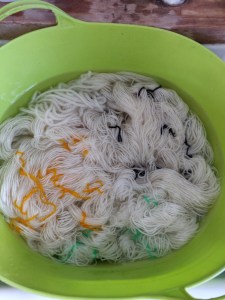
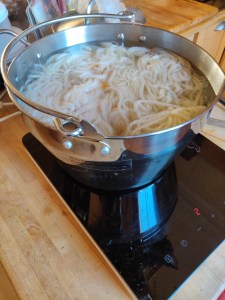
My BIG pan was not big enough, so two lots were necessary, and the room was a bit steamy by the end of it all. I use a portable induction hob for dyeing – I think it is pretty energy efficient – and love it’s responsiveness.
So on to the workshop. Our dye materials were:
Ammonia and vinegar were the only modifiers used to change the acidity of the dye baths, as I did not want to work with copper or iron in this situation.
Firstly a concentrated dye was made by boiling up the chopped red cabbage, onion skins, and coffee grounds in enough water to cover them. The avocado baths were brought to a high heat, but not boiled as this helps keep the colour fresh and pinker. Once the colour was really released (this took between 30-60 minutes), these concentrates were strained into larger pots, cold water was added to make them lukewarm, and salt stirred in to help fix the colours. The red cabbage was divided into three baths: one left plain, one with ammonia added and one with vinegar added. The plain dye yields a purply-blue, ammonia encourages the dye to yield blue/green and the vinegar brings out a lilac colour. This was the fun part; the students introduced their hanks of yarn to different dye baths and they were brought back up to tempature. There were lots of ‘oohs’ and ‘ahhs’ at the lovely colours – even though I explained that they may change or wash out!
They experimented with tie-dying, dip-dyeing and rinsing and over-dye colours. Some more successful than others of course, and time (and hanks of yarn) were limited. One asked me, ‘Can I do this at home?’ , which seemed a strange question to me, but in retrospect it was a reasonable one, because it all seemed a bit to easy!


I spent a happy (ha ha) half hour picking nettles last week, and another not-so-painful time collecting laurel leaves. These were going to be my latest experiments in natural dyeing. Yes, I know everyone else has probably moved onto far more exotic materials, but I am still plodding along with what I remember to collect in the park or garden. Luckily I had a pair of gloves (it was windy and cold), and a clean dog poo-bag in which to store those nasty nettles. I didn’t think the nettles would sting through gloves, but they seemed to. My fingers were still stinging when I went to bed.
So I chopped up the nettles and laurel and boiled them in large pans, left them to steep in the cooling water and re-boiled the next day, left them to steep again.
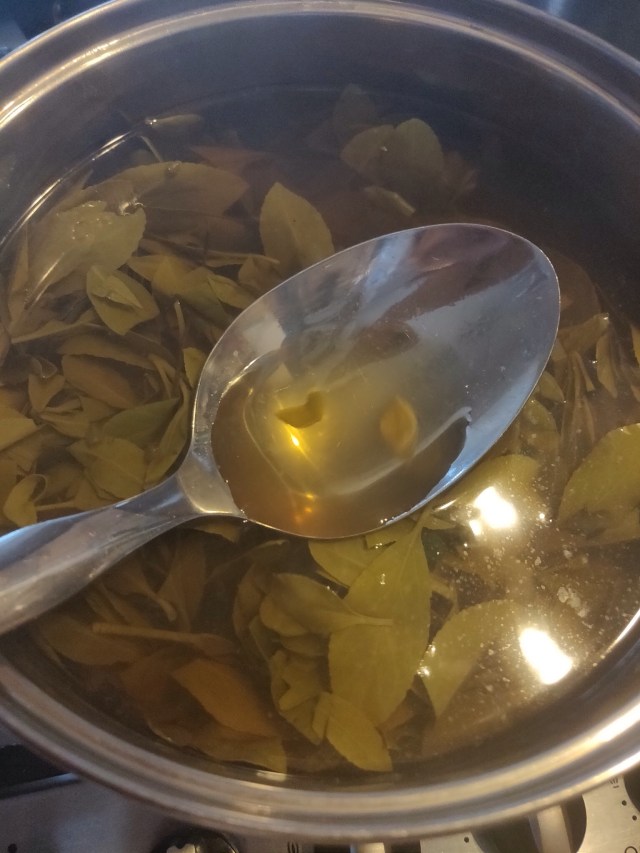
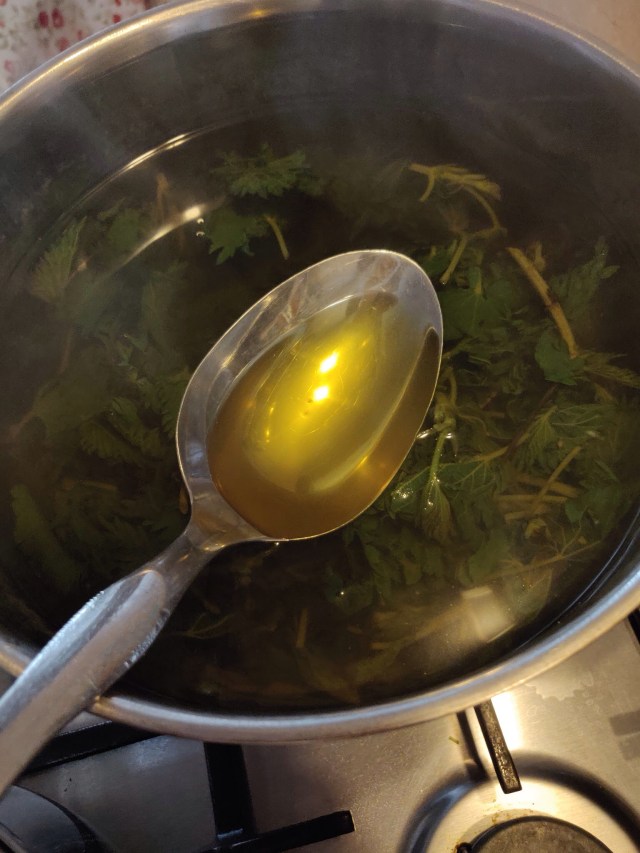
So far the liquid was looking a pretty good colour. Next I strained this off and pressed the remaining soggy leaves to remove all that precious colour. To encourage the dye bath the give up all its colour, I added some salt to the dye bath.
I had already mordanted hanks of DK wool, and some of Aran 60/40 wool acrylic in a pale tweedy beige to see what happened with this coloured blend. The mordant was 8% Alum with a teaspoon of cream of tartar added to the water. This was also boiled for an hour and left in the mordant overnight before being rinsed and used damp.
The damp hanks went into the dye baths, and simmered away for an hour or so, then I removed those and added some vinegar to the laurel bath and added some new hanks. This was supposed to make the colour a little pinker, but not sure it did.
The nettle hanks were put into a bowl of copper modifier to see if the green would intensify. It did.
Because I wanted to check out the colour saturation possible with the 60/40 blend, I had included a hank of this with each test.
Next I made a madder bath (cheating here with madder extract), and dyed two hanks – keeping the heat below boiling to try to preserve the brighter red. Not sure I managed this, but got some lovely rich reds.
Finally I made an onion skin bath and dyed a hand of 60/40 wool acrylic – bingo, this worked really well!
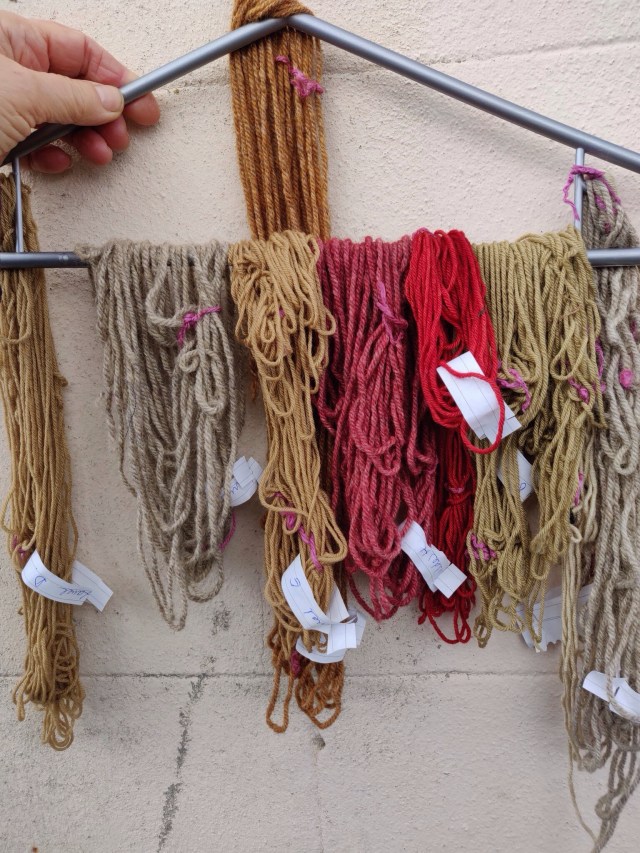
Above hanks left to right are: laurel (DK wool), Laurel (60/40), laurel +vinegar (DK wool), madder (60/40), madder (DK wool), nettle+copper modifier (DK wool), rather obscured hank is nettle (DK 50/50 wool acrylic – this slipped through when I was mordanting), nettle +vinegar (60/40), and at the top, onion skins (60/40).
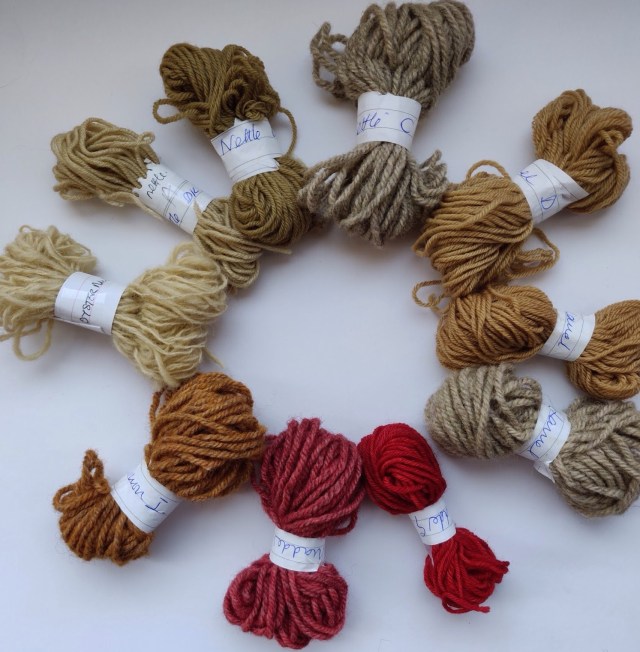
And below are the small hanks wound into knitable balls.
On the left is a hank of hand spun yarn that I dyed the week before last using oyster mushrooms gathered from a tree trunk.
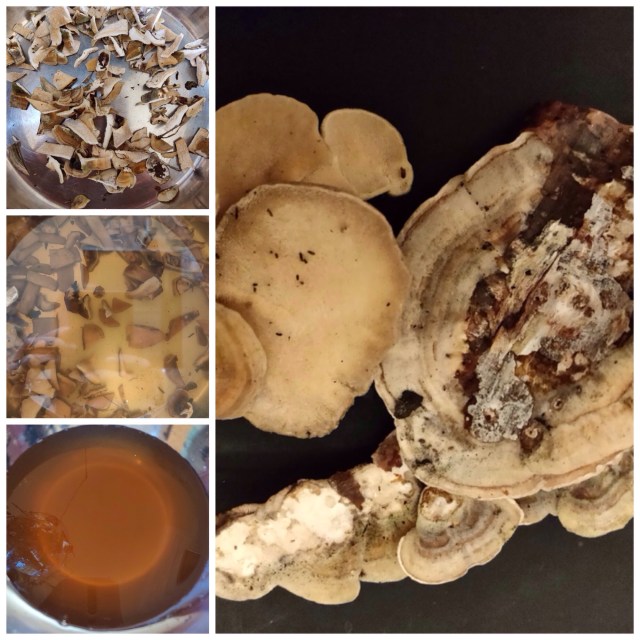
I dyed a couple of hanks with mushrooms, not an exciting colour, but very pretty.
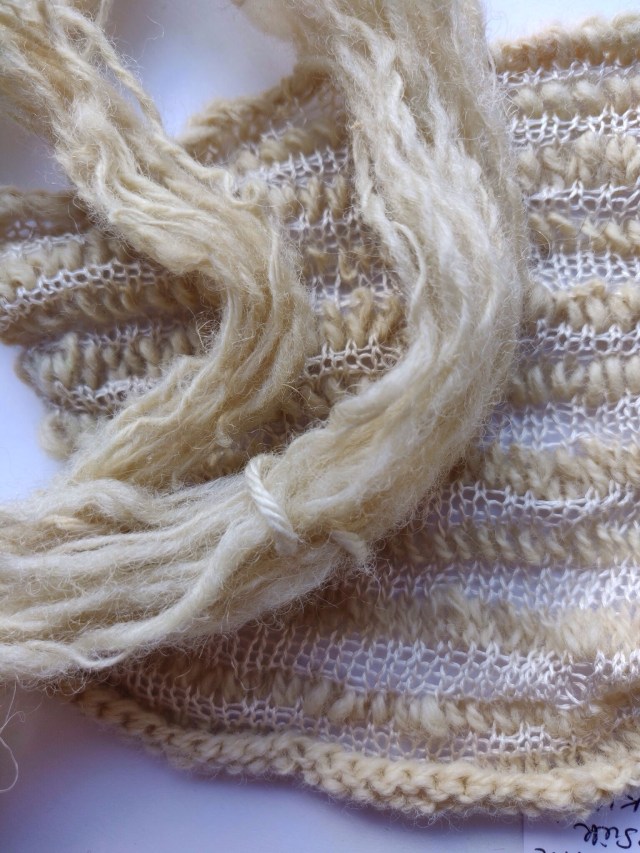
Hand spun yarn dyed with oyster mushrooms. In background the yarn has been machine knitted with a silk in stripes before being dyed.
So that is that for the moment, but I am pleased with the results, and will be sharing them with students before a natural dye workshop next week. There won’t be time to stew up plants as I did for these, but we will be using red cabbage, carrots, madder extract, onion skins and turmeric with vinegar as a modifier. Plus we will be over-dying, dip dying and tie-dying for effects.
Should be fun!
This week I took part in a short radio interview with Simon May on Scala Radio. Apparently a recent question asked by a listener had caused some headaches, and they asked me if I could shed some light on the subject.
You can listen to my suggestions about the genesis of these annoyingly different terms in the interview here on the Planet Radio/Scala Radio Listen Again page. Slide the time slider to 1:40 (it only seems to go in 5 minute increments, (and won’t rewind). Then listen for a minute or two; my interview is just after the chat about Hans Zimmer – between approximately 1:42-1:47.
One point I must make, especially if you plan to listen to interview, is that I did not say that ‘crochet people hate knitting people’, what I said was that people tend to affiliate to one in particular, so there are knitters who do not crochet and crocheters who do not knit. I also pointed out that many people, like me, practise both crafts to lesser or greater extents. I do dislike the way presenters try to make an adversarial situation out of one that is not. Just wanted to clear that up!
As it was a radio interview, time was of course limited, so I thought I’d share some of my thoughts that I didn’t have the opportunity to include in the interview. I will be posting some of these over the next few days.
Meanwhile, whilst I found this BBC article about crochet in Brazilian prisons
Crochet: from the French word croc or croche (hook) which originated from the old Norse word krokr which also meant ‘hook’. Variously know as haken (Holland), haekling (Denmark), hekling (Norway) and virkning (Sweden).(1)
Question I was asked: Why are crochet terms different in the UK and US?
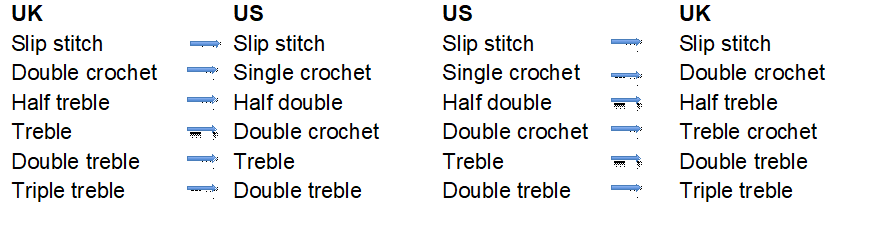
Well, this was a biggie, and of course those of you who have done any reading around this will know that there is not definitive answer!
I quite quickly developed a theory that the terms probably diverged around the end of the 19th century. My guess is that this was a hugely significant period – when skilled crochet practitioners took their skills with them when they emigrated from Europe to the US; four million people emigrated there from Ireland alone between 1850-1990.
I decided to begin my explanation with the history of the craft itself, to try to decipher how these might have come about. I started with a bit or reading and found that Lis Paludan, although she addressed this subject from a largely European perspective, theorised that crochet originated in either China, the Middle East or South America. Both Ann Stearns and Clinton MacKenzie discussed the connections between modern day crochet and historical textiles, but MacKenzie cited Mary Thomas as his source. Now this gives us is a pretty wide geographical ballpark, but let’s explore these theories a bit.
There were most likely some crochet and knit-like practises in China and Japan prior to the importation of Western crafts when trade began with the West in the 1800s. Paludan suggests that crochet’s roots may have stemmed from tambour work (chain stitching with a hook through tightly stretched mesh), which came via the Middle East, and Stearns shows her contemporary experiments with this technique.(p72-74) Paludan speculates that latterly the mesh was discarded, so that the chain stitches became a self-supporting fabric. Regarding the Middle Eastern theory, Stearns dedicates a chapter to the 19th century textiles of Turkey, discussing lace, purses and ‘tiğ oyasi’ (headscarf decorations) made with crochet, and from the way in which she describes these as embedded in the culture, it is clear that these practises had a long history in this arguably Middle Eastern country. (p144-153)
MacKenzie writes that Mary Thomas did not give much credence to the suggestions that crochet-type textiles, possibly descended from Pre-Columbian textile practises and used in puberty rites, existed in South America before the Spanish introduced European methods. However, we know that crochet is popular in South America today, with highly skilled practitioners producing varied types from fine white lace to chunkier colourful work.
Many claims are made that crochet was first practised in Italy and France during the 16th century, and cite ‘nun’s lace’, created in religious houses for ecclesiastical textiles, as evidence for this. Ruthie Marks, writing for the Crochet Guild of America, reports that Anne Potter agrees with this, but I sadly don’t have access to this text, so can’t verify this. What I can tell you is that Potter was as mystified as others, and had her own theories, like we all do. However according to Paludan the surviving evidence does not resemble crochet so fails to support this theory.
Like knitting, and other crafts considered ‘domestic’, crochet skills would have been taught informally by being demonstrated and explained verbally in domestic situations, (and indeed this is still often the case, but we now use written patterns as well). This was opposed to the largely male orientated formal craft apprenticeship system that continued for several centuries in which mastering craft skills led to recognition, authority and inclusion in record keeping of the craft guild system.
Knitting and crochet patterns were not written down until the mid-1800s, and even then, this may have been in a form that would be largely unrecognisable today. Many authors assumed the actual skill of making the stitches was already understood (for the reasons discussed above), so did not include the explicit instructions we are accustomed to in modern patterns. An exception to this was Mlle Eleonore Riego de la Branchardiere, who wrote over fifty books of crochet and knitting patterns, (the first one when she was only 18), and so brought crochet to a wide audience. According to Marks, Mlle Branchardiere, who had a French father and an Irish mother, claimed to have invented the form of lace-like crochet later known as ‘Irish crochet’. You can read some of her books on the University of Southampton Knitting library web resource and via the VADS website, or as eBooks via Project Gutenberg.
In Knitting, Crochet and Netting, published in 1946, Branchardiere describes working what in modern UK terms is called a slip stitch as making a ‘Shepherd or Single Crochet’. She writes, ‘Put the needle in the 1st chain, draw the wool through; there will now be 2 loops on the needle; draw the last loop through the 1st’. Although she describes drawing the new loop through the old loops one after the other, rather than both together as we would do today, this is clearly a slip stitch. (p57) She then describes making a modern UK double crochet stitch and designates it as, ‘Plain, Double or French Crochet’. (p57-58) So at this point in history, there is already some confusion; single crochet is being used to describe a slip stitch.
It seems that Branchardiere was not the first crochet author. I happened upon https://blog.lovecrochet.com/the-history-of-crochet-is-it-as-old-as-the-hills/ which featured an article by Kathryn Senior, The History of Crochet: is it as old as the hills?. In this she writes of an early crochet bag pattern published in 1824 in Amsterdam by Penelope magazine. Sadly there is only an image and no instruction shown which might shine some more light on the terminology in use then.
Crochet was particularly significant in Ireland in the mid-to late 1800s, because it could provide vital economic support for families that were starving in the terrible famine. This lasted from 1846-1852 and devastated the Irish population leading to mass immigration, and of course those who could crochet went as well, taking their skills to a new land.
Irish crochet comprises very finely worked motifs, sometimes with a relief effect, joined together by a crochet mesh. The thread used is fine cotton, and it is worked with a very small hook. Originally the hooks would have been home-made from steel wire and set into a wooden handle. To learn more about the technique and history of Irish Crochet, I recommend visiting Ann Reillet’s ‘Crochet Thread’.(2)
Nuns were partly responsible for bringing crochet to Ireland. As reported in the Kenmare Times of 2011, in the 1860s Carmelite nuns established a lace school in which they taught Irish crochet amongst other lace-making skills. Other crochet schools were established, but the Kenmare school became famous for its excellent design quality. Through collaboration with two design schools in London and Cork and the establishment of an art programme the quality of design was developed further until their clientele included royalty, which in turn influenced additional fashion interest in lace. Irish lace of various types was highly prized for both wedding dresses, veils, lingerie and ecclesiastical pieces.
The Victorian and Edwardian obsession with lace ensured the continuing popularity of fine crochet, and although this abated by the 1920s, it was replaced by using crochet to make complete garments. The new synthetic rayon yarns draped exceedingly well, and crochet worked in these made elegant, elongated shapes perfect for the ‘flapper’ look.
Through the two World Wars knitting tended to take precedence, possible because it seemed more utilitarian and practical compared to the lacey crochet look.
Come the 1950s crochet grew in popularity and re-entered the fashion scene. Magazines such as Stitchcraft featured patterns for hats and accessories made in the new synthetic yarns coming onto the market, and certainly by the 1960s, crochet was really back. In the 60s all sorts of clothing was made from crochet and in the early 70s fashion embraced the granny-square in bold colours. The power dressing 1980s saw a slump in popularity, hand crafts were not part of the new look, being relegated to the ‘hippy’ and ‘homely’.
It wasn’t until the turn of the century that there was a resurgence of interest in both knitting and crochet, ignited partly by Debbie Stoller’s Stitch’n Bitch movement, but also inspired by a reaction to the fast pace of life. Although part of the technology that might be seen to be encouraging the fast pace, social media is still playing a significant part in maintaining and widening the impact of hand making. The latest in this is of course the popularity of the Japanese Amigurumi style of crochet, making small items from tightly packed stitches.
Now I know I have not answered the question, but the history is important when considering how the terms diverged. I still think it has to do with the influx of immigrants, taking their skills with them to a new land, and the terms drifting apart after that. We have already seen some ambivalence in Branchardiere’s terminology, so why would this not be perpetuated and terms come to mean different movements/stitches during a century of geographical separation? After all the size designations of the hooks have evolved differently; US are alpha-numeric and old Imperial became larger the smaller the number (and where is the sense in that?), whilst modern European metric hooks work on a direct millimetre diameter measurement.
Some theories suggest that the UK terms are based on the number of loops left on the hook after the pulling the first loop through the stitch below, whilst US terms refer to the number of movements needed to complete the stitch after the pulling the first loop through the stitch below. This comes a bit unstuck when you get to the half-treble stitches, but it seems reasonable otherwise. There are probably others, but I think we just have to accept, and translate, rather like we do with other linguistic difference such as pavement being called a ‘sidewalk’ in the US, and a car boot being a ‘trunk’.
Most modern books now make it clear which terms they are using (US or UK), but older books and patterns can be a minefield. If you want to check whether a pattern or book is US or UK, the best way is to see if there is any reference to single crochet (sc) in the instructions. If there is, it is definitely a US pattern – as there is no single crochet in UK terms. If there is no reference to single crochet, this doesn’t mean it is a UK pattern, because it may just not include single crochet! So, beware and look for other signs; the hook sizes may give you a clue, and so may the yarns listed in the pattern.
I sometimes write the pattern out again, (if its short), or use a highlighter to mark where I need to be careful. Otherwise, a drop of Tippex works well, (but not on a library book)!
I apologise in advance for any mistakes, and hope that this has been of interest.
Bibliography:
Paludan, Lis. Crochet: History and Technique, Interweave Press, 1995
Thomas, Mary. Mary Thomas’s Knitting Book, Toggit, ??
Stearns, Ann. The Batsford Book of Crochet, Batsford, 1981
MacKenzie, Clinton. New Design in Crochet, Van Norstrand Reinhold, 1972
Lucey, Anne. Fabric of Kenmare: nuns’ role in lace industry celebrate, https://www.irishtimes.com/news/fabric-of-kenmare-nuns-role-in-lace-industry-celebrated-1.630452, 2011.
The Art of Kenmare Lace Making, https://www.discoveringireland.com/the-art-of-kenmare-lace-making/, 2019.
Codiron, Roxanne. Meet Eleonore Riego de la Branchardière, the Mother of Modern Crochet https://www.marthastewart.com/1527206/meet-eleonore-riego-de-la-branchardiere-mother-modern-crochet
de la Branchardiere, Eleonore Riego. Knitting, Crochet and Netting, S.Knights, 1846. https://vads.ac.uk/large.php?uid=133532&sos=0
Further reading:
Potter, Annie Louise. A living mystery: The international art & history of crochet, A. J. Publishing International, 1990.
Download a pdf of this article
I have reposted these articles by Ms Premise-Conclusion on my blog because I thought this was a wonderful piece of technical work. The formula is so useful and well explained, making the principle easy to understand.
If you visit the website you can download template patterns for ‘ideal’ crochet spheres, squares and rectangles. These don’t do all the maths for you, but give you the tools to create the shapes in your chosen yarn and hook size.
A little while ago, I got a comment on my Ideal Crochet Sphere post, requesting a pattern for a giant crochet sphere. Too cool! It’s taken me a while to get around to calculating the number of rows required (especially since I had to extrapolate the size based on smaller spheres that I’ve made), but I think this will work.
So, here are the patterns for 60 row (~10 inch) and 85 row (~15 inch) spheres.
Since there are so many rows, I haven’t included how to space the increases nicely for each row, so I’ll leave that up to you, should you attempt it. For each row, I’ve written it as follows:
Row i: Increase by N (X stitches total)
So, for Row i, you have to work N increases as evenly as possibly into the row so that after you’ve completed the row, you will have X stitches…
View original post 62 more words
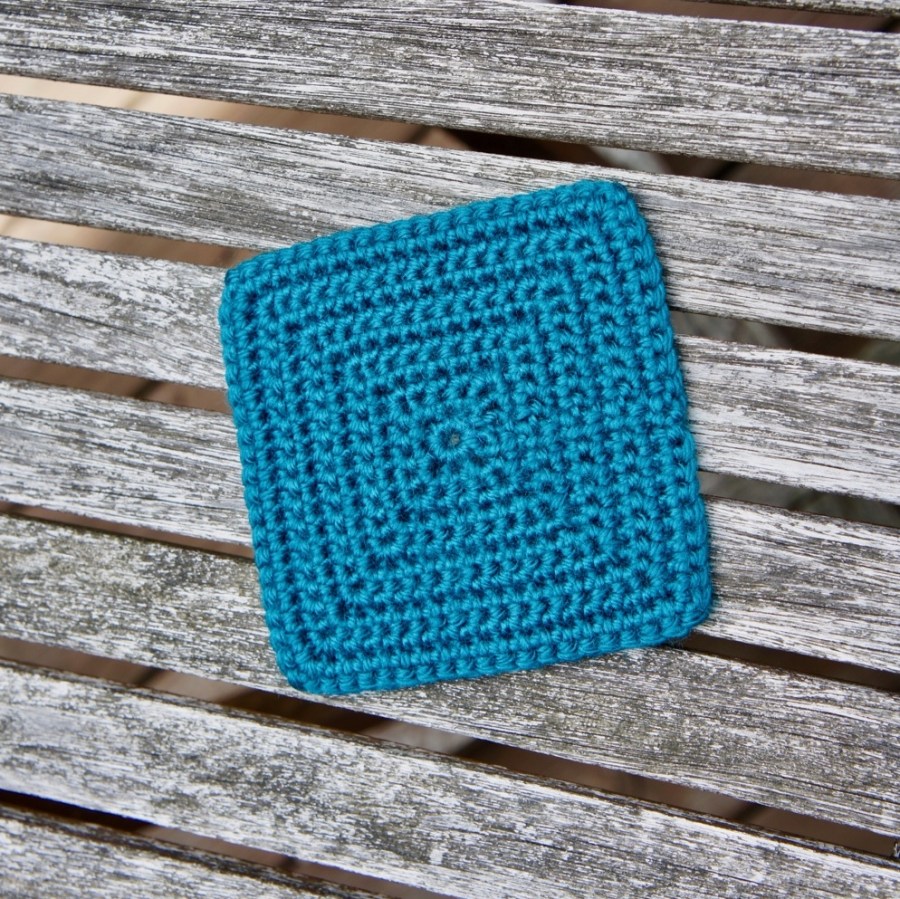
I love to see such detailed technical knowledge shared so generously – thank you
Whenever I look at the completed projects section of my Ideal Sphere page on Ravelry, I love how people have incorporated it into a huuuuge variety of projects! For a while now, I’ve wanted to go back and make more basic shapes for people to use as a spring board. And now I am! Yay!
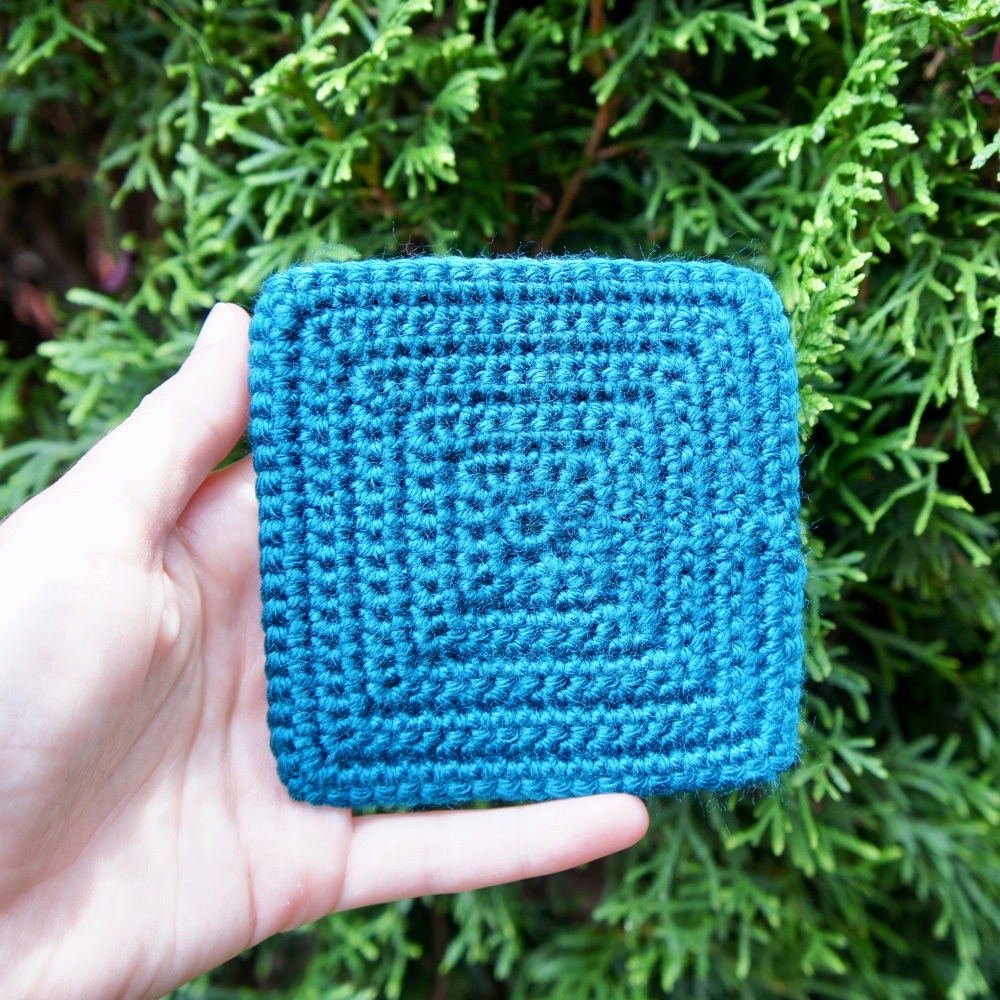
This is a crochet square. Now, if you crochet, you have almost certainly made a granny square before. (I think it’s one of the first things I ever crocheted while I was still learning.) This one is a little different.
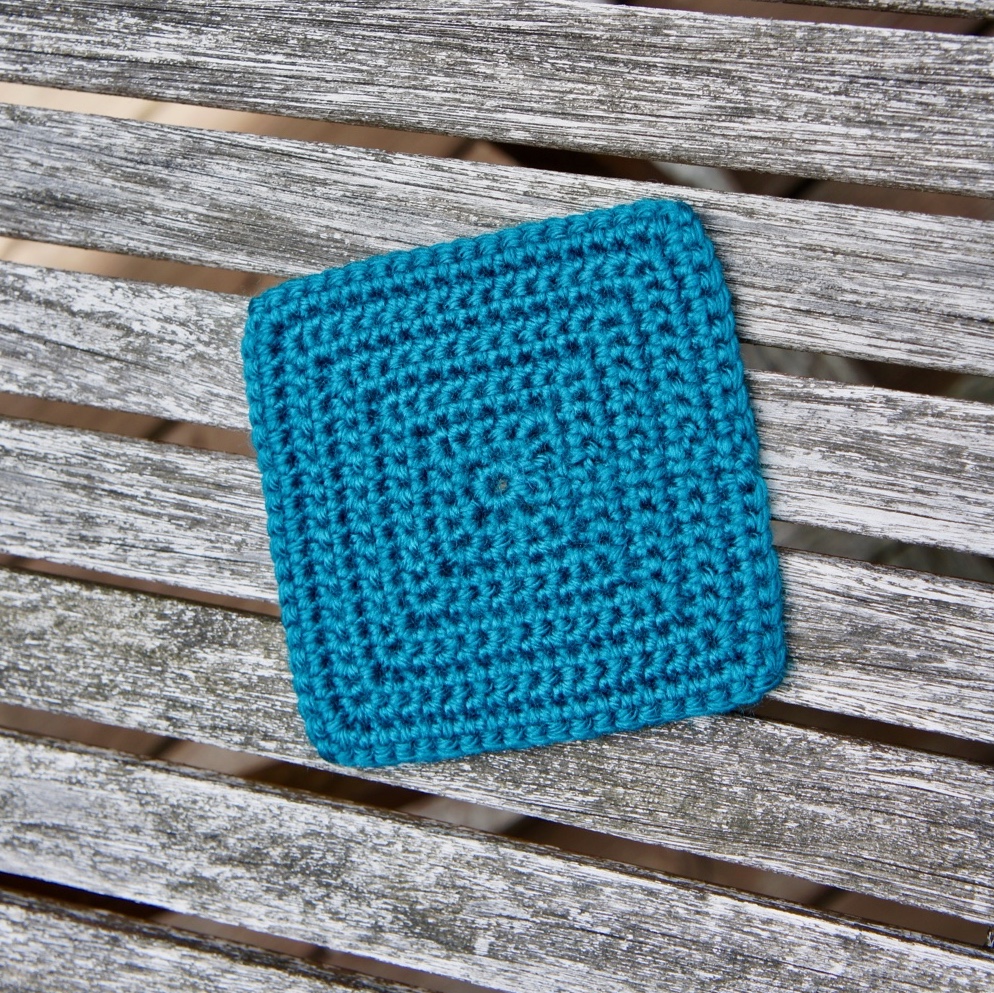
This square is made in single crochet and is worked in rows (from the inside to the outside). I’ve also made sure that it has the correct number of stitches in each row to make it a mathematically ‘ideal’ square. Because reasons. (Scroll to the end of this post for more geeky details.)
You…
View original post 425 more words
Last week I hosted a ‘learn to spin’ afternoon. We had drop spindles and two wheels. Because no-one had spun before I started with lengths of commercial my sun yarn – about 12 metres each. These were used to learn the basics of working the spindle and twist direction.
After everyone was feeling more confident, fibre was introduced. This was lightly scoured Jacobs fleece with a little oil left to make it easier to spin.
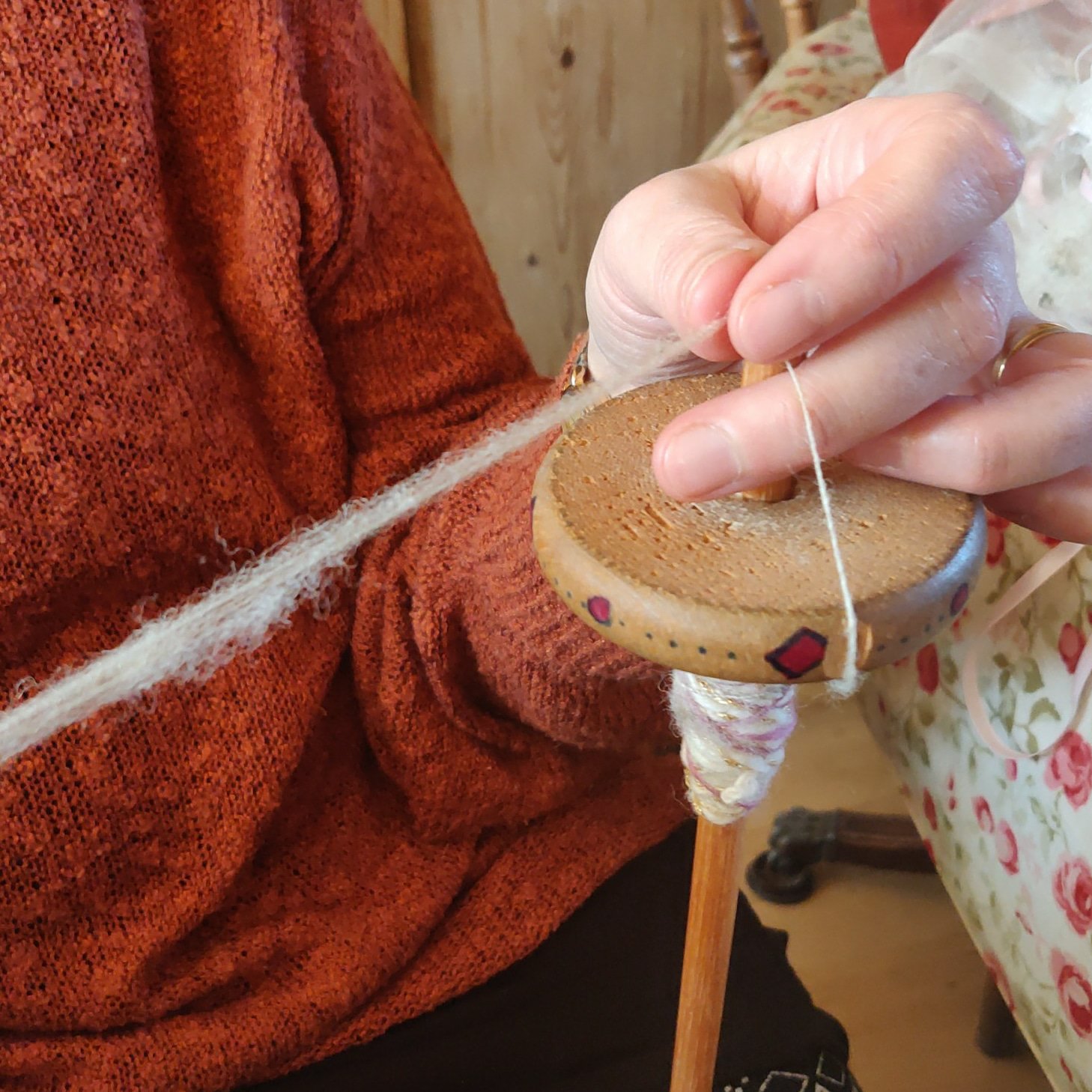
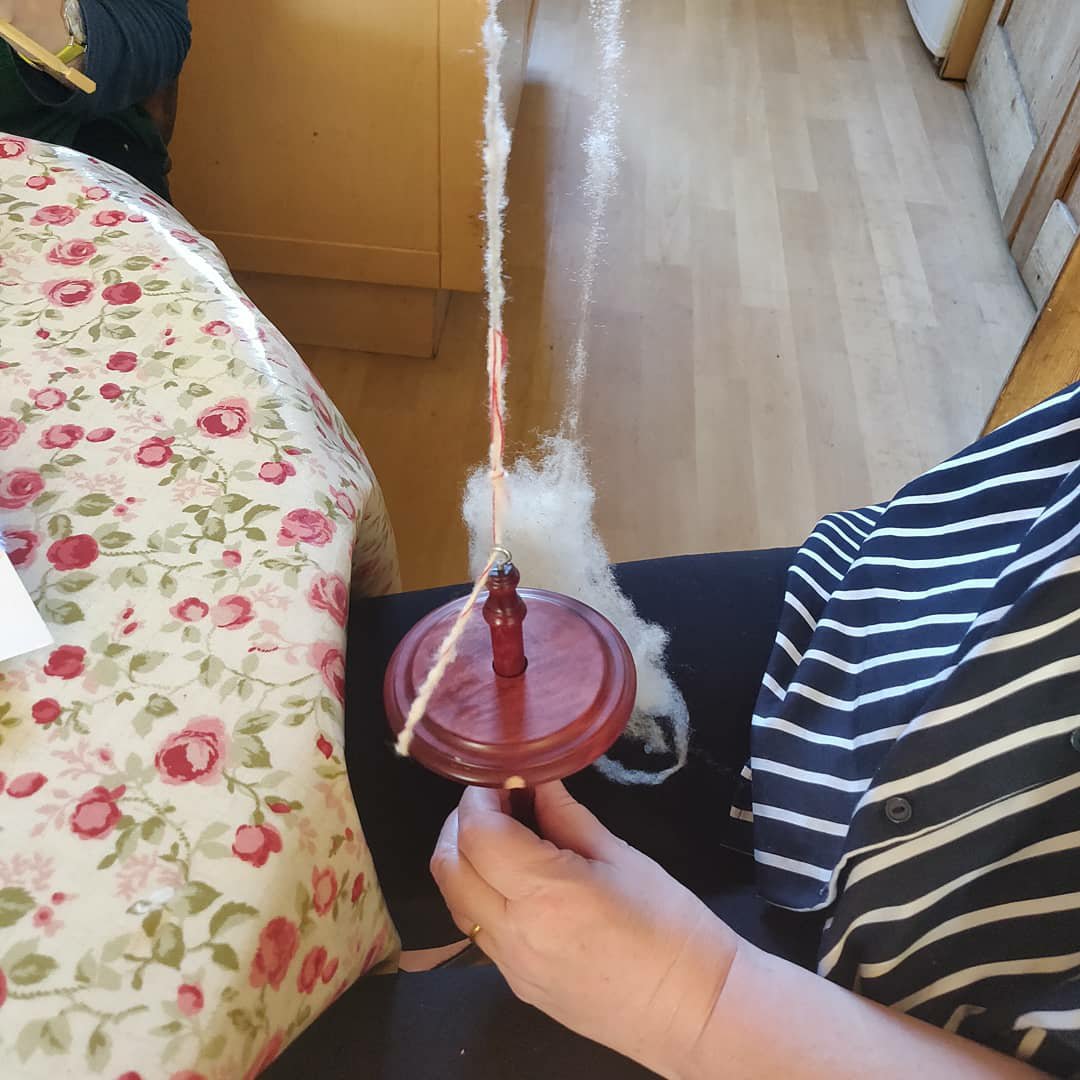
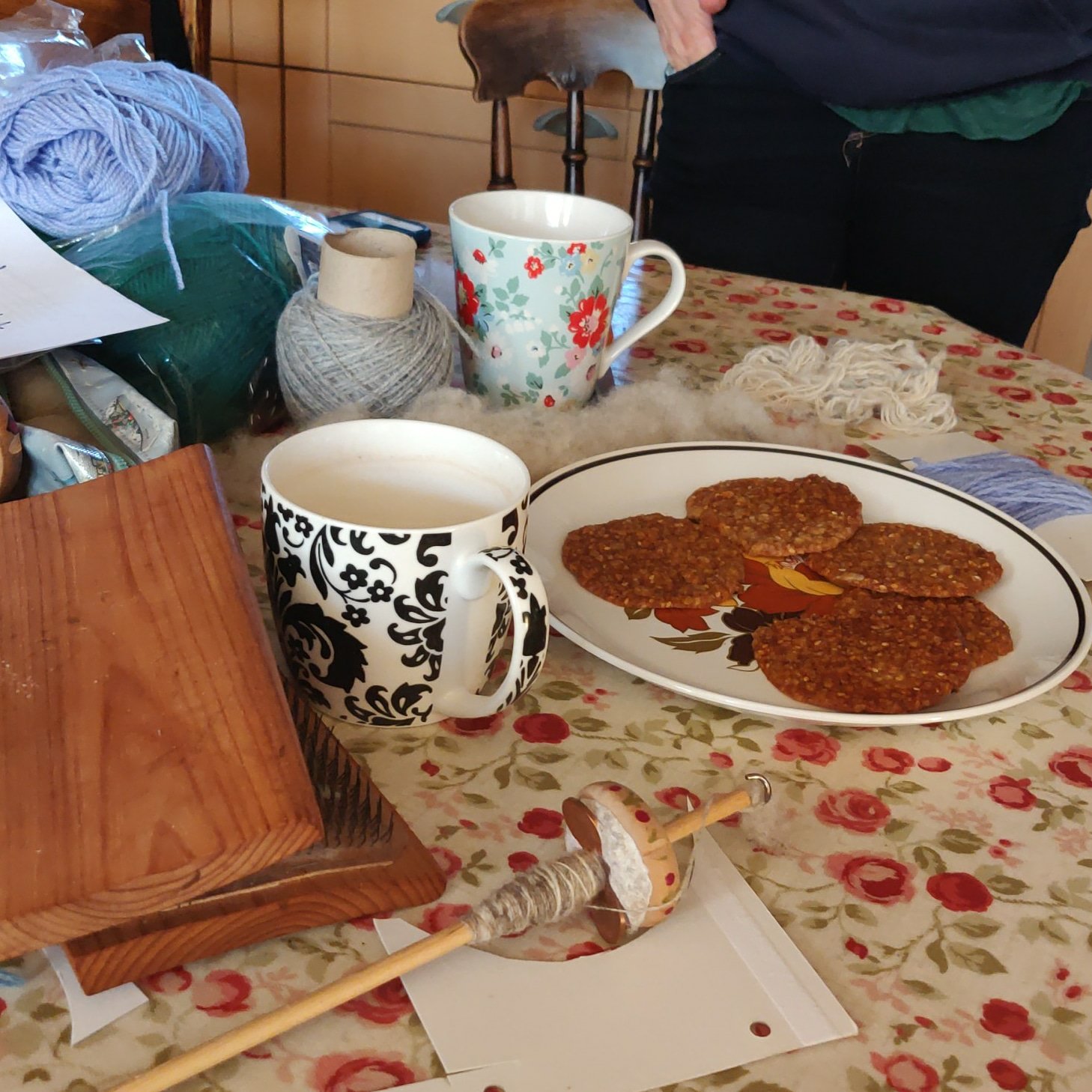
Strengthened by team and home made oat biscuits we progressed to the wheels.
The Ashford single drive, double treadle Traveller was the most popular. But even that took some easing into.
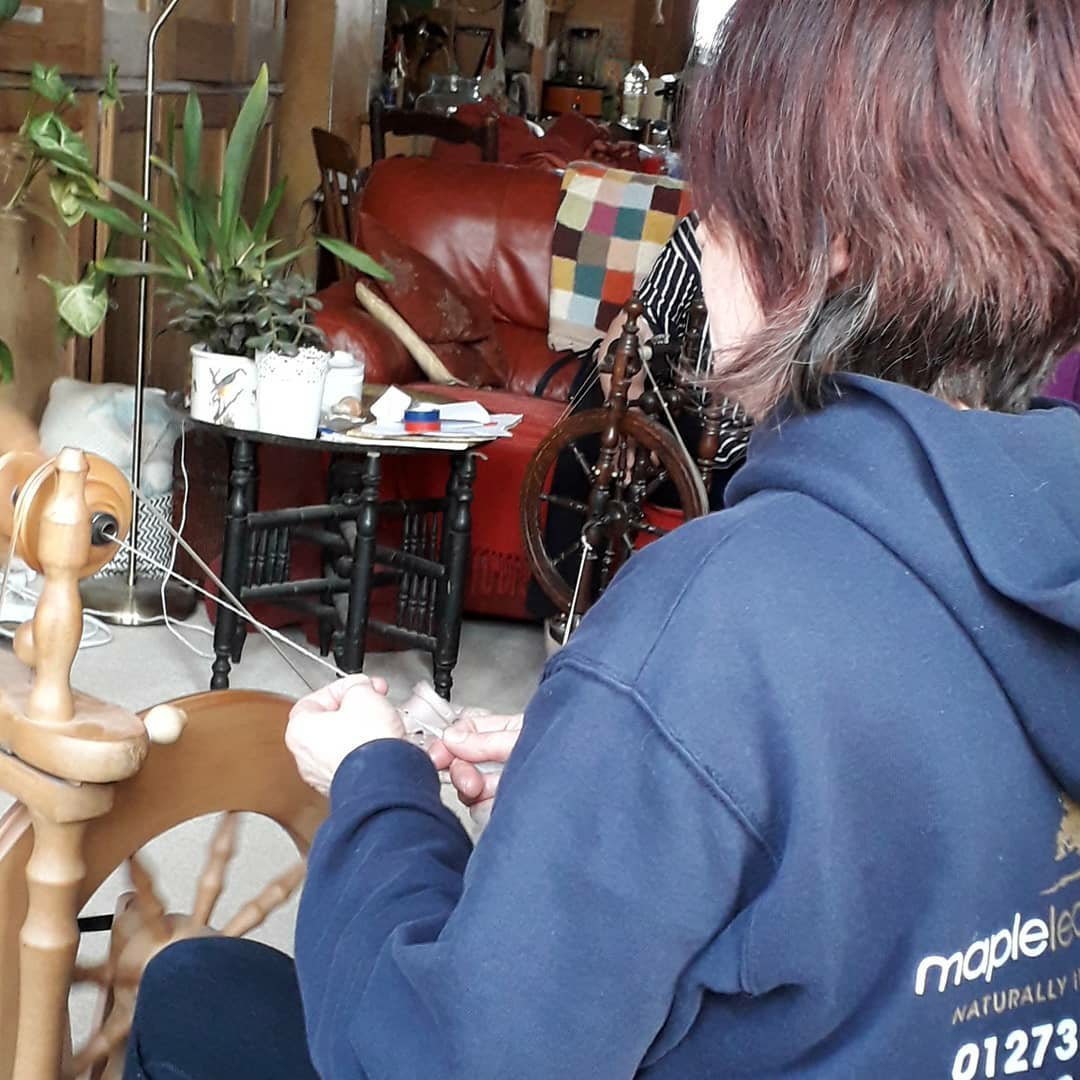
Everyone got some yarn made.
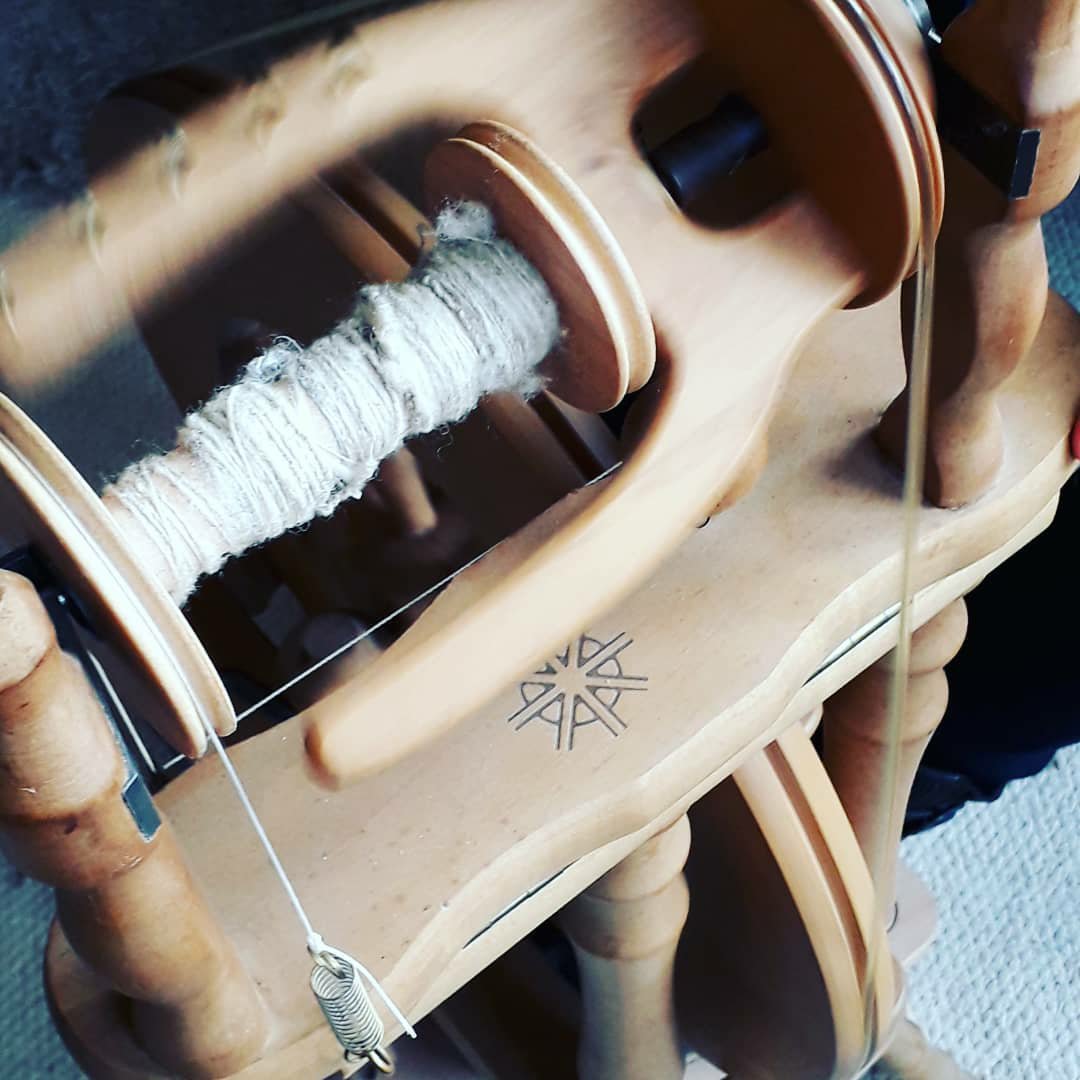
We plan another soon.
Two weeks ago I poked a pin underneath my left index fingernail, painful, but a common occurrence. I thought nothing of it. Then a week later my finger had become progressively more painful to the touch. I was away from home and didn’t have any antiseptic with me so hoped it would calm down. However the side of the nail went black and the top of my finger – above the last knuckle – became red, swollen and began to throb. ‘Uh oh’, I thought, that looks, and feels, infected.
Once home I applied Magnesium Sulphate, but eventually needed antibiotics to bring it under control. Now my finger has drained and is on the mend, but it was a silly thing I could have avoided. I did the same into my thumb over the weekend, so I was straight to the TCP antiseptic this time.
So learn from my mistake, and remember that it was only a tiny pin prick that led to all that.
Don’t scroll down if you don’t want to see the repairing finger. The bandaged appendage severely hampered my hand knitting and sewing activities and it still catches fibres when knitting as it heals.
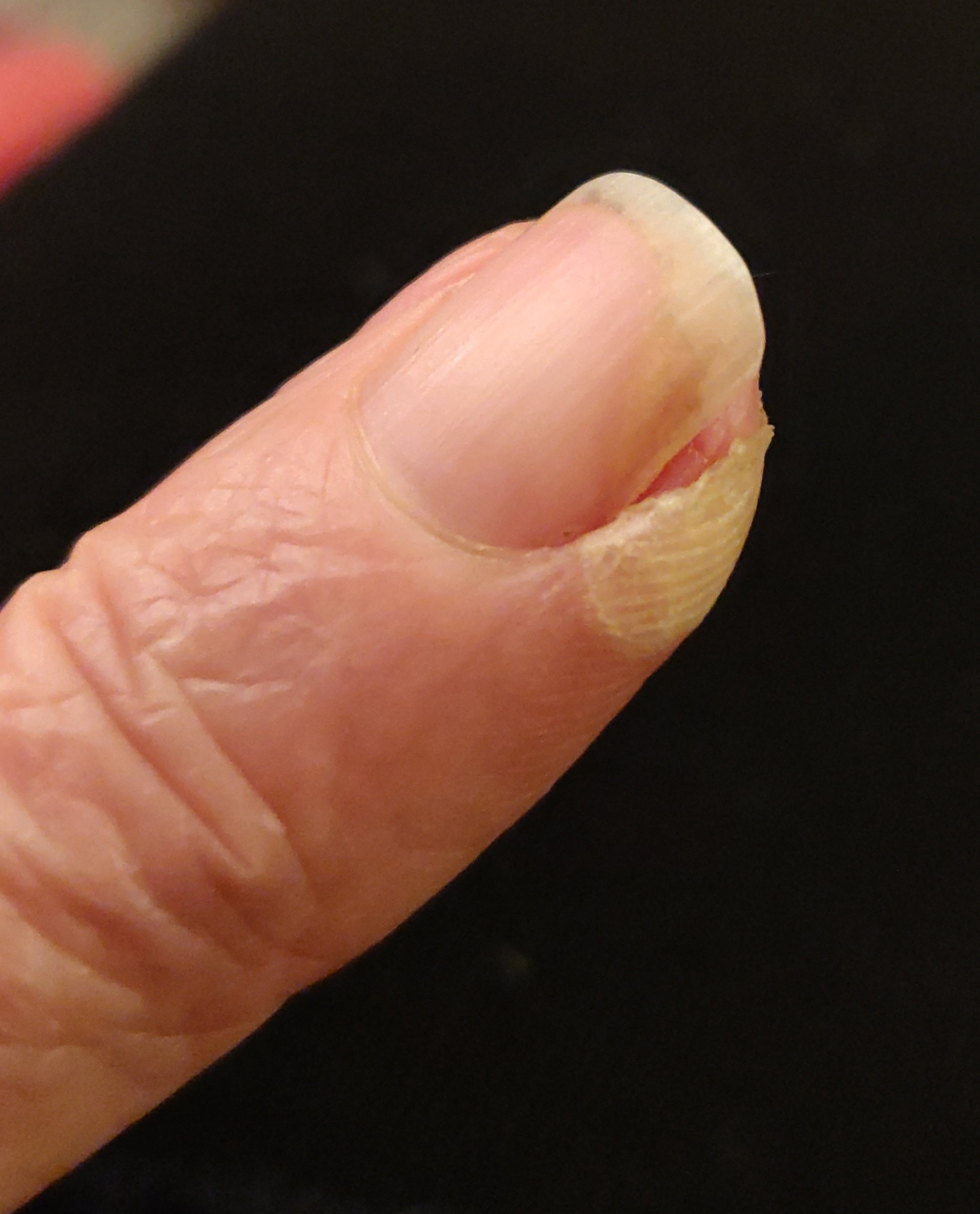
Annoyingly this catches on everything, but I am trying hard not to pick at it.
OK, I know it’s now mid January and this is a post about a Christmas gift but I’ve only just got around to finishing it off and getting it online. This is the story of knitting the hat worn in this photo.

December 2018…
I’ve started a beanie hat as a Christmas gift. Its in yarn from my stash, a rather nice airforce blue tweed 90% wool 10% acrylic blend Aran weight yarn. I dithered about the acrylic content I have to say, as I believe one’s toil is best rewarded by natural fibres, but the the colour (and having the yarn to hand), won the day.
The brim should work out to be around 7cm (3″) deep, and I’m going to knit it in a 3 row 2×2 cabled rib, with the shaped crown in stocking stitch. The pattern has been designed for a 61cm (24′) head circumference.
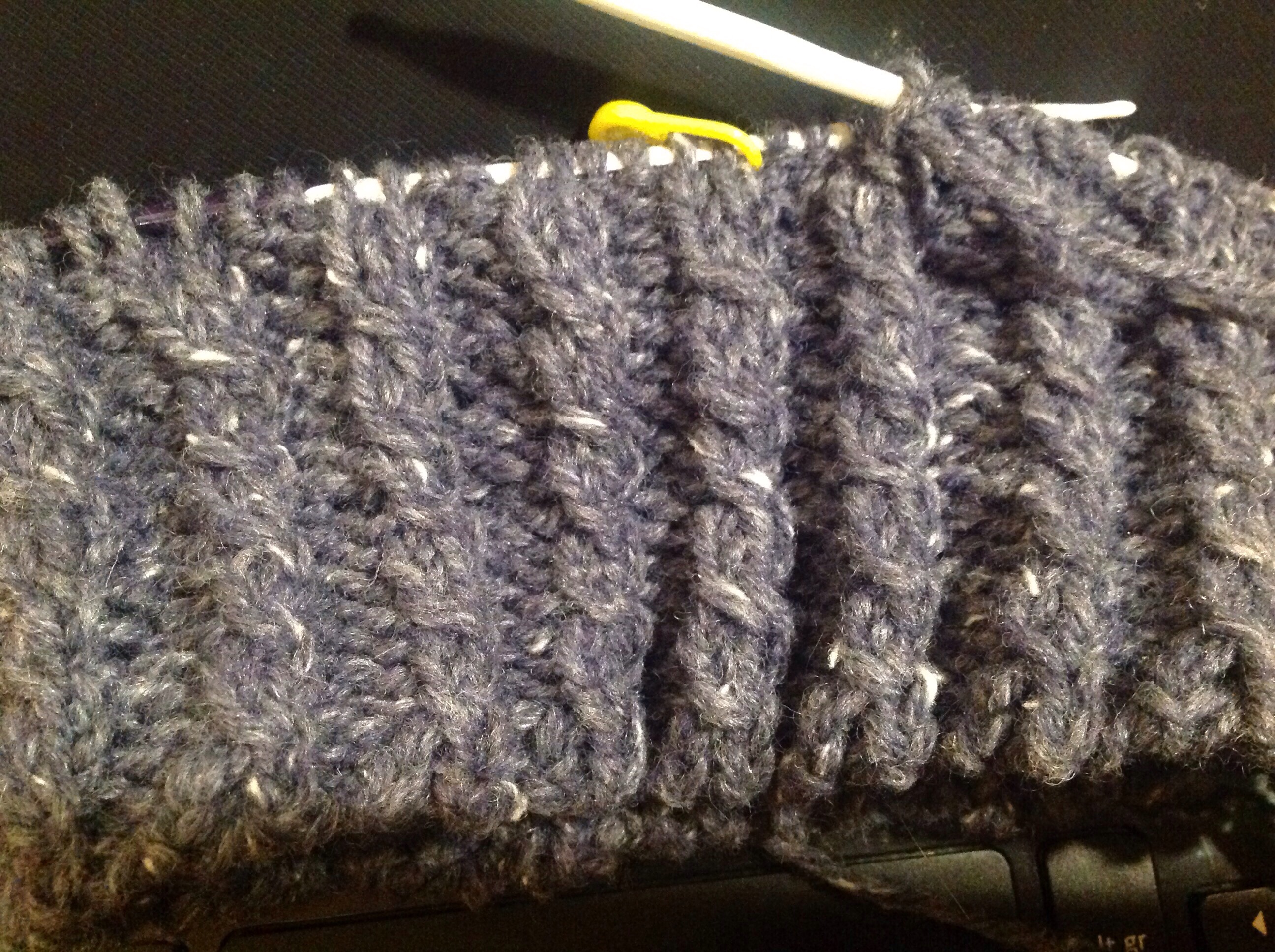
Gosh that doesn’t look very blue, more grey, must be the light. The rib shows though.
The cabled rib is worked on a 3.5mm circular needle, and the crown on a 4.5mm circular needle.
I have a set of those lovely interchangeable KnitPro needles, which means the world is my oyster when using circulars, but because the yarn is quite dark I have decided to use a white Prym triangular pointed circular so its easy to see the stitches. These are also comfortable to work with, and have a strange knob on the point that I quite like.
So far I have cast on 80sts (has to be divisible by 4 for the 4 stitch rib repeat) worked 2 rows rib and 6 repeats of the cable, and then 6 rows straight rib. I used the 2×2 alternate rib cast on recommended by Woolly Wormhead. Its not as stretchy as I had hoped, but looks good. Any stretchy one will do though, don’t beat yourself up about it.
How to work the c2b cable on the rib: Either use a cable needle, or work them as follows: slip the two knit stitches one-by-one knitwise, then insert the left needle from the right into the front of these stitches and slip them back to the left needle. This twists the stitches. Knit them one by one.
How I knitted the hat:
Cast on 80sts, using a stretchy cast on.
Join the round securely in your favourite way; for example work the first stitch, and pull the yarn to tighten the join before working the next stitch, or before working the first round slip the first stitch of the cast-on onto the point of the right needle so that it will be knitted at the end of the first round.
Mark the end of the round with a stitch marker.
Round 1 and 2: (k2, p2) to end.
Round 3: (c2b, p2) to end.
Repeat round 1-3, 5 times.
Round 16-20: (k2, p2) to end.
Round 21: purl.
Move the marker up to the current row.
Now you have the option to work all the stocking stitch in purl, and replace the knit decreases with purl versions, or if like me you find knit faster than purl, this is what I did.
Slip the last stitch to the left needle, and take the yarn to the back between the stitches then slip the stitch back so that the yarn is caught around the stitch. Invert the knitting and working in the opposite direction to former rounds, work the rest of the crown as knit stitches.
Round 22: knit
Continue working as Round 22 until the work measures 20.5cm from edge of rib.
Now to do the shaping.
I worked the first and every fourth round as a decrease round as follows.
First round,: k7, k2tog (70)
Second and third round: k all.
Fourth round: k6, k2tog (60)
Fifth and sixth round: k all.
Continue in this sequence, knitting one less stitch between decreases until 50 stitches on needle. Then work decreases on every second round until 20 stitches remain, finishing with a knit round.
Break yarn leaving a 40cm tail. Thread yarn onto a darning needle and slip the open stitches onto the darning needle. Draw the stitches in and secure the yarn end.
The designers of the Multipom have been kind enough to send me one of these little gadgets so that I can try it out.
This is me discussing how I fared following the packet instructions and making 12 tiny pom-poms in DK yarn. I chose acrylic yarn for these test pom-poms, because I thought that would be a good test. In my experience wool yarn, or at least with some wool in it, makes the most luscious pom-poms. They must be steamed though. This opens out the fibres at the cut ends of the yarn, plumping them beautifully.
This was my method, following the instructions that came with the Multipom.
Firstly I wrapped the yarn 40 times, lengthwise around the Multipom. Doing fine so far.
Next it needed to be tied off into 12 equal lengths. Well not equal, as the end tie is closer, which was tricky. Somehow I managed to tie only 11 ties, but couldn’t work out where I had gone wrong. A ruler has been printed on the instruction sheet so it should have been easy. I put it down to me being tired!
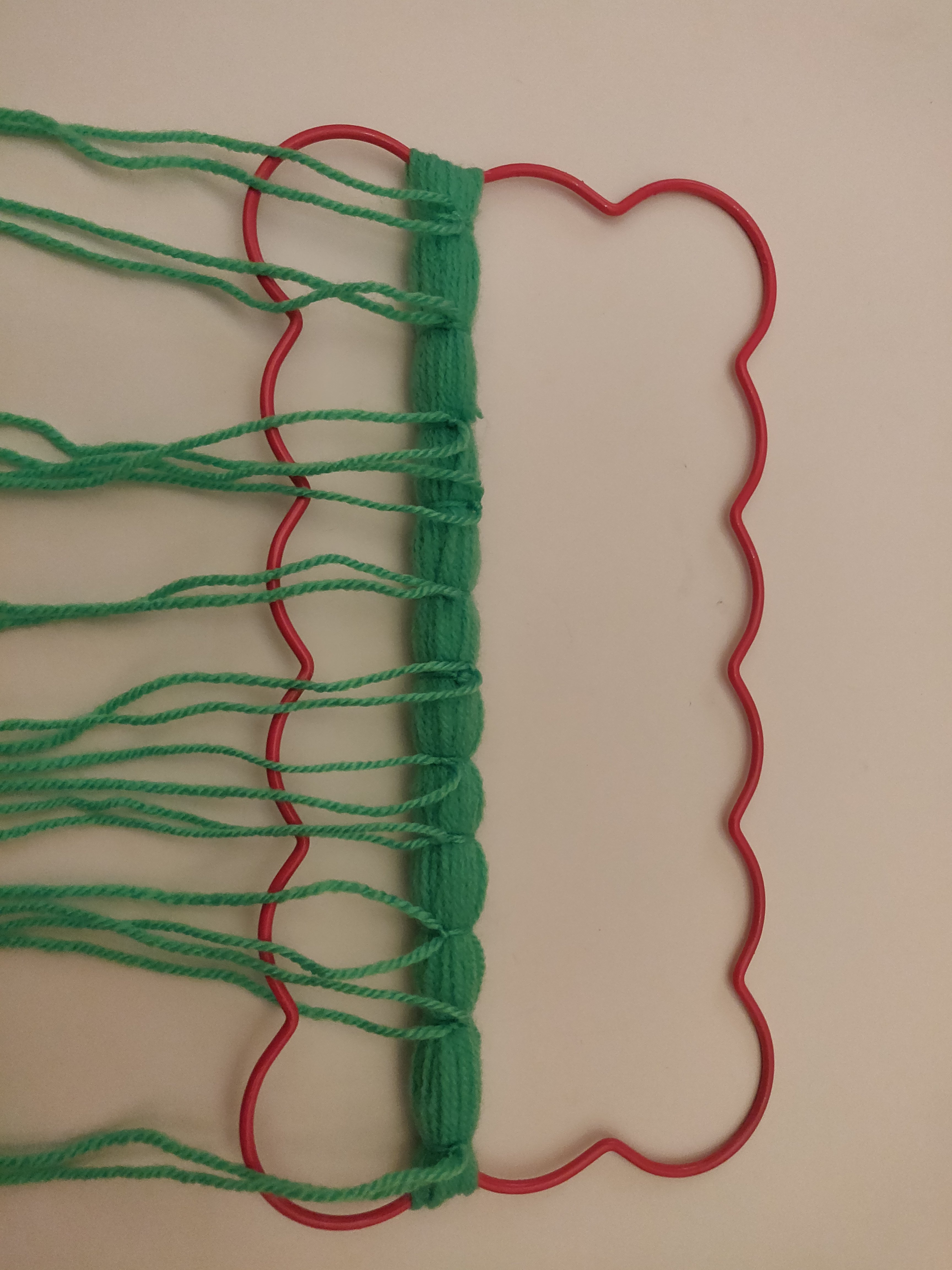
Tied yarn on the Multipom
Tying the wrapping threads was challenging. Another pair of hands to hold the knots tight would have been helpful. The advice to use a strong thread is very sensible as you have to tug hard to make a nice ‘waist’ on each pom-pom before cutting.
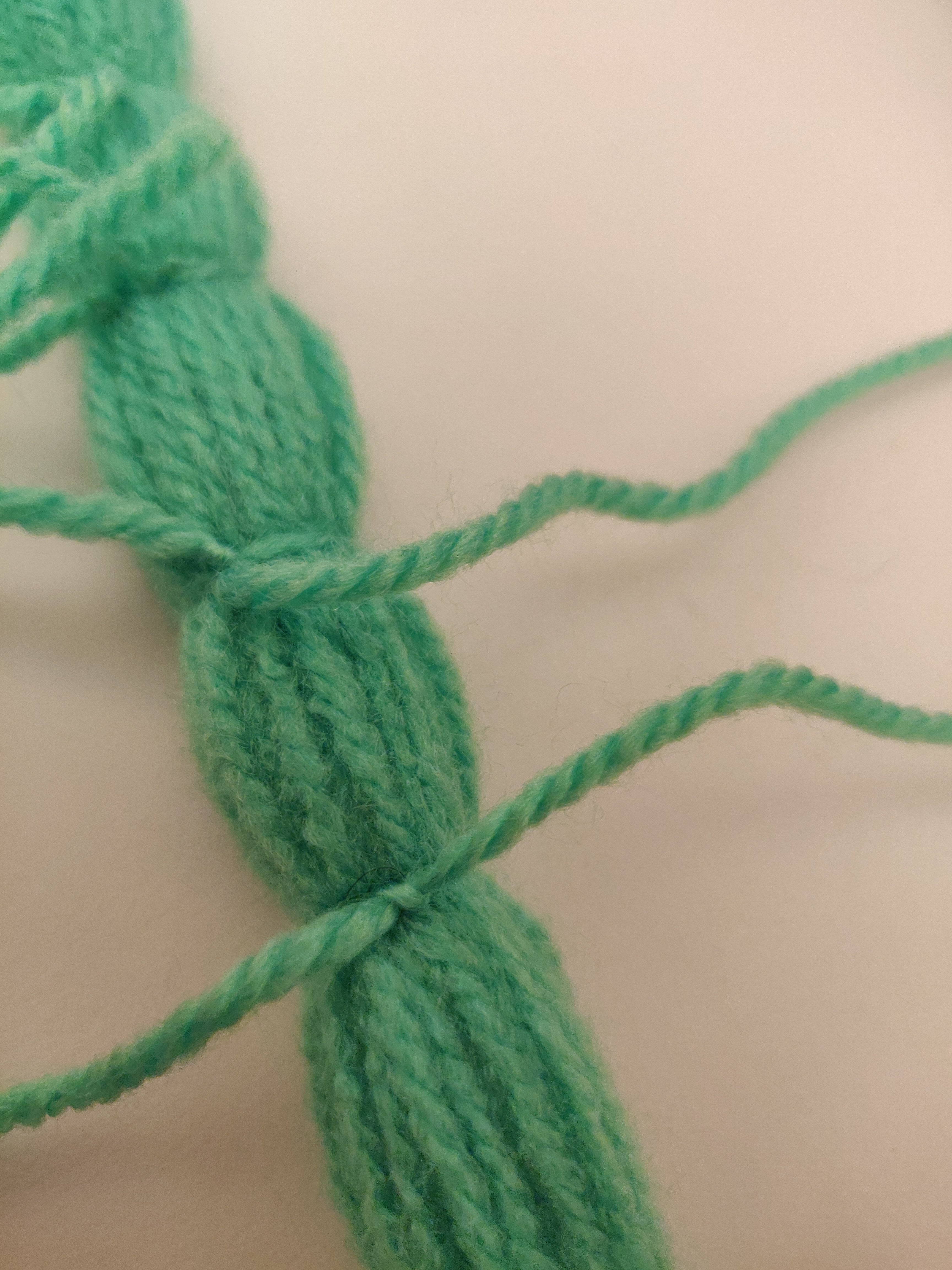
Tying the knots tight enough was fiddly. Strong yarn needed, and strong fingers.
Anyway I decide to get ahead and cut them anyway. Cutting the end ones was awkward,so that pom-pom was more ragged than the others immediately after cutting.
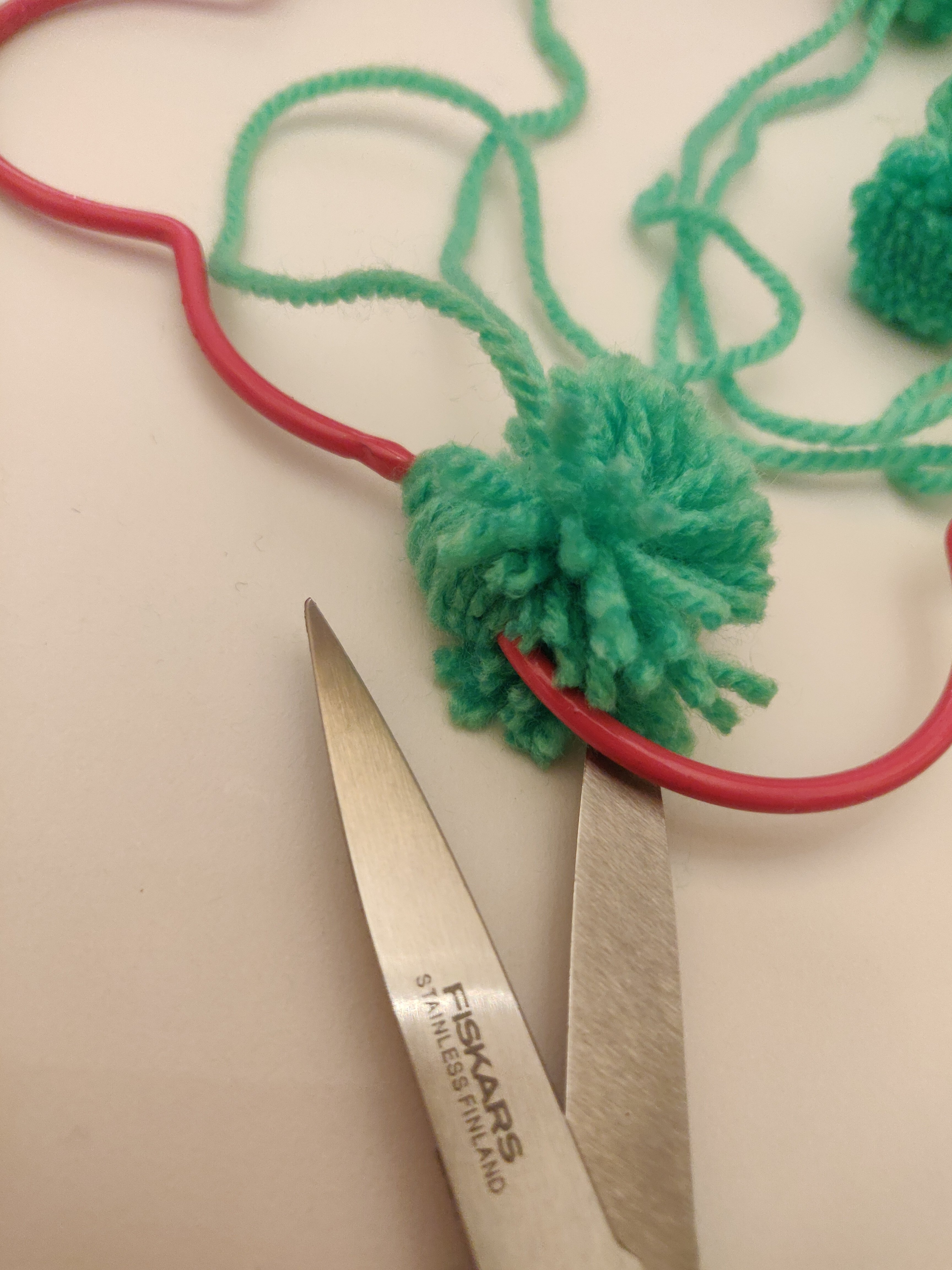
Getting the scissors in to cut the end folded yarn was a bit awkward.
I rolled each cut pom-pom between my palms to encourage them into balls, and then started to trim them. This is where a pair of curved blade embroidery scissors would be useful.
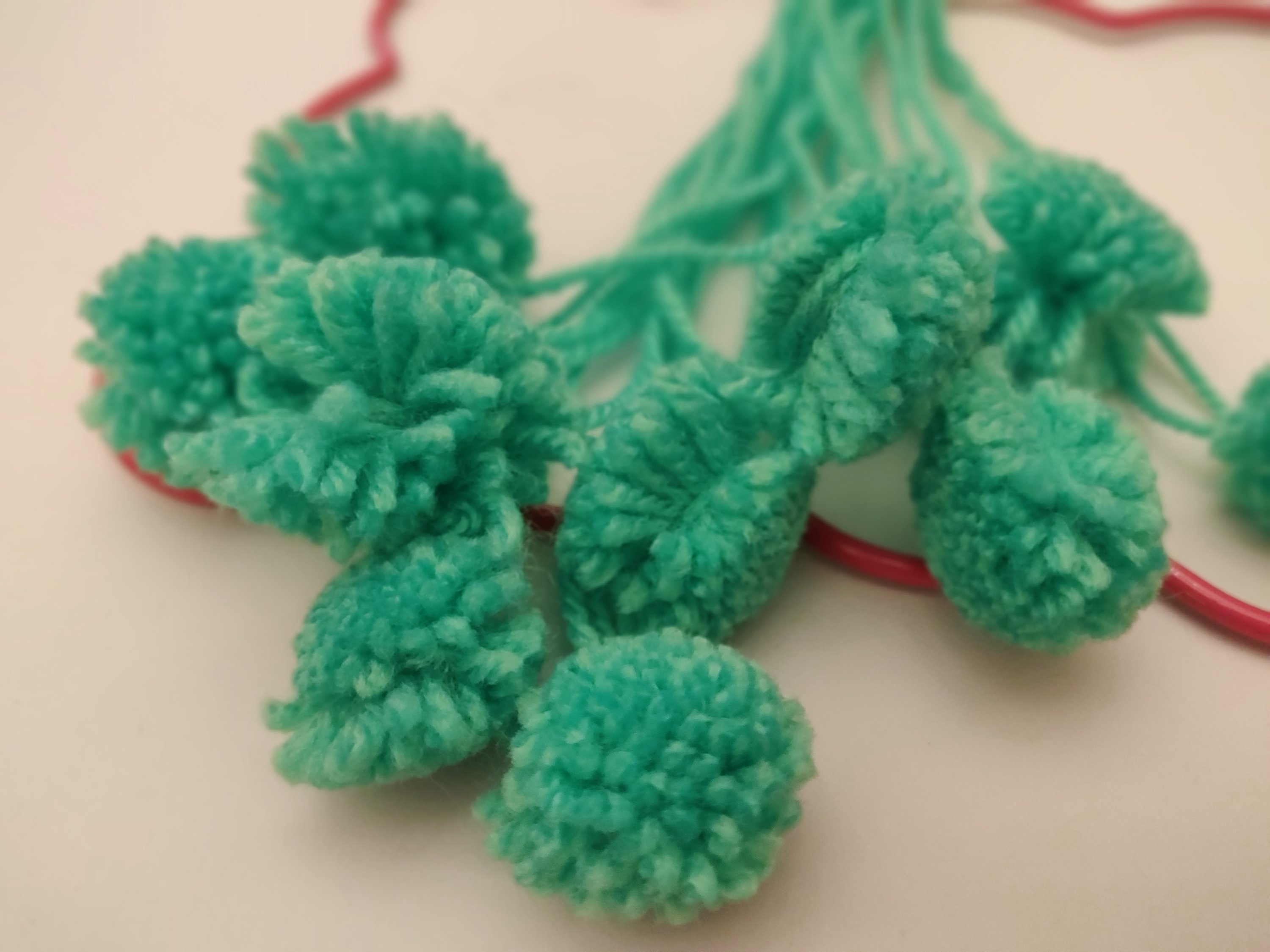
The pom-poms after cutting but before being rolled between my palms.
Once again, a good tip is given in the instructions, ‘Don’t be afraid to cut too cut off quite a lot’, and thats what they mean Take it a little at a time and turn the pom-pom as you work; there is a lovely nugget of firm roundness inside those straggly monsters.
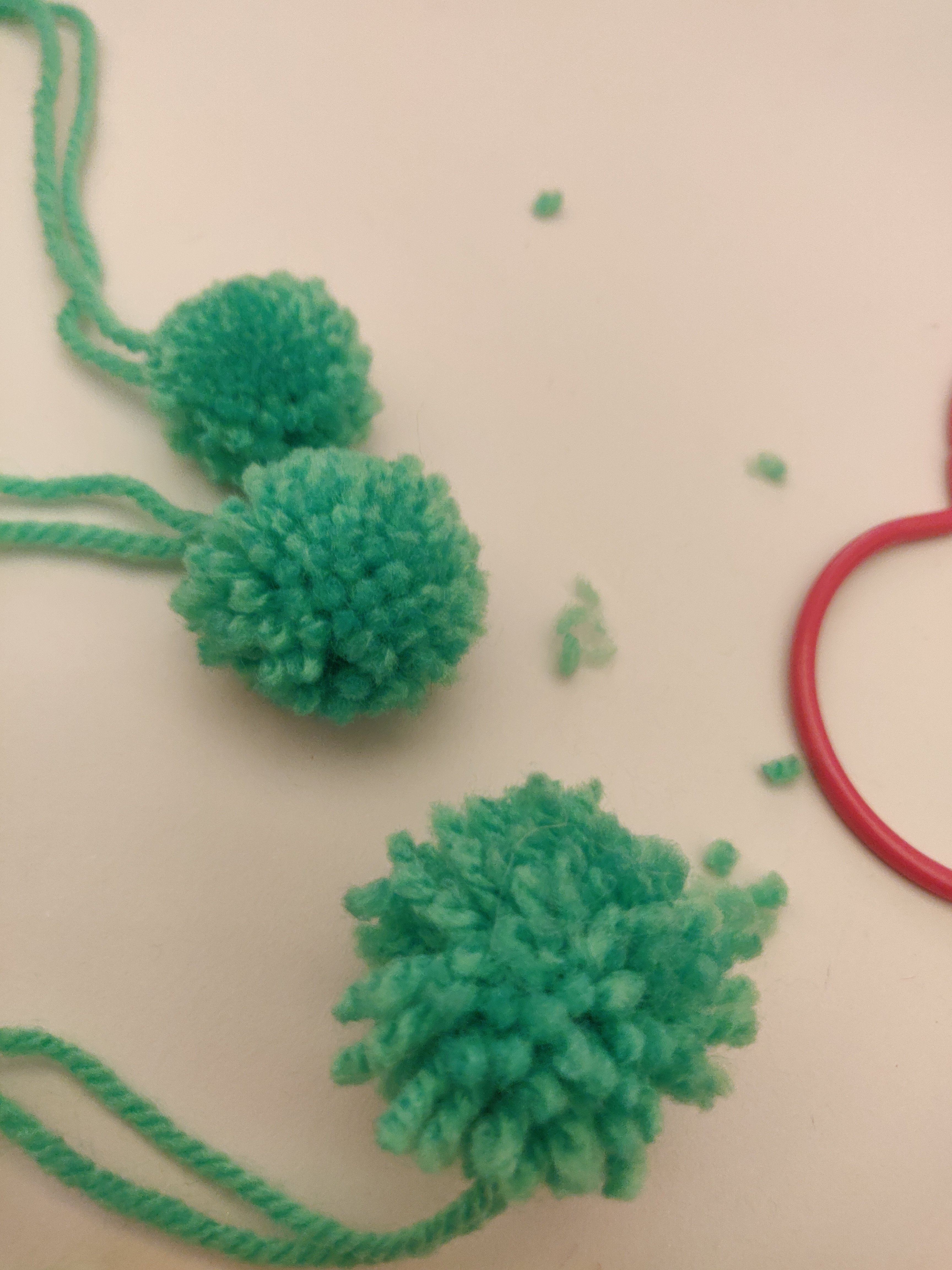
Trim,turn,trim,turn. And again
It took me at least 10 minutes to trim them all to my satisfaction.
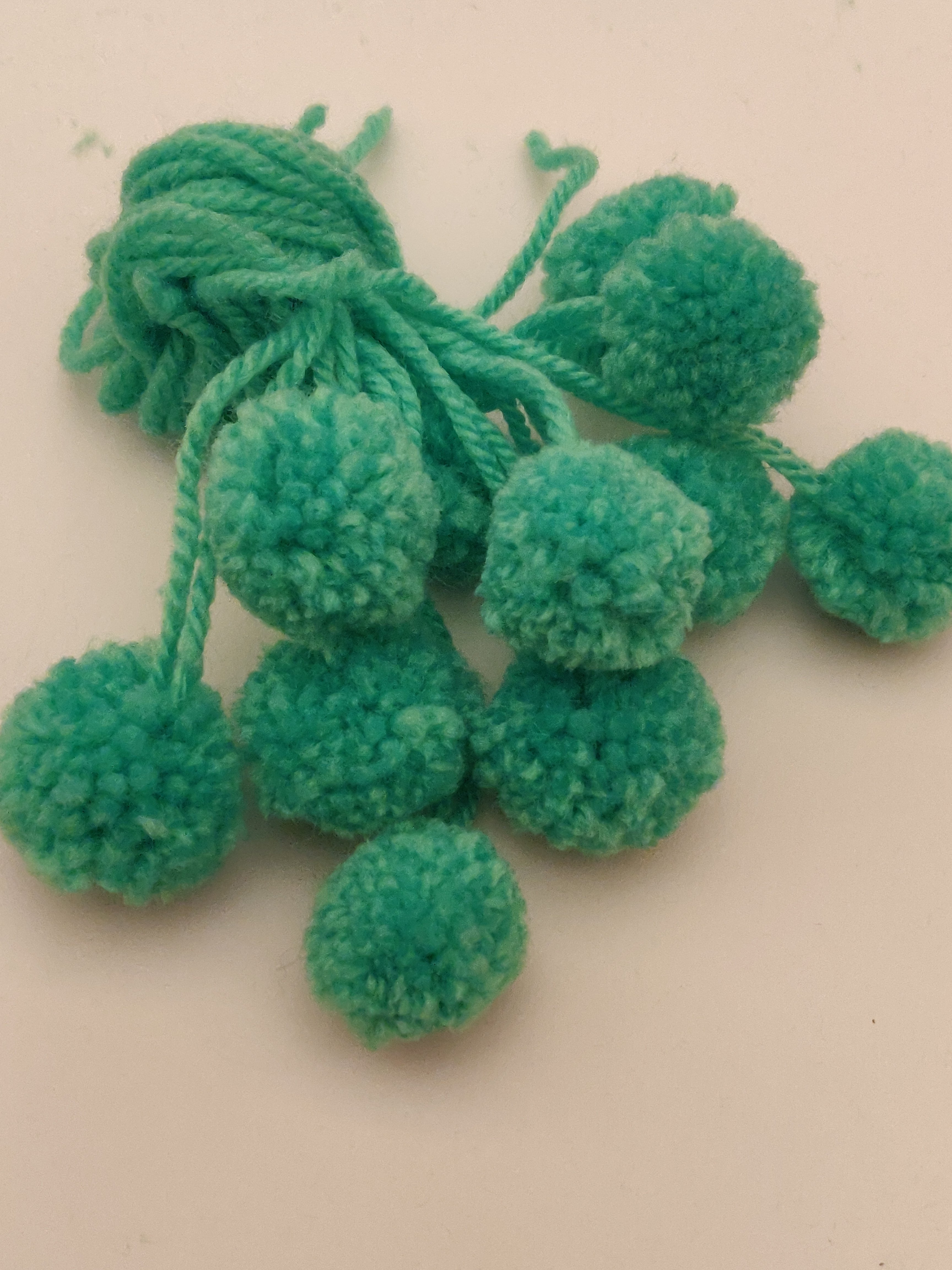
Trimmed and almost done
Then I steamed them by hanging them inside an electric kettle. Do be careful if you do this. Don’t put too much water in the kettle so the pom-poms won’t get wet, and when you take them out be very very careful not to scald yourself with the boiling steam. Use an oven glove and let them cool before handing them. If they do get wet, don’t worry as this can improve their density. It just means you’ll have to wait for them to dry before working on them any further.
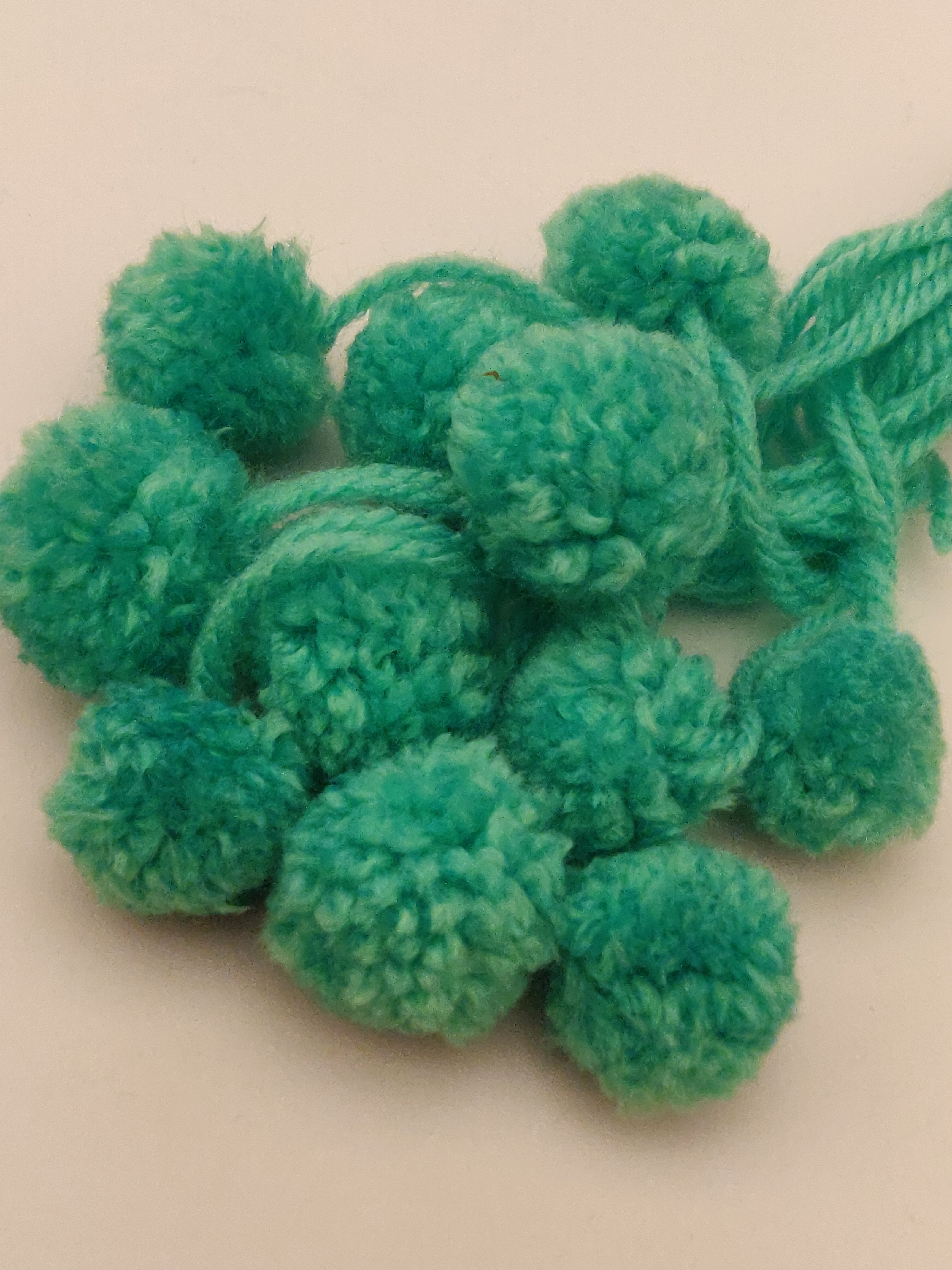
After steaming the outer fibres expand and fill in the shape.
So what’s my verdict on the process and result?
Is it quicker than making individual pom-poms on other gadgets?
Yes, although the trimming is a bit more arduous.
I find the yarn management much easier than when wrapping the small, individual pom-pom makers. It also avoids that situation where you are struggling to pop the two parts together, but they always spring apart again, or worse still the hinged bit pops off.
Cutting is a lot easier because you are just slicing straight across rather than inserting the blades between the plastic halves and trying to cut in a narrow space, whilst trying to hold the maker together. When using the Multipom there is the rather fiddly end cuts on the frame to deal with, but that’s only 2 per 12 pom-pom s, so pretty minimal compared to using an individual maker.
Wrapping core yarn is easier on an individual maker, as you seem to be able to get a better cinch around a circular waist, although that may improve with practise.
I haven’t tried larger pom-poms yet, but I suspect the individual pom-pom makers may give better results because trimming becomes more important to the final shape on big pom-poms.
So the Multipom gets my vote if you want to make lots of smaller or mini pom-poms, which after all is what it was designed for. However there is still space in my workshop drawer for the larger, individual pom-pom makers
Thanks once again to the Multipom team, it’s good to see innovative tools being designed to meet the diverse needs of the craft community.


