Although it’s taken me a while I have finally finished this cushion.
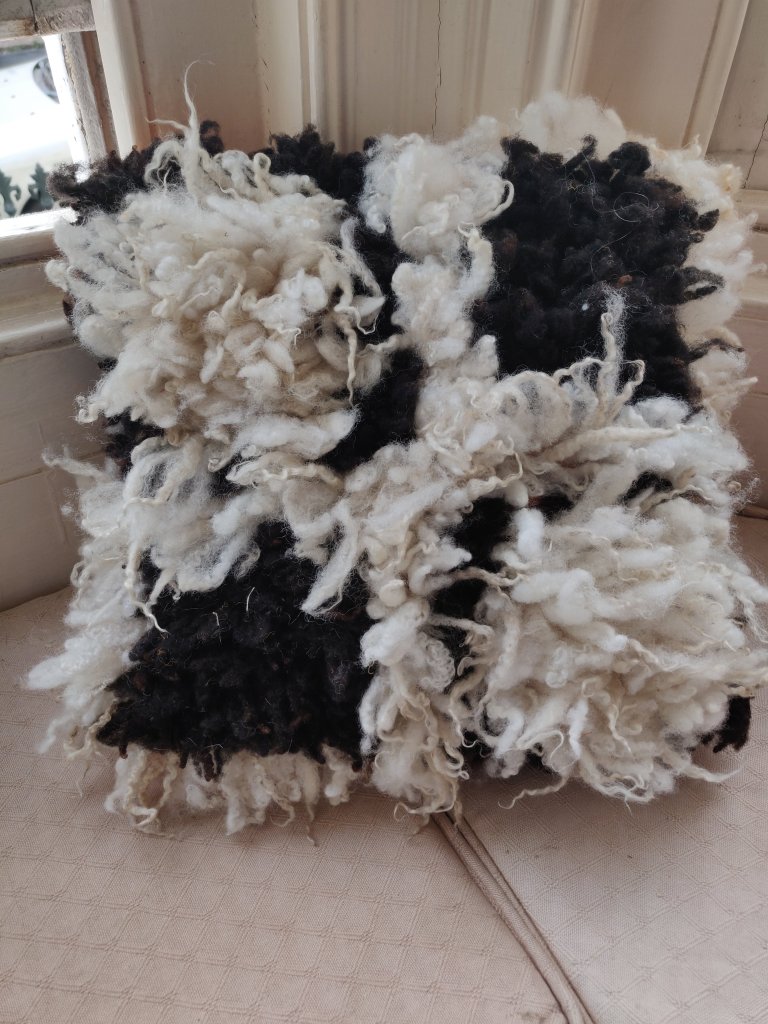
Front of the cushion. A tufted chequer board that is very tactile and squishy.
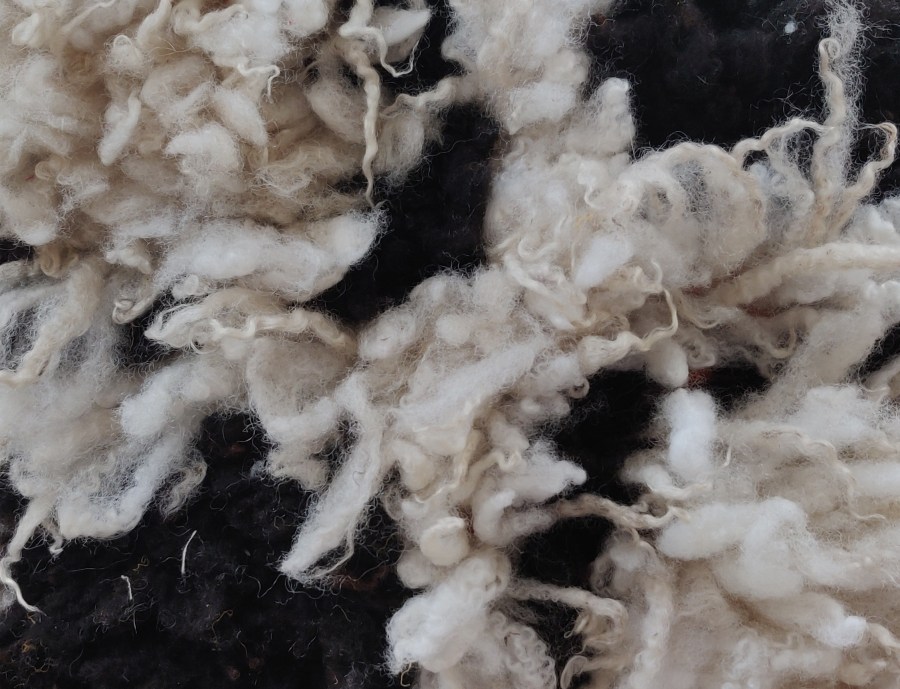
The front is Rya tufted and woven with a British wool rug yarn on a linen/cotton warp. The black tufts are Shetland staples and the cream is a mixture of Devon/Dorset staples. Although it’s not that clear in the photo, the squares are reversed; black edging with a cream centre and cream edging with a black centre.
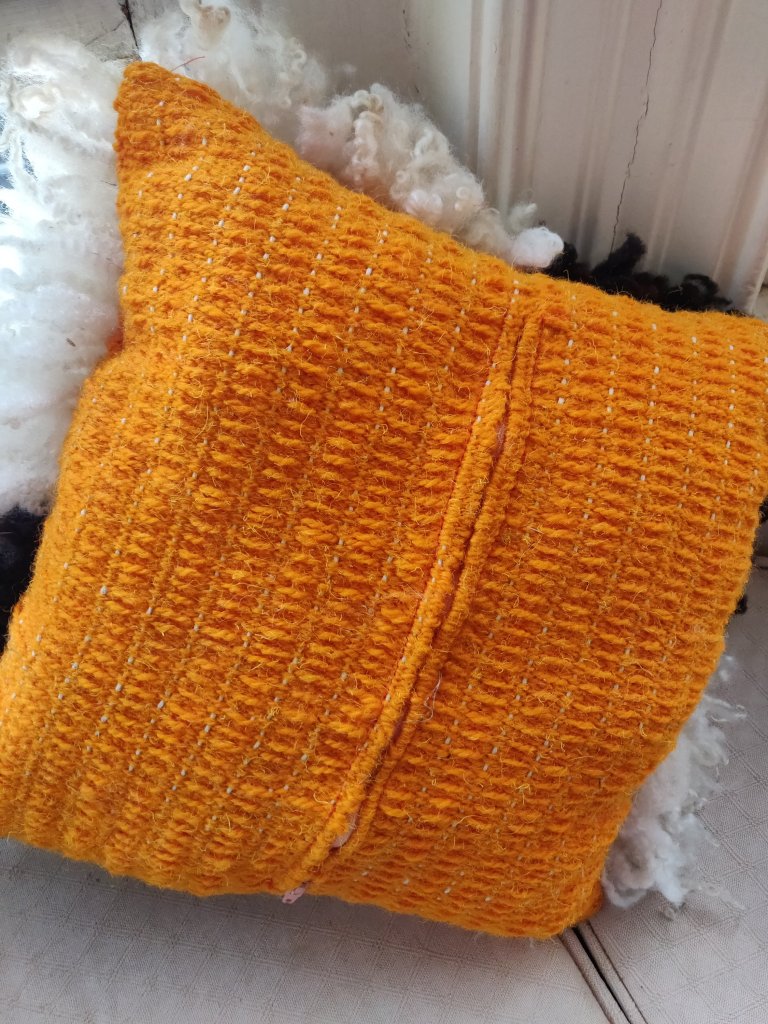
The reverse of the cushion is a faux waffle weave in the same rug yarn that underlies the Rya tufts. Because my rigid heddle loom is only a 20 inch wide, the cushion is composed of four pieces.
I took the opportunity to insert a zip in the centre back seam.
Instead of feathers or polyester wadding, the cushion is filled with a pad of lofty carded wool fleece. I will use this cushion to make my chair extra comfortable whilst spinning at my wheel.
Having acquired a Devon/Cornwall fleece that is quite similar to a Romney in feel and quality, I thought I’d dye some for blending. This fine will be great to comb for a semi-worsted spun yarn.
One of my favourite methods for safely dyeing fleece without matting the fibres is to use a slow cooker. I have a large family sized one that will dye 100g comfortably and 150g at a pinch, and a single-person one that does 20g for samples etc.
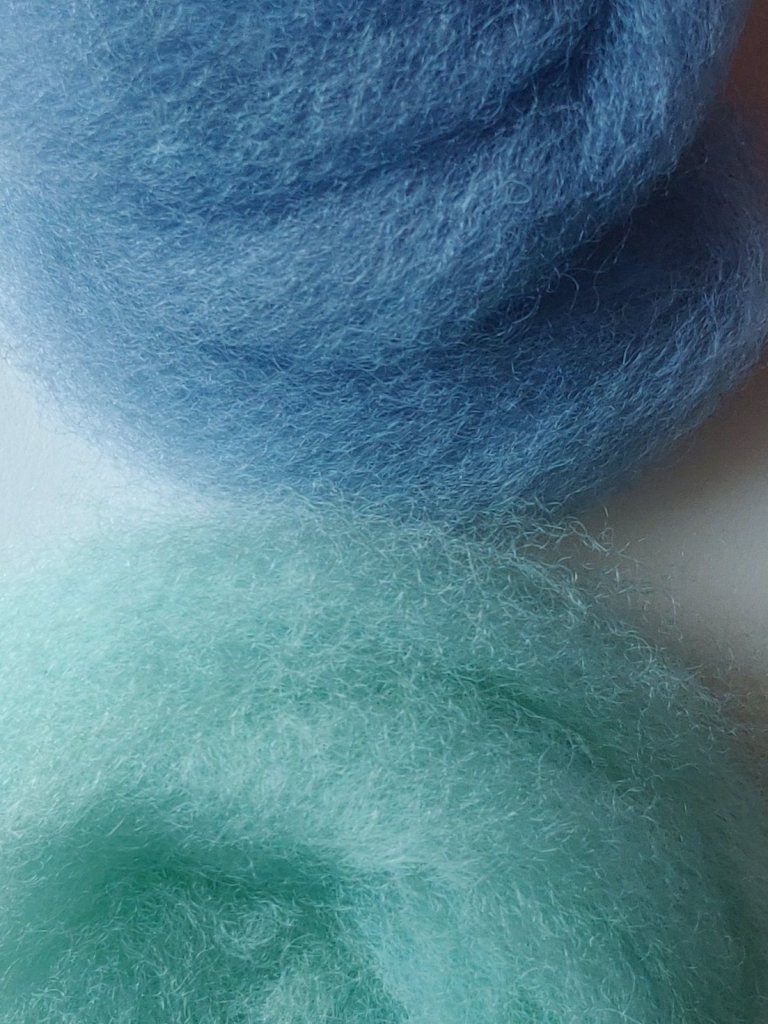
Using a pre-mixed colour I’ve used before I did a blue first. However, on this fleece it came out darker than I anticipated, but will probably lighten up once combed or carded and spun.
From the remains of the dyebath I got a pretty light turquoise.
The blue at the back, turquoise at the front
I have combed these colours as shown in this video.
Note that in this video I talk about ‘roving, but technically I am making ‘tops’. Roving is a similar narrow length of fibres drawn off a drum carder (usually, but can be hand carders) and has a slight twist added to keep the fibres together. After combing, both colours have come out as I hoped.
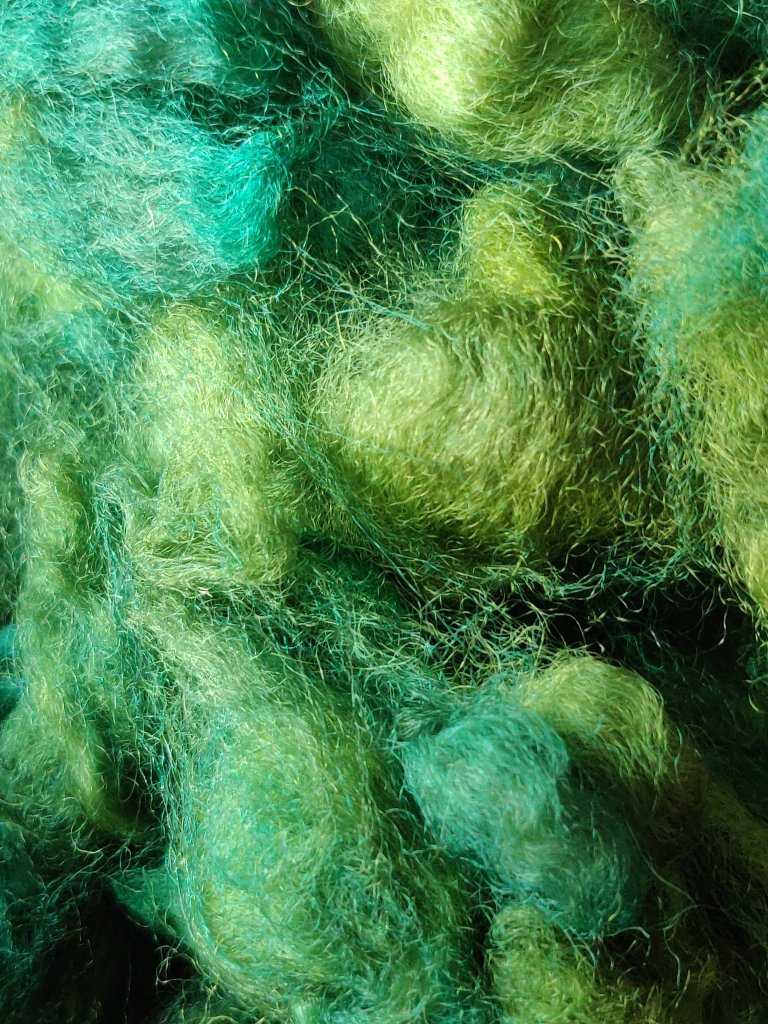
I also wanted an olive green, and have a recipe that worked perfectly on a Dorset fleece last year. I must have made a mistake somewhere, because I got a dark green instead. Maybe it is the different fleece, but I think I got my proportions wrong!
Pretty enough, but not olive green!
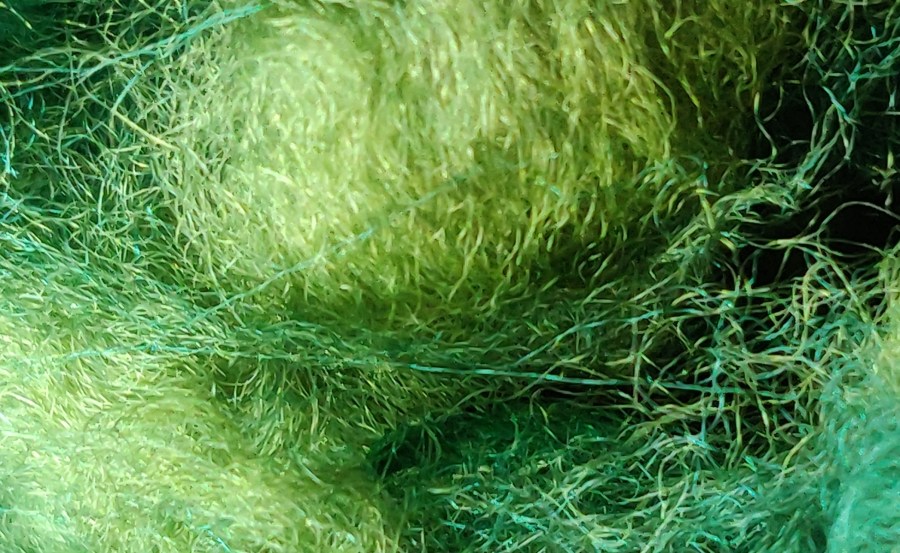
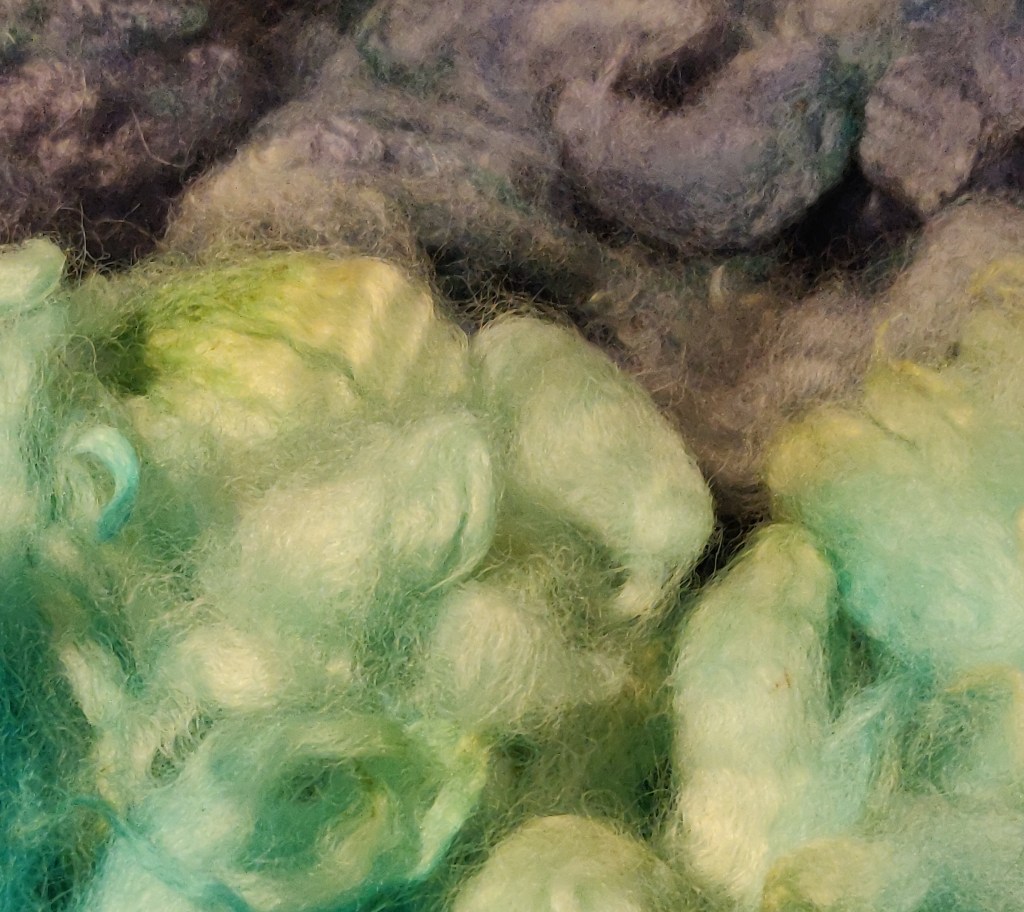
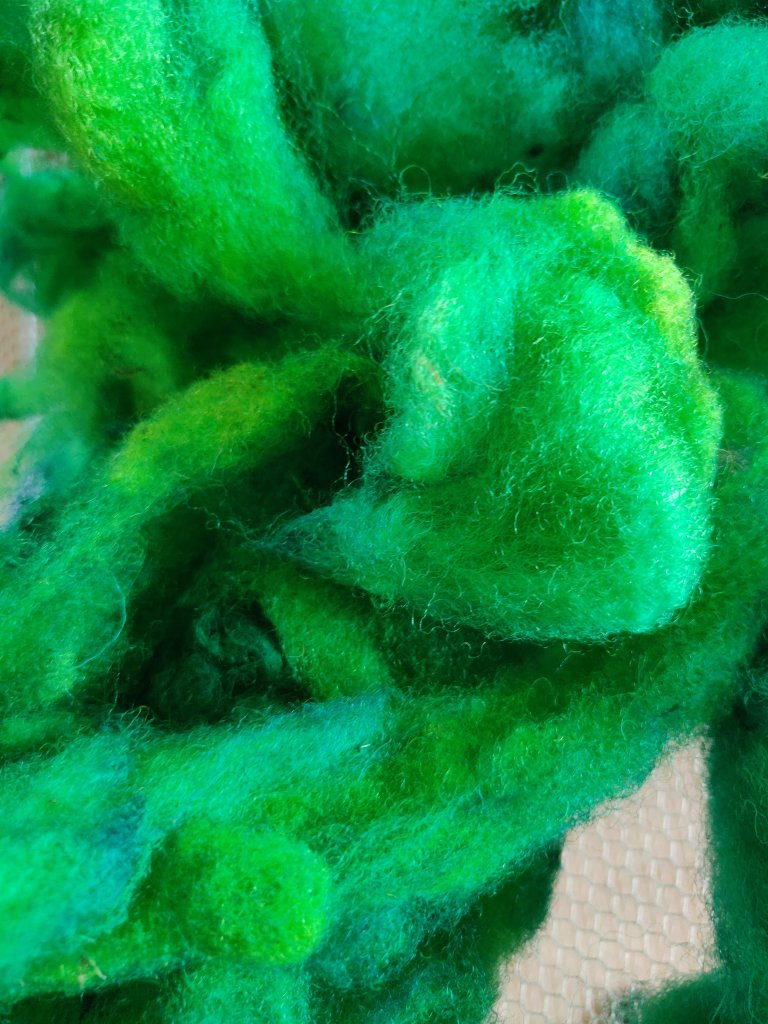
Once again they was some colour left in the bath, so in went 100g of Dorset fleece. OMG, the colour was bright! No idea what I did wrong, but it makes me blink.
The only compensation is that the fleece has not called at all due to using the slow cooker method.
That bright green total exhausted the dye – no surprise really! I will probably card this as the staples of the Dorset fleece are short and it is a soft fibre. Great for soft woollen spun yarn.
If you are interested in discovering the difference between different terms such as roving, tops etc, click here to read Abby Franquemont on Spin Off.
A recent stock-take of the various bits of hand-spun yarn sitting on bobbins I now want to use for other projects inspired me to ply them all up and dye them into interesting yarns. Only small quantites of most, but great for small items.
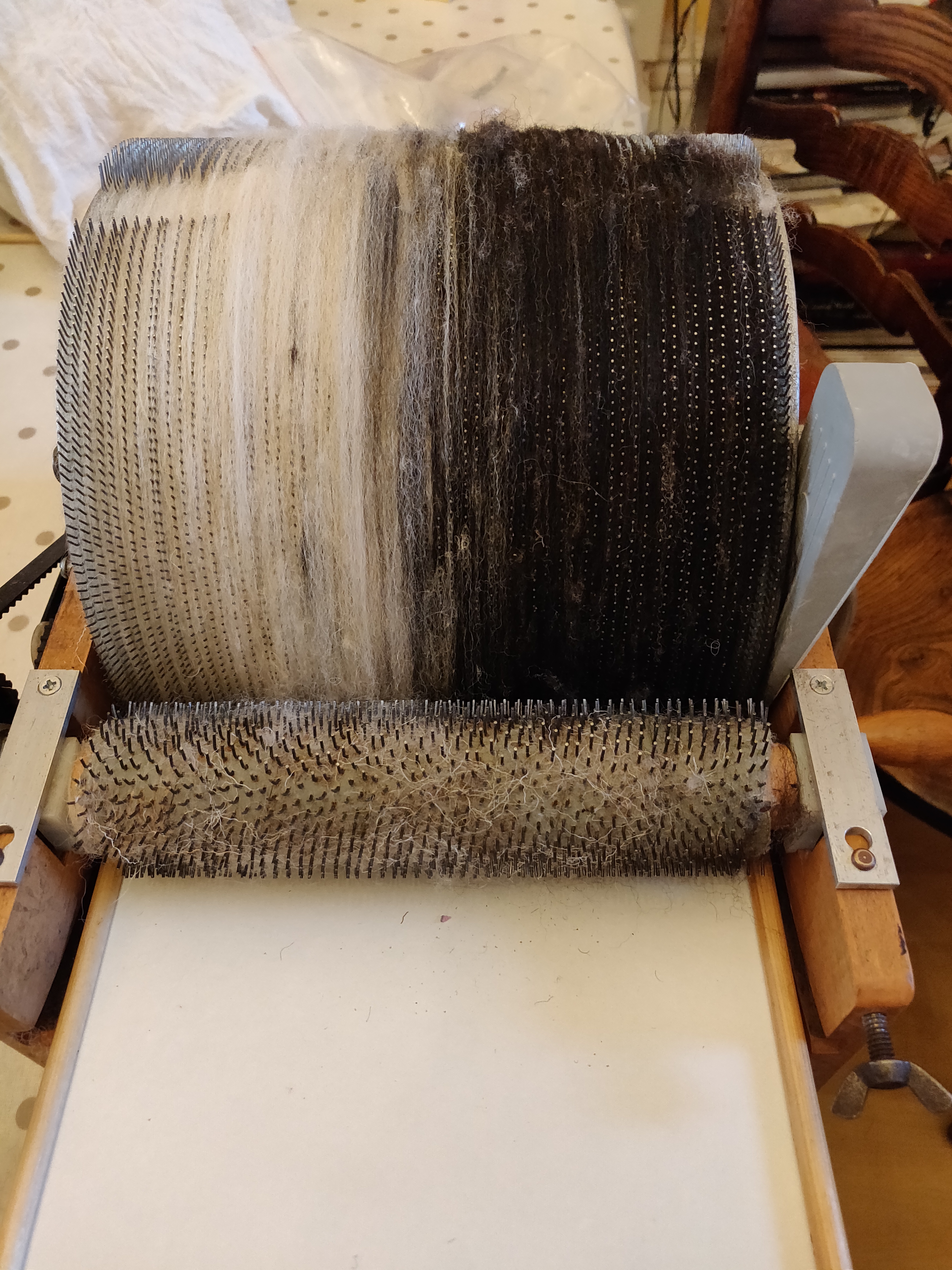
One was a test of blending Tussah silk with Lleyn fleece, and I plied this with some nice soft spun Dorset singles. The silk added a pleasant dry handle to the plied yarn, and the noils added texture. There was more Dorset singles left, so I plied these together as a separate yarns. Next I plied two ends of Suffolk together, they were somewhat different thicknesses and twists, so made a slightly uneven, spiralled yarn. Finally I worked with a lovely colour changing singles, spun from a blend of Alpaca and Texel (cream) and Black Alpaca and Dark Grey (almost black) Suffolk fleece. The Alpaca blends had been carded in stripes on the drum carder so that when it was spun off the batt it alternated in dark and then light lengths. I plied this with a pale grey Suffolk single that I had acquired from a farm in Hereford last summer.
Stripe carding blended fibres
Bi-coloured rolags
All these came out as interesting yarns in their own right, but I wanted to add some COLOUR. So I got out the dye kettle and the acid dyes. After some thought I decided to aim for a Deep Red and a Blue-Violet. I’ve been trying to be more technical about my dye mixing, and so with the aid of an Excel spreadsheet I have devised, I carefully mixed the solutions, but the Blue-Violet still emerged as Violet.
There was 66g of the Dorset and Suffolk/Dorset, and they went into the Red dyebath, whilst the 45g of Lleyn/Tussah/Dorset went into the Blue-Violet bath and they gently cooked away for an hour or so.
Part of my improved technique is to use a jam thermometer to keep the bath below 90C, preferably just above 89C to prevent felting. I also walk away so I am not tempted to STIR IT! The only stir I am allowed is after teh bath gets to temperature, when I gently remove the yarns, add the vinegar and stir it in. I read that doing this allows the different colours in the mix to be absorbed into the yarn (or fibre), before the acid does its work to set the dye to the fibres. Both these techniques seem to work well for me as I am getting less felting and more even, accurate colours (apart from the Blue Violet of course).
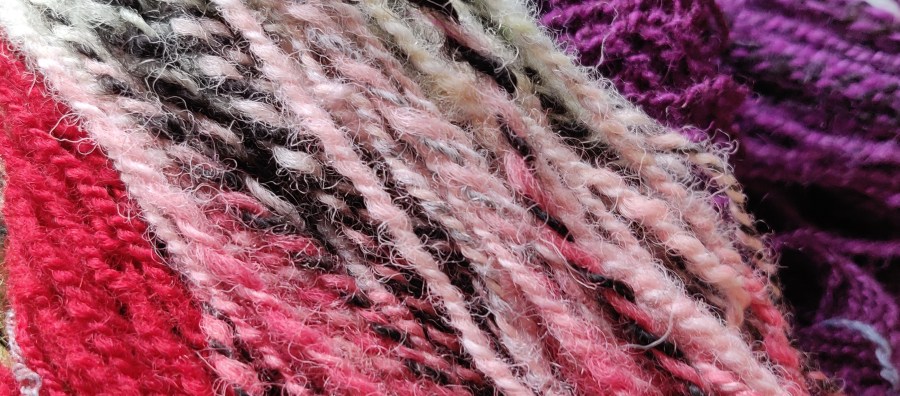
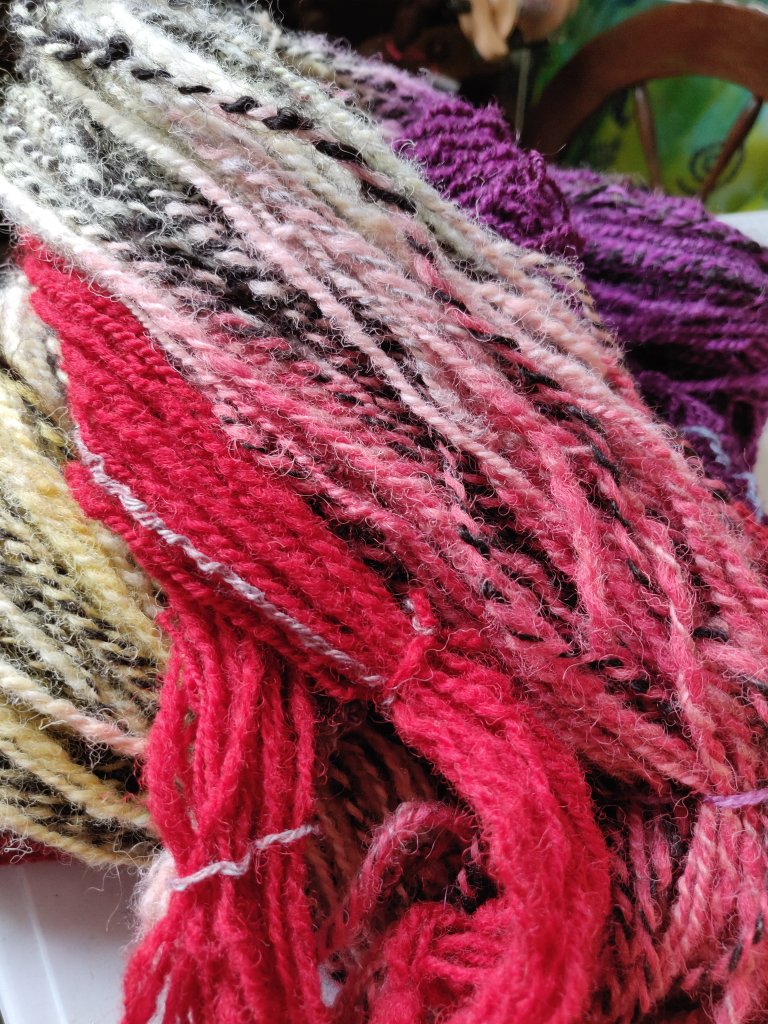
The dye baths were not exhausted – I had worked with a 2% colour to fibre weight ratio for medium depth of colour – so the lovely tweed ply was dip dyed into both pots, leaving mid-sections of the natural tweed plies undyed. I felt this needed a third colour to lift the others, so a very small section between each of the main colours was dipped into a weak yellow dye.
Dark red in front, dip dyed tweed in the middle, blue-violet at the back. You can just see the texural Tusssah silk blended purple yarn.
I’m really pleased with the products of the session – carried out whilst I watched the new TV programme ‘Roadkill’. Unfortunately I was a bit stupid, or maybe it was the effect of the programme I was watching, and whilst mixing a new batch of yellow stock solution I mindlessly poured boiling water onto the dye powder in a plastic jar. Of course the jar melted, buckled sideways and then toppled to the floor before I could catch it. Waves of strong yellow dye flooded the kitchen floor (I am exaggerating, it was only 150ml or so, it just felt like waves). It took five washes to clean the floor so that no-one would walk yellow onto the beige carpets, and my socks will never be the same again! Plus I had to start again with the stock solution. I did debate mopping the floor with some yarn, but decided that might be too hit-and-miss even for me…
In fact this morning, whilst hiding from the dog, (don’t ask why) I noticed a snail-trail of yellow dye snaking down the side of the kitchen cabinet – how did I miss that one?
What am I going to use the yarns for? I think a warm hat to cheer me up with its bright colours during this depressing winter-to-come is on the cards. I might knit it by hand or I maybe use my Brother KH260 chunky machine, and hope to report back on here when its finished.
Footnote:
Leaving the dye overnight in the pots – I was tired after all that floor-mpopping – the next morning I decided to finally extract the last from each one. So 50g of Dorset fleece went into each, and I got a rich coral pink, and surprisingly bright lilac for my troubles. It was so rewarding to empty clear water out of the dye baths afterwards.


 Vikki Haffenden