I planned this project of a collapsible fleece-drying rack over a year ago. Setting is always difficult as it requires a lot of space and works best if air can circulate to as much of the fibre as possible. I toyed with the idea of folding herb drying racks, but the ones I found were small, flimsy and expensive. I’ve seen others use those plastic crates with open mesh sides, but couldn’t find any of those locally, plus they take up space when not in use.
So I decided to design and make my own. My brief was:
freestanding
reasonably lightweight and portable
widely spaced shelves
a large surface area so that the fleece could be opened up to speed drying
collapsible so could be folded down and packed into a bag when not in use
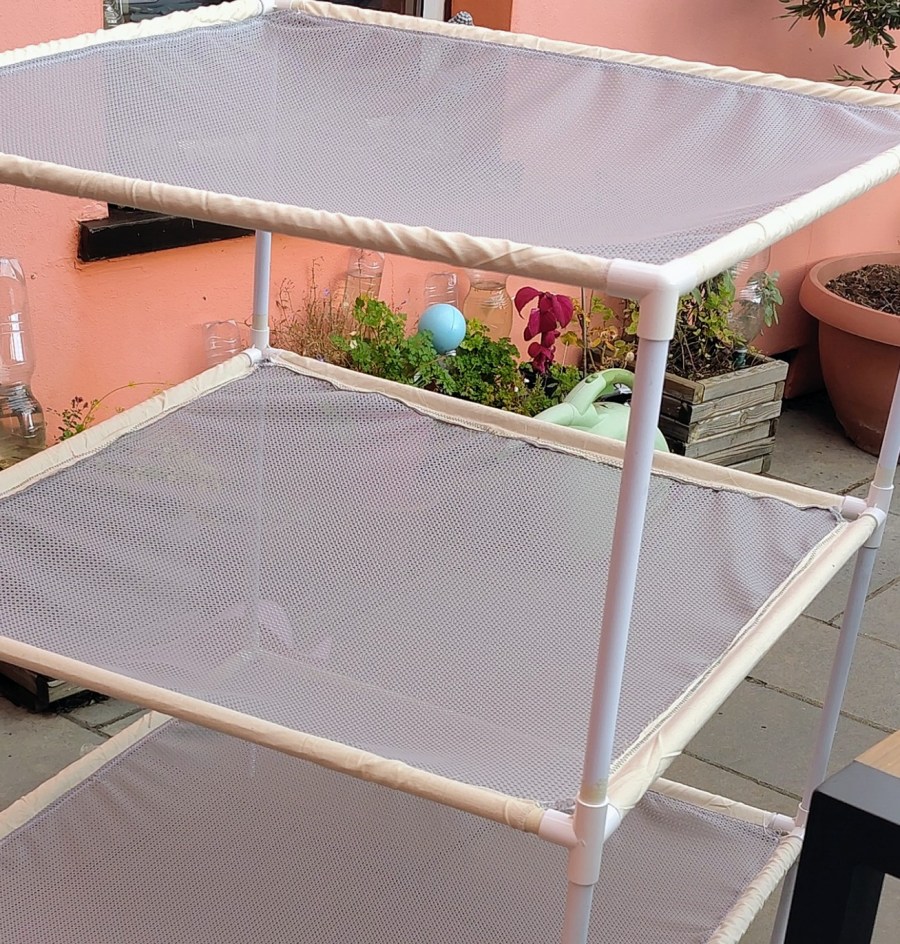
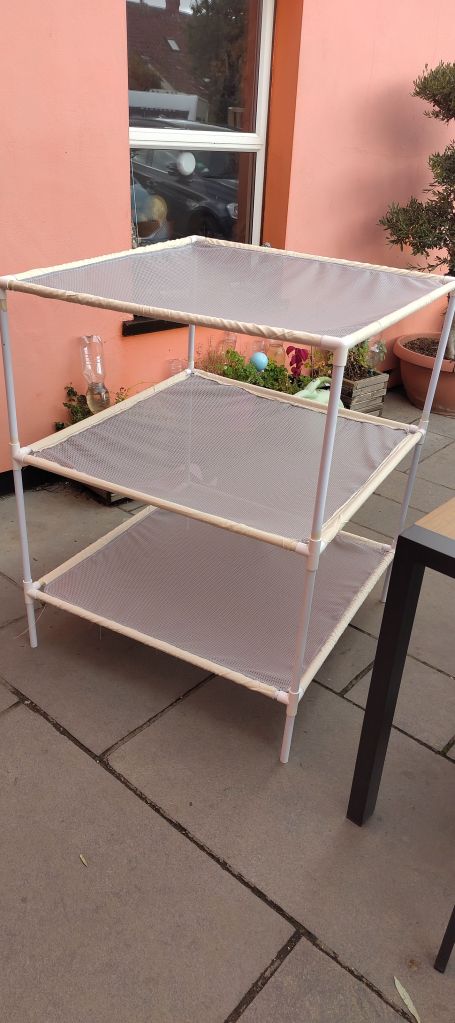
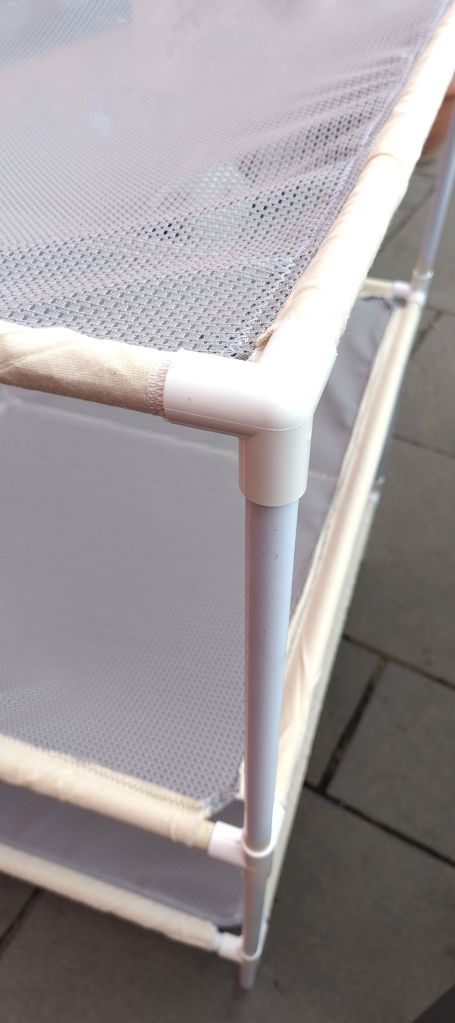
Designing the rack and working out the specs took some thought. I ended up with a plan for a three shelf rack, each shelf being approximately 80cm square. I intended to use plastic pipe and elbow joints for the frame and mesh fabric for the shelves. Mesh fabric would allow air to circulate, and if made from synthetic fibre, would dry fast itself and hopefully reduce the likelihood of mould whilst packed away. Each of the mesh shelves would have sleeves sewn along all four sides through which the pipes of the frame would be inserted. Then the pipes would be connected via the 3 and 4-way joints, putting the shelf under tension. In this way the shelves would stabilise the whole structure.
I already had some plastic piping left over from making a collapsible niddy-noddy, but bought the rest from Wickes, then cut it all into the correct lengths. I borrowed a plastic pipe cutter to do this, which gave nice neat and smooth cuts which would facilitate threading the pipe into the shelf pockets. The 3 and 4-way joints came from ebay, as I couldn’t find them locally. However, if you decided to make one of the racks, do try a local plumbing store if you have one first, before going online.
So I had the frame and it fitted together, but then winter came so fleece washing ceased and access to my sewing machine was limited by building work. But I went ahead and ordered 3m of fine mesh fabric for the shelves in anticipation of getting started when I could.
Sadly, when I finally got to sewing the shelves, the mesh proved to be too fine, overstretchy and delicate, so it was back to the drawing board. This time around I sourced a much sturdier, low-stretch mesh fabric on eBay. It was pricier, but fitted the bill really well. Luckily I found some seconds of the danger fabric, which helped keep the cost down. I also decided to use Calico I already had to sew smooth, non- stretchy sleeves for the pipes so that it would make it much easier to slide the shelves on and off the pipes. The sleeves would also make a stable attachment to the between shelf and pipe, and hopefully reduce stretching and drooping of the central, mesh shelf. As usual, cutting out and sewing took some time because I was doing it around other things.
Finally it all came together. Probably too late to test on a fleece this year, but it might work in the greenhouse if necessary. I hope the shelves will not droop under a layer of damp fleece. I spin it after washing, so hopefully it will support the weight.
I guess it would also work for herb drying.
If you would like the instructions for making this fleece drying rack I will add them in a few weeks time. Please pop back to this page to download the instructions.
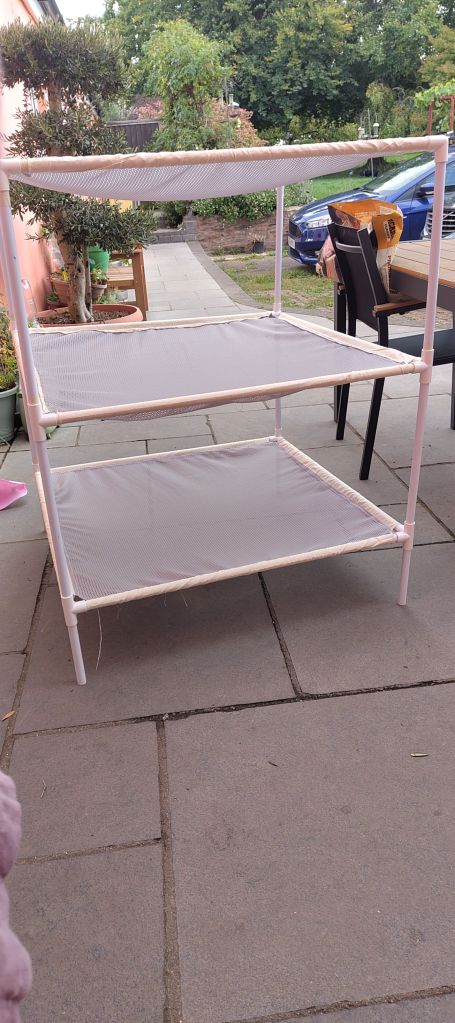
The finished rack The top, 3-way jointsMiddle 4-way jointsLegs are interchangeable, so the shorter ones could go in the middle if desired
Yesterday, Easter Saturday was the Guild Skill Share. There were many generous members who shared their knowledge and skills in weaving, knitting and spinning related sessions.
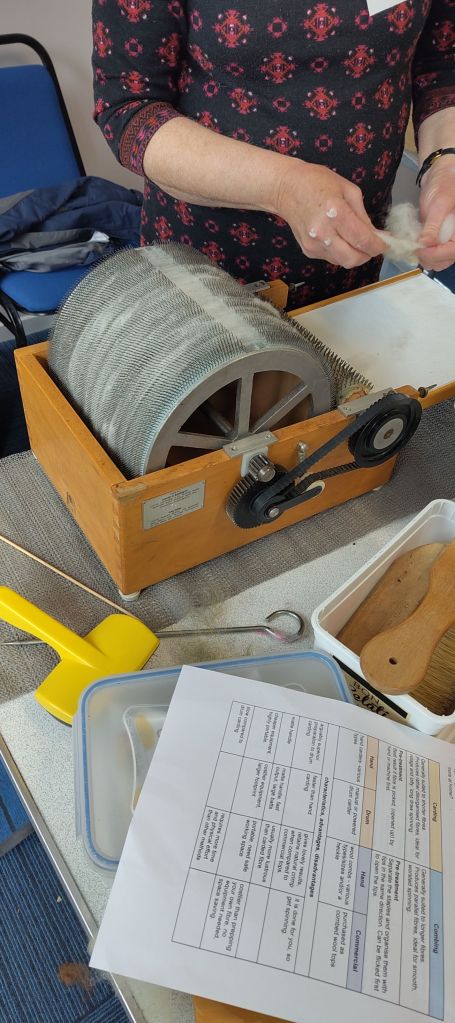
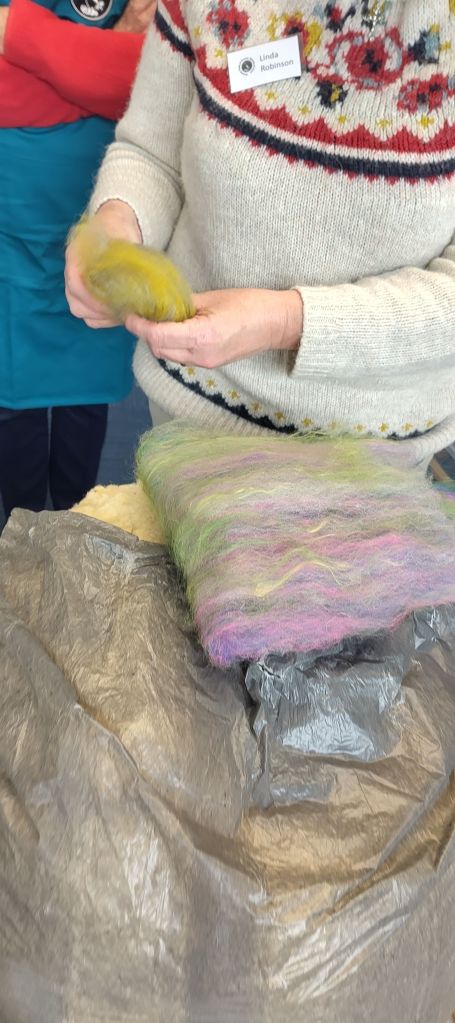
Kathy and I offered a Wool Fibre Preparation day so that members could have an induction on the Guild equipment or bring their own carders and combs etc. along to learn how to use them or just pick up some tips.
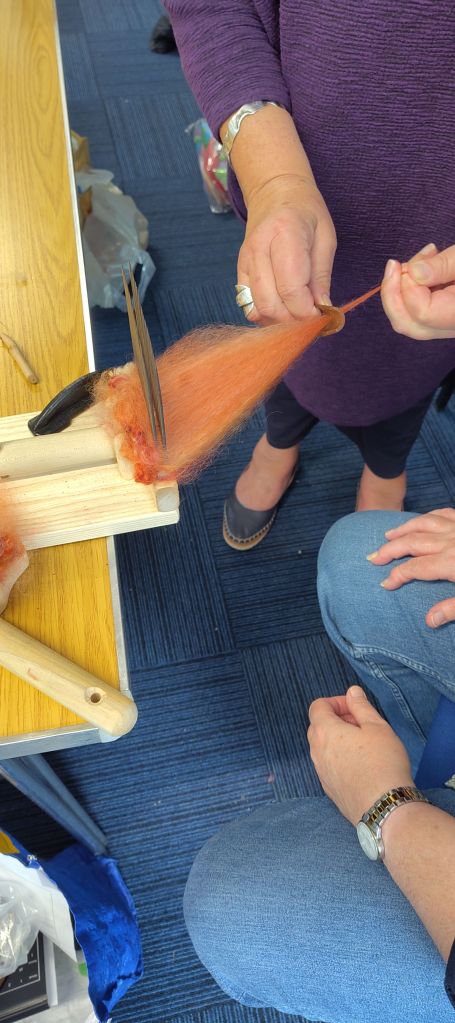
The morning was all about using swing or box pickers and hand and drum carders plus how to use these for blending. After lunch we tackled wool combing using a pair of English Combs and smaller Valkyrie ones plus blending in a heckle.
We enjoyed running the session and everyone seemed happy. After my initial H&S talk it was me that pricked my finger on the combs!
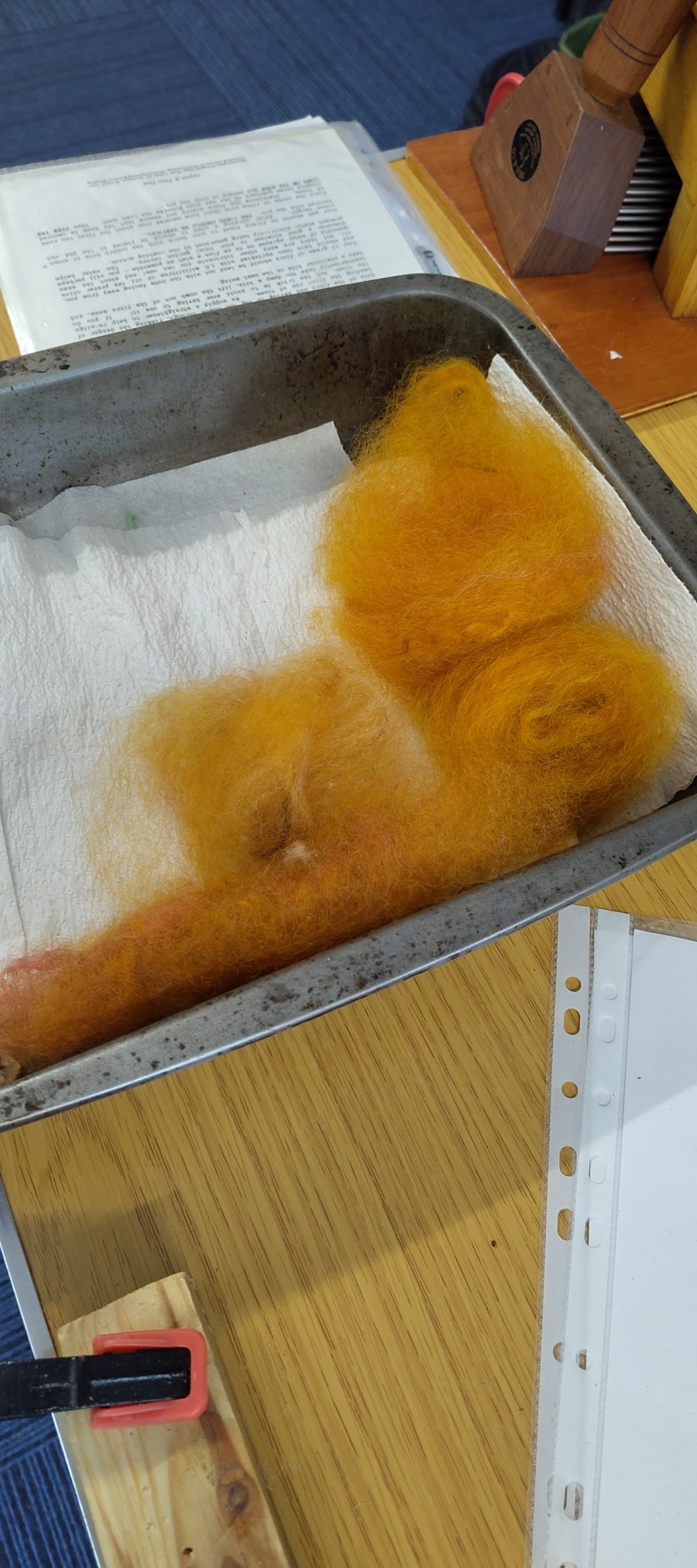
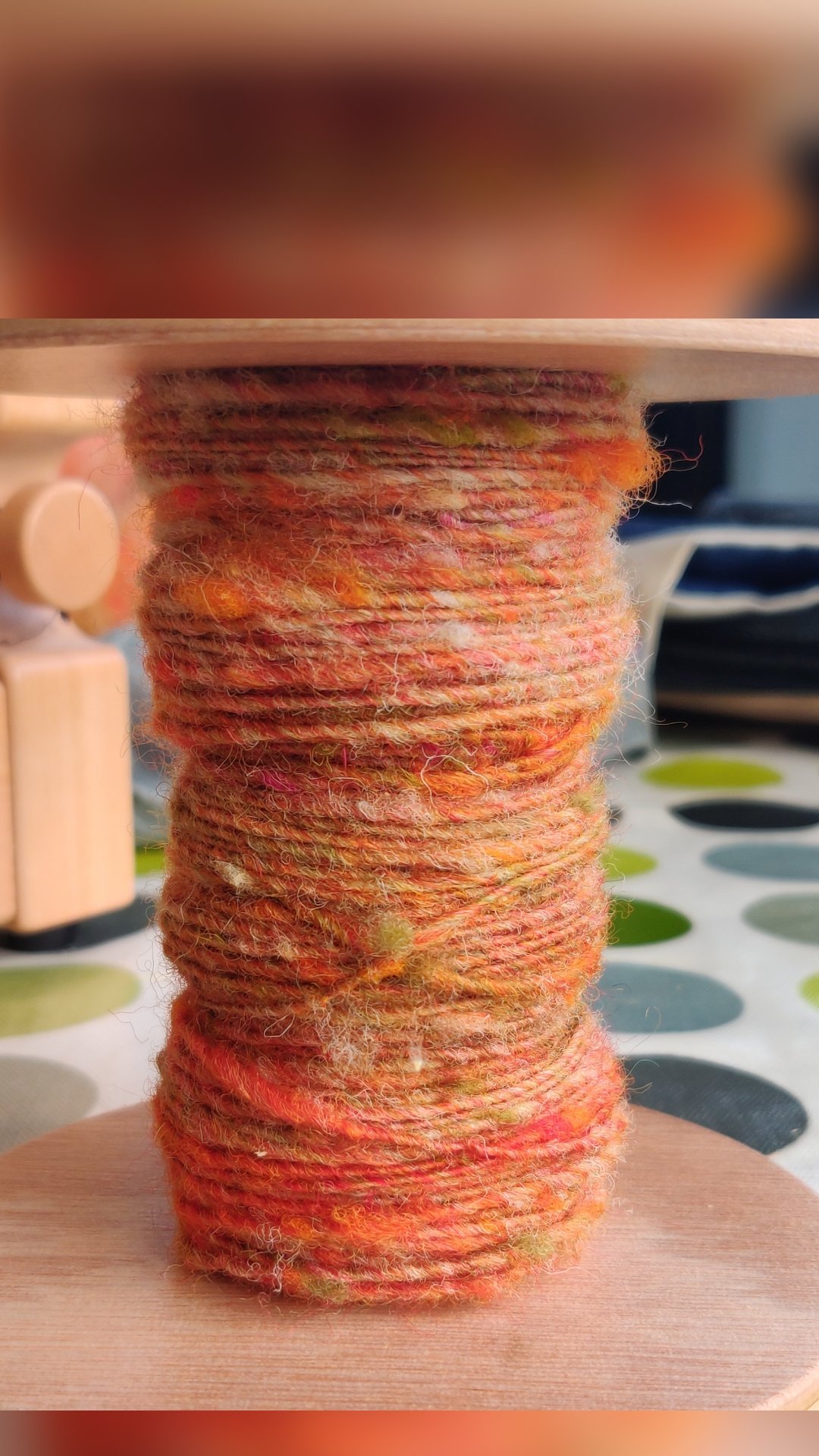
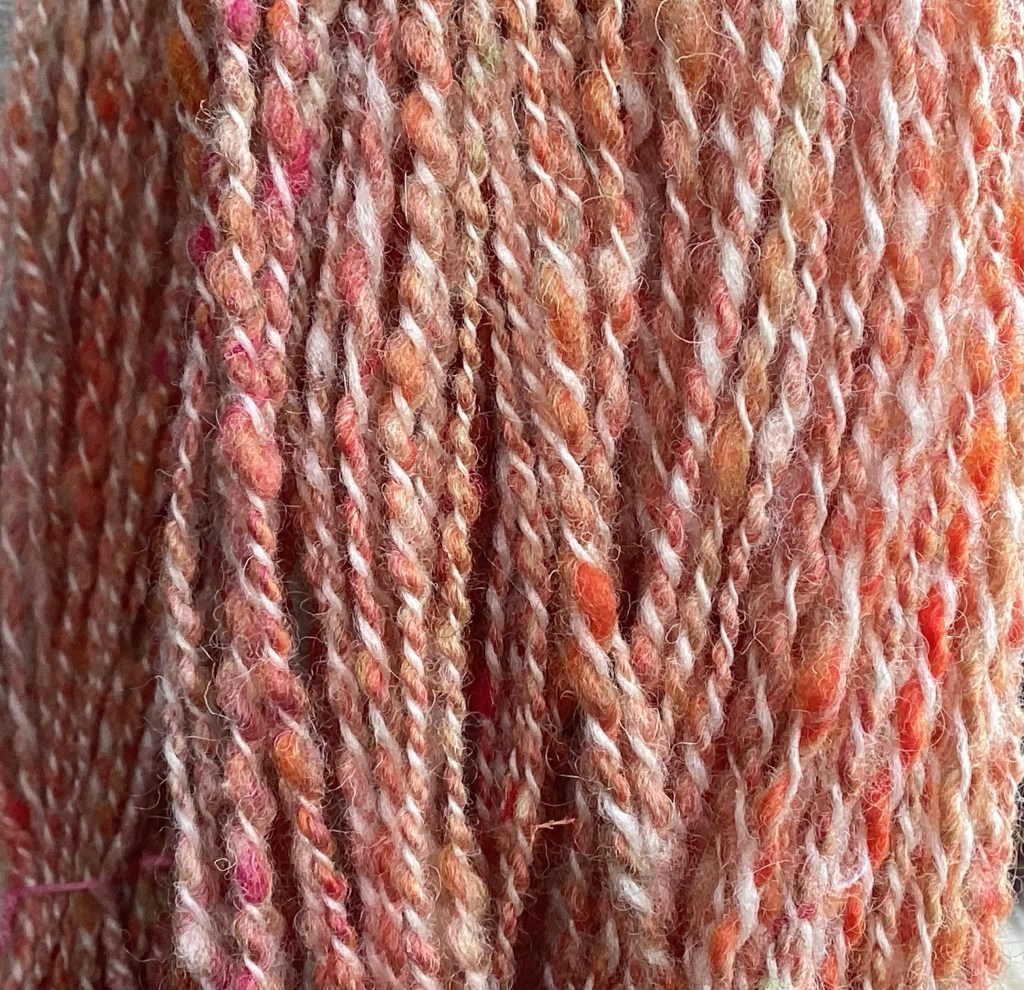
Its a mix of rain and sun this afternoon, and we are in our caravan so I decided to do some spinning on my Ashford Espinner. I’ve brought four Frankenstein batts I carded from a mixture of old cream Jacobs and two pink and orange poorly dyed batches of Dorset fleece. Plus a small amount of a pretty olive green. The poorly dyed had nepps from the partial felting, and I kept some of these when carding to add texture.
These were all carded on the electric from carder in stripes. I ended up with four largish batts which I split and spun as rolags.
Below you can see how I split the batts and I worked out the TPI of the singles on the espinner.
Author’s not: I originally intended to upload this as a ‘story’ post, but after the uploads gobbled up my mobile data and it still didn’t work properly I decided to make it a normal post.
Cream Jacobs, pink and orange Dorset (a bit felted during dyeing) and a small amount of olive green Dorset fleece drum carded into several Frankenstein battsFor once I remembered to divide the rolags evenly between two bobbins for easy plying later on.
I split the large batt horizontally into smaller sections.
The smaller sections were then hand-rolled into individual rolags. Because the batt had been double carded and divided between each carding, the colours ran from side to side. I like to work with small rolags, so halved each one, but worked with through the rolags in a zig zage way so that the ends met to keep consistency to the colour grading.
Spinning singles on my Ashford Espinner in the caravan awning
Achieving the desired TPI on an espinner is based on knowing the number of flyer rotations per minute, which is controlled by the speed dial.
For this singles I wanted around 8 TPI, and I had already measured my drafting of 2″ lengths at about 40 which equals me 80″ per minute. So I multiplied the TPI x draft length per minute
8 x 80 = 640.
So I set my speed dial to where I know I get about 640rpm. Its not exact, but neither is it on a wheel, but it gave a pretty good average of 8TPI.
I plan to ply this with a plain colour, otherwise the colours become overwhelmed by each other. Maybe a rust or cream, or even a black?
Update. I eventually plied it with a Dorset singles from my stash. Made 70g of very useable yarn or approximately 7 TPI, 8 WPI and 20 degree angle of twist.
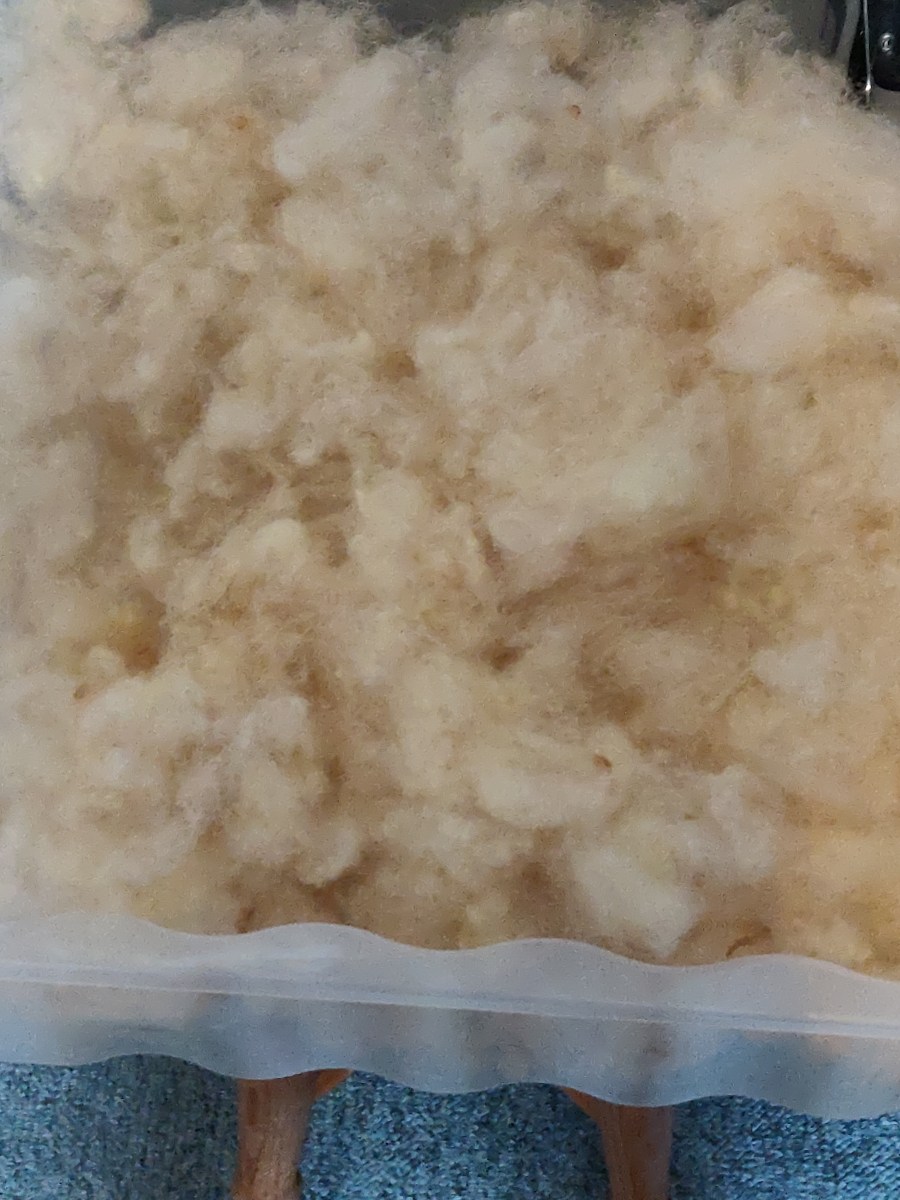
I’ve been running a suint bath for washing fleeces this summer. Whilst the temperatures are reasonably good the suint has worked well. I’ve actually finished washing all the fleeces now so we’ll probably use the diluted suint bath as fertilizer.
Suint is explained it chemical terms by other people far better than me, but basically it means that the fleece soaks in a liquor composed of the sweat and dirt and developing microbes. The bath is built up from other fleeces. I use the dirtiest fleece first as that made the best base for the suint and have worked through 5 fleeces weighing about 1-2 kg each before going into the bath. I skirt and sort the fleece first because I don’t see the point in washing really dirty stuff that’s never going to come clean, but I equally try to preserve as much of the fleece as possible. I’ve got a bucket of the really unsalvageable stuff soaking so that I can use that liquid as a fertiliser as well.
I didn’t take a photograph of the locks of this Scoth Mule fleece before the suint bath so can’t make a comparison but it has come up beautifully clean.
My process was as follows. I laid The fleece out on a mesh grid cleaned as much of the dirt out as I could by shaking it and then skirted it. Next I sorted it into qualities, picked out as much vegetable matter as I could. Each quality was put into several smallish mesh laundry bags and then into the suint in manageable quantities. The suint bath really stinks, which I think must be caused by ammonia, as it makes my eyes water!
I left the fleece in the suint for 5 to 7-days then using rubber gloves and, with a peg on my nose, I removed it and left it to drain. Once it was drained, I rinsed it in a couple of changes of clean, cold water. Because I didn’t want to put the stinky mess in spin dryer I swung and it around to remove excess water.
Next I washed the fleece in batches in hot water with Eurolana wool wash. This is good as it cleans well without loads of suds so rinses out easily. The smell was slowly fading, but even after two rinses it lingered.
A final spin and then the fleece was emptied out of the mesh bags into a two-tiered flat mesh dryer. This goes outside and by the time the fleeces are dry the smell has gone. Phew.
A bit like outdoor anything – providing its not raining or freezing – spinning is enhanced by the open-air. I took my little Louet wheel with me whilst on holiday on the Pembroke coast recently. We were being careful and avoiding towns etc in our caravan sitting on a farm, so there was plenty of opportunity to spin in the lovely sunshine. It seems ages ago now, but was so refreshing.
Victoria beside the caravan, enjoying the view.
I took a bag full of mixed colour Jacob’s fleece and sorted it into dark and light before hand carding it. Ifirst of all spun a skein of cream to test the tpi and grist I was aiming at and on a rainy day decided to dye it with the onion skins from our soup.
All very earthy!
I can’t resist a marl yarn, so plied the colours into variations on this.
From left: knot or knop marl, slubby marl, onion dyed 2 ply, chain plied random carded colours
I have a large sack of Texel fleece that had been making me feel guilty for a while. It’s not the most soft of fleece so I decided to blend it with some Alpaca that has also been lurking in the cupboard. Unfortunately the Alpaca (from an animal called Kiki), has quite a bit of VM in it, but it is deliciously soft.
Picking and hand picking got a lot of the VM out, but sadly not everything. I carded both the Texel and Alpaca separately and then split the batts and layered them up in alternate layers; one wool, one Alpaca etc, and put them back in smaller batches through the drum carder.
As my carder is quite coarse I do a second run through for most fibres. So I did it for these batts. I think I probably should have done a third run, but I was afraid of over-carding the fibres and decided they had blended well enough. The result is a little uneven!
I’ve spun two small samples, one thick singles sort of semi-woollen and the other long draw woollen spun.
I’m now perfecting, (ha ha) my long draw technique with several hundred grams of comb waste that I have carded up. Hopefully by the time I get through that I will be proficient enough to tackle long draw spinning that large amount of Texel/Alpaca fibre!
I’ve hand knitted small samples of the both yarns The thicker spun on 6mm needles and the long-draw spun on 5mm needles
Left: Long draw spun yarn hand knitted on 5mm . Right: Thicker semi-woolen spun hand knittedon 6mm needles.
Whilst digging in our loft today to make space for the plumber to run new pipes, I found a fleece!
I couldn’t believe what I saw, because I was sure I remembered throwing it away years ago, and I mean years…probably the best part of twenty years! I can say that with quite a lot of certainty because it was given to my Mother when she wanted to learn to spin on her Westbury wheel. She had bought it in the 1970s I think, in Glastonbury, as a kit. My Father made it up for her and she stained it a dark walnut colour. But she didn’t have any fleece – or to be honest the faintest idea how to spin. A friend of a friend found her two Jacob fleeces from a local shepherd in Somerset, but I don’t believe she ever got any yarn off the wheel.
Not bad for a 20 year old fleece
I ‘inherited’ the wheel (and the fleece) when I bought a flat and had space to house it. Once again it sat unused, and the fleece sat lonely and unloved as well. When I had children, the wheel became the object of their attention. They delighted in treadling it and bits fell off.
After my Mother died I took the drastic decision to sell it to save it, if you see what I mean. I so regret that now, I wish I’d put it in the loft, which is somehow where this fleece ended up – I must have chucked the other one, or maybe gave it with the wheel.
Since then, I have acquired an Ashford Traveller and a Traditional, but I would love to have another Westbury for sentimental reasons. So if anyone is looking to sell a Westbury wheel do get in touch with me first.
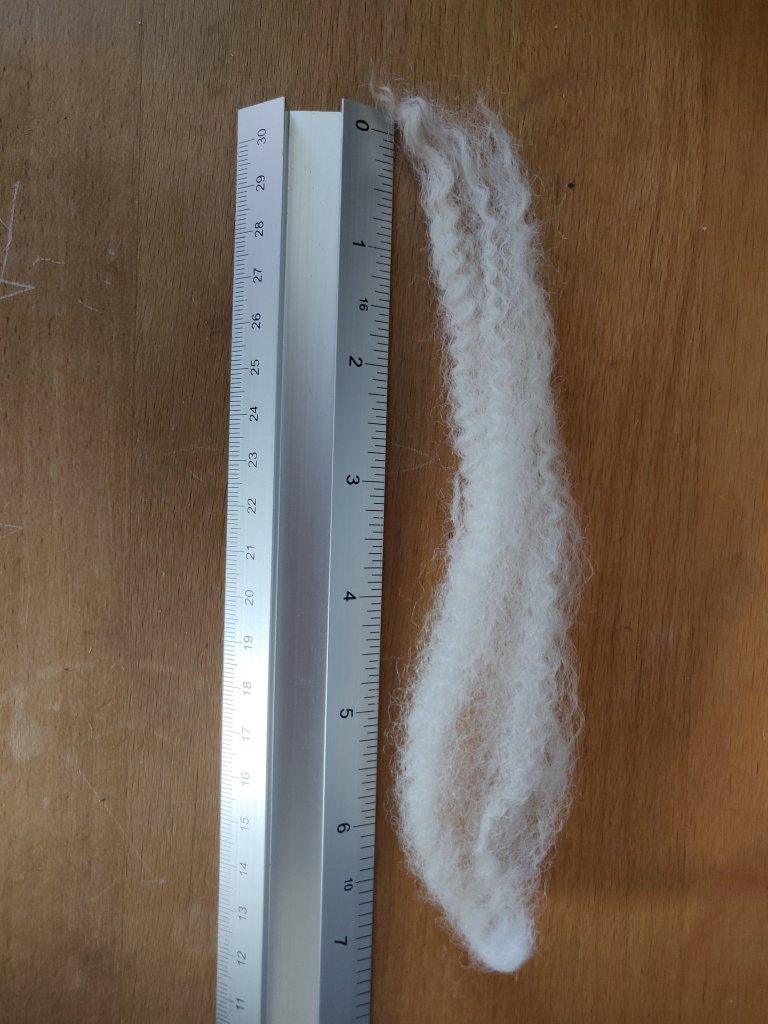
So today the fleece saw the light of day after many years. I thought it would be absolutely ruined, if not full of moth, but no, it is fine. I don’t think it was very greasy to start with, and there isn’t much VM. I’m in the middle of a test wash of a part of it to see what happens. I can’t believe it has survived, but I’ve given parts a good tug and there isn’t any breakage, and very little discolouration. It is a beautiful chocolate brown and cream, so I plan to separate the colours and spin it as a tweed-effect, providing all goes well.
It will lovely if I can spin it; a sort of homage to my Mum who never quite got it together to spin it herself, much as she would have loved to. If I could spin it on a Westbury, my homage would be complete!
We had a few rainy days recently so I put a lot of fleece to soak outside – hoping the rain water would help the process along. The catch of course was that I then didn’t want the waste the opportunity that the glorious weather we had today offered for washing the fleece in the garden and getting a head start on the drying.
When will I learn? Four hours later I do have a load of lovely white fleece hanging up to dry on meshes, but I am exhausted.
Because I had soaked the fleece in cold water for a few days, I had to wash it by slowly heating it in batches in a pot on a stove. I wish I had an old Burco boiler – my Mum used to use one for washing the bed linen. I will keep an eye out for one. Using pots meant that I had to do four batches. I have two big maslin pans I use for this and for dyeing, so after heating the first one, the second could be warming whilst the first was cooling sufficiently for me to handle it.
It was a pretty filthy fleece and the overnight cold water soak had really helped loosen the dirt, but I still had to give each batch two washes before rinsing twice.
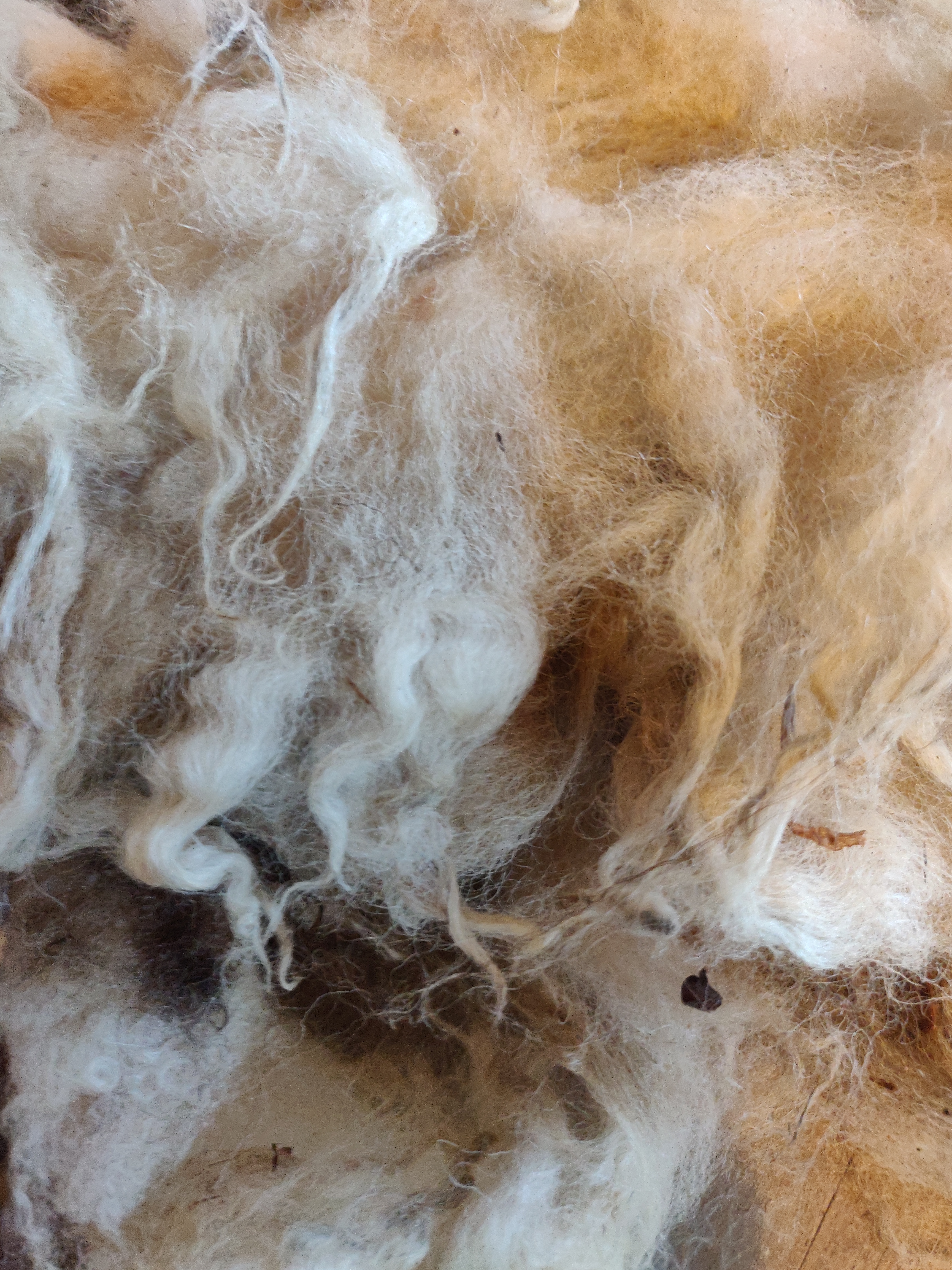
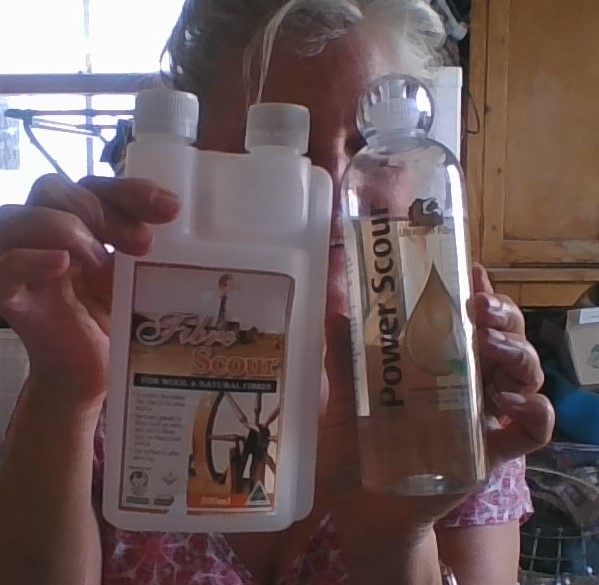
I’ve invested in both Fibre Scour and Power Scour for washing fleece, as well as working with washing up liquid. I’ve not tried Kookaburra or any other as I haven’t found them for sale in the UK. The results of both of the ‘professional’ scourers I have tested are very good, there is no doubt about it. But, and its a big BUT, is it financially worth it?
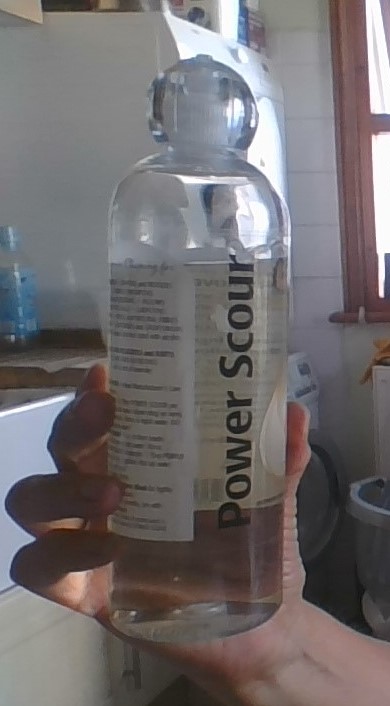
This was the first lot I have washed using Power Scour, but because I did all the fleece with this, I don’t have any of the same fleece washed in any other way to compare. However, the Power Scour has done a good job. It doesn’t foam up so is easier to use than washing up liquid. Price-wise per wash some people claim its no more expensive than using washing up liquid, but in the UK the 473ml (16 oz) bottle of Power Scour cost me £21! OK, they claim you only need a tablespoon to wash a pound of fleece, using around 2 gallons of water (that is 15ml to wash approximately 450g of fleece in 9 litres of water), but I think this will still work out more expensive than using washing up liquid.
UPDATE 11th August 2020 The Unicorn website recommend using 1 tablespoon of Power Scour to 2 gallons of water (15ml to 9 litres of water) when washing in a washing machine. As those of us in the UK don’t generally have top-loader washing machines this is not usually an option for us, but it is useful to know the water to detergent ratio as opposed to the fibre weight to detergent ratio.
2 gallons being equivalent to 9 litres is neat as that is the capacity of my maslin pans. My fleece was in batches of around 250-300g, so I used 10ml per batch). My frugal soul overrode my experimental spirit and I have to admit that I did the second wash in washing up liquid.
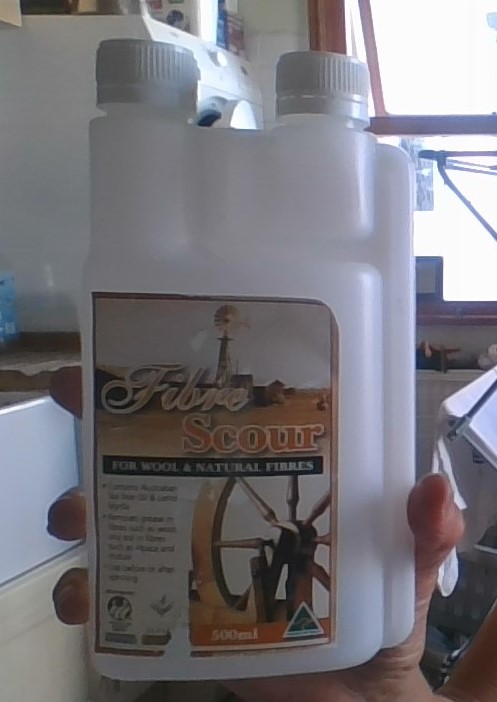
I also added a few drops of Tea Tree oil to the second wash for its antibacterial properties, and lovely clean smell. Fibre Scour already has Tea Tree oil as an ingredient which is a plus for me, as well as the clever bottle that measures the dose each time.
Power Scour ingredients are listed as:
Nonionic and Anionic Surfactants, Propylene Glycol or Ethanol, Copolymer, Lavender Fragrance & Filtered Water.
POWER SCOUR COST
Lets do the maths: At 15ml per wash you can get between 31 and 32 washes out of the 473ml bottle of Power Scour. If 15mls wash 450g fleece this means you can wash up to 14 kilos of fleece with one bottle (assuming you only do one wash using Power Scour).
My bottle of Power Scour cost £21 (including post and packing). Divide £21 by the number of washes (31) makes it about 68 pence per 450g wash, or £1.50 per kilo of fleece.
So how does this compare to washing up liquid?
WASHING UP LIQUID COSTS
Washing up liquid ranges between £5.64 per litre for Method, £3.56 for Ecover, £2.88 per litre for Fairy, down to £1.78 for supermarket own brands (all prices for Tesco website 30th July 2020).
Lets work with Fairy as it is pretty like Dawn, the one recommended by many spinners in the US. I will work with the regular sized 625ml bottle, not the giant one (it will offer a bit of a saving if you opt for that size, in the same way that buying a gallon of Power Scour should save on cost per wash).
I reckon you need a pretty good squirt of Fairy to wash even 100g fleece. I count 1-2-3 whilst squirting and find this about right. I’ve just measured this and it comes out as 20ml of washing up liquid (give or take a bit for the size of the nozzle and the viscosity of the liquid).
Lets do the maths again: At 20ml per wash you can get between 31 and 32 washes out of the 625ml bottle – so far so similar! However, here is the difference, if 20ml is needed to wash 100g fleece you can only wash up to 3 and a bit kilos of fleece with one bottle of Fairy, (assuming you only wash the fleece once).
A 675ml bottle of Fairy costs £1.80 at Tesco. Divide £1.80 by the number of washes (31) makes it about 6 pence per 100g wash, or 60 pence per kilo of fleece. Hmm, that seems a big difference; less than half the cost per kilo of Power Scour.
So unless my amounts or maths are totally off the mark, washing up liquid is clearly cheaper to use that Power Scour, even when the amount of washing up liquid used to wash a kilo of fleece is significantly more than Power Scour.
FIBRE SCOUR COSTS
Fibre Scour recommends 20ml to 10 litres of water – but does not give a fibre weight which I find really annoying – you can wash 10g or 500g of fibre in 10 litres! So lets opt for the 500g.
Lets do the maths: At 20ml per wash you can get 25 washes out of the 500ml bottle of Fibre Scour. If 20mls wash 500g fleece this means you can wash up to 12.5 kilos of fleece with one bottle (assuming you only do one wash using Fibre Scour).
My bottle of Fibre Scour cost £14.99 (including post and packing). Divide £14.99 by the number of washes (25) makes it about 60 pence per 500g wash, or £1.20 per kilo of fleece. Marginally cheaper than Power Scour, but no real economic challenge to washing up liquid.
Lets return to the fact that the results of both Fibre Scour and Power Scour are very good, there is no doubt about it. They also seem to make the washing a lot easier, removing the dirt more thoroughly and getting the stains out. But is it worth it?
CONCLUSION
In believe the reviews that compare the cost as ‘not that different’ are based on purchasing Power Scour in the US, where it is considerably cheaper than in the UK. US websites advertise it at around $19 for the 473ml bottle, whereas the cheapest I could find it in the UK was £19.99. $19 is about £14.50 at current exchange rates. Still pricey to my mind, but more in line with the Australian Fibre Scour which costs £12 for a 500ml bottle in the UK.
I wish I could afford to use either Fibre Scour or Power Scour for all my fleece as I do like the result. I’ve opted to purchase another bottle of Fibre Scour as it is a better financial option in the UK.
I look forward to a time when increased sales volume might mean that the ‘professional’ products come down to a more reasonable price. However, until then I shall be saving these for either extremely dirty (but what I hope are good quality fleece), or my ‘best’ planned and purchased special fleece, whilst continuing to use washing up liquid for everything else. I will mostly likely always use washing up liquid if a second wash is needed.
If there is a UK based chemical/cleaning company out there who would like to venture into ecological raw-fleece-washing territory it would be wonderful to hear from you.
There is more about my experiences scouring raw fleece here…
Last week a few of us got together (safely distanced and masked), to take our textiles into the park. I enjoyed myself so much I forgot to take a photo!
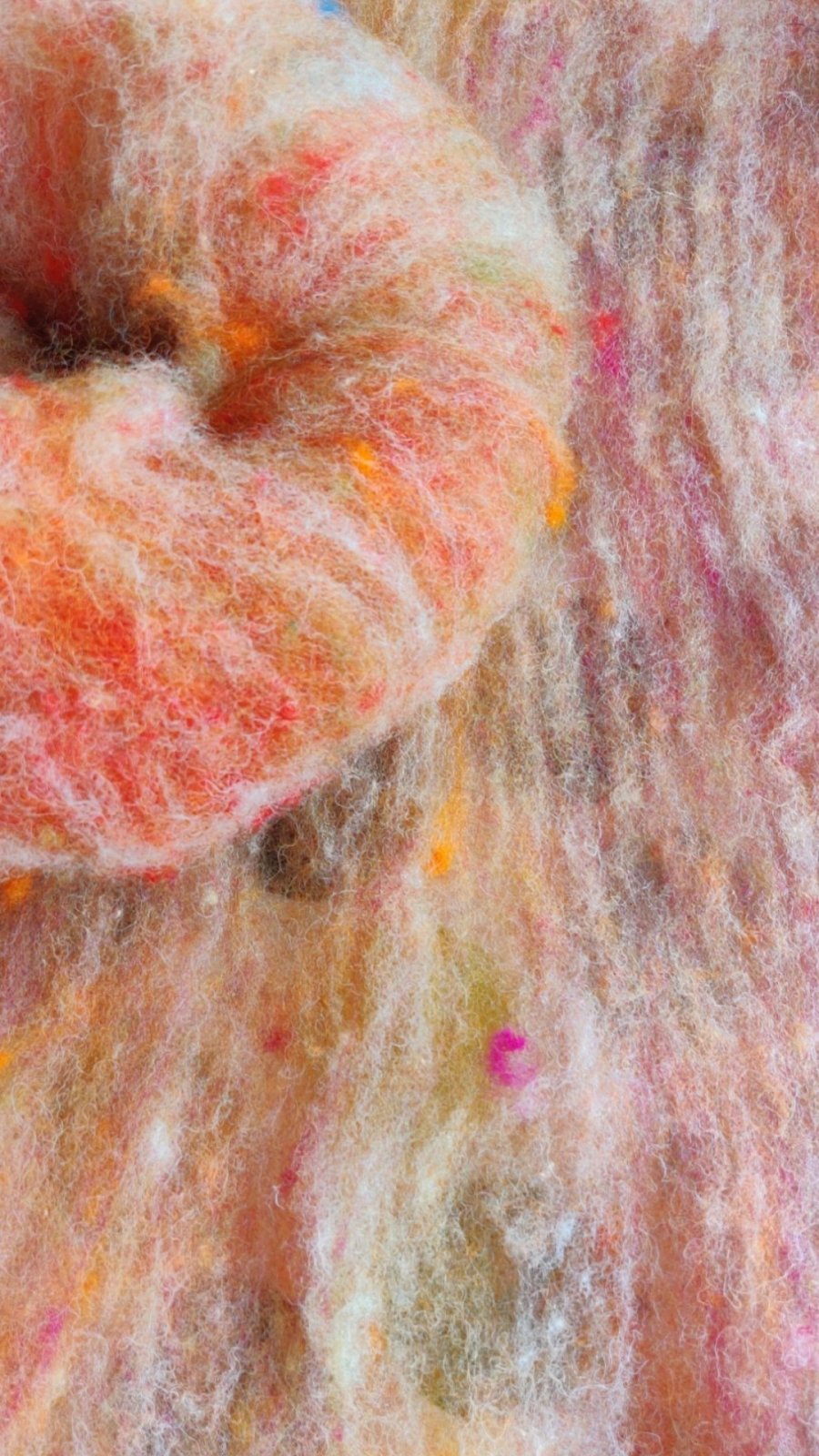
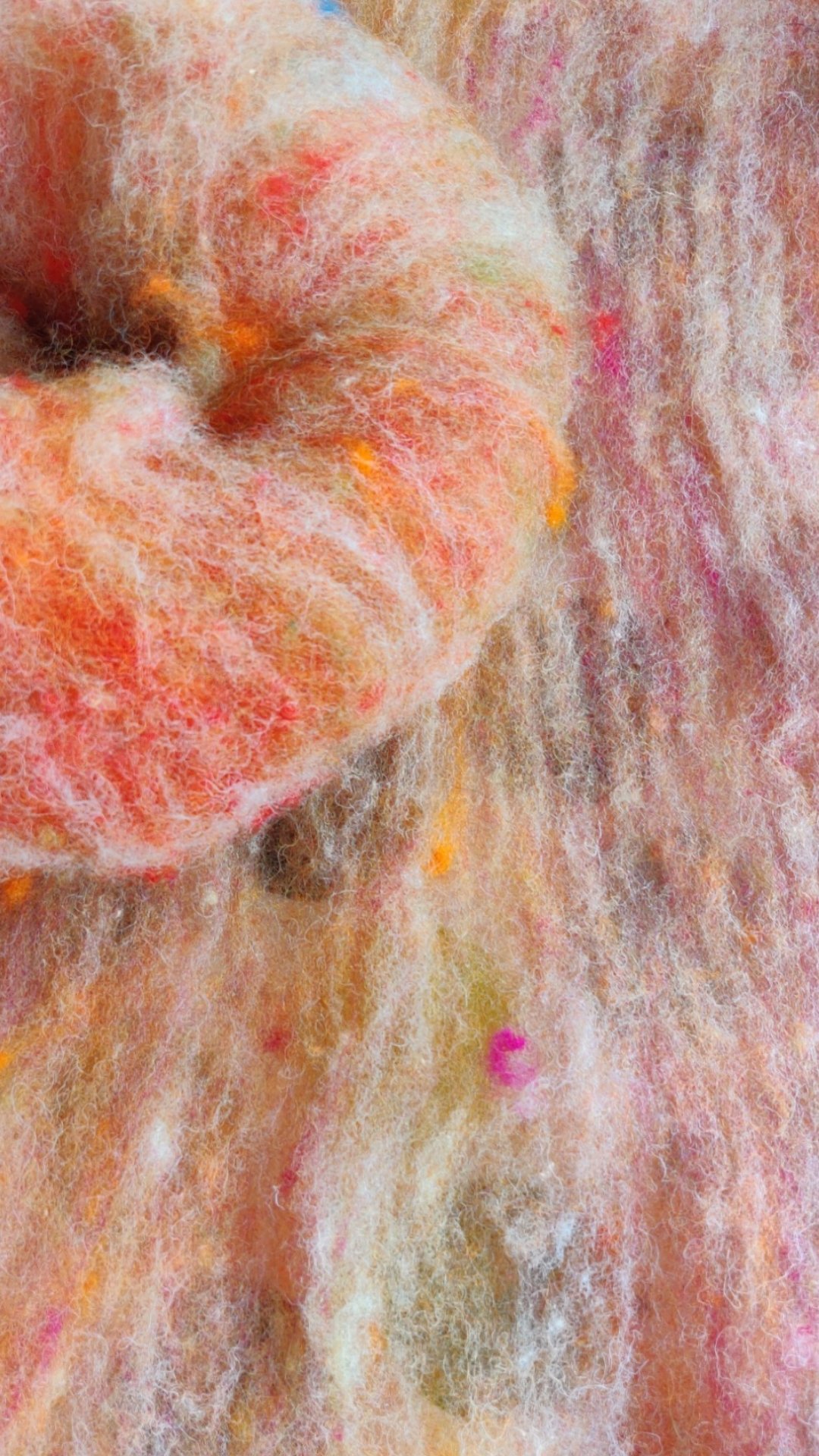
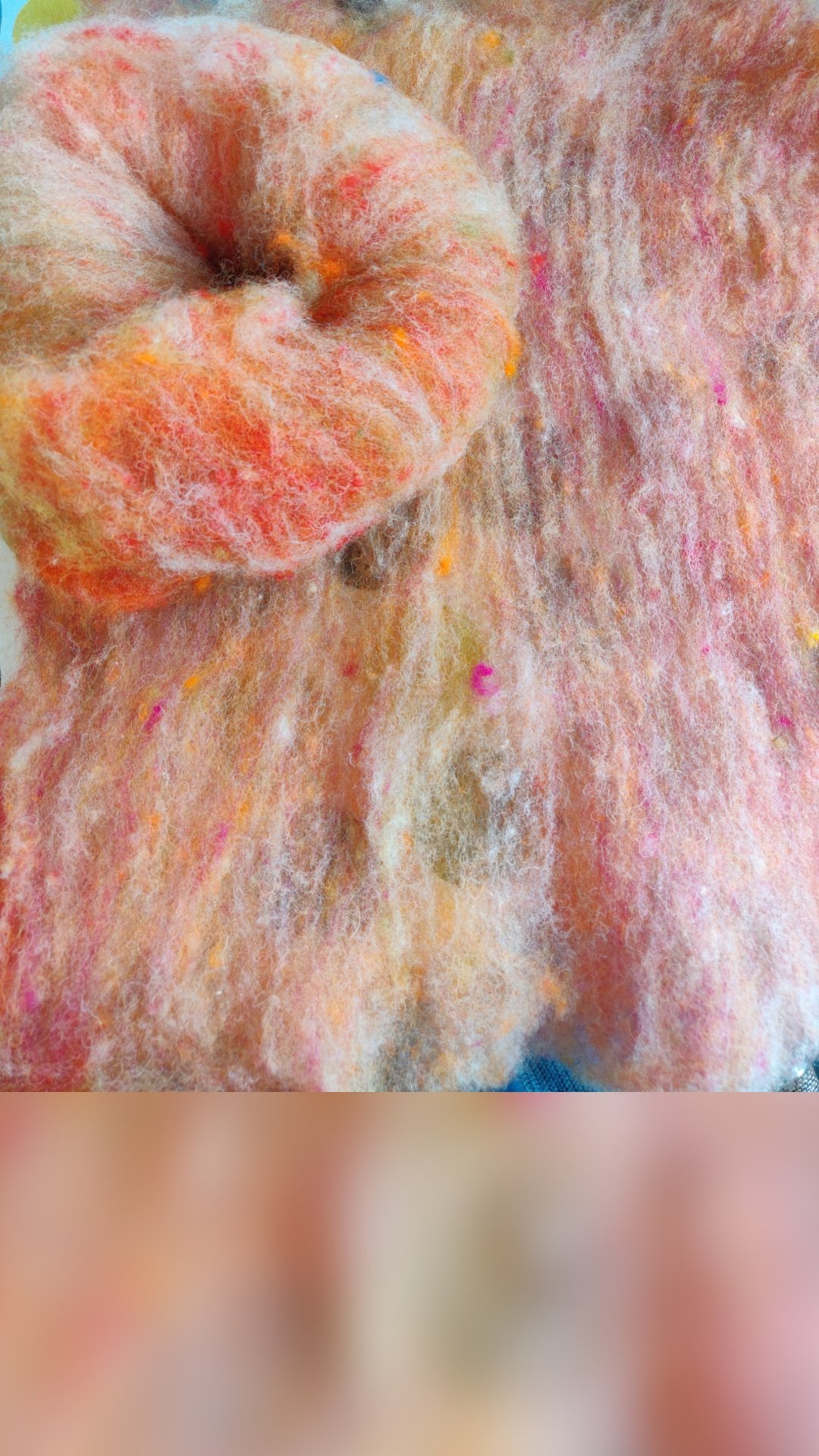
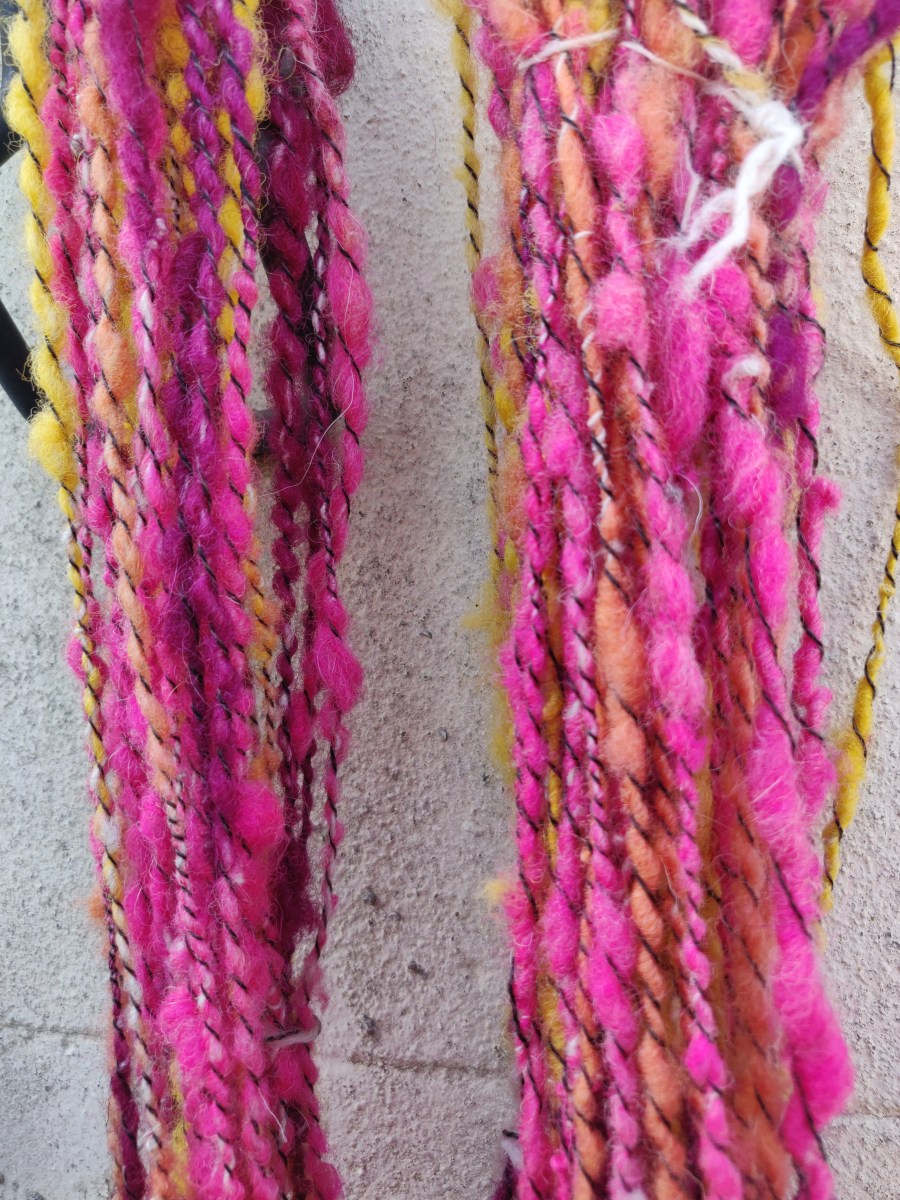
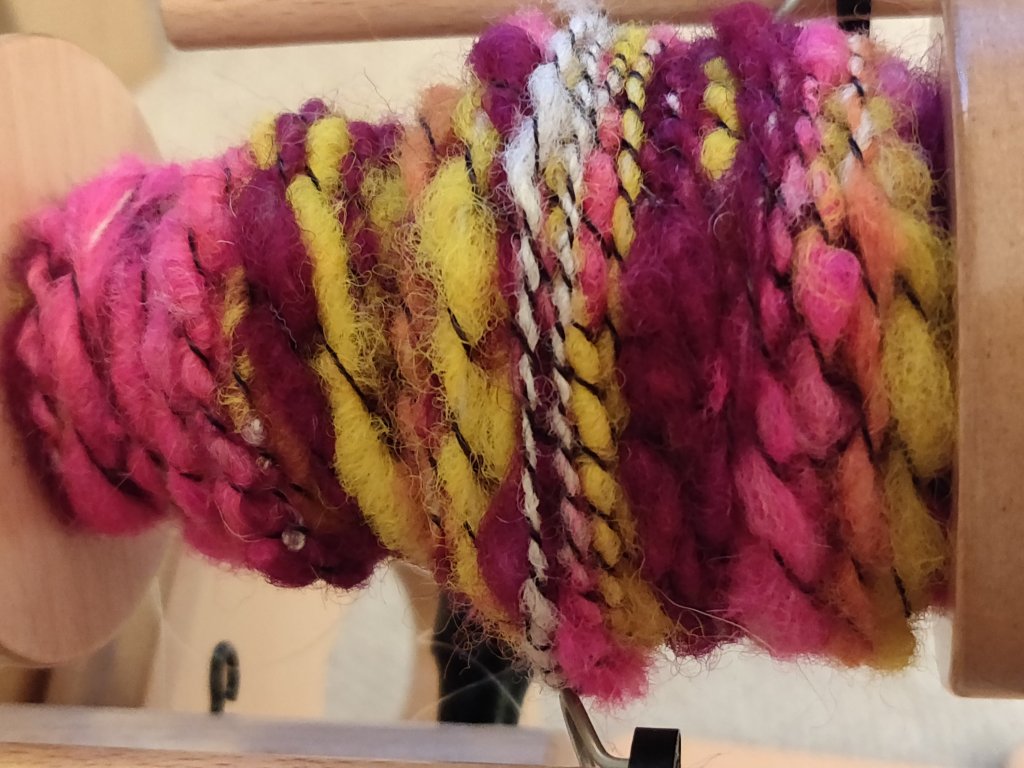
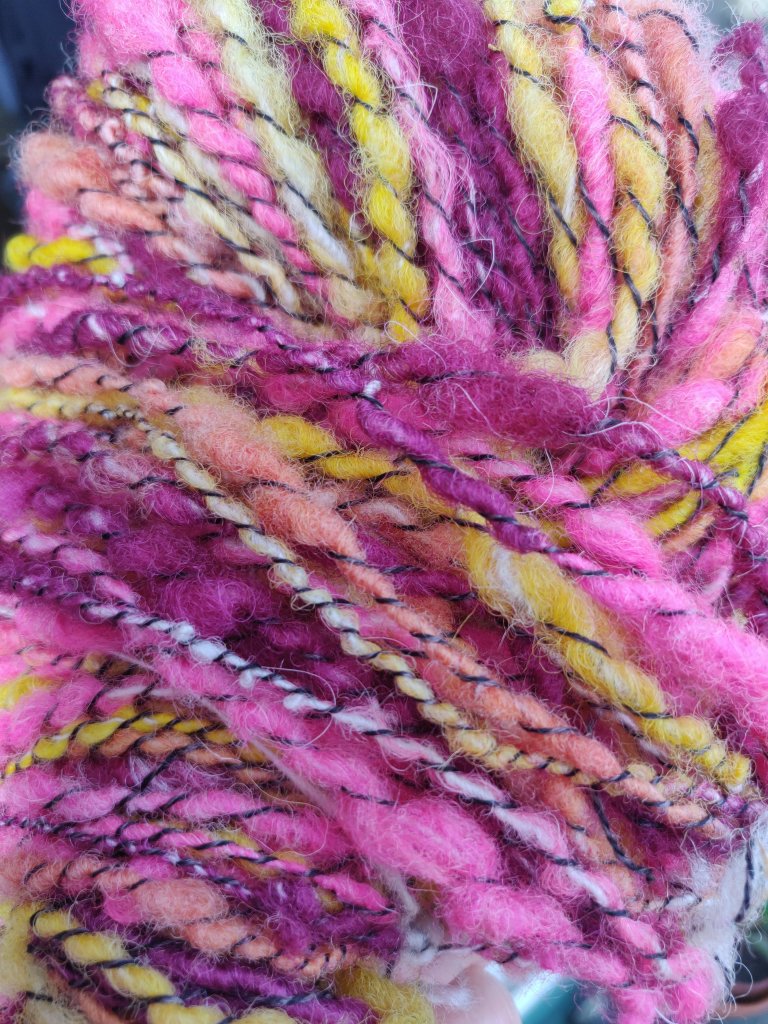
The thought of spinning outside in the sunshine encouraged me to use bright colours. So I took along some Shetland fleece I dyed a while ago using acid dyes, (I have written more about dyeing fleece with acid dye here).
I’d spun up a bobbin of Suffolk fleece that is not very exciting, so I planned to use that as the core for a bright, irregular spun, core-spun yarn to which I would add a charcoal wrapping yarn. All 100%wool. I took my folding Louet Victoria S95 wheel which is a joy to use.
The core yarn was Z twisted quite tight. The wrapping colours were also put on Z twist, and the final charcoal, commercial yarn was S spun over the others.
Photo taken at might, so the colours are not accurate.
After washing and drying the twist the colours hardly muted and it’s come out as lovely yarn.









 Vikki Haffenden