I planned this project of a collapsible fleece-drying rack over a year ago. Setting is always difficult as it requires a lot of space and works best if air can circulate to as much of the fibre as possible. I toyed with the idea of folding herb drying racks, but the ones I found were small, flimsy and expensive. I’ve seen others use those plastic crates with open mesh sides, but couldn’t find any of those locally, plus they take up space when not in use.
So I decided to design and make my own. My brief was:
freestanding
reasonably lightweight and portable
widely spaced shelves
a large surface area so that the fleece could be opened up to speed drying
collapsible so could be folded down and packed into a bag when not in use
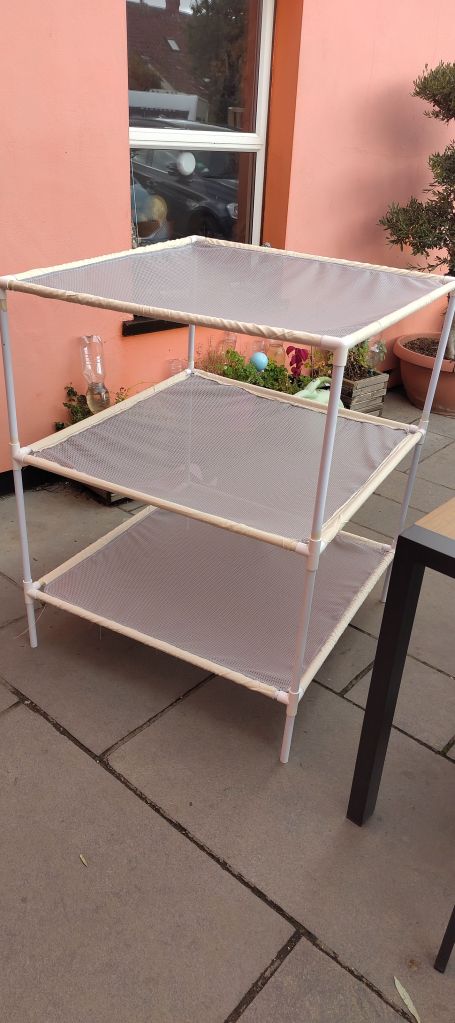
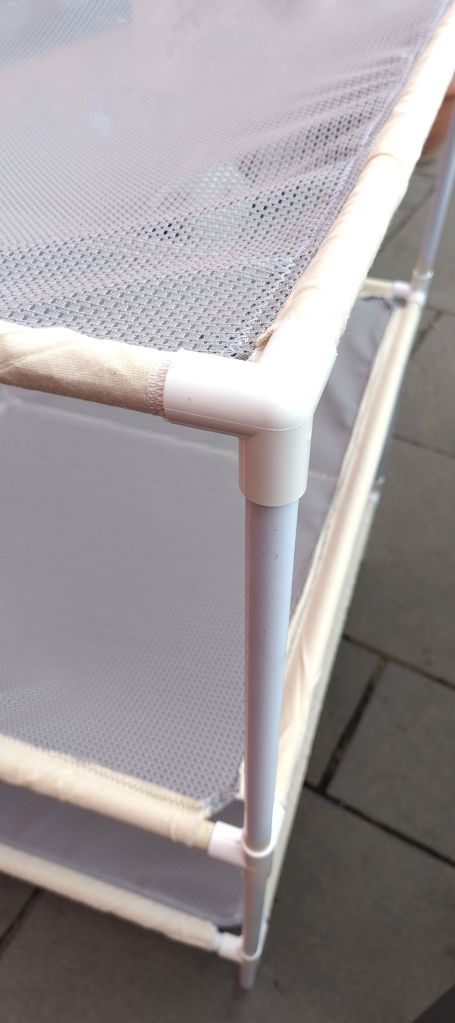
Designing the rack and working out the specs took some thought. I ended up with a plan for a three shelf rack, each shelf being approximately 80cm square. I intended to use plastic pipe and elbow joints for the frame and mesh fabric for the shelves. Mesh fabric would allow air to circulate, and if made from synthetic fibre, would dry fast itself and hopefully reduce the likelihood of mould whilst packed away. Each of the mesh shelves would have sleeves sewn along all four sides through which the pipes of the frame would be inserted. Then the pipes would be connected via the 3 and 4-way joints, putting the shelf under tension. In this way the shelves would stabilise the whole structure.
I already had some plastic piping left over from making a collapsible niddy-noddy, but bought the rest from Wickes, then cut it all into the correct lengths. I borrowed a plastic pipe cutter to do this, which gave nice neat and smooth cuts which would facilitate threading the pipe into the shelf pockets. The 3 and 4-way joints came from ebay, as I couldn’t find them locally. However, if you decided to make one of the racks, do try a local plumbing store if you have one first, before going online.
So I had the frame and it fitted together, but then winter came so fleece washing ceased and access to my sewing machine was limited by building work. But I went ahead and ordered 3m of fine mesh fabric for the shelves in anticipation of getting started when I could.
Sadly, when I finally got to sewing the shelves, the mesh proved to be too fine, overstretchy and delicate, so it was back to the drawing board. This time around I sourced a much sturdier, low-stretch mesh fabric on eBay. It was pricier, but fitted the bill really well. Luckily I found some seconds of the danger fabric, which helped keep the cost down. I also decided to use Calico I already had to sew smooth, non- stretchy sleeves for the pipes so that it would make it much easier to slide the shelves on and off the pipes. The sleeves would also make a stable attachment to the between shelf and pipe, and hopefully reduce stretching and drooping of the central, mesh shelf. As usual, cutting out and sewing took some time because I was doing it around other things.
Finally it all came together. Probably too late to test on a fleece this year, but it might work in the greenhouse if necessary. I hope the shelves will not droop under a layer of damp fleece. I spin it after washing, so hopefully it will support the weight.
I guess it would also work for herb drying.
If you would like the instructions for making this fleece drying rack I will add them in a few weeks time. Please pop back to this page to download the instructions.
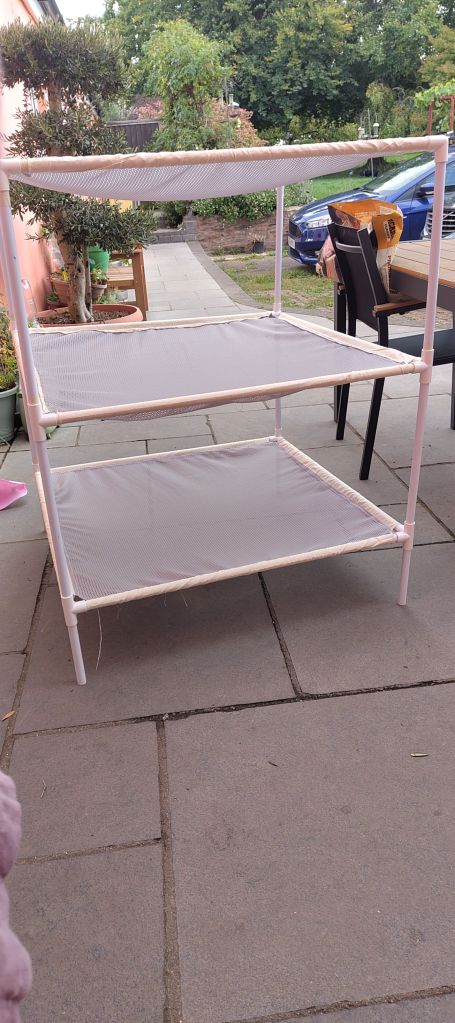
The finished rack The top, 3-way jointsMiddle 4-way jointsLegs are interchangeable, so the shorter ones could go in the middle if desired
Having acquired a Devon/Cornwall fleece that is quite similar to a Romney in feel and quality, I thought I’d dye some for blending. This fine will be great to comb for a semi-worsted spun yarn.
One of my favourite methods for safely dyeing fleece without matting the fibres is to use a slow cooker. I have a large family sized one that will dye 100g comfortably and 150g at a pinch, and a single-person one that does 20g for samples etc.
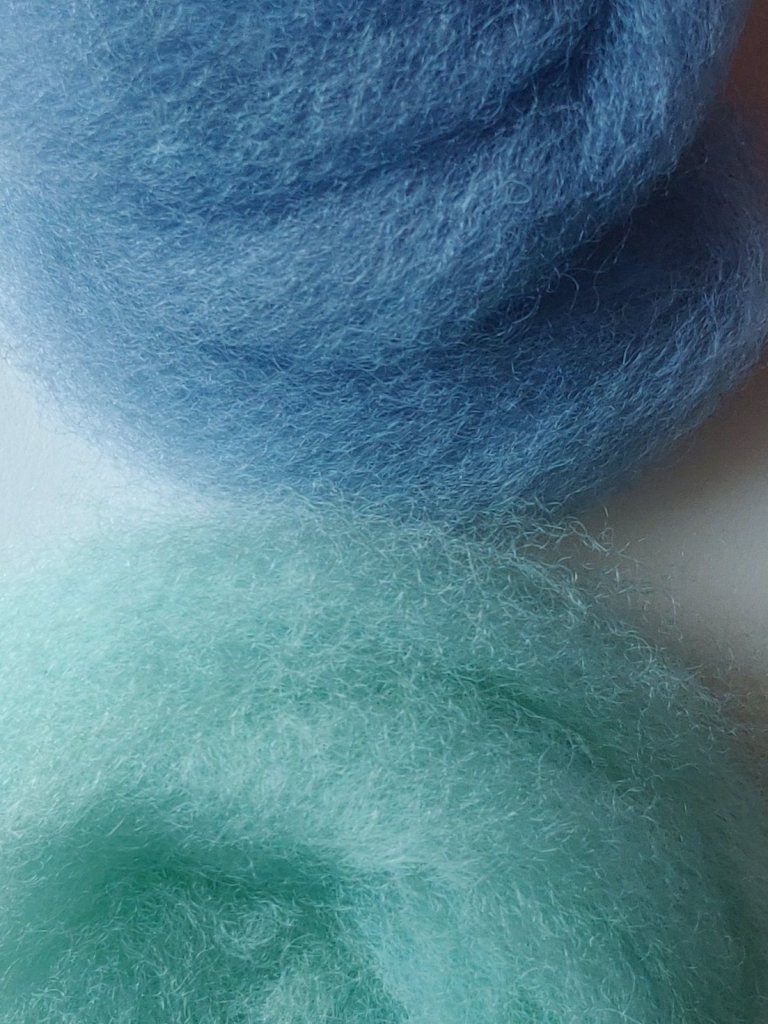
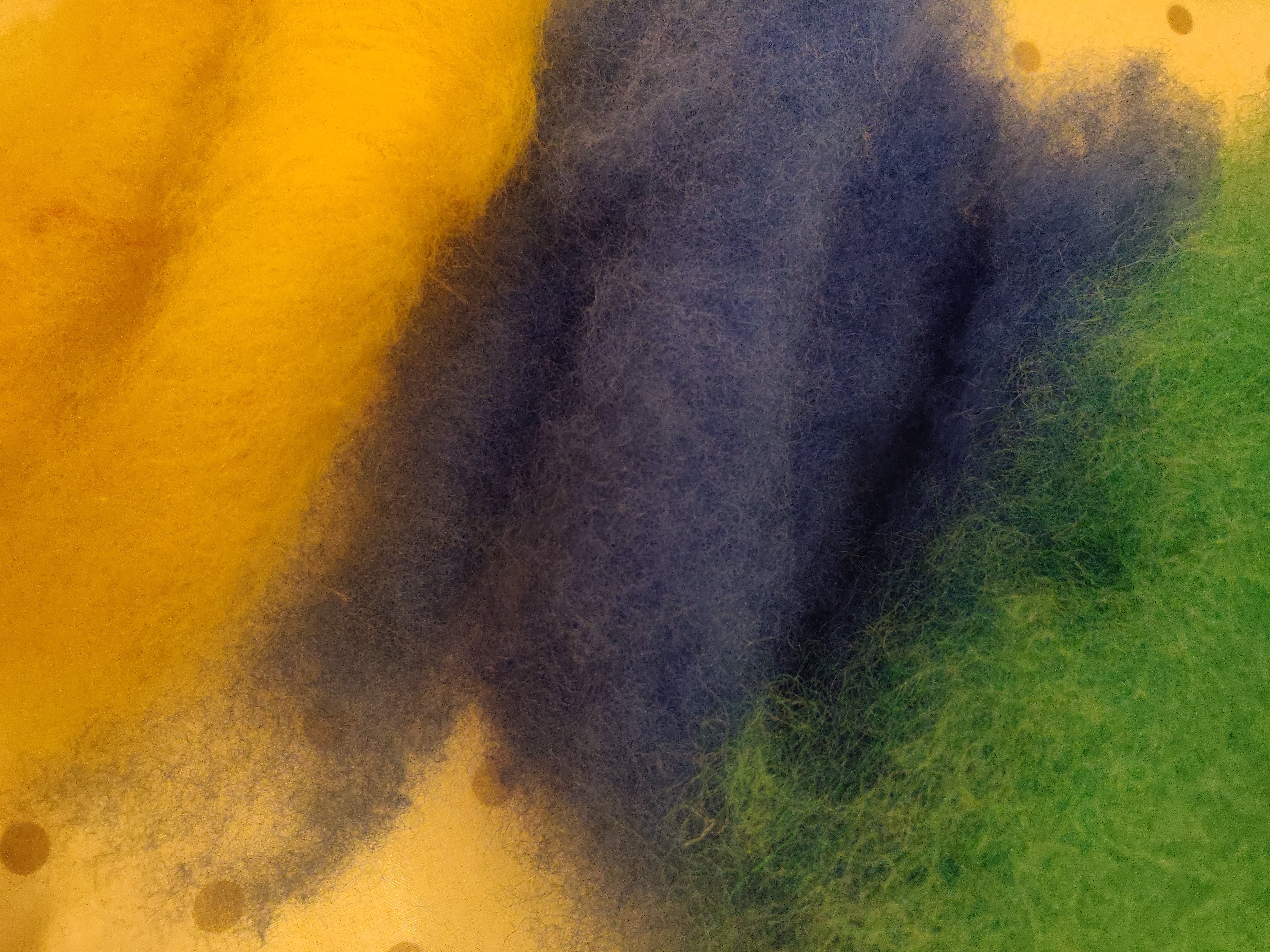
Using a pre-mixed colour I’ve used before I did a blue first. However, on this fleece it came out darker than I anticipated, but will probably lighten up once combed or carded and spun.
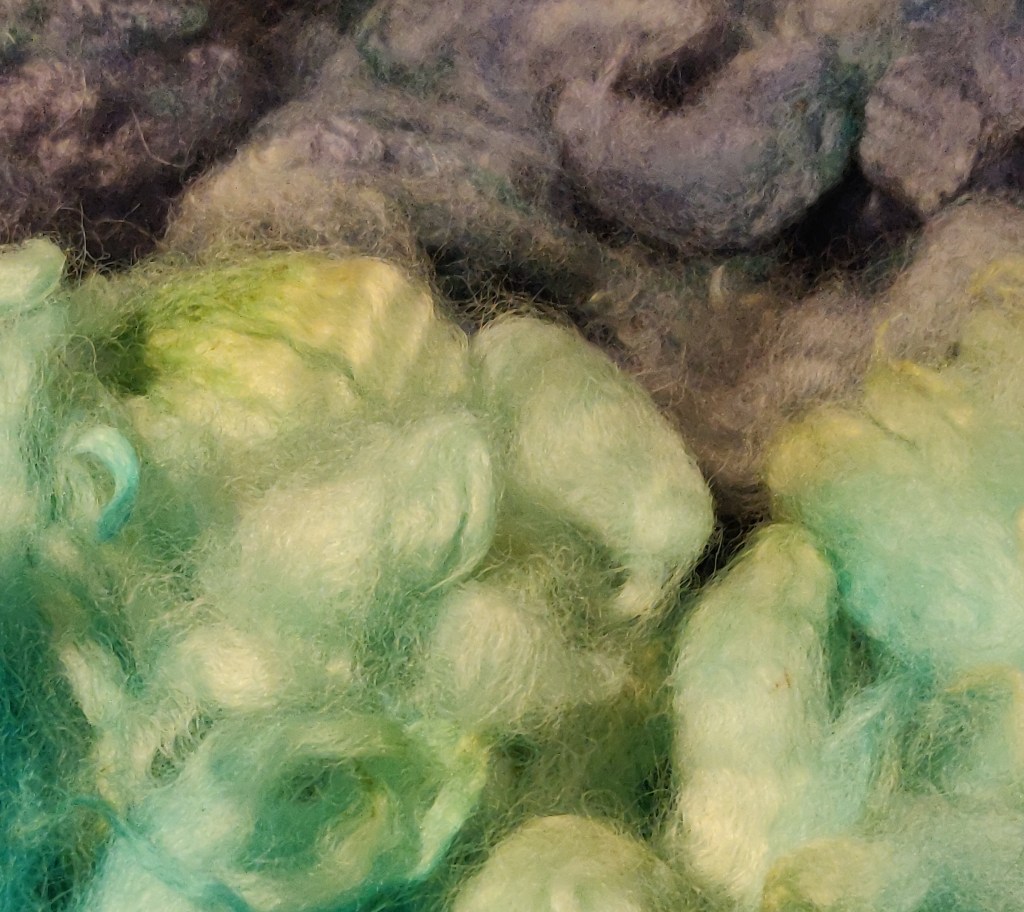
From the remains of the dyebath I got a pretty light turquoise.
The blue at the back, turquoise at the front
I have combed these colours as shown in this video.
Note that in this video I talk about ‘roving, but technically I am making ‘tops’. Roving is a similar narrow length of fibres drawn off a drum carder (usually, but can be hand carders) and has a slight twist added to keep the fibres together. After combing, both colours have come out as I hoped.
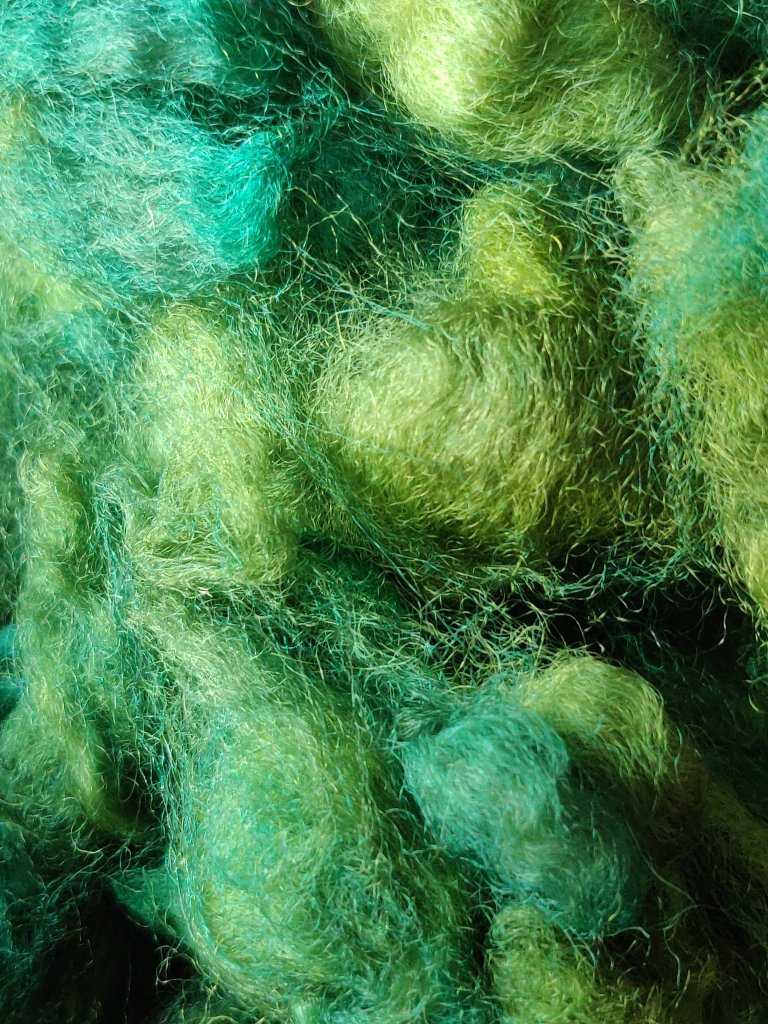
I also wanted an olive green, and have a recipe that worked perfectly on a Dorset fleece last year. I must have made a mistake somewhere, because I got a dark green instead. Maybe it is the different fleece, but I think I got my proportions wrong!
Pretty enough, but not olive green!
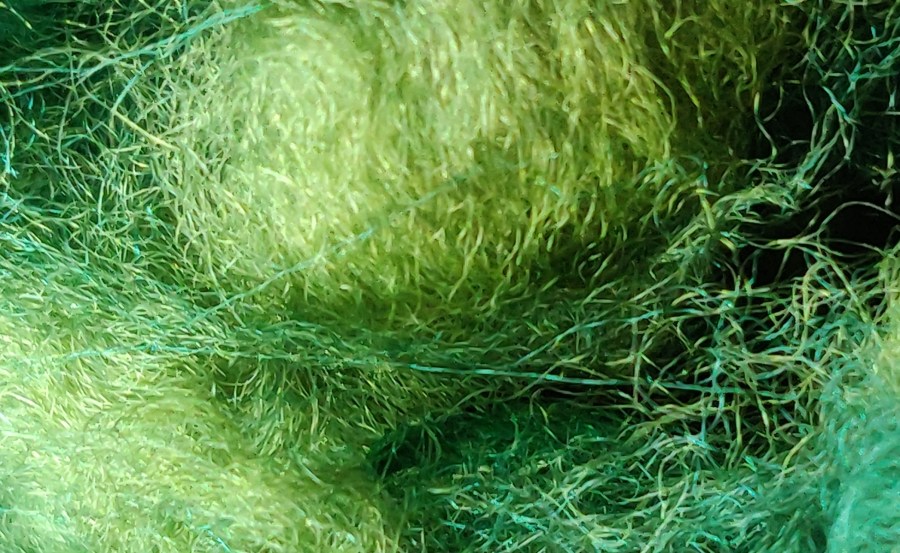
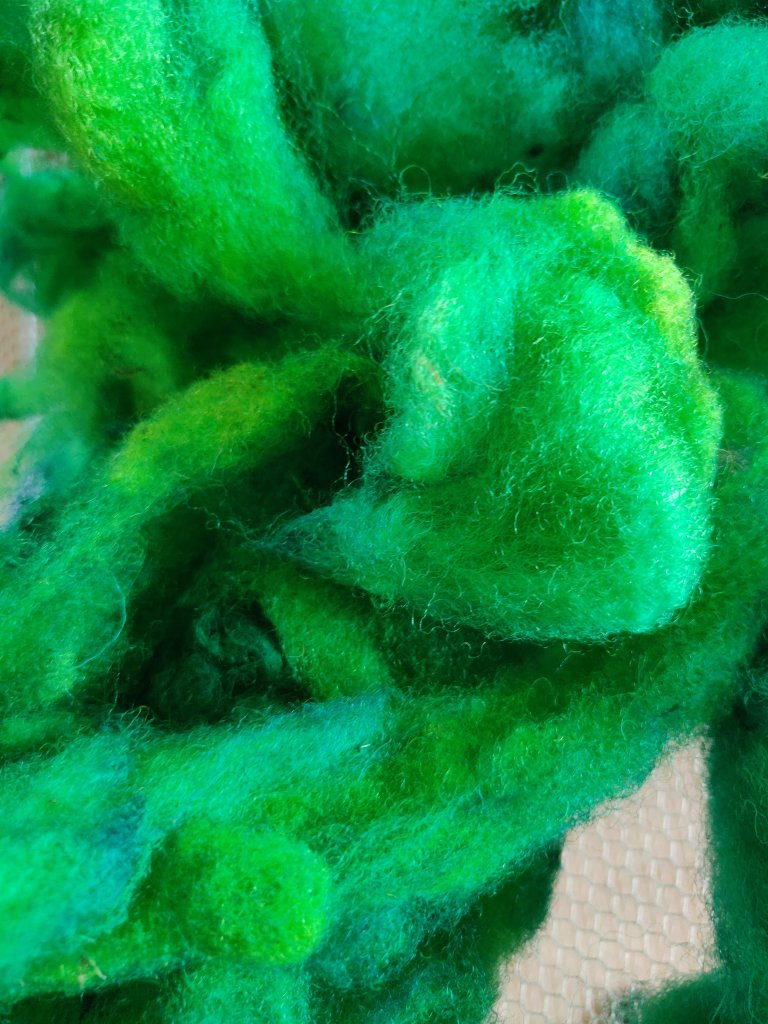
Once again they was some colour left in the bath, so in went 100g of Dorset fleece. OMG, the colour was bright! No idea what I did wrong, but it makes me blink.
The only compensation is that the fleece has not called at all due to using the slow cooker method.
That bright green total exhausted the dye – no surprise really! I will probably card this as the staples of the Dorset fleece are short and it is a soft fibre. Great for soft woollen spun yarn.
If you are interested in discovering the difference between different terms such as roving, tops etc, click here to read Abby Franquemont on Spin Off.
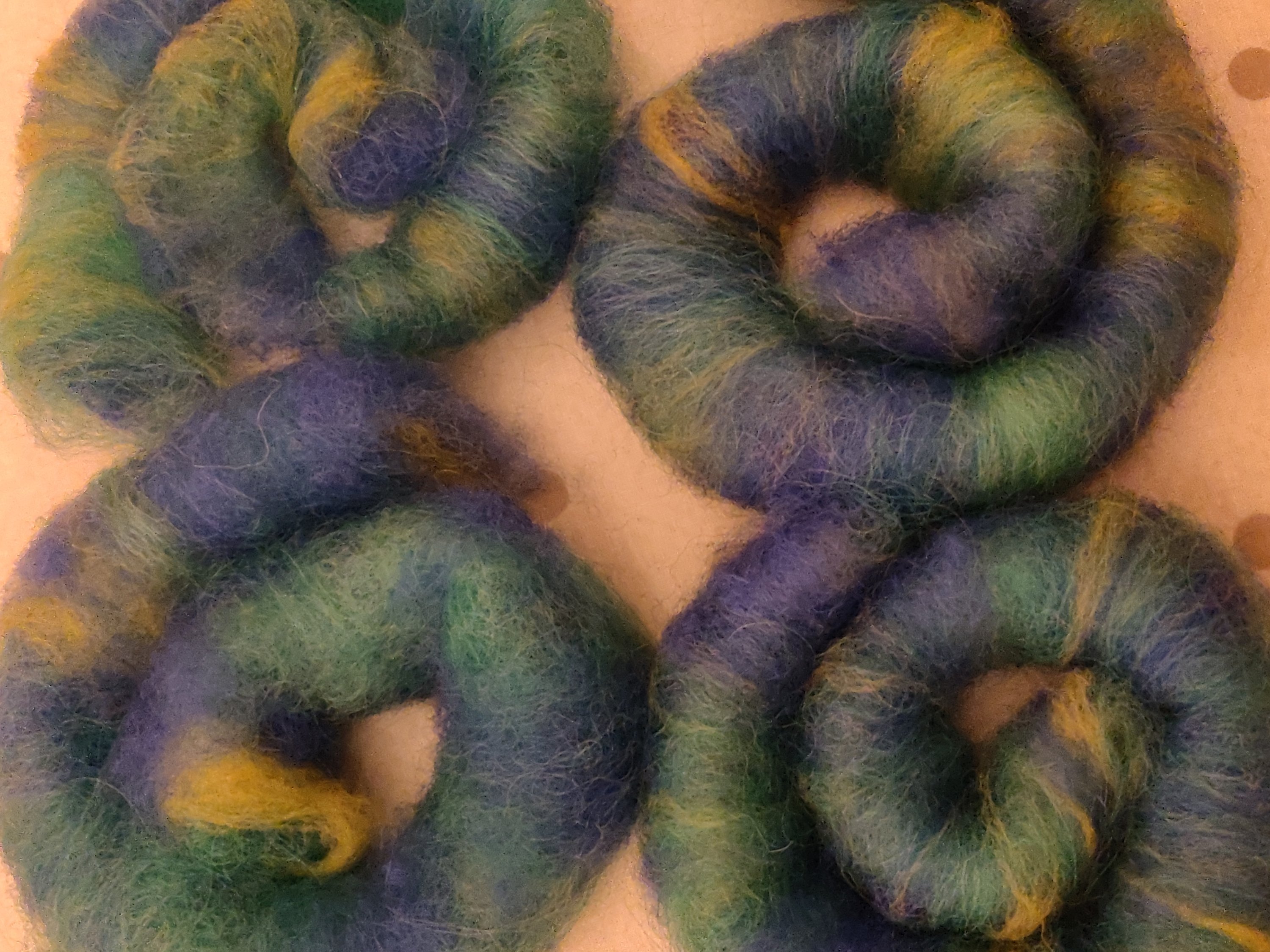
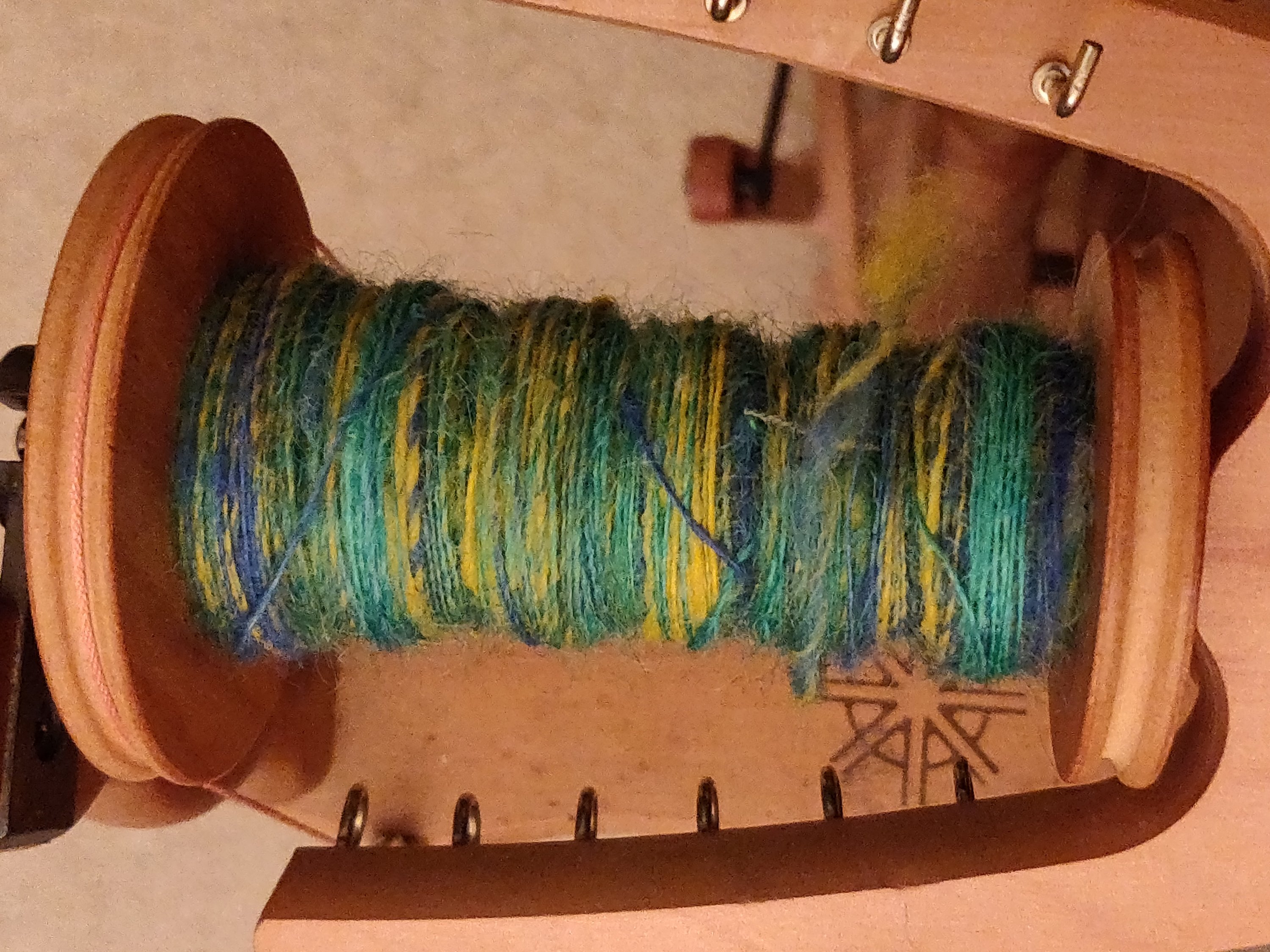
A happy hour or so spent hand carding hand dyed fleece, whilst watching tv. Then using my home made blending board to make the next batch of rolags to spin more of my ‘Greenfinch’ variegated singles.
Although I promised myself not to get any more fleece until I had emptied my cupboard, I’ve cheated . Well only a bit. Over the winter I have used a lot up, but not all of it!
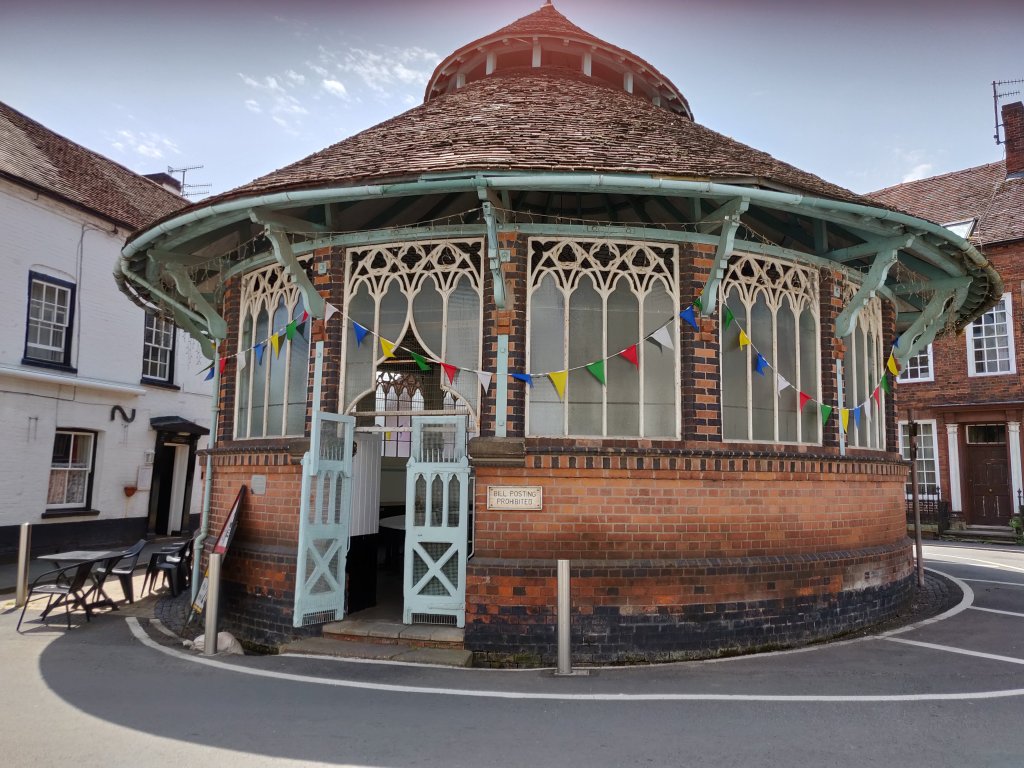
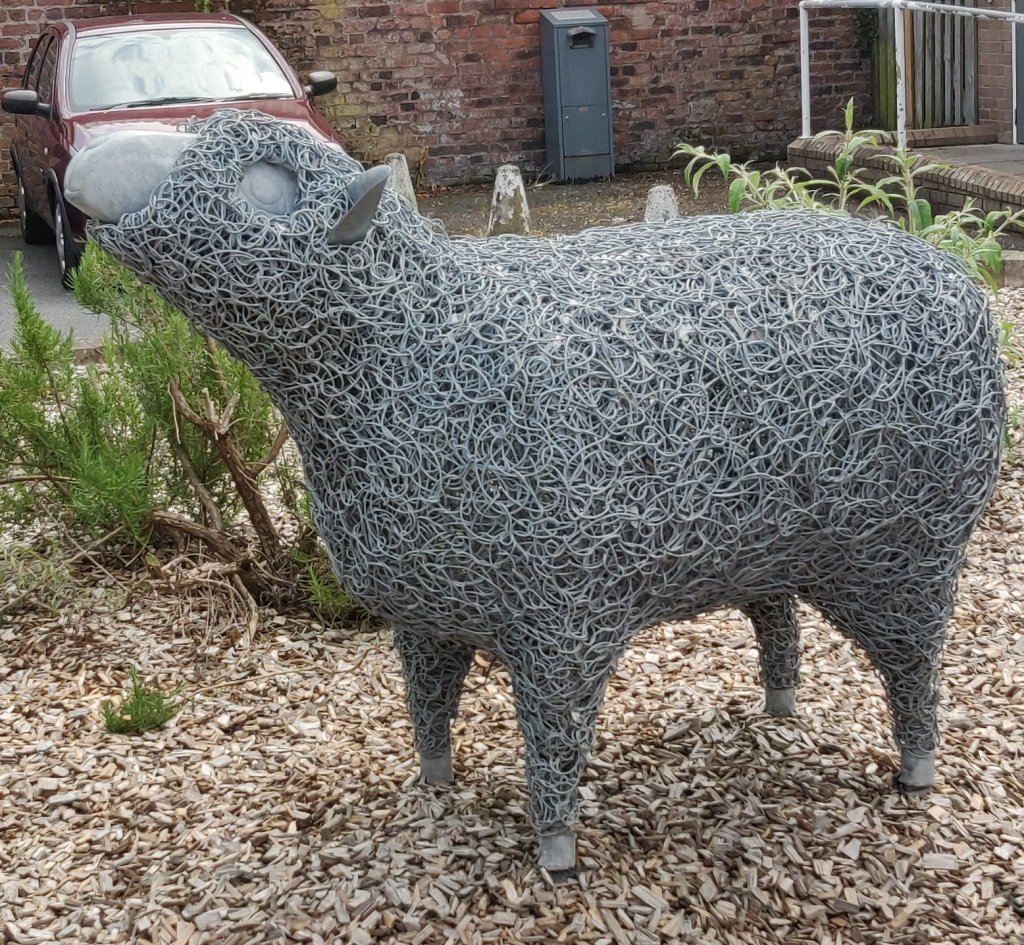
Having been to Herefordshire and seen the Ryeland sheep sculpture in Leominster I read up about the Ryeland breed and wanted to try a fleece. From what I understand the Ryeland was one of the breeds that can from the Romans crossing their imported Merino sheep with local British breeds. This is probably why they look like Teddy Bears with dense fleece. This breed was instrumental in the success of the British wool trade in the Middle Ages and after, which laid the foundations for wealth in Britain, especially in Herefordshire. Fascinating stuff!
The Old Market hall. Tenbury Wells.Sculpture of a Ryeland sheep in Leominster.
The long and the short of it is that I now have a Ryeland fleece to play with. I sorted out today and have started to wash it with promising results. Not to much VM, but a bit yellowed – the name for this escapes me right now, is it ‘yoked’? I’m guessing its last years crop.
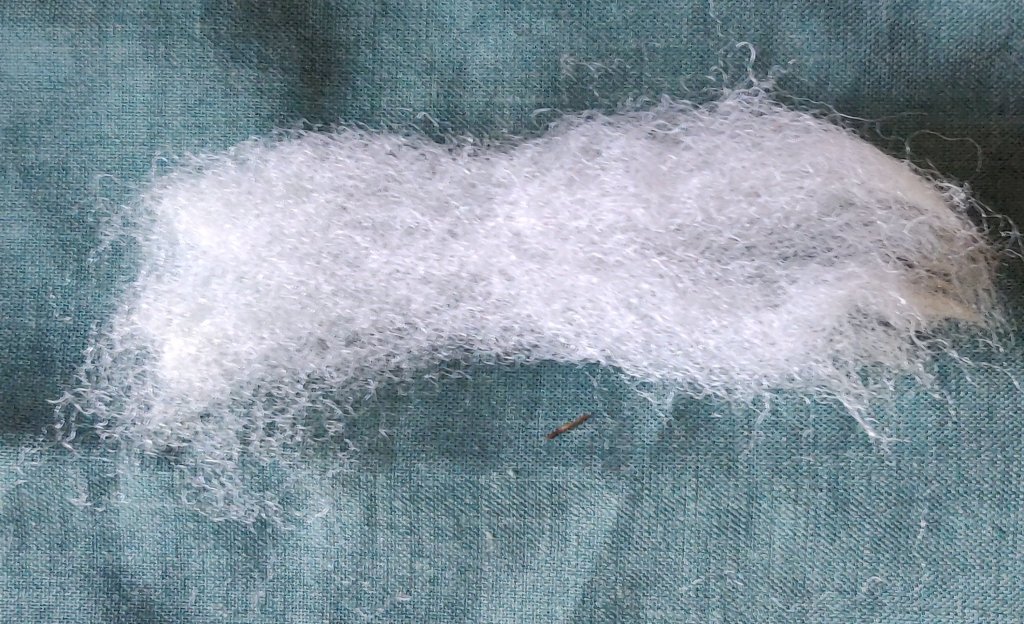
You can see a staple in the photo, and i’ll post once I start spinning. I plan to spin Long Draw, ply and then to dye it.
Washed Ryeland staple. Its about 3.5 inches when straight, but is quite crimpy. Yummy.
We had a few rainy days recently so I put a lot of fleece to soak outside – hoping the rain water would help the process along. The catch of course was that I then didn’t want the waste the opportunity that the glorious weather we had today offered for washing the fleece in the garden and getting a head start on the drying.
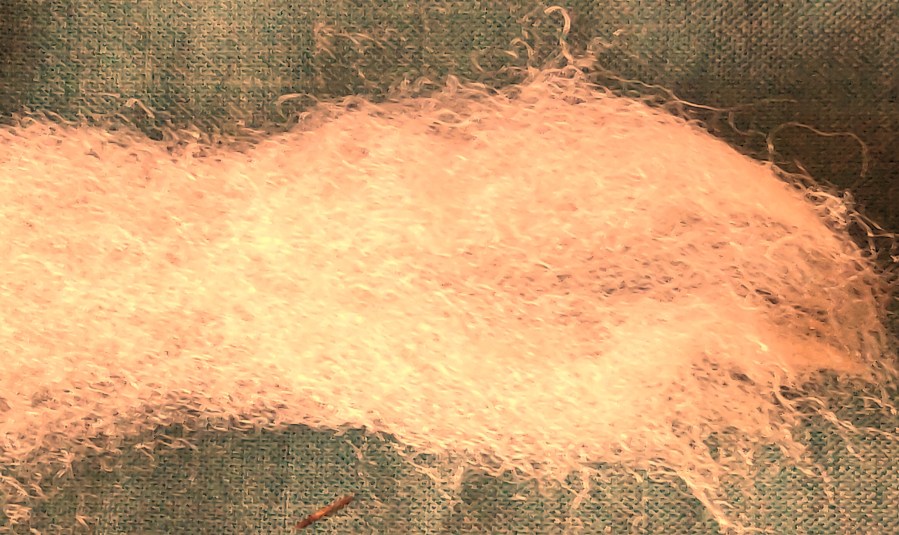
When will I learn? Four hours later I do have a load of lovely white fleece hanging up to dry on meshes, but I am exhausted.
Because I had soaked the fleece in cold water for a few days, I had to wash it by slowly heating it in batches in a pot on a stove. I wish I had an old Burco boiler – my Mum used to use one for washing the bed linen. I will keep an eye out for one. Using pots meant that I had to do four batches. I have two big maslin pans I use for this and for dyeing, so after heating the first one, the second could be warming whilst the first was cooling sufficiently for me to handle it.
It was a pretty filthy fleece and the overnight cold water soak had really helped loosen the dirt, but I still had to give each batch two washes before rinsing twice.
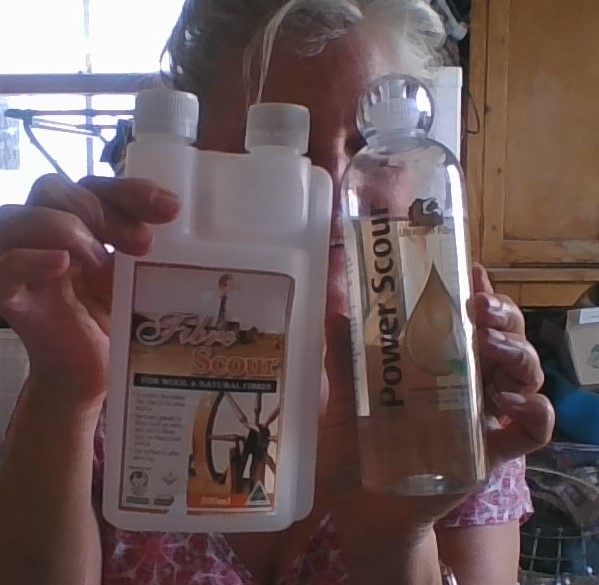
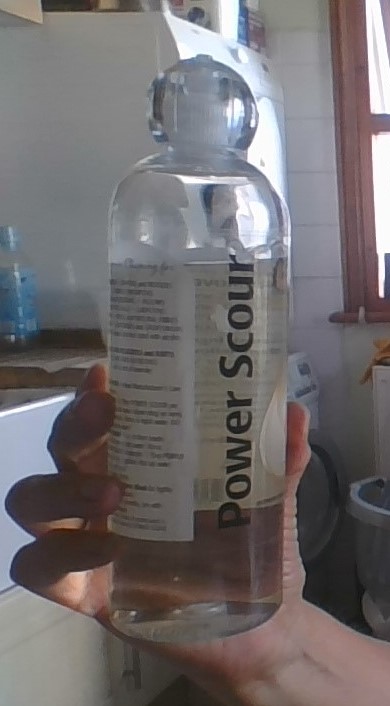
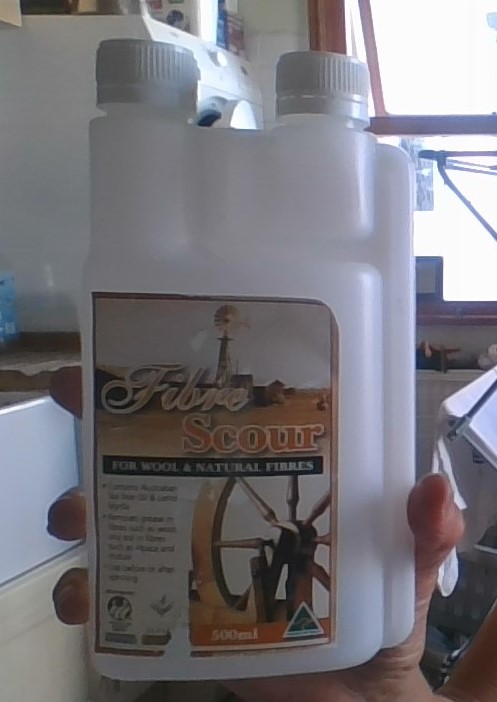
I’ve invested in both Fibre Scour and Power Scour for washing fleece, as well as working with washing up liquid. I’ve not tried Kookaburra or any other as I haven’t found them for sale in the UK. The results of both of the ‘professional’ scourers I have tested are very good, there is no doubt about it. But, and its a big BUT, is it financially worth it?
This was the first lot I have washed using Power Scour, but because I did all the fleece with this, I don’t have any of the same fleece washed in any other way to compare. However, the Power Scour has done a good job. It doesn’t foam up so is easier to use than washing up liquid. Price-wise per wash some people claim its no more expensive than using washing up liquid, but in the UK the 473ml (16 oz) bottle of Power Scour cost me £21! OK, they claim you only need a tablespoon to wash a pound of fleece, using around 2 gallons of water (that is 15ml to wash approximately 450g of fleece in 9 litres of water), but I think this will still work out more expensive than using washing up liquid.
UPDATE 11th August 2020 The Unicorn website recommend using 1 tablespoon of Power Scour to 2 gallons of water (15ml to 9 litres of water) when washing in a washing machine. As those of us in the UK don’t generally have top-loader washing machines this is not usually an option for us, but it is useful to know the water to detergent ratio as opposed to the fibre weight to detergent ratio.
2 gallons being equivalent to 9 litres is neat as that is the capacity of my maslin pans. My fleece was in batches of around 250-300g, so I used 10ml per batch). My frugal soul overrode my experimental spirit and I have to admit that I did the second wash in washing up liquid.
I also added a few drops of Tea Tree oil to the second wash for its antibacterial properties, and lovely clean smell. Fibre Scour already has Tea Tree oil as an ingredient which is a plus for me, as well as the clever bottle that measures the dose each time.
Power Scour ingredients are listed as:
Nonionic and Anionic Surfactants, Propylene Glycol or Ethanol, Copolymer, Lavender Fragrance & Filtered Water.
POWER SCOUR COST
Lets do the maths: At 15ml per wash you can get between 31 and 32 washes out of the 473ml bottle of Power Scour. If 15mls wash 450g fleece this means you can wash up to 14 kilos of fleece with one bottle (assuming you only do one wash using Power Scour).
My bottle of Power Scour cost £21 (including post and packing). Divide £21 by the number of washes (31) makes it about 68 pence per 450g wash, or £1.50 per kilo of fleece.
So how does this compare to washing up liquid?
WASHING UP LIQUID COSTS
Washing up liquid ranges between £5.64 per litre for Method, £3.56 for Ecover, £2.88 per litre for Fairy, down to £1.78 for supermarket own brands (all prices for Tesco website 30th July 2020).
Lets work with Fairy as it is pretty like Dawn, the one recommended by many spinners in the US. I will work with the regular sized 625ml bottle, not the giant one (it will offer a bit of a saving if you opt for that size, in the same way that buying a gallon of Power Scour should save on cost per wash).
I reckon you need a pretty good squirt of Fairy to wash even 100g fleece. I count 1-2-3 whilst squirting and find this about right. I’ve just measured this and it comes out as 20ml of washing up liquid (give or take a bit for the size of the nozzle and the viscosity of the liquid).
Lets do the maths again: At 20ml per wash you can get between 31 and 32 washes out of the 625ml bottle – so far so similar! However, here is the difference, if 20ml is needed to wash 100g fleece you can only wash up to 3 and a bit kilos of fleece with one bottle of Fairy, (assuming you only wash the fleece once).
A 675ml bottle of Fairy costs £1.80 at Tesco. Divide £1.80 by the number of washes (31) makes it about 6 pence per 100g wash, or 60 pence per kilo of fleece. Hmm, that seems a big difference; less than half the cost per kilo of Power Scour.
So unless my amounts or maths are totally off the mark, washing up liquid is clearly cheaper to use that Power Scour, even when the amount of washing up liquid used to wash a kilo of fleece is significantly more than Power Scour.
FIBRE SCOUR COSTS
Fibre Scour recommends 20ml to 10 litres of water – but does not give a fibre weight which I find really annoying – you can wash 10g or 500g of fibre in 10 litres! So lets opt for the 500g.
Lets do the maths: At 20ml per wash you can get 25 washes out of the 500ml bottle of Fibre Scour. If 20mls wash 500g fleece this means you can wash up to 12.5 kilos of fleece with one bottle (assuming you only do one wash using Fibre Scour).
My bottle of Fibre Scour cost £14.99 (including post and packing). Divide £14.99 by the number of washes (25) makes it about 60 pence per 500g wash, or £1.20 per kilo of fleece. Marginally cheaper than Power Scour, but no real economic challenge to washing up liquid.
Lets return to the fact that the results of both Fibre Scour and Power Scour are very good, there is no doubt about it. They also seem to make the washing a lot easier, removing the dirt more thoroughly and getting the stains out. But is it worth it?
CONCLUSION
In believe the reviews that compare the cost as ‘not that different’ are based on purchasing Power Scour in the US, where it is considerably cheaper than in the UK. US websites advertise it at around $19 for the 473ml bottle, whereas the cheapest I could find it in the UK was £19.99. $19 is about £14.50 at current exchange rates. Still pricey to my mind, but more in line with the Australian Fibre Scour which costs £12 for a 500ml bottle in the UK.
I wish I could afford to use either Fibre Scour or Power Scour for all my fleece as I do like the result. I’ve opted to purchase another bottle of Fibre Scour as it is a better financial option in the UK.
I look forward to a time when increased sales volume might mean that the ‘professional’ products come down to a more reasonable price. However, until then I shall be saving these for either extremely dirty (but what I hope are good quality fleece), or my ‘best’ planned and purchased special fleece, whilst continuing to use washing up liquid for everything else. I will mostly likely always use washing up liquid if a second wash is needed.
If there is a UK based chemical/cleaning company out there who would like to venture into ecological raw-fleece-washing territory it would be wonderful to hear from you.
There is more about my experiences scouring raw fleece here…



 Vikki Haffenden